
The last 72 hours before you certify your rank list will expose every insecurity you have about your choices. That panic is normal. Ignoring it is a mistake.
Here is the structure you need. Hour by hour, what to check, what to fix, and what to stop obsessing about.
Big Picture: The 72-Hour Gameplan
At this point you should stop “exploring options” and start verifying decisions. The job now is not more data. It is eliminating avoidable errors and emotional sabotage.
Think of the last 72 hours in three phases:
- 72–48 hours: Deep verification and reality checks
- 48–24 hours: Scenario testing and commitment
- 24–0 hours: Final technical check and psychological lockdown
Here is the overall flow.
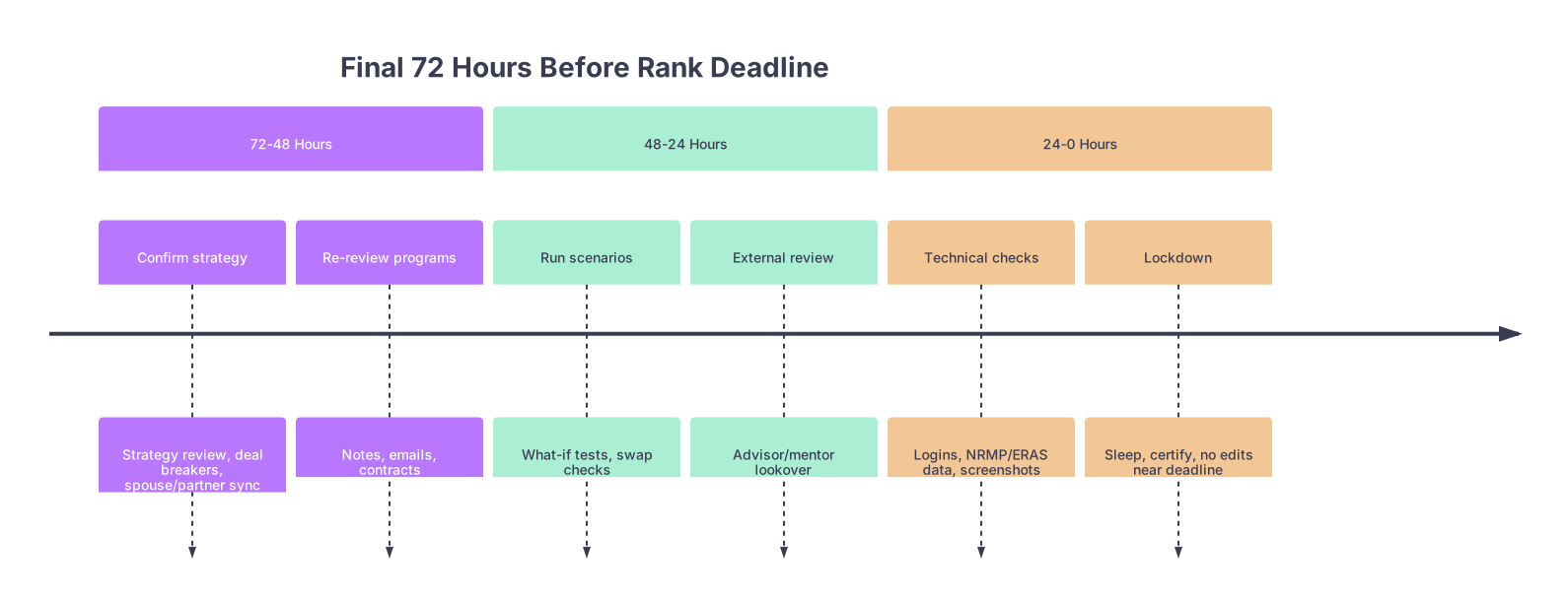
| Period | Event |
|---|---|
| 72-48 Hours - Confirm strategy | Strategy review, deal breakers, spouse/partner sync |
| 72-48 Hours - Re-review programs | Notes, emails, contracts |
| 48-24 Hours - Run scenarios | What-if tests, swap checks |
| 48-24 Hours - External review | Advisor/mentor lookover |
| 24-0 Hours - Technical checks | Logins, NRMP/ERAS data, screenshots |
| 24-0 Hours - Lockdown | Sleep, certify, no edits near deadline |
72–48 Hours Before Deadline: Strategy and Hard Facts
At this point you should step away from NRMP for a few hours and grab your raw materials:
- Your interview spreadsheet or notebook
- Any emails from programs (especially about prelim vs advanced, funding, visas)
- NRMP and ERAS confirmation emails
- Your significant other or family if they are part of the decision
Step 1: Re-anchor on your overall strategy (60–90 minutes)
If you cannot explain your rank philosophy in two sentences, you are not ready to certify. Write it out, literally, in one place.
Examples:
- “I am ranking in order of where I will be happiest and best trained in internal medicine, ignoring perceived prestige beyond that.”
- “My priority is matching in the same city as my partner in pediatrics, even if that means lower-tier programs.”
Then check that your current draft rank list actually reflects that.
Key questions to answer on paper:
- What is my true top tier? (Programs I would be legitimately happy to match at.)
- What are my hard deal breakers? (Geography, partner match, visa, no children’s hospital, etc.)
- Am I over-weighting:
- One charismatic PD?
- Free housing/parking?
- One bad interview day after call?
If your list contradicts your written strategy, flag that. You will adjust it in the next step.
Step 2: Confirm program facts against your notes (2–3 hours)
At this point you should validate memory against reality. Memory gets rosy or bitter this late in the game.
Create a quick-check table for your top 10–15 programs (or more if competitive specialty). Something like:
| Program | Call Schedule Checked | Board Pass Rate Verified | Geography & Partner Plan | Funding/Salary Confirmed | Program Type (Categorical/Advanced/Prelim) |
|---|---|---|---|---|---|
| Program A | Yes | Yes | Yes | Yes | Categorical |
| Program B | Yes | Yes | Yes | No | Advanced |
| Program C | No | Yes | Yes | Yes | Prelim |
You are checking facts that materially affect your life, not minutiae.
Verify for each program (especially top 5–10):
Program structure
- Categorical vs prelim vs advanced vs PGY2 start.
- Required transitional year if advanced.
- Number of positions and tracks (e.g., primary care vs categorical IM).
Workload and schedule
- Call frequency (q4 vs night float, etc.).
- Average weekly hours (as honestly as residents described).
- ICU exposure and elective time.
Outcomes and reputation where it matters
- Board pass rates.
- Fellowship match list if you care about subspecialty.
- Where graduates end up geographically.
Location and logistics
- Cost of living (do the numbers, not vibes).
- Commute realities.
- Proximity to partner/family support.
- Weather and safety if those are real factors for you.
Contracts and special situations
- Any mention of funding uncertainty (I have seen programs abruptly lose spots).
- Visa sponsorship details if you are an IMG/need a visa.
- For couples match: confirmation that both programs participate and understand your situation (if discussed).
You are not re-rank-ordering yet. You are verifying you are not basing decisions on half-remembered cafeteria conversations.
Step 3: Risk assessment by program tier (60 minutes)
Now you shift to risk management, especially if you are in a competitive specialty (Derm, Ortho, ENT, etc.) or couples matching.
Create three buckets for your current draft list:
- Reach – programs where your stats are on the low end or you did not feel strong vibes, but you received an interview.
- Target – your profile fit the program well, interviews neutral to good.
- Safety – community or less competitive programs where you clearly meet or exceed their usual profile.
Quick visual helps. Rough example:
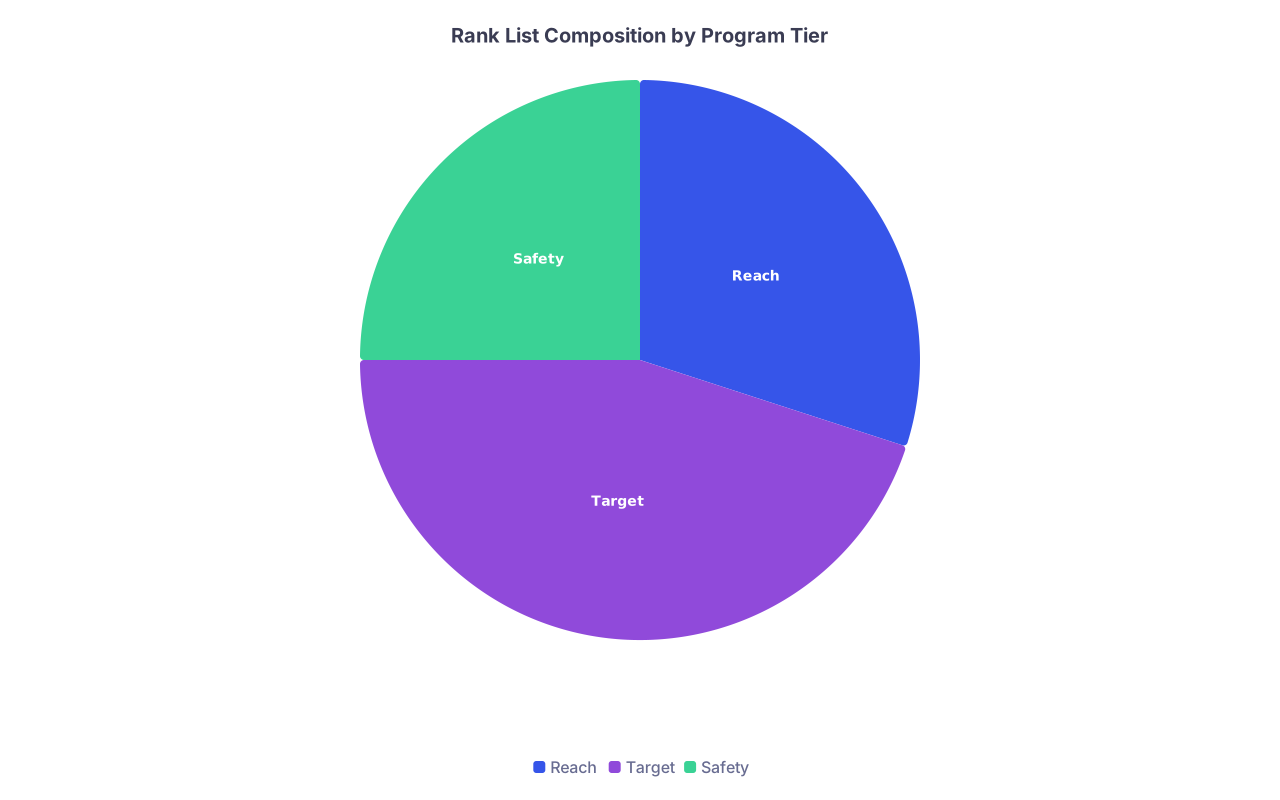
| Category | Value |
|---|---|
| Reach | 30 |
| Target | 45 |
| Safety | 25 |
Warning sign: A list dominated by reach programs with very few true safeties, especially in competitive specialties.
Ask yourself:
- Do I have at least 3–5 realistic target/safety programs ranked, especially if my Step scores or grades are average or below for the field?
- For couples match: have we both included enough joint realistic options, not just dream pairings?
If the answer is no, you still have 72 hours to re-rank to bring realistic programs higher without abandoning your top choices.
48–24 Hours Before Deadline: Scenario Testing and Commitments
At this point you should have a fact-checked, strategy-aligned draft list. Now you stress-test it.
Step 4: “If I match here…” scenario drill (1–2 hours)
Sit down with your rank list open. For each of your top 10–15 programs, go one by one and say out loud:
“If I match at [Program X], I will be living in [City] doing [specialty/focus] with [call schedule] and [partner/family situation] for the next [3–7] years.”
Watch your gut.
Then ask three blunt questions per program:
- If this were my only match option, would I sign today?
- Am I ranking this above a program I would secretly prefer to match at?
- Does this program create serious strain (partner, kids, finances) that I am downplaying?
Any “no” or heavy hesitation means your ordering needs adjustment.
This is where people realize they ranked a shiny name above a solid program in a city they actually want to live in. I have seen residents miserable in a “top-10” program they never really wanted.
Step 5: Check internal consistency – no backwards rankings (45–60 minutes)
You want to eliminate incoherent ordering. If your list does not make sense to you now, it will definitely not make sense later when you are stuck with it.
For each adjacent pair in your top 10–15:
- Compare Program A vs Program B.
- Ask: “If both offered me a spot today, where would I sign?”
- If your answer contradicts the current ordering, switch them.
Walk sequentially down your list like this. Yes, it is tedious. Do it anyway.
This simple A-vs-B test cleans up:
- Prestige biases (“I ranked X higher because everyone talks about it on Reddit”).
- Recency bias (last interview feels best).
- One-off emotional swings.
Step 6: Couples Match and dual-application verification (60–90 minutes)
If you are in the couples match or dual-applying (e.g., IM + prelim TY), this is where mistakes often happen.
At this point you should have:
- A clear, written priority order as a couple.
- An understanding that couples match is not magic; it just pairs probabilities. You can end up far apart if you create risky combinations.
For couples:
- Pull up your full pairs table in NRMP (not just your individual lists).
- Verify:
- Your top 5–10 combinations truly reflect your joint priorities.
- You have progressive “stretch to safe” combinations (e.g., same city top programs → same city mid programs → nearby cities → last-resort acceptable distance).
- No combinations where one person is at a program the other finds unacceptable. Delete those.
For advanced/prelim combos (e.g., Radiology + TY):
- Confirm you have:
- Enough prelim options ranked.
- At least a few combinations that pair your advanced spot with prelims you actually would tolerate.
- No impossible geography pairs (e.g., advanced in California + prelim in NYC unless you are unusually thrilled about one year of bi-coastal chaos).
Step 7: External review by one trusted person (30–60 minutes)
This is not the moment to crowdsource on social media. That is how you end up rewriting your list for strangers.
Identify one or two people max:
- A specialty mentor who knows you.
- A residency advisor or dean.
- Possibly a senior resident you trust.
Send them:
- Your rank list (at least top 10–15).
- Your two-sentence strategy.
- Any unique constraints (partner, visa, kids, debt burden, etc.).
Ask them to answer only three questions:
- Does this list match the priorities I wrote?
- Are there any obvious red flags or mismatches?
- If you were me, would you swap any adjacent programs? Why?
Listen carefully, but remember: you live the outcome, not them. Their job is to catch blind spots, not run your life.
24–6 Hours Before Deadline: Technical and Administrative Checks
At this point you should have your final order decided. From here on, your goal is not “better list.” Your goal is “no technical disaster.”
Step 8: Full NRMP and ERAS cross-check (45–60 minutes)
You would be shocked how many people mess this part up.
Log into NRMP. Then:
Verify your NRMP ID, AAMC ID, and personal info
- Name spelling.
- Email and phone current.
- Programs and specialties listed correctly.
Compare program names and codes with your records
- Match each program in your NRMP rank list with:
- Your interview spreadsheet.
- ERAS program codes when applicable.
- Make sure you did not accidentally rank:
- The wrong track (e.g., prelim vs categorical).
- The wrong hospital with a similar name.
- An advanced position when you meant categorical.
- Match each program in your NRMP rank list with:
Check special tracks
- Research tracks, primary care tracks, rural tracks.
- Confirm that what you ranked is what you want (and interviewed for).
Do not assume anything. Program names can be maddeningly similar.
Step 9: Screenshots, backups, and evidence (20–30 minutes)
This is your insurance policy against your own anxiety and any rare technical issue.
Do all of the following:
- Take clear screenshots of:
- Your finalized rank list (entire list, may need multiple shots).
- NRMP confirmation page after you certify.
- Save as PDF or image files with a date/time in the filename.
- Email them to yourself from a stable account you will have access to.
You probably will never need them. But if NRMP shows an empty list when you log in later (I have seen this panic), you will want proof of what you entered.
Step 10: Final technical rehearsal (15–20 minutes)
At this point you should do one dry run:
- Log in to NRMP from the device you intend to use for final submission.
- Navigate through the menus to your rank list and the certification page.
- Confirm:
- Time zone of the deadline (NRMP posts Eastern Time).
- Your local time equivalent.
- That you can receive any needed 2-factor authentication codes on that device.
If your Wi‑Fi is unreliable:
- Plan a backup location with stable internet (library, hospital, friend’s place).
- Avoid being on call or scrubbed into cases in the final 2–3 hours before the deadline if at all possible. If not possible, submit earlier.
Final 6 Hours: Lockdown, Certify, and Walk Away
This is where people ruin otherwise solid decisions because of last-minute panic. Do not be that story.
Step 11: Set a hard internal deadline (10 minutes)
Your real deadline is not the NRMP cutoff. You need an internal one:
- Aim to certify at least 2–3 hours before the official deadline.
- Put it on your calendar with alerts:
- T – 24 hours reminder.
- T – 3 hours reminder (your internal deadline).
- T – 1 hour “hands off” warning.
That way if NRMP is slow, your internet dies, or you hit a login problem, you have buffer.
Step 12: Final read-through and certification (20–30 minutes)
At this point you should be calm enough to just execute.
Steps:
- Open NRMP rank list.
- Starting from #1 down, read each program name out loud, slowly.
- For each:
- Confirm this is truly where it belongs, given everything you checked.
- Do not reorder anything unless you find a clear, factual mistake or a genuine misalignment with your written priorities.
Then:
- Click Certify.
- Read any confirmation statements carefully.
- Confirm you receive email confirmation from NRMP that your list was certified.
Take a screenshot of the confirmation page.
Step 13: Hands off and mental health protocol (remainder of time)
The single worst habit I see: continuing to log in and tweak your list in the last 30–60 minutes.
After you certify and confirm:
- Log out.
- Close the browser.
- If you know you are impulsive, have a friend or partner literally sit with you and block you from logging back in.
Then do something deliberately non-medical:
- Go to the gym.
- Watch something dumb.
- Dinner with a friend.
- Sleep. Seriously.
Your brain will try to replay every interview and second-guess every rank. That is not analysis. That is anxiety. Your work is already locked in.
Quick Checklist: What Must Be Done in Each Time Block
To keep this brutally clear, here is the non-negotiable checklist.
| Time Window | Must-Do Tasks |
|---|---|
| 72–48 hours | Strategy statement, fact-check programs, risk tiers |
| 48–24 hours | Scenario drills, A-vs-B swaps, couples/dual sync |
| 24–6 hours | NRMP/ERAS cross-check, screenshots, tech rehearsal |
| Final 6 hours | Internal deadline, certify, hands-off |
And the simplified “if nothing else” version:
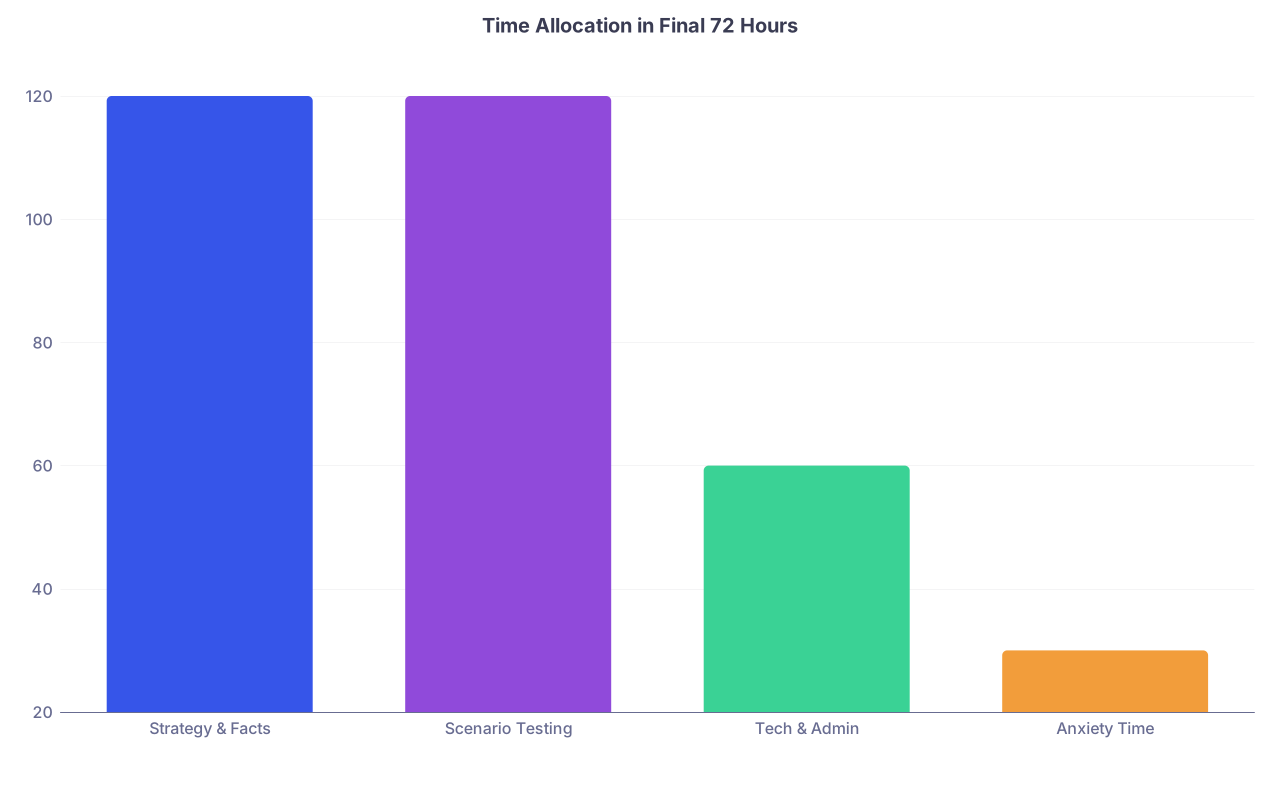
| Category | Value |
|---|---|
| Strategy & Facts | 120 |
| Scenario Testing | 120 |
| Tech & Admin | 60 |
| Anxiety Time | 30 |
What You Should Ignore in the Final 72 Hours
A few things are not worth your time anymore:
- Reddit and SDN “rank me” threads – Those people are not living your life, paying your rent, or dealing with your partner’s job.
- Last-minute rumors about programs going malignant or “going downhill” based on one anonymous comment.
- Microscopic differences (slightly nicer call rooms, one more MRI, etc.) between otherwise similar programs.
If it does not change your top few priorities (training quality, happiness, relationships, finances), it probably does not deserve attention this late.



Final Takeaways
- In the last 72 hours, your job is verification, not exploration: confirm strategy, facts, and risk balance.
- In the last 24 hours, your job is execution, not optimization: cross-check NRMP/ERAS, certify early, and document everything.
- After certification, your job is rest, not revision: log out, walk away, and let the algorithm do its work.