
The dangerous myth four weeks before rank list lock is this: “I already did the hard part; now I just have to put them in order.” That mindset is how people end up miserable PGY-1s in the wrong city, wrong culture, wrong schedule.
Four weeks out, you’re not “done.” You’re entering the most critical research phase of the entire Match cycle.
Below is your week-by-week and then day-by-day checklist for the final month before rank list certification. At each point, I’ll tell you exactly what you should be doing and what should already be done.
Four Weeks Before Rank List Lock: Clean the Slate
At this point you should stop passively “thinking” about your list and start treating it like a project with a deadline.
Step 1 (Today): Build the Master Program Tracker
If you do not already have a central document, you’re flying blind.
Today, create a single spreadsheet or note that includes:
- Program name + ACGME code
- City / region
- Program type (university, community, hybrid, county, VA-heavy, etc.)
- Your gut rating after interview (1–10)
- Deal-breakers (yes/no flags)
- Call schedule structure
- Clinic load / continuity clinic frequency
- Fellowship match outcomes (for IM, Peds, etc.)
- Board pass rates
- Moonlighting options (if relevant to your specialty)
- Notes on culture (“malignant?”, “supportive?”, “very academic,” “procedural heavy,” etc.)
If you have more than ~15 programs, you need this tracked or you will confuse details across places. I’ve watched people swear Program A had a night float system only to realize too late that was Program C.
Create three columns that you’ll actively use over the next four weeks:
- “More Info Needed?” (Y/N)
- “Contact Person” (chief, resident, coordinator)
- “Tentative Rank Tier” (Top, Middle, Backup)
| Column | Purpose |
|---|---|
| Program Name | Identify and sort |
| Gut Rating (1–10) | Quick initial impression |
| Culture Notes | Malignant vs supportive |
| Call Structure | Lifestyle impact |
| Fellowship Outcomes | Long-term career alignment |
At this point, your goal is NOT to finalize ranks. Your goal is to see where your information gaps are.
Week 4: Clarify Priorities and Weed Out Fantasies
This week is about you, not them.
Day 1–2: Define Your Non‑Negotiables
Before you research programs, you need to research yourself. Sounds cheesy. It isn’t.
Sit down and write — literally write — your top 5 priorities. Things like:
- Staying within X hours of family
- Strong fellowship pipeline in cardiology / heme-onc / GI / derm / whatever
- Minimal 24-hour call vs okay with heavy call for better training
- Program reputation (for future fellowships or jobs)
- Cost of living / ability to save or pay loans
- Procedural volume (for surgical specialties and procedural IM/peds tracks)
Force-rank them from 1 to 5. No ties. Yes, this is uncomfortable. That’s the point.
Now translate those into simple “weights” you’ll use later:
, Schedule/Lifestyle, Reputation](https://cdn.residencyadvisor.com/images/articles_svg/chart-example-resident-priority-weights-1345.svg "Example Resident Priority Weights")
| Category | Value |
|---|---|
| Location | 25 |
| Fellowship Opportunities | 25 |
| [Program Culture](https://residencyadvisor.com/resources/choosing-residency-program/the-hidden-signals-programs-use-to-decide-if-youll-fit-their-team) | 20 |
| Schedule/Lifestyle | 20 |
| Reputation | 10 |
You can change numbers, but not the concept: you need a mental weighting system before comparing programs.
Day 3–4: Rough Tiering of Programs
Using your spreadsheet and your gut:
- Mark programs as:
- Tentative Top Tier – places you’d be genuinely excited to train
- Middle Tier – solid options, not thrilling, not awful
- Safety / Backup Tier – places you’d tolerate if necessary
If any program lives in the “dread” category (you felt off, residents looked exhausted, odd vibe), label that clearly. Start thinking if you should rank it at all. Ranking a program you truly hate just “to be safe” is a good way to spend multiple years hating life.
Day 5–7: Identify Information Gaps
By the end of this week you should have:
- Clear top 5 life/practice priorities
- Each program roughly tiered
- A list of specific questions you still have, like:
- “Is there protected didactic time actually respected by attendings?”
- “How many residents per class left or transferred in the last 3 years?”
- “What’s the real call frequency on wards, not the brochure version?”
- “How flexible are they about fellowships outside their own system?”
Flag every program where you answered “More Info Needed? = Y”.
Those flags are your research targets for Weeks 3 and 2.
Week 3: Deep-Dive Residency Research (Residents, Not Brochures)
At this point you should be done fantasizing about city names and logos. Time to hunt for unfiltered data.
Day 8–10: Resident Intel – Your Primary Source
This week, your main task is simple: talk to current residents. Not just the golden child chief they showed you on interview day.
Tactics:
Email or message a current resident you vibed with.
Keep it short:- Remind them who you are.
- Say you’re finalizing your list.
- Ask if they’re okay answering 3–4 quick, specific questions.
Focus on questions that reveal culture and reality, not brochure fluff:
- “How does the program respond when someone struggles or has family issues?”
- “What is the worst part about the program that applicants don’t see on interview day?”
- “How often do you feel unsafe or unsupported in the hospital?”
- “If you had to do it again, would you choose this program?”
The exact wording matters. If you ask “Is the program supportive?” they’ll say yes. If you ask “What type of resident fails here?” you’ll actually learn something.
- Talk to at least:
- One intern or PGY-2
- One senior or chief
- Bonus: Someone recently matched into a fellowship you care about
By Day 10, any Top or Middle tier program without real resident intel should be on your “contact or cut” list.

Day 11–12: Track Record – Board Pass, Fellowship, Attrition
Now you switch to hard outcomes. Open your browser and your spreadsheet.
For each serious program (top and middle tier), track:
- Board pass rates (if your specialty has boards early in residency)
- Fellowship match list for last 3–5 years (for IM, Peds, EM, etc.)
- Job outcomes (for fields like FM, EM, Psych where many go straight to practice)
- Attrition: how many residents have left = huge red flag
Programs love to list where their fellows matched but not how many applied and failed. Ask residents:
- “What percent of people who seriously go for fellowship usually match somewhere decent?”
Do not obsess over single names like “we had one person match MGH GI once.” Look for patterns.
Day 13–14: City, Money, and Real Life
Weekend task.
At this point you should accept that lifestyle and cost of living are not “superficial.” They will affect your burnout risk and long-term sanity.
For each city:
- Look up average rent for a one-bedroom or similar near the hospital.
- Estimate commute time and parking/street safety.
- Identify any non-negotiable needs: partner job market, schools, proximity to support system.
Use something simple like:
- Green = Very livable (cost reasonable, safe-ish, supports your life)
- Yellow = OK but tradeoffs
- Red = You’d be isolated or financially squeezed
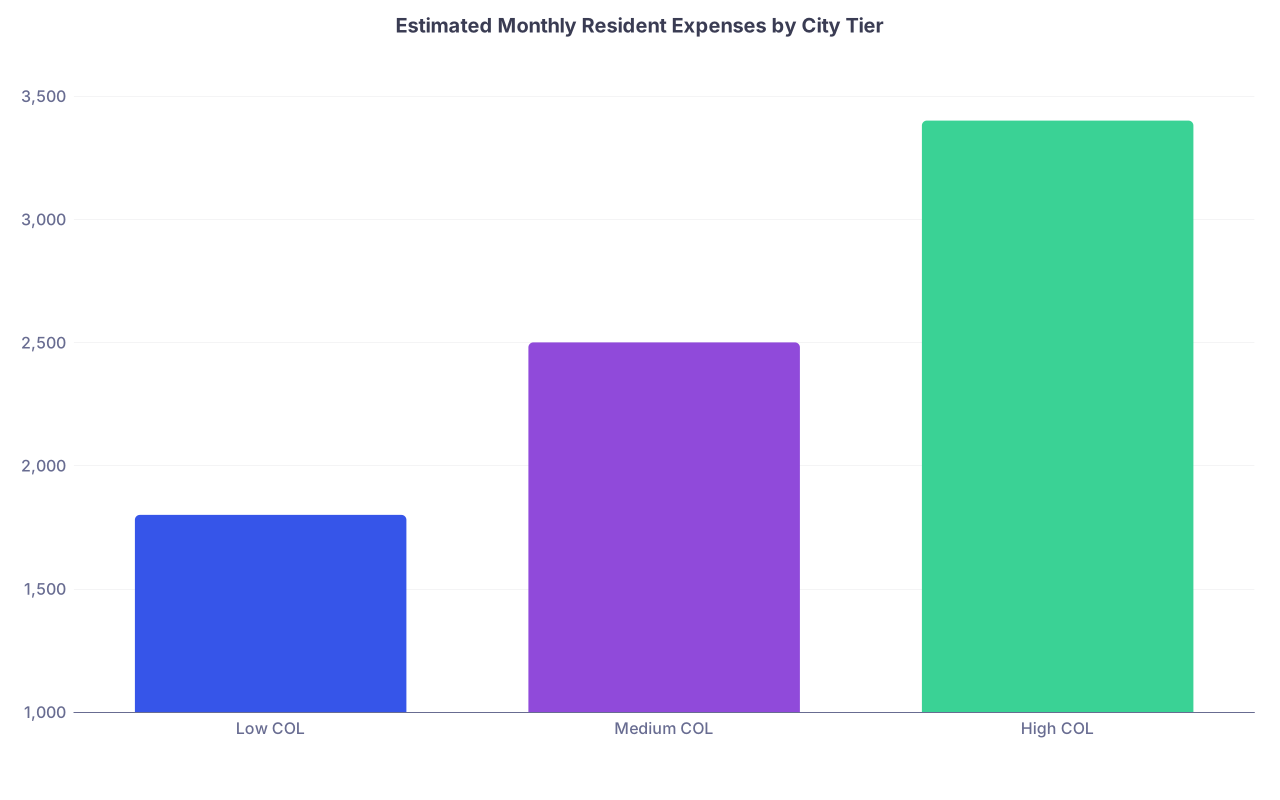
| Category | Value |
|---|---|
| Low COL | 1800 |
| Medium COL | 2500 |
| High COL | 3400 |
If a “dream name” program is in a city that will bankrupt you and isolate you, you need to see that problem in writing right now—before you give it a top rank just for prestige.
Week 2: Pressure-Test Your List and Assumptions
Now you have data. Time to attack your own biases.
Day 15–16: Build a Provisional Rank List
At this point you should create your first ordered list. Yes, actually drag them into order.
Use your priority weighting from Week 4. Quick method:
- Rate each program 1–10 on:
- Fit with your top 5 priorities
- Culture/support
- Outcomes (boards/fellowship/job)
- Lifestyle/city
- Do NOT spend an hour per program. First pass = gut + data.
Then look at the top 5–7. Ask yourself:
- “If I matched at #1, how would I feel — relief, joy, or low-key dread?”
- Same question for #2 and #3.
If your emotional reaction doesn’t match the rank order, something is off.
Day 17–18: Sanity Checks With Real Humans
You don’t need a committee, but you do need at least 1–2 people who know you and the field.
Who to consult:
- A trusted advisor / PD / APD at your med school
- A resident or fellow you respect in your specialty
- Someone who understands your personal life priorities (partner, close friend, etc.)
Ask them focused questions, not “what should I do?”:
- “Here are my top 4. Does anything look obviously out of order for what I’ve told you I want?”
- “Am I overweighting prestige relative to what I say I care about?”
- “Is there any serious red flag about X program I’m missing?”
Take their reactions seriously but remember: this is your list.
Day 19–20: Look for Red Flags You’re Currently Ignoring
Common ones I see people rationalize:
- Multiple residents quietly warned you about toxic attendings or retaliation
- High attrition “for personal reasons” (translation: people ran)
- Program leadership turnover, multiple PDs in a few years
- Over-reliance on residents as cheap labor with lack of true education
Make a written “Red Flag Notes” column in your sheet. If you have any serious flags on a program in your top 5, you need to consciously justify why it stays there.
Week 1: Locking the Logic (Before the NRMP Deadline Week)
Four weeks out, you were collecting information. One week out, you’re stress-testing your future.
Day 21–22: Final Resident Follow-Ups and Loose Ends
At this point you should not be starting new deep dives. Just tying up loose ends:
- Any resident you emailed who hasn’t replied → send one brief, polite follow-up.
- Any missing data that genuinely matters to you (night float vs 24-hr call, elective time, ICU months) → get clarification from program coordinator or chief.
Do not send long, anxious emails. Specific, targeted:
“I’m finalizing my rank list and wanted to clarify: do interns take 24-hour call on wards, or is it night float only?”
That’s it.
Day 23–24: Compare Your Top 5 Like a Hawk
Now you narrow your focus to the top of the list.
Make a simple head-to-head comparison for your top 5:
| Program | Culture | Fellowship Pipeline | Lifestyle | Location Fit |
|---|---|---|---|---|
| A | Strong | Excellent | Moderate | Great |
| B | Good | Good | Good | Good |
| C | Weak | Excellent | Poor | Fair |
| D | Strong | Moderate | Good | Fair |
| E | Moderate | Good | Excellent | Weak |
Ask yourself a brutal question:
“If Program A and Program B both called me today with an offer and told me I had 10 minutes to decide, which would I pick?”
Your brain usually knows the answer faster than your spreadsheet.

| Step | Description |
|---|---|
| Step 1 | Start - Top 5 Programs |
| Step 2 | Move down list or remove |
| Step 3 | Rank higher |
| Step 4 | Rank higher |
| Step 5 | Recheck emotional gut reaction |
| Step 6 | Adjust rank order |
| Step 7 | Deal breaker present |
| Step 8 | Better fit with priorities |
Final 3–4 Days Before Certification: Polish, Don’t Panic
At this point you should be essentially done with research. These days are about error-proofing and emotional reality checks.
Day 25–26: Enter Your List in NRMP and Walk Away
Do this before the last day. People get burned when the site is down or they’re on call and forget.
Steps:
- Enter your provisional rank list as-is into NRMP.
- Double-check:
- All program codes are correct.
- No missing programs you meant to include.
- No accidental duplicates or wrong tracks (prelim vs categorical confusion happens every year).
Then step away for at least 24 hours. Let your brain cool.
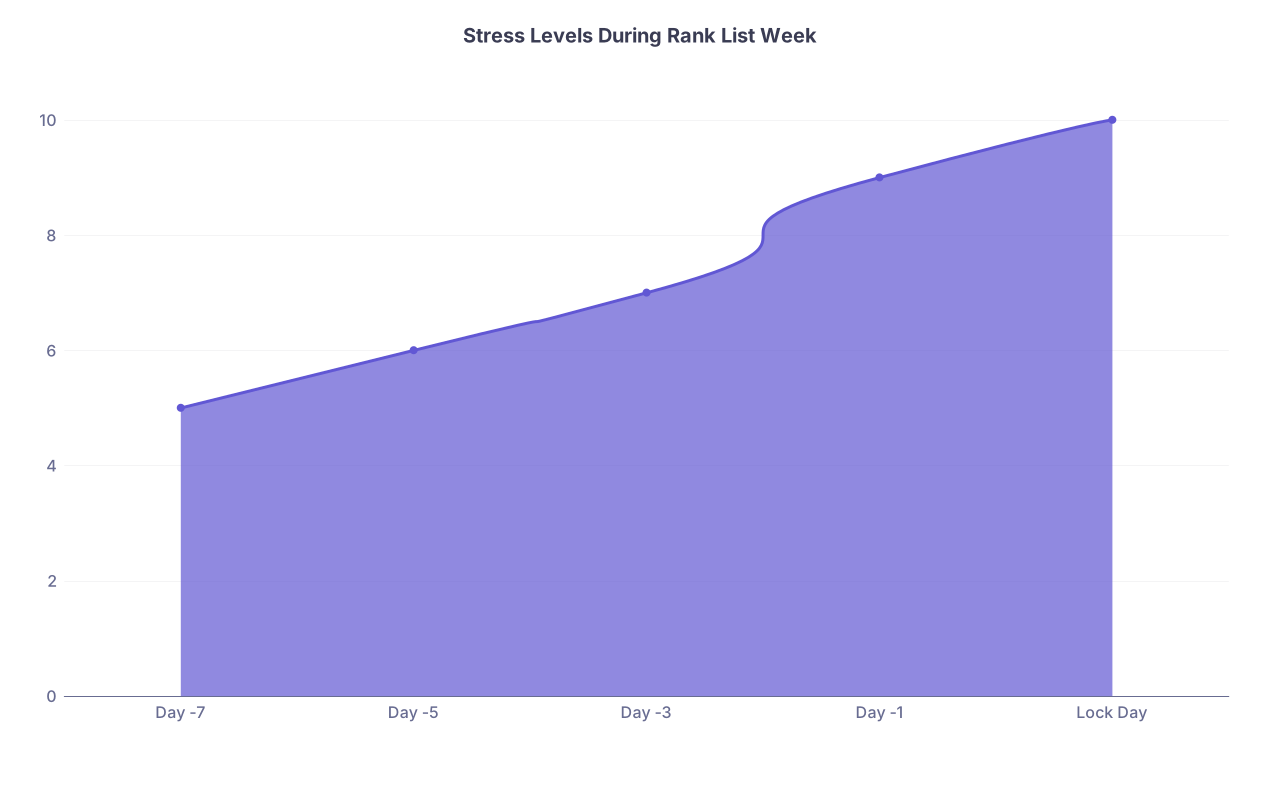
| Category | Value |
|---|---|
| Day -7 | 5 |
| Day -5 | 6 |
| Day -3 | 7 |
| Day -1 | 9 |
| Lock Day | 10 |
Day 27: The “If I Matched Here” Thought Experiment
Open your list again, starting from #1.
For each program, imagine you just opened your Match email and it says:
“You matched at [Program X].”
Pay attention, honestly, to your first reaction:
- Relief + excitement → good sign.
- Neutral “okay, that’s fine I guess” → acceptable but maybe not #1 material.
- Sinking feeling, chest tightness, urge to justify (“but the name…”) → that program is ranked too high.
Move programs up or down based on this reaction, not on what you think you “should” want.
Day 28: Final Rational Check and Lock
This is the last day you touch the list.
Run through four simple questions:
- Does my rank order match my stated priorities from Week 4?
- Did I over-weight prestige relative to culture, outcomes, and lifestyle?
- Are there any programs ranked that I would genuinely rather scramble than attend? (If yes, remove them.)
- Do I understand that the NRMP algorithm favors my true preferences, not game-playing?
Once you’re satisfied:
- Re-check every ACGME code. Slowly.
- Confirm the right track for specialties with prelim, categorical, or different hospital sites.
- Hit certify. And actually remember to re-certify if you made any edits.
Take a screenshot or save confirmation.

What You Should Not Be Doing in the Final Month
Just to be explicit:
- Do not email programs begging for higher ranking or fishing for where they’ll rank you.
- Do not reorganize your list daily based on group chat panic.
- Do not let someone else (partner, parent, advisor) override your core instincts. Input is good. Ownership is non-negotiable.
- Do not blindly rank based on “name brand” if it contradicts everything you learned on the trail.
You’re the one who has to show up for nights, for codes, for terrifying first solo calls. The people giving loud opinions are not.
If You’re Behind Right Now
If you’re reading this four weeks out and you’ve done none of this, here’s your triage timeline:
Today (within 2 hours):
- Build the program spreadsheet.
- Write your top 5 priorities.
- Rough-tier all programs.
Next 3 days:
- Contact residents at all top/middle tier programs with targeted questions.
- Fill in deal-breaker info (call schedule, city, attrition, fellowship record).
Within 7 days:
- Create your first full ordered list.
- Sanity-check with one trusted advisor and one current resident/fellow.
Then merge into the Week 2 and Week 1 plan above.
Rank lists do not magically sort themselves with time. They sharpen with intentional research and brutal honesty about what kind of resident, physician, and human you want to be.
Your next step, right now: open a blank spreadsheet and list every program you’re considering, side by side. Add three columns—“Gut Rating,” “More Info Needed?,” and “Tentative Tier”—and fill them in from memory without overthinking. That 20-minute exercise will tell you exactly where to focus your remaining four weeks.