
The biggest mistake between interviews is doing nothing and assuming “I’ll just know” when it is time to submit the rank list. You will not. You need a weekly system.
You are in the messiest phase of the residency process: interviews are scattered, impressions blur together, and everyone around you keeps saying, “Trust your gut,” as if that is an actual strategy. It is not. You need structure.
Below is a week‑by‑week, then interview‑by‑interview timeline of concrete tasks to refine your rank list criteria while you are still in the middle of the interview grind.
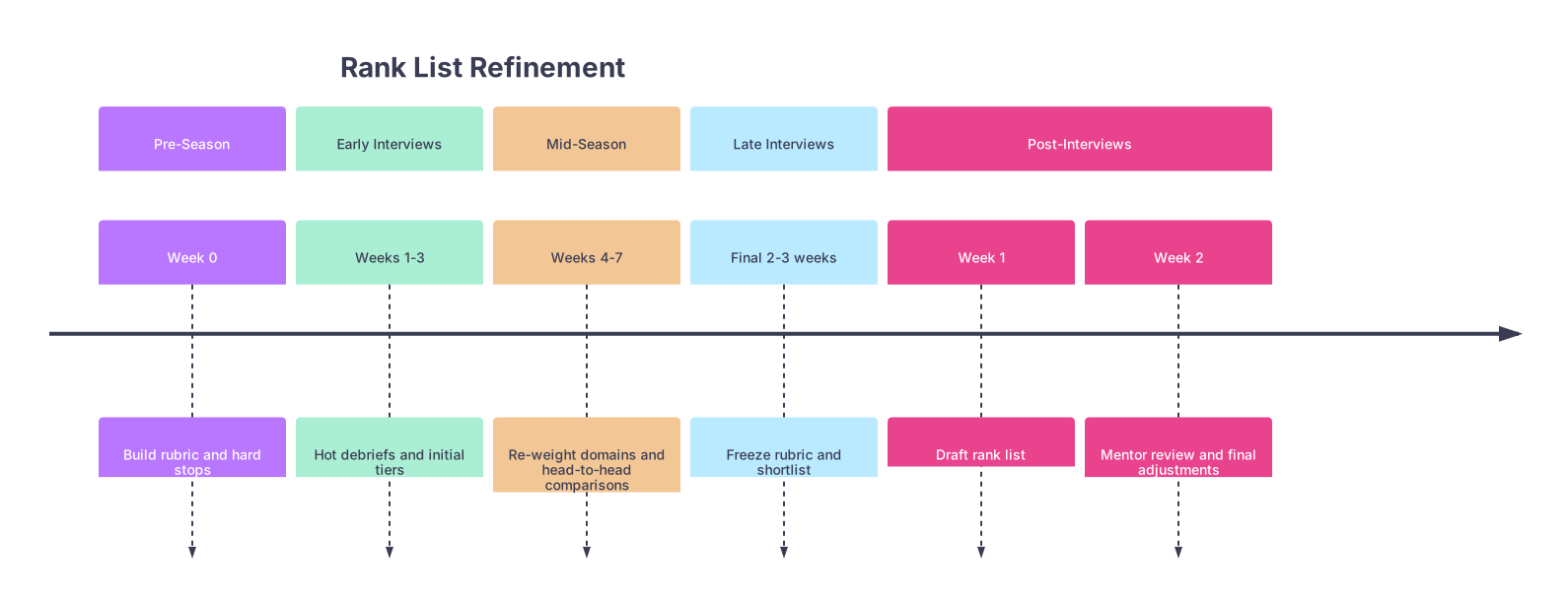
Week 0: Before Interview Season Starts – Build Your Ranking Framework
At this point you should not be “going with vibes.” You should be building a scoring system.
This week, do:
Define your top 6–8 decision domains
Do not make a list of 25 items. You will never use it. Force yourself to pick the things that actually move the needle.Typical high‑yield domains:
- Training quality and case volume
- Fellowship or career outcomes
- Location and cost of living
- Program culture and resident happiness
- Schedule, call, and workload
- Support (mentorship, wellness, childcare, visas if relevant)
- Prestige/network (for some specialties)
- Fit for your specific goals (academic vs community, research vs clinical)
Turn those domains into a numerical rubric
Use a simple 1–5 or 1–7 scale for each domain. Weight them differently if needed.
Example:
- Training quality: weight 3
- Location: weight 2
- Culture: weight 3
- Schedule/workload: weight 2
- Career outcomes: weight 2
Final score for a program = Σ (domain score × domain weight).
Create this in:
- Excel / Google Sheets, or
- Notion table, or
- A physical notebook with one page per program (if you are analog‑inclined)
Just be consistent.
Pre‑define “hard stops”
These are non‑negotiables. If a program fails one, it drops to the bottom or off the list completely.
Common hard stops:
- No support for couples match or visa when you need it
- History of serious harassment issues not addressed
- Location absolutely incompatible with partner/family
- Call schedule or 24‑hour shifts that you know you cannot handle for health reasons
- Missing ACGME accreditation red flags in less traditional paths
Write these hard stops in bold at the top of your rubric.
| Domain | Scale (1–5) | Weight | Hard Stop? |
|---|---|---|---|
| Training Quality | 1–5 | 3 | No |
| Culture | 1–5 | 3 | Yes |
| Location | 1–5 | 2 | Yes |
| Schedule/Call | 1–5 | 2 | Possible |
| Career Outcomes | 1–5 | 2 | No |
By the end of Week 0 you should have:
- A rubric template
- Your non‑negotiables stated
- A blank row for each program you are scheduled to interview at
Week 1 of Interviews: Capture Raw Data, Not Conclusions
At this point you should not be ranking anything. You are collecting inputs.
After each interview day, within 24 hours, do:
Complete a 10‑minute “hot debrief”
Immediately after logging off Zoom or leaving campus:
- Open your rubric or notebook
- Free‑write for 5 minutes:
- “What did I like?”
- “What bothered me?”
- “What surprised me?”
- Then quickly score the obvious domains you can judge already (e.g., location, culture vibe).
This is messy on purpose. Your memory will smooth everything over in a week. You want the raw, emotional data now.
Tag the program with 3 adjectives
Force yourself to distill:
- Example: “Supportive, busy, urban”
- Or: “Rigid, prestigious, cold”
These three words will be gold when you compare 10 “great” programs later and cannot remember what felt different.
Document quotes and micro‑moments
I have seen applicants change their rank list entirely over one resident’s offhand comment. So write them down:
- “I feel safe calling attendings at 2 a.m.”
- “We had three residents quit in the past year.”
- “You will be in the hospital 80 hours a week; that is just the culture here.”
These comments anchor reality more than glossy slides.
Do a quick “gut check” score
Add one unweighted score: “Overall gut feel 1–10.”
Do not overthink it, but do not skip it. Sometimes your body notices misalignment before your brain can explain it.
Week 2–3: Start Weekly Review Sessions (60–90 Minutes)
By now you have 3–6 interviews done. At this point you should start ranking within tiers, not finalizing.
Pick one consistent time each week (Sunday evening works for most people). That time is now “Rank List Lab.”
Weekly Session Tasks
Update your master spreadsheet
Columns you should have filled by now:
- Program name
- City/Region
- Interview date
- Gut score (1–10)
- Domain scores (from your rubric)
- Notes / quotes
- Tier (you will assign this soon)
Calculate preliminary weighted scores
Use your rubric to assign 1–5 scores for each domain for each program interviewed so far. Do not obsess. Ballpark is fine at this stage.
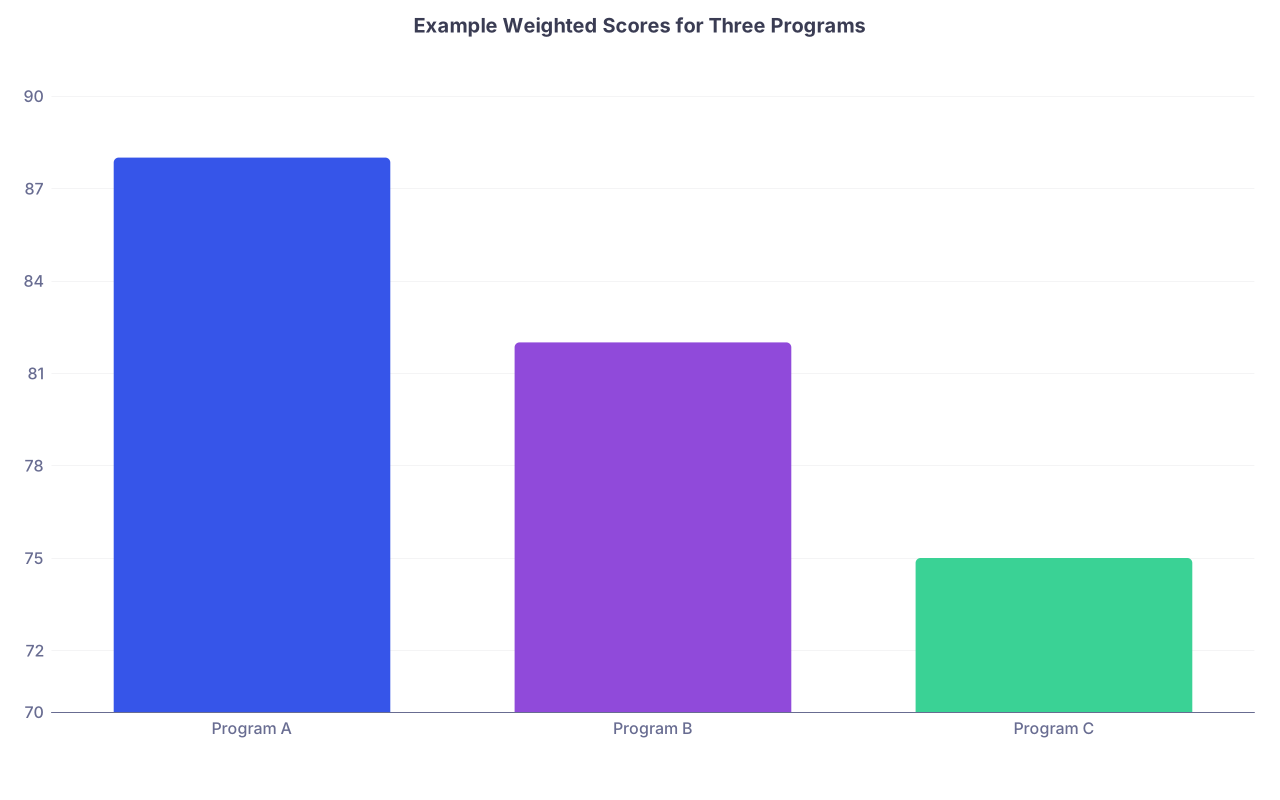
Example for Program A (Internal Medicine):
- Training quality: 5 × 3 = 15
- Culture: 4 × 3 = 12
- Location: 2 × 2 = 4
- Schedule: 3 × 2 = 6
- Career outcomes: 4 × 2 = 8
- Total: 45
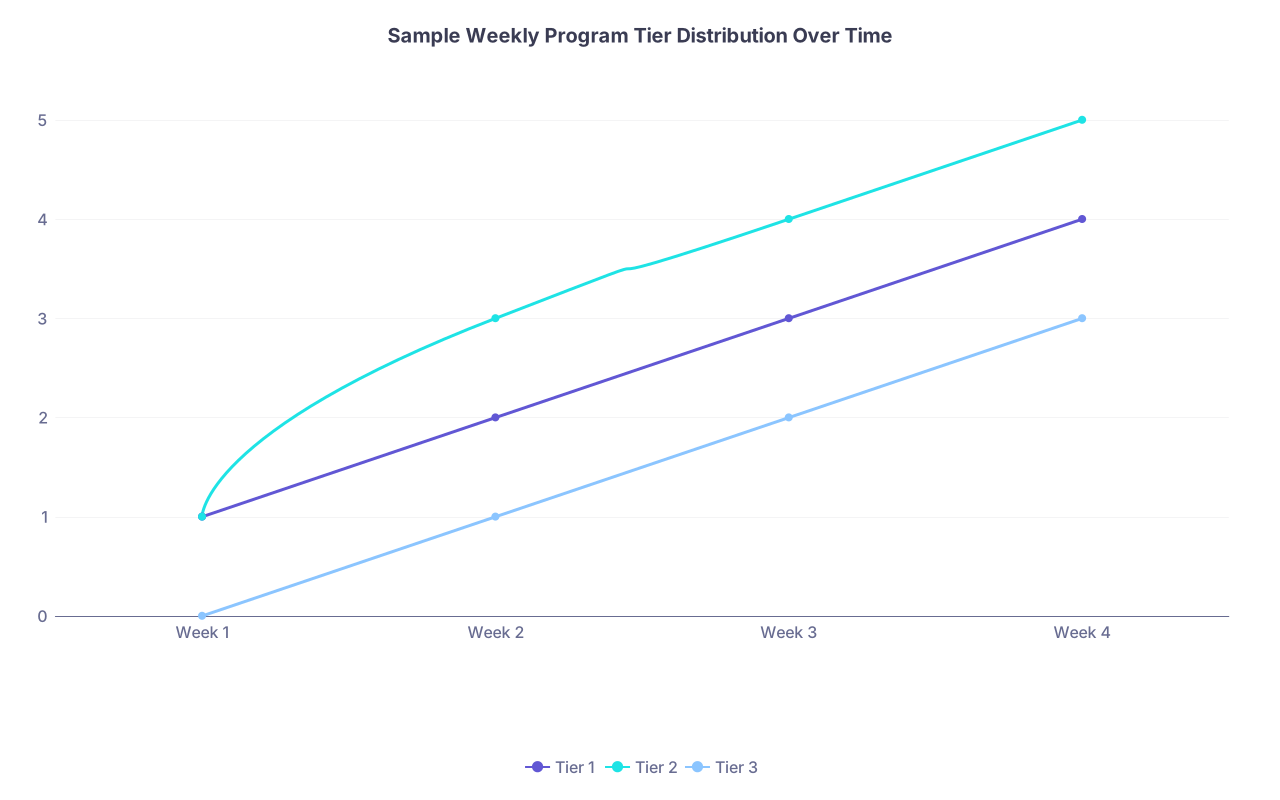
Create tiers instead of final ranks
Do not pretend you can rank #3 vs #4 now. It will change. Focus on sorting:
- Tier 1: “Would be thrilled”
- Tier 2: “Solid, would be content”
- Tier 3: “Only if needed”
- Tier 4: “Do not rank” or “Near bottom”
Assign each program to a tier based on:
- Weighted score
- Your gut score
- Hard stops (if any triggered, they auto‑drop)
Your question in Week 2–3 is:
“Does this program belong in my ‘thrilled’ group, ‘content’ group, or ‘backup’ group?”Document “why” for Tier 1 and Tier 3
For each Tier 1 and Tier 3 program, write two sentences:
- Why it is Tier 1 (what makes it special)
- Why it is Tier 3 (what makes you hesitate)
You are writing for Future You, who will be exhausted and anxious in February.
| Category | Tier 1 | Tier 2 | Tier 3 |
|---|---|---|---|
| Week 1 | 1 | 1 | 0 |
| Week 2 | 2 | 3 | 1 |
| Week 3 | 3 | 4 | 2 |
| Week 4 | 4 | 5 | 3 |
By the end of Week 3, you should:
- Have every interviewed program scored on your rubric
- See early patterns (e.g., “all my Tier 1 programs are urban academic centers”)
Week 4–5: Refine Criteria Based on Real Experience
Now you have enough data to realize your pre‑season priorities were a bit naive. This is normal.
At this point you should adjust your rubric based on what actually matters to you, not what you thought should matter.
Mid‑Season Reality Check (One 45‑minute Block)
Look at your Tier 1 programs side by side
Ask yourself:
- What do they have in common?
- What did you actually get excited about during interviews?
- What complaints do you easily forgive because other parts are so strong?
Example: You might discover you said “I want big city life,” but your Tier 1 list is all mid‑sized cities with close‑knit programs.
Re‑weight your domains
If all your favorite programs share strong mentorship and culture but differ widely in call schedule, you might be over‑valuing schedule.
Adjust the weights:
- Increase weight for what is truly making programs rise in your tiers
- Decrease or merge less influential domains
Then re‑calculate total scores.
Watch how the relative order changes. That is data.Introduce “deal‑sweeteners” and “deal‑breakers” columns
Add two simple yes/no columns:
- Deal‑sweetener: strong reason to bump a program up inside its tier
- Deal‑breaker: reason to drop it a bit despite good scores (but not a total hard stop)
Examples:
- Deal‑sweetener: couples match friendly, top fellowship match rate, family nearby
- Deal‑breaker: unclear response to wellness questions, vague about board pass rates
Refine your question sets for upcoming interviews
Week 4–5 is where your question list should evolve. Stop asking generic things you can read off the website.
Start asking:
- To residents: “What made you consider leaving, if anything, in intern year?”
- To PD: “What are 1–2 concrete changes you have made based on resident feedback in the last year?”
- To chiefs: “Where do graduates land who do not pursue fellowship?”
You are now interviewing them with your updated rubric in mind.

Week 6–7: Direct Program Comparisons, Not Just Scores
You are now deep enough into the season that everything feels the same. This is where most people start panicking. Instead, you will run structured comparisons.
At this point you should spend 60–90 minutes each week on head‑to‑head matchups.
Weekly Comparison Workout
Pick 3–4 programs in the same tier
Example:
- IM: University A
- IM: University B
- IM: Community C with academic affiliation
Pull up their rows side by side. Ignore tier labels. Look at:
- Total scores
- Culture and mentorship notes
- Quotes and micro‑moments
- Gut scores
Run the “forced choice” test
Ask:
“If I could only rank one of these higher, which would I choose today?”Do this:
- A vs B → choose one
- Winner vs C → choose one
- That winner sits higher on your provisional order
Do not defer by saying “they are equal.” That is lazy. Pick.
Write a one‑sentence summary for each
Example:
- Program A: “Best research and prestige, but cold culture, big city, could open doors.”
- Program B: “Supportive residents, decent training, medium city, feels like ‘home’ but less name recognition.”
- Program C: “Lighter call, more autonomy, less academic, great for community career.”
You will use these summaries in late‑season decisions and when talking through the list with mentors.
Interview‑after‑action audit (same week)
For each new interview that week:
- Immediately place it in a tier
- Immediately insert it approximately into your provisional order within that tier
- Mark it with a star if it displaces a prior favorite
The goal is: No program is “unplaced” for more than 48 hours after its interview.
| Category | Value |
|---|---|
| Program A | 88 |
| Program B | 82 |
| Program C | 75 |
Weekly Micro‑Tasks Between Interviews
Now, zoom in even tighter. Between interviews, your weeks start to blur: travel, Zoom, notes. Here is the micro‑timeline for each week of interview season.
Early in the Week (Mon–Tue): Prep and Criteria Tuning
At this point you should:
Review last week’s new rankings (15 minutes)
- Look at where you placed new programs
- Ask if anything feels “off” after a few days of distance
- Adjust 1–2 positions if needed, not the whole list
Refine your must‑ask questions for upcoming programs (20–30 minutes)
- Identify 2–3 uncertainties in your rubric from past interviews (e.g., “I still cannot tell what real hours are like”)
- Craft targeted questions aimed at those missing data points
Email for clarifications as needed (10–15 minutes)
- If a program was vague about something critical (board pass rates, procedural numbers, support for your situation), send a short, respectful email to the coordinator or PD asking for specifics
- Document any response in your notes. Programs that respond thoughtfully often rise a notch.
Mid‑Week (Interview Days): Focus on Raw Impressions
During each interview day:
- Add a quick note to your phone at lunch and end of day
Just 2–3 bullet points:- “Residents laughing together, seemed honest about workload”
- “PD dodged question about attrition”
These become anchors for later scoring.
After the interview (same evening):
- Complete your 10‑minute hot debrief
- Tag the 3 adjectives
- Enter at least preliminary scores for culture, location, and gut feel
End of Week (Fri–Sun): Consolidation and Ranking Work
End of week is where you actually refine your rank list criteria and positions.
Update rubric and re‑calculate totals (20–30 minutes)
- Enter all new data from the week’s interviews
- See how new programs fit numerically
Re‑tier any outliers (20 minutes)
- If a program’s total score and your tier do not match (e.g., high score but Tier 3), ask why
- Your rubric might be missing something important that is not captured yet → add that domain next week
Journal a short “ranking reflection” (10 minutes)
One paragraph:- “This week, I learned that ______ matters more to me than I thought.”
- “I am increasingly sure I want ______ and want to avoid ______.”
The pattern over 4–6 weeks will show you your true priorities.

Last 2–3 Weeks of Interview Season: Lock Your Criteria, Not Yet the Order
As interview season winds down, the temptation is to fixate on exact order. At this point you should first lock your criteria.
Weekly Task: Freeze Your Rubric (60 Minutes Once)
Stop changing domain weights
Decide:
- “This is my final rubric. These are the 6–8 domains that matter.”
From here out, you change only program data, not the scoring system itself. This prevents endless re‑engineering.
Do a “sanity pass” on every program
For each:
- Confirm: no new red flags since interview (you will hear gossip)
- Confirm or adjust domain scores one last time based on all information you have now
- Re‑check against your hard stops
Create “shortlist” groups
Make three new categories:
- Top 3–5 realistic favorites
- Middle pack you would be fine attending
- Safety/backup tier
This is not the final order. It is your focus list for the last stretch.
Post‑Interview Season (Rank List Crunch Time): Weekly Reordering and Final Checks
Now interviews are done. No new data, only new anxiety. This is where people either overthink or freeze. You will run a clean, time‑boxed process.
At this point you should schedule 2–3 focused sessions over 2–3 weeks, not 20 tiny panicked edits.
Week 1 After Last Interview: First Full Draft
Session (60–90 minutes):
Sort by total score, then adjust by gut
- Sort your spreadsheet descending by total weighted score
- Note any programs where gut score strongly disagrees (e.g., high score, low gut, or the reverse)
- Manually move those a few spots up or down with a comment: “Moved above score due to X.”
Run “future self” scenarios
Ask yourself:
- “If I matched here and not there, would I feel disappointed, relieved, or neutral?”
Move programs accordingly: - If not matching at a place feels like a relief → it goes lower
- If matching there feels like a genuine “I hope so” → it goes higher
- “If I matched here and not there, would I feel disappointed, relieved, or neutral?”
Freeze Version 1 of your rank list
- Save or print it with date: “Draft 1 – [date]”
- Do not touch it for at least 72 hours

Week 2: External Validation and Edge Case Decisions
Session (60 minutes):
Discuss the draft with 1–2 trusted mentors
Not a group chat of stressed classmates. Actual mentors:
- A faculty member in your specialty
- A senior resident who knows multiple programs on your list
Share:
- Your rubric domains and weights
- Your top 5–10 order
- Your biggest 2–3 dilemmas (e.g., “higher prestige vs better culture”)
Listen for:
- Concrete data you missed
- Clear warnings (“everyone I know from there burned out”)
- Reassurance that your logic is sound
Make one deliberate revision
After mentor input:
- Adjust your list once
- Re‑label: “Draft 2 – [date]”
Do not enter an endless loop of edits. One revision after fresh input is enough.
Run “life logistics” checks
Especially for couples, parents, or visa‑dependent applicants:
- Re‑check cost of living, childcare options, commute, partner job market
- Confirm that the top segment of your list is realistically livable, not just professionally appealing
| Period | Event |
|---|---|
| Pre-Season - Week 0 | Build rubric and hard stops |
| Early Interviews - Weeks 1-3 | Hot debriefs and initial tiers |
| Mid-Season - Weeks 4-7 | Re-weight domains and head-to-head comparisons |
| Late Interviews - Final 2-3 weeks | Freeze rubric and shortlist |
| Post-Interviews - Week 1 | Draft rank list |
| Post-Interviews - Week 2 | Mentor review and final adjustments |
Final Week Before Submission: Confirm, Then Stop
Last 5–7 days:
Read your own notes, not Reddit
- Re‑read hot debriefs, quotes, and one‑sentence program summaries
- Check that your current order matches those impressions more often than it contradicts them
Ask three closing questions
For each program above the middle:
- “Can I see myself growing here?”
- “Would I trust these people when things go badly?”
- “If I match here, could I explain why without apologizing to myself?”
If a program fails those, drop it a few spots.
Lock it, submit, and walk away
When your list is consistent with:
- Your rubric
- Your gut notes
- Mentor reality checks
Submit it. Then close the spreadsheet. Obsessing after submission changes nothing.
Key Takeaways
- Between interviews, your job is not to “feel it out.” Your job is to systematically collect data, score it, and refine your criteria weekly.
- Use structured weekly sessions: hot debriefs within 24 hours, tier updates on weekends, rubric re‑weights mid‑season, and head‑to‑head comparisons when everything starts to blur.
- In the final weeks, freeze your rubric, build a draft list, seek focused mentor input once, then submit. Clear criteria plus disciplined timing beats last‑minute panic every single year.