
Is a brand‑new residency program a smart launchpad for your career—or a career risk you will regret in five years?
Let me answer this the way you actually need: a new program is neither automatically gold nor automatically garbage. It’s higher variance. You’re trading stability and proven outcomes for potential upside and potential chaos.
So the real question is not “Is a new residency program risky?” but “How do I tell the difference between a well‑built new program and a disaster in slow motion?”
Here’s how to do that, step by step, with specific questions you should ask—and how to interpret the answers.
1. Start with the hard floor: accreditation and leadership
If these first pieces look weak, stop. You do not need to overanalyze anything else.
Question 1: What is the program’s accreditation status and sponsoring institution?
You want:
- ACGME accreditation (initial accreditation is fine—but know what that means).
- A stable, experienced sponsoring institution with a long track record of training residents or fellows somewhere, even if this specialty is new.
Ask directly:
- “When did you receive ACGME accreditation?”
- “Are there any citations from ACGME, and how are you addressing them?”
- “How many other residency or fellowship programs does this hospital sponsor?”
Red flags:
- They dodge or minimize ACGME citations.
- Hospital has no other GME programs and no academic culture.
- PD seems confused by basic accreditation questions.
| Status | What It Typically Signals |
|---|---|
| Initial Accreditation | New program; under close ACGME oversight |
| Continued Accreditation | Stable; met core requirements over time |
| Probation | Significant deficiencies; high‑risk for you |
| Application in Process | You should not match here yet |
Question 2: Who is the program director and what is their track record?
This is non‑negotiable. A strong PD can make a new program excellent. A weak PD can ruin an established one.
Ask:
- “Where did you train? How long have you been faculty? Have you been APD or PD before?”
- “Have you graduated residents in this specialty before (even at another institution)?”
You’re looking for:
- Someone who has actually shepherded residents from intern year to graduation.
- Credible academic or education experience: prior APD role, clerkship director, core faculty in a reputable program.
- A clear vision: they should explain concretely how the curriculum, rotations, and wellness/feedback systems work.
Red flags:
- PD is brand‑new to academic medicine, came straight out of fellowship, and has never managed trainees.
- High turnover in leadership within the first few years.
- Vague answers like, “We’re still working that out.”
2. Follow the money and the bodies: patients, funding, and staffing
No patients = no learning. No funding = no future. It’s that simple.
Question 3: Is there enough clinical volume and case mix?
Do not just ask, “Is it busy?” Everyone says yes.
Ask specifics:
- “For [your specialty], what’s the annual patient volume?”
- “How many major cases per resident by graduation do you expect (or target)?”
- “What proportion of care is inpatient vs outpatient?”
For surgery/OB/EM, you want hard numbers: intubations, deliveries, operative cases, trauma activations, etc. For IM/FM/psych, look at census, acuity, and diversity of pathology.
Good signs:
- They can quote their typical census, procedure numbers, and show you case logs from similar services (even if resident logs are not yet available).
- Established service lines (e.g., Level 1 trauma, cath lab, stroke center, NICU).
Bad signs:
- “We think it will be busy” with no historical data.
- A small community hospital trying to support multiple new programs at once without expansion of services.
Question 4: How is the program funded and how secure is that funding?
Yes, this is awkward to ask. Do it anyway.
Ask:
- “What are your primary funding sources for resident salaries and positions (Medicare GME caps, hospital support, grants)?”
- “How many resident positions are approved, and are they fully funded for all years?”
You’re gauging:
- Whether the program will actually be able to keep your class size through all years.
- Whether they’re near or beyond their Medicare GME cap (for hospitals new to residency, cap is set based on early years—this matters).
Strong answers:
- Clear explanation of GME funding, hospital commitment, and multi‑year budget.
- “We have hospital board approval for X residents per year through 20XX.”
Weak answers:
- “We’re figuring that out as we go.”
- “We’re starting with 4 positions but hope to add more if finances allow”—without a concrete plan.
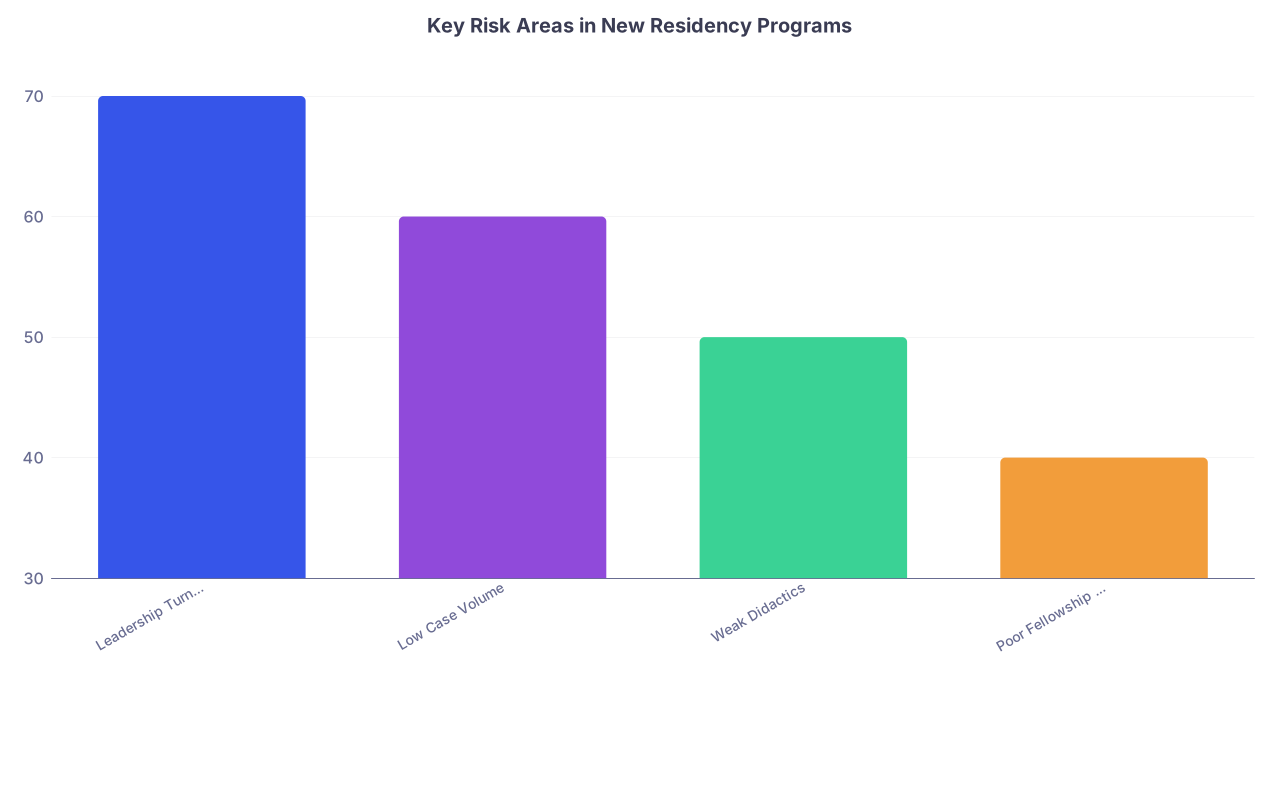
| Category | Value |
|---|---|
| Leadership Turnover | 70 |
| Low Case Volume | 60 |
| Weak Didactics | 50 |
| Poor Fellowship Placement | 40 |
3. Education, not just service: curriculum and support
A new program can be amazing if it’s built with education first. Or it can be a cheap labor pipeline. You need to separate the two.
Question 5: What does the rotation schedule actually look like—for every year?
You want to see:
- A full, year‑by‑year rotation grid, not “sample blocks.”
- Coverage of all ACGME requirements for your specialty.
- Access to needed subspecialties (cards, GI, heme/onc, NICU, trauma, etc.), even if via affiliated sites.
Ask:
- “Can I see the PGY‑1 through PGY‑3/4/5 rotation schedules?”
- “For [key subspecialty], where will I rotate? Who supervises me?”
Good signs:
- They show you a real schedule, with named services and clear goals.
- Thoughtful balance of inpatient, outpatient, elective, and ICU time.
Bad signs:
- “We’re still finalizing PGY‑3/4/5 rotations.”
- Heavy early‑year scut/service with vague promises of electives “once things are stable.”
Question 6: Who are the core faculty—and are they actually around?
You are not just training under the PD. You need a team.
Ask:
- “How many core faculty do you have, and how many are full‑time?”
- “What percentage of their time is protected for teaching?”
- “Who advises residents on research, QI, and career planning?”
Evaluate:
- Number of faculty per resident. If they’re starting 6 residents/year and have only 4 real teaching attendings, expect burnout—for both sides.
- Faculty stability. Are they all recent hires? What’s the turnover?
Red flags:
- Heavy reliance on locums or per diem attendings to staff core rotations.
- No clear advising or mentorship structure.

4. Outcomes and reputation: ask about the future, not just the brochure
The hardest part of evaluating a new program: there’s no alumni data yet. But you’re not powerless.
Question 7: What are your plans for board pass support and monitoring?
Your board pass rate is not a detail. It’s your career.
Ask:
- “What is your strategy to support board prep?”
- “How will you monitor in‑training exam performance and intervene?”
Look for:
- Structured board prep: question banks, review sessions, protected study time.
- Clear expectation: “We expect residents to score at/above national average on in‑training exams, and here is how we help them.”
If they shrug and say, “We expect residents to study on their own,” that’s lazy and risky.
Question 8: How are you building reputation and connections in the specialty?
This matters most if you want competitive fellowships or academic positions.
Ask:
- “Which faculty are involved in national societies, committees, or research collaborations?”
- “Are your faculty known in subspecialties that residents might pursue? Do they write letters that ‘count’?”
- “Do you have formal affiliation with a university or large academic center?”
Good signs:
- Named involvement: “Our PD sits on the [specialty] program directors committee,” “Our cards attending trained at Mayo and still collaborates with them.”
- Academic affiliation that’s real, not just a logo on the slide.
Bad signs:
- No one presents at national conferences.
- They lean hard on “we’re affiliated with University X” but won’t explain what that means day‑to‑day for residents.
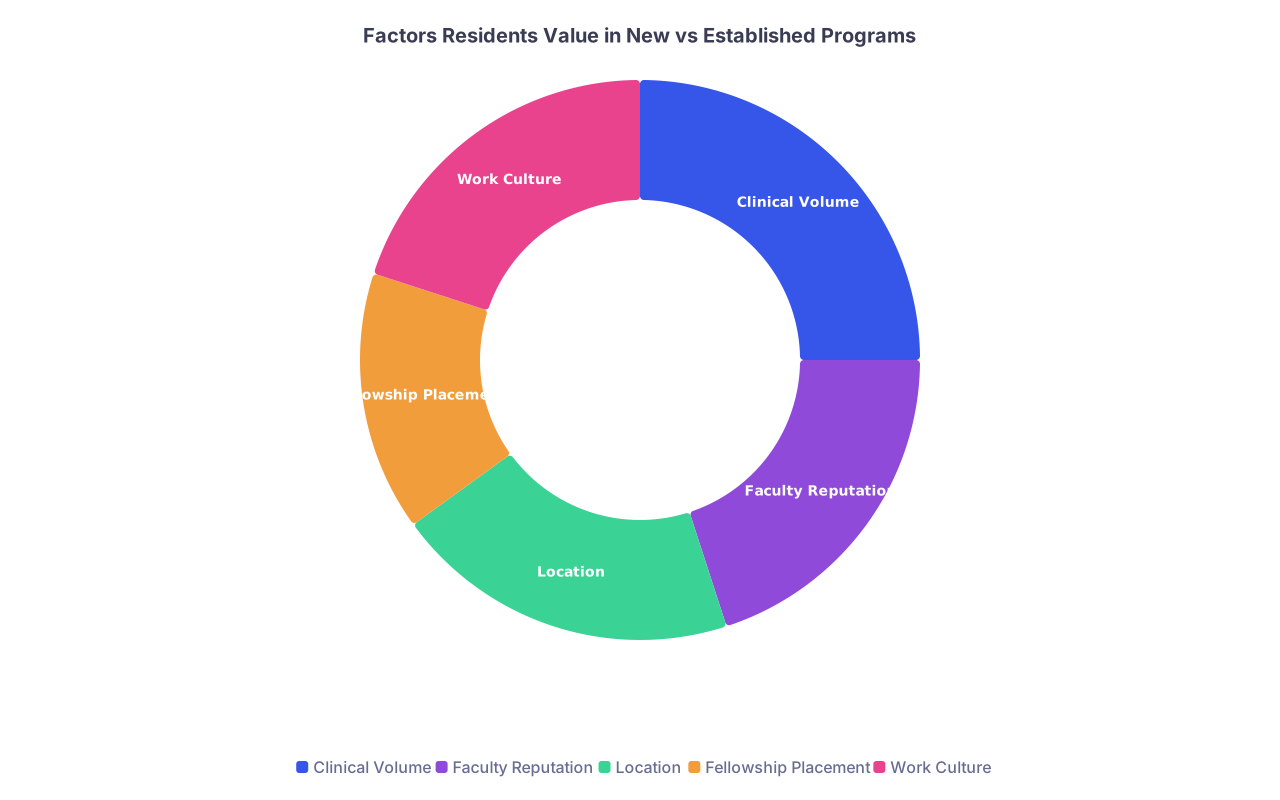
| Category | Value |
|---|---|
| Clinical Volume | 25 |
| Faculty Reputation | 20 |
| Location | 20 |
| Fellowship Placement | 15 |
| Work Culture | 20 |
5. Culture and workload: are you a trainee or just cheap labor?
Culture makes or breaks your day‑to‑day life. New programs sometimes start healthy. Sometimes they’re created to patch staffing holes. You must figure out which one you’re walking into.
Question 9: What is the call schedule and how is workload monitored?
Ask:
- “What is a typical call/night float schedule for each year?”
- “How many patients does an intern or senior typically carry?”
- “How do you monitor duty hours and resident fatigue?”
You want:
- A clear, realistic call structure.
- Reasonable caps for patient loads.
- Demonstrated use of duty hour monitoring (and a history of actually responding to violations, if any).
Red flags:
- “We’re very busy, but we’re like a family” with no numbers.
- PD brags about “old school” workload.
- Residents (if any) look exhausted and scripted.
Question 10: What concrete support systems exist for residents?
Ask specifics, not vibes:
- “Do you have 24/7 phlebotomy and IV teams, or is that all resident‑driven?”
- “Do you have scribes or ancillary staff in the ED?”
- “Who handles admissions data entry, prior auths, discharges?”
Good support means:
- Ancillary staff actually present: RT, phlebotomy, EKG techs, transport, case managers.
- Systems that let you function as a physician in training, not as the hospital’s everything‑person.
If they proudly tell you, “Our residents do it all, from blood draws to transport,” translation: you’ll be doing a lot of scut that adds nothing to your education.

6. How to interpret different scenarios: when is a new program worth it?
Let me give you a simple framework.
Scenario A: New program, strong institution, strong PD
Example: A large academic medical center that’s had IM and surgery residencies for decades is starting a new EM program. PD is former APD at a top‑tier EM program. Faculty are a mix of experienced educators and fresh hires. Well‑defined curriculum, tons of volume.
Risk level: Reasonable. I’d rank them competitively, especially if the vibe and location work for you.
Scenario B: Brand‑new hospital, brand‑new GME, all at once
Example: Community hospital just built a tower, hired a bunch of hospitalists, and is starting IM, FM, psych, and EM programs same year. PD is a former private practice doc with no academic history. No residents yet. Rotations “in development.”
Risk level: High. This is where you see service overload, weak structure, and residents being guinea pigs. I’d list this low unless you have no better options or compelling personal reasons.
Scenario C: New specialty in a strong but non‑academic hospital
Example: Big referral center with high volume but historically non‑academic starts surgery residency. They bring in a PD from a respected academic center, give them protected time, and hire several fellowship‑trained surgeons.
Risk level: Mixed but often workable. You may get great volume and operative experience, but research and academic reputation may lag. Good for those aiming for community practice; less ideal if you’re dead‑set on elite fellowships.

| Step | Description |
|---|---|
| Step 1 | Considering New Program |
| Step 2 | Rank low or not at all |
| Step 3 | Reasonable to rank in middle to upper list |
| Step 4 | Strong PD and institution |
| Step 5 | Adequate volume and funding |
| Step 6 | Clear curriculum and faculty |
| Step 7 | Culture and workload acceptable |
7. What to ask current residents (if they exist)
If there’s at least one class already there, use them. Away from faculty.
Ask bluntly:
- “What surprised you—good and bad—after you started?”
- “If you had to choose again, would you still come here?”
- “How often do you feel like you’re just plugging staffing holes rather than learning?”
- “How quickly does leadership respond when residents raise concerns?”
- “How many residents have left or transferred, and why?”
If they will not let you talk to residents without a faculty member present, that’s a massive red flag. I’ve never seen that end well.

8. How to decide where to rank a new program
Here’s a simple way to place a new program on your rank list.
- Write down your non‑negotiables (for example: geographic area, minimum case volume, desire for fellowship, family needs).
- For each new program, answer these bluntly:
- Will I be competent and board‑eligible at graduation?
- Do I trust this leadership to have my back when things get messy?
- Is the workload sustainable for 3–5 years?
- If any answer is “no” or “I honestly don’t know and couldn’t get a straight answer,” that program goes below any option where your answers are “yes.”
One more harsh truth: choosing a safer, mid‑tier established program over a shiny new “we’re building something great!” program is almost never a mistake. The reverse can be.
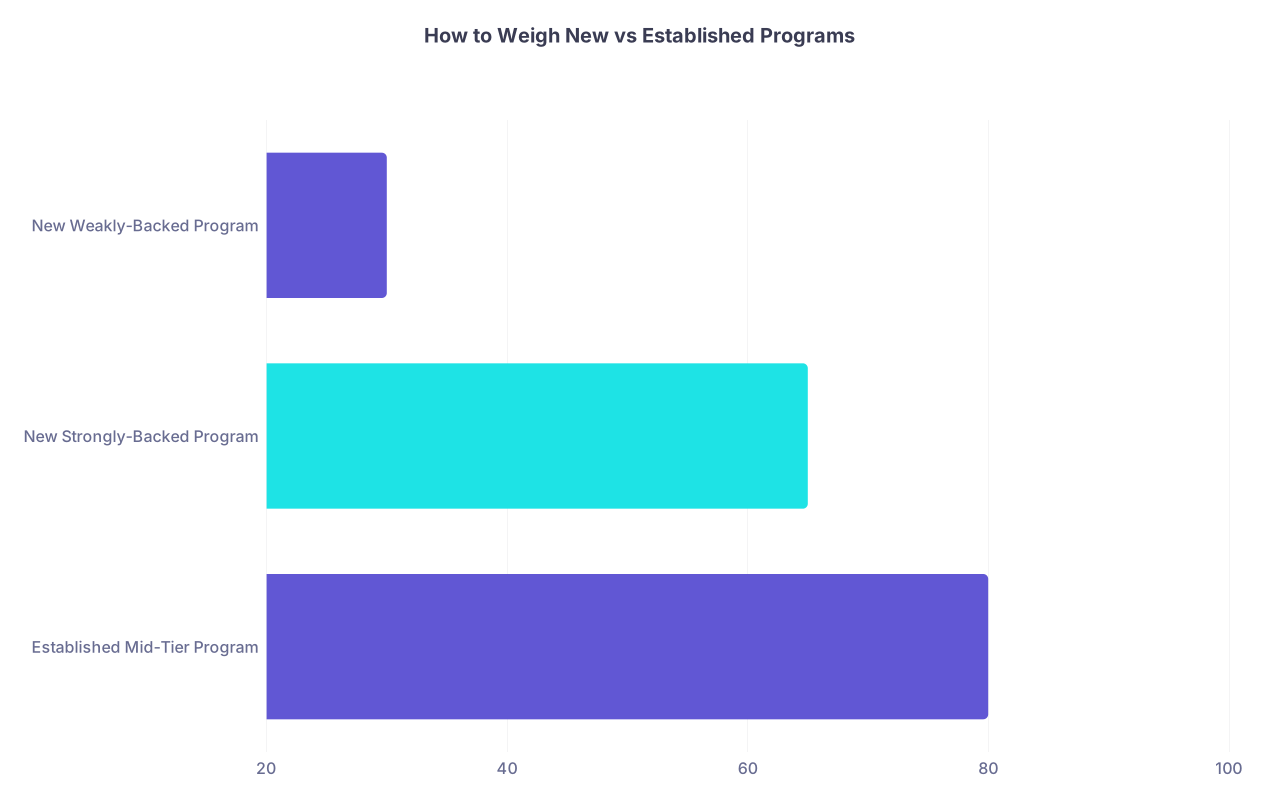
| Category | Value |
|---|---|
| Established Mid-Tier Program | 80 |
| New Strongly-Backed Program | 65 |
| New Weakly-Backed Program | 30 |
FAQ: New Residency Programs and Risk
1. Is it a bad idea to rank a new residency program at the top of my list?
Not automatically. It’s reasonable to rank a new program highly if:
- The hospital is a strong, stable institution.
- The PD and core faculty have serious prior teaching experience.
- You’ve confirmed solid case volume and a real curriculum.
- You care more about location or specific lifestyle factors than brand name.
But if those boxes are not clearly checked, putting a brand‑new program at #1 is gambling with your training. I’d only do it if the alternative options are truly unacceptable to you.
2. Could a new program lose accreditation while I’m there?
Yes, it can happen, but ACGME usually moves slowly and gives programs chances to improve. If a program is on probation or facing loss of accreditation, there are processes to help residents transfer. It’s stressful, but not career‑ending. Your best defense is to avoid obviously shaky programs up front—ask about citations, response plans, and any recent ACGME visits.
3. Will a new program hurt my chances for fellowship?
It might, depending on the specialty and the program’s connections. For competitive fellowships (GI, cards, heme/onc, derm, ortho, etc.), having faculty who are known in the field helps a lot. A brand‑new program with no reputation and no research can be a handicap. But if the PD and subspecialty faculty have strong prior affiliations and are active academically, you can still match well. Look at the people, not just the program age.
4. Is it true that new programs overwork residents to cover hospital staffing?
Sometimes. This is one of the biggest real risks. Some hospitals start programs primarily to solve staffing problems. The giveaway: vague educational structure, understaffed services, heavy scut, and leadership who brag about how “hard‑working” their residents are without describing actual learning. If the workload conversation feels hand‑wavy, assume you’ll be used as cheap labor.
5. What if I really want a specific city and the only option there is a new program?
Then you treat it like any other trade‑off. Ask all the questions above. If the program is reasonably solid—good leadership, adequate volume, real curriculum—it may be worth it if living in that city matters a lot to you or your family. Just do not lie to yourself about the risk. Put it where it honestly belongs on your rank list after weighing training quality vs location.
6. How can I research a new residency program beyond the interview day?
Do three things:
- Search for the program and PD on PubMed and society websites—see who is academically active.
- Look up hospital quality measures (readmissions, mortality, patient volumes) and trauma/center designations.
- Ask your med school advisors and any attending in your chosen field if they know the PD or faculty; reputation travels fast in small specialties.
If all of that turns up blank or negative and the interview day felt vague, that is your answer.
Open your interview note file right now. For every new program on your list, write down these three things: PD’s background, evidence of clinical volume, and how clearly they answered your questions about curriculum and workload. If you cannot fill those in confidently, you either need to ask follow‑up questions—or move that program down your rank list.