The “chill program” everyone talks about on Reddit is mostly a mirage—and chasing it can quietly sabotage your training and your career.
The Myth: “Low Workload = Better Life + Same Training”
Walk into any M4 group chat in October. You’ll see the same phrases repeated like gospel:
- “Heard they’re super chill, you should rank them high.”
- “Malignant? No. Just busy.”
- “It’s a lifestyle program but you still get great training.”
This is how people talk when they have no data and a whole lot of anxiety.
Residents (and especially applicants) massively overestimate how well they can judge training quality and workload from the outside. They anchor on vibes: “residents looked happy,” “everyone left by 5,” “they said they cap at 8 patients,” “no 24s.” None of that, by itself, tells you whether:
- you’ll graduate competent
- you’ll match into a competitive fellowship
- you’ll actually be able to function as an attending without getting eaten alive your first year
Let’s walk through what “low workload” actually tends to mean—and where the real danger lies.
What the Data Actually Shows About “Chill” vs “Busy”
First, let’s ground this in evidence, not hallway gossip.
Duty hours and outcomes: less isn’t always more
ACGME duty hour limits were supposed to fix burnout and improve patient safety. The big trials looking at more-flexible vs stricter hours tell a pretty uncomfortable story.
- The FIRST Trial (surgery) and iCOMPARE (internal medicine) compared stricter vs more flexible duty hours.
- Result: No meaningful difference in patient outcomes. No magical improvement in resident well‑being in the stricter/“easier” arm.
- Translation: Simply chopping total hours or micromanaging shift lengths doesn’t automatically make your life better or your training safer.
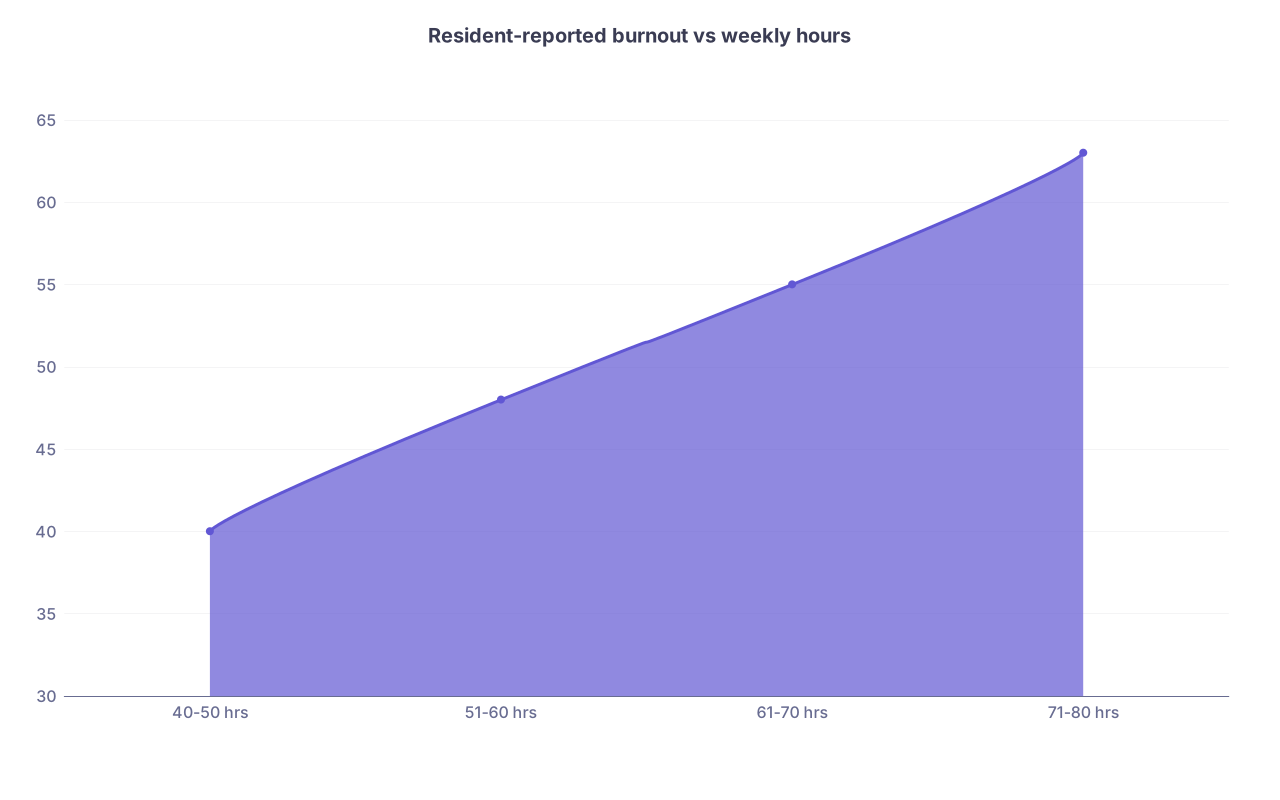
| Category | Value |
|---|---|
| 40-50 hrs | 40 |
| 51-60 hrs | 48 |
| 61-70 hrs | 55 |
| 71-80 hrs | 63 |
Notice something: burnout climbs with hours, but it’s not a cliff. It’s a gradient. And more important than raw hours is how those hours are structured and supported.
Volume and competence: you cannot fake reps
For procedure-heavy fields (surgery, EM, anesthesia, OB, GI, cards, etc.), case volume correlates with confidence and skill. This is not controversial. It’s just quietly ignored by people desperate for a “chill” PGY1.
Look at fellowship application data and you see a pattern:
- Residents from high-volume, “busy” programs list bigger case logs.
- Those programs’ graduates report feeling more prepared their first year as attendings.
- Fellowship directors consistently prefer applicants who trained at places known to be demanding but well‑run over programs with a “lifestyle” reputation but limited complexity.
No one says this on interview day, because “We will work you hard but train you well” doesn’t play great in the wellness era.
Residents are terrible judges of their own training
Every year, ACGME surveys residents about their education, supervision, and workload. And every year you see a weird disconnect:
- Programs with objectively high case volume sometimes get mediocre self‑ratings (“we feel overworked”).
- Programs with thin volume get glowing comments about “great work-life balance” while graduates quietly struggle as juniors in fellowship or real practice.
You’re not evaluating how prepared Future You will be. You’re reacting to how Tired Present You feels.
What “Chill Program” Usually Means in Practice
Let me translate “chill” from applicant-speak to reality. I’ve heard this stuff at pre‑interview dinners, on rounds, and in call rooms at 2 AM.
1. Low inpatient volume or narrow case mix
When residents say:
- “We cap low, it’s very manageable.”
- “Only a few ICU months, and they’re not that busy.”
- “We don’t see a ton of super sick patients, they go downtown.”
What that often means:
- Your reps with truly sick, complex patients will be limited.
- You’ll be less comfortable with acute decompensation, codes, and complex management.
- You’ll be fine in a cushy, well-staffed system. Much less fine in a resource-poor or high-acuity environment.
2. Heavy reliance on non‑resident labor
You’ll hear:
- “We’ve got a lot of NPs/PAs, so residents don’t have to do as much.”
- “Night float mostly covers admissions; cross‑cover is light.”
- “We don’t really draw labs, place lines, or do many bedside procedures.”
This can be a blessing or a trap, depending on the balance.
If advanced practice providers are doing most of the heavy procedural and admission work, ask yourself bluntly:
- Who is actually getting those learning opportunities?
- Are you observing and signing notes, or actually managing?
A “chill” program where residents function like auxiliary scribes for APCs is a training disaster dressed up as wellness.
3. Weak expectations, vague feedback
Other “green flags” applicants love that are actually red‑ish:
- “They’re super laid back about conference.”
- “Nobody yells at you if you’re late or behind on notes.”
- “Faculty are hands‑off; you get a lot of autonomy.”
Autonomy is good. Unstructured, unsupported autonomy is how you bake in bad habits and miss entire chunks of your education.
You want:
- Clear expectations
- Real feedback
- Someone who will tell you, “Your notes are weak” or “You missed X in that patient”
The program where “everyone is cool, nobody cares” is the program where nobody really cares about your growth either.
The Flip Side: What “Busy Program” Actually Means
Let’s be equally honest about the other extreme.
People label programs “malignant” or “soul‑crushing” for three very different reasons:
- Toxic culture – belittling, retaliatory, abusive.
- Unsafe workload – routinely violating duty hours, no backup, dangerous ratios.
- Just…hard – high acuity, rapid pace, demanding attendings, but solid support.
Those are not the same thing.
1. Toxic is non‑negotiable
If you consistently hear:
- “They humiliate you on rounds.”
- “Retaliation if you call out or raise concerns.”
- “People get blacklisted for using mental health resources.”
That’s not “busy.” That’s broken. You don’t fix that with resilience training.
2. High volume + good structure = where competence is built
Here’s how a hard but healthy program usually looks from the inside:
- You’re tired, but not chronically destroyed.
- You see a lot of sick patients and do a lot of real work.
- Faculty actually know your name and your strengths/weaknesses.
- There is real teaching on rounds, not just data regurgitation.
- When things get unsafe, someone shows up.
Residency is not supposed to feel like a 9–5 office job. If you’re never stretched, you’re not really training. You’re shadowing with extra steps.
How to Actually Evaluate Workload vs Training (Instead of Chasing Vibes)
If you want to avoid both the malignant grinder and the hollow “chill” program, you have to ask better questions.
Look at objective signals, not slogans
Here’s what separates a genuinely solid program (busy or not) from an empty one:
| Factor | Strong Training Signal | Weak Training Signal |
|---|---|---|
| Case Volume | Residents hit or exceed ACGME/fellowship case minima | Residents barely meet minima or scramble in PGY3 |
| Board Pass Rates | Consistently above national average | At or below national average, unexplained dips |
| Fellowship Placement | Graduates match where they want, competitive fields possible | Few match into desired fellowships, vague explanations |
| Supervision | Accessible attendings, graded autonomy | Either micromanagement or chaotic “figure it out” |
| Resident Attrition | Rare, with clear reasons when it happens | Frequent quiet departures or PGY2 transfers |
If a program proudly sells “chill lifestyle” but can’t show you strong board pass rates, solid fellowship matches, and adequate volume? That’s not lifestyle. That’s low expectations with marketing.
Ask pointed, uncomfortable questions (nicely)
During interviews and resident dinners, skip the fluff.
Try these:
- “How many ICU months do you do, and how many patients are you usually carrying?”
- “Have any recent residents struggled as new attendings or in fellowship? Why?”
- “Where do graduates typically work—community, academic, rural, urban?”
- “Do you ever need to scramble to hit procedure or case minimums?”
- “How often are duty hours violated, and what happens when they are?”
Watch for:
- Evasive answers (“it depends,” with no specifics)
- Residents glancing at each other before answering
- Jokes that sound too close to the truth (“Oh yeah, you will live in the hospital on ICU, ha ha…”)

| Step | Description |
|---|---|
| Step 1 | Program seems chill |
| Step 2 | Low training quality risk |
| Step 3 | Limited clinical exposure |
| Step 4 | Toxic or malignant |
| Step 5 | High quality, balanced program |
| Step 6 | Strong outcomes? |
| Step 7 | Adequate volume? |
| Step 8 | Supportive culture? |
The goal isn’t to find the lowest workload. It’s to find the best ratio of workload to training value.
Where “Chill” Is Actually Reasonable—and Where It’s Not
Let me be clear: You do not need to martyr yourself to become a good doctor. But you also can’t under‑train and expect to magically be competent later.
When a lighter program can make sense
A relatively lower‑intensity program can be fine—even smart—if:
- You’re aiming for a lower-acuity, outpatient‑heavy future (some primary care, psych, non-procedural fields).
- The outpatient training is truly robust: continuity clinic, diverse panels, real autonomy with supervision.
- You have concrete reasons: family responsibilities, health issues, dual‑career constraints.
But then you must verify:
- Board pass rates are still solid
- Graduates feel prepared for the jobs they actually take
- You’re not sacrificing core competencies for comfort
When choosing a “chill” program backfires
People get burned when they:
- Say “I might want cards/critical care/surgery/fellowship X… but I hate the idea of being tired, so I’ll pick the chill place and figure it out later.”
- Ignore the fact that many fellowships care a lot about where and how intensely you trained.
- Underestimate how miserable it feels to be underprepared and constantly behind in fellowship or first job.
Under‑training is a slower, quieter type of burnout. It shows up when you’re alone with a crashing patient at 3 AM and realize you’ve never actually managed this level of acuity without someone holding your hand.
A More Honest Framework: Train Hard, Live Sane
Here’s the grown‑up version of choosing a program, stripped of Reddit fantasy.
Decide what future you’ll likely want. High-acuity specialty? Fellowship‑heavy path? Rural generalist? Outpatient only? The more complex the future, the less excited you should be about the “chillest” program in the region.
Aim for high‑quality training with sustainable—not minimal—workload. You want enough exposure that residency is undeniably hard. But in a place where you’re supported, not sacrificed.
Use data and outcomes as your north star.
- Board pass rates
- Case logs
- Fellowship and job placement
- Alumni stories, not just PGY2 opinions
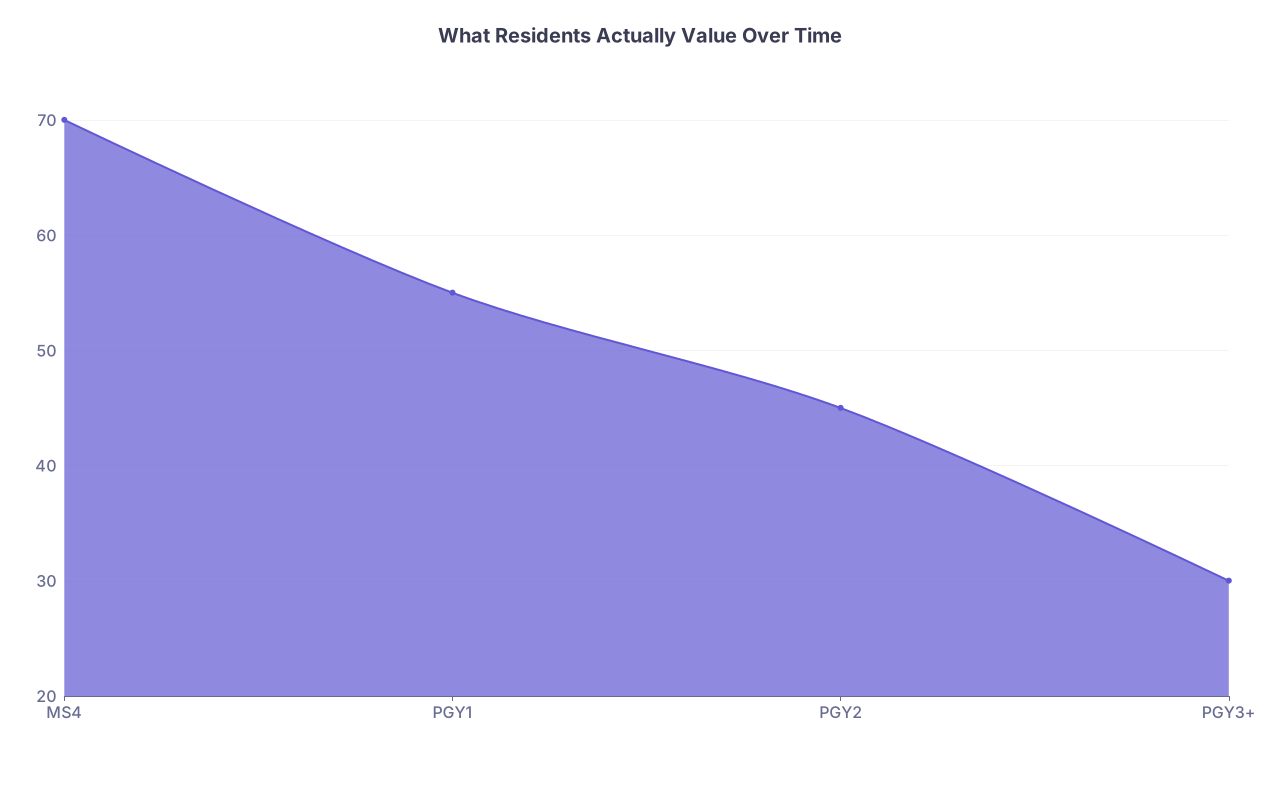
| Category | Value |
|---|---|
| MS4 | 70 |
| PGY1 | 55 |
| PGY2 | 45 |
| PGY3+ | 30 |
That chart might as well be labeled “How much people prioritize ‘chill’ over training quality over time.” MS4s obsess over lifestyle. By PGY3, they obsess over competence and the job market.
Problem is, you can’t redo the first three years.
A quick gut check for your rank list
Ask yourself, honestly:
- “If I end up in a rough, high‑acuity attending job straight out of residency, at which of these programs would I feel least terrified to start?”
- “If I decide in PGY2 that I want a competitive fellowship, where will I have the best shot?”
- “Ten years from now, will I be more bothered that residency was tiring—or that I feel out of my depth?”
You already know the right answers. The hard part is not letting short‑term comfort win over long‑term competence.

FAQs
1. Does choosing a “chill” program automatically hurt my fellowship chances?
Not automatically. But if “chill” comes from low acuity, thin volume, and weak research or mentorship, it absolutely can. Fellowship directors look at:
- Where you trained
- Who writes your letters
- What kind of cases and complexity you’ve actually handled
If a program gives you relaxed hours but minimal exposure and weak academic support, you’re handicapping your future options.
2. Are malignant programs ever “worth it” because the training is so strong?
No. True toxicity—retaliation, abuse, constant humiliation—erodes learning, mental health, and patient safety. There are plenty of demanding, high‑volume programs with strong cultures. You do not need to accept abuse to get good training. If everyone you talk to uses the word “toxic,” believe them.
3. How many hours per week is “reasonable” in residency?
Most solid programs cluster around the 55–75 hour/week range depending on rotation. Consistently under 50? You should be asking hard questions about volume and exposure. Consistently flirting with 80 with no backup or support? That’s a red flag for safety and culture. It’s not about a magic number; it’s about what you’re doing in those hours and how supported you are.
4. What’s the single best question to ask residents about workload?
Ask this: “If you had to choose again, knowing exactly how hard this program is and how it’s prepared you, would you still come here?” Then stop talking. If they answer quickly and say yes—even while acknowledging it’s hard—you’re probably looking at a place that gets the balance mostly right.
Key Takeaways
- The “chill program” is often just code for lower volume, less acuity, and weaker expectations—none of which help you become a competent doctor.
- You’re not choosing the residency that feels easiest at 26; you’re choosing the training that Future You has to live with for decades.
- Rank programs by the quality and structure of training with sustainable workload—not by who promised you the earliest sign‑out time.