

The most expensive mistake new attendings make is signing their first contract without a real legal review. Not burnout. Not student loans. A bad contract that locks them into years of regret.
Here’s the blunt answer you’re looking for:
You do not legally need a lawyer to review your first physician contract.
You absolutely do practically if you care about money, autonomy, and not getting trapped.
Let’s break this down like adults who have loans, fatigue, and no time for vague advice.
1. The Real Question: What Happens If You Don’t Use a Lawyer?
The right question isn’t “Do I need a lawyer?”
It’s: “What’s the realistic downside if I skip one?”
Here’s what I’ve repeatedly seen new attendings do when they don’t get proper legal review:
- Sign non-competes that prevent them from working anywhere within 25–50 miles for 1–2 years
- Accept opaque bonus structures that never actually pay out
- Miss automatic contract renewals that kill their leverage
- Agree to one-sided call obligations or schedule expectations hidden in policy manuals
- Ignore termination language that lets the group fire them with 30–60 days’ notice and no tail coverage
None of those are dramatic hypotheticals. They’re pulled straight out of actual physician contracts at hospitals, private groups, and PE-backed practices.
So yes, you can sign without counsel. Many people do.
But the cost of one bad clause can easily dwarf the $500–$2,000 you would have spent on a competent review.
2. What a Good Physician Contract Lawyer Actually Does
A lot of residents imagine a lawyer review as “I send them the PDF, they say it looks fine, I sign.”
If that’s what you’ve seen, either:
- The lawyer was lazy
- Or you don’t know what they actually did behind the scenes
A solid physician employment attorney will:
Translate the contract into plain English
Not law school abstraction. Actual: “Here’s how this plays out if you want to leave / get sick / have a bad quarter / get a better offer.”Identify deal-breakers by specialty and region
Non-competes that are “standard” for dermatology in Dallas are not the same as hospitalist jobs in rural Iowa.Compare your offer to market norms
They won’t magically know every number for your exact subspecialty, but they know when something is clearly low, risky, or weird.Fix the structure of compensation
- Base vs RVU
- Thresholds
- Draw vs true-up
- Bonus metrics
The text can look impressive and still be mathematically awful.
Hammer termination, malpractice, and tail coverage
This is where people get crushed. You care about:- Who pays for tail
- How much notice you must give
- Whether “cause” is defined tightly or is basically “if we feel like it”
Arm you with talking points for negotiation
They don’t just redline. The good ones tell you:- What to push
- What to let go
- How hard to push without blowing the offer
You’re not paying them to rubber-stamp. You’re paying them to 1) protect your downside and 2) increase your upside by at least 5–10x their fee.
3. When You Really Should NOT Skip a Lawyer
Here’s the decision framework that actually matters.
If any of these are true, you should get a lawyer. Period.
You’re signing your first attending contract
You don’t yet know what “normal” looks like in the real world. You’re the easiest person to take advantage of.The contract has a non-compete
If there’s a geographic radius + time duration + “restricted activities” language, you need someone to evaluate if it’s enforceable and reasonable.You’re in a highly specialized or high-RVU field
Cards, GI, ortho, neurosurg, ENT, anesthesia, EM, radiology. Your RVUs and call structure are complicated. That means more room for games.The employer is a private equity–owned group or large corporate entity
Their contract has been optimized by their lawyers. You need one on your side.Relocation requires you to move away from your current support system
If this job falls apart and you can’t work across town because of the non-compete, you may be moving again. That’s not a small risk.You’re considering partnership or buy-in
If there’s any talk of equity, partnership track, or buy-in formulas buried in the contract or related documents, you need legal eyes on it.
If none of those apply, you could consider skipping a lawyer—but you still need to know what you’re doing. I’ll get to the DIY approach in a second.
4. What’s Actually Negotiable (And What Isn’t)
You’re not trying to rewrite their entire template. You’re trying to move the handful of levers that truly matter.
Here’s the reality of what’s commonly negotiable:
| More Negotiable | Harder to Change |
|---|---|
| Base salary amount | Core compensation model |
| Signing bonus | Full removal of non-compete |
| Relocation allowance | Malpractice carrier itself |
| Non-compete radius/duration | Number of call sites |
| Notice periods (within reason) | Benefits platform |
The lawyer’s value is not “getting you everything you want.” It’s:
- Identifying which hills are worth dying on
- Knowing how to propose realistic edits that don’t scare off HR
- Spotting subtle traps (like “policies and procedures” that can be changed at will but are binding on you)
5. Cost vs Benefit: Does a Lawyer Pay for Themselves?
Let’s talk money like adults.
A typical physician contract review will run somewhere around:
- $500–$1,500 for a straightforward review with written comments and maybe a call
- Up to $2,000+ if there’s heavy back-and-forth or partnership/comp issues
So what’s the upside?
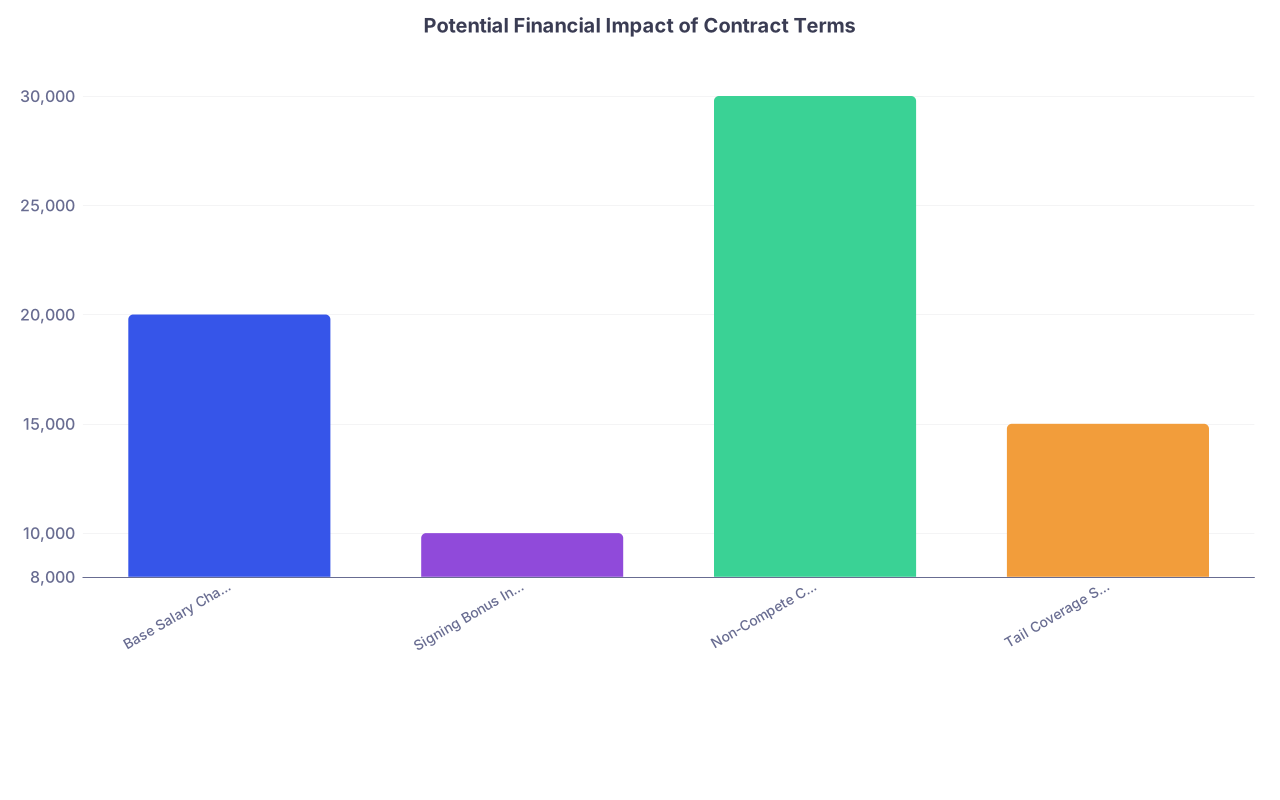
| Category | Value |
|---|---|
| Base Salary Change | 20000 |
| Signing Bonus Increase | 10000 |
| Non-Compete Change | 30000 |
| Tail Coverage Shift | 15000 |
Rough, realistic examples I’ve seen:
- Lawyer pushes base salary up by $10K/year over a 3-year term → +$30K
- Shortens non-compete radius so you can take a better job nearby a year later → easily worth tens of thousands
- Gets employer to pay tail instead of you → common tail bills are $15K–$80K depending on specialty
- Clarifies productivity bonus so you actually get paid what was intended → easily another $5K–$20K
You don’t need all of that to “win.”
You just need one of those improved outcomes to more than cover the legal fee.
6. How to Handle It If You Cannot Afford or Access a Lawyer
Sometimes you’re strapped. Or in a rural area. Or on a compressed timeline.
If you’re genuinely going to sign without legal review, then you can’t be lazy. Here’s the minimum protecting-yourself checklist.
A. Print the contract and read it three times
Yes, print it. On paper. Once fast, once slow, once with a pen.
Highlight:
- Anything involving money
- Anything involving “termination” or “non-compete” or “exclusivity”
- Any reference to policies, manuals, or attachments “incorporated by reference”
B. Non-compete sanity check
You care about:
- Radius – is it 5 miles from your primary site or 25–50 miles from any location?
- Duration – 6–12 months is better than 2 years
- Scope – can you not practice medicine at all, or only specific services?
If you read it and your gut says, “So if this job goes bad I basically have to move,” that’s a red flag.
C. Malpractice and tail coverage
Find these lines and do not gloss over them:
- Type: occurrence vs claims-made
- Who pays for tail
- What happens if you’re the one who terminates vs they terminate you
If it’s claims-made and you’re on the hook for tail, you need to at least know what that will likely cost for your specialty.
D. Termination clauses
There are usually two types:
- Without cause – both sides can walk away with X days’ notice
- With cause – for specific misconduct or failure
Watch for:
- Very long notice required from you (e.g., 180–365 days)
- Very short notice required from them (e.g., 30 days)
- Vague “cause” language like “in the employer’s sole discretion”
E. Compensation structure
Understand, specifically:
- Your guaranteed base for year 1 (and 2, if listed)
- When and how productivity starts
- If there’s a draw or advance that you later “pay back” through RVUs or collections
- When bonuses are calculated and paid out
If you can’t explain the comp structure clearly to another co-resident, you don’t understand it yet.
7. How to Work With a Lawyer Efficiently (So You Don’t Waste Money)
If you decide to get legal help, don’t just throw the PDF at them and say “tell me if this is fine.”
Here’s how to get the most for your money:
Do your own first pass.
Mark your questions. Flag anything that feels off. You’ll avoid wasting billable time on basics.Send the offer letter too.
Lawyers need to see what was promised versus what actually made it into the full contract.Ask for priorities, not perfection.
“Tell me the top 5 issues I should negotiate” is a better ask than “fix everything.”Use a scheduled call.
A 30–60 minute live call where you hit your top concerns is often more productive than slow email ping-pong.Have the lawyer empower you, not negotiate for you (usually).
Most groups expect the physician to be the one asking for tweaks. The lawyer gives you the language and rationale.
8. Red Flags That Scream “Get a Lawyer Now”
Here’s a short list of things that, if you see them, you should not sign without counsel:
- Non-compete covering huge geography (e.g., “within 50 miles of any facility where you provide services”)
- Contract says your schedule, duties, and locations are “as determined by Employer” with no limits
- Tail coverage on you, plus low pay and short notice termination
- Compensation heavily based on collections with no transparency on billing or control over staff
- Mandatory arbitration with a forum/state law that is very employer-friendly
- Ever-changing “policies and procedures” that are binding but not attached
If you feel cornered by HR to sign “quickly” or “before they move on to other candidates,” slow down. Solid employers don’t panic when you say “I need a lawyer to review this.”
9. Quick Reality Check: Academic vs Private vs Hospital Employment
Different job types have slightly different norms.
| Job Type | Typical Flexibility | Risk Level First Contract |
|---|---|---|
| Academic (W-2) | Low | Moderate |
| Hospital employed | Moderate | High (non-compete, tail) |
| Private group | Variable | Very high |
| Locums | Moderate | Moderate |
Academic contracts are often more rigid and standardized. You’ll still want clarity on non-compete (if any), outside work (moonlighting), and promotion expectations, but the raw exploitation risk is a bit lower.
Private groups and PE-backed entities are where I see people get burned the most. That doesn’t mean they’re bad. It means the variance is wide—and the contract matters a lot.
10. Should You Use a Lawyer For Every Single Contract Forever?
No.
By your third or fourth job, you’ll know what’s negotiable, what your market looks like, and where you’re willing to compromise. You might still use a lawyer for:
- Partnership agreements
- Equity or buy-in deals
- Side ventures, MSOs, ancillaries
But for your first attending contract, skipping a lawyer is like doing your own anesthesia because you watched a YouTube video and “read the label.” Could you technically do it? Maybe. Should you? Not if you care about outcomes.

| Step | Description |
|---|---|
| Step 1 | First Physician Contract |
| Step 2 | Hire physician contract lawyer |
| Step 3 | Careful self review + peer input |
| Step 4 | First attending job? |
| Step 5 | Non compete or tail risk? |
| Step 6 | Comfort reading contracts? |

FAQs
1. How do I find a good lawyer for physician contract review?
Look for attorneys who explicitly list “physician employment contracts” or “healthcare provider contracts” as a core part of their practice, not a side hobby. Ask senior residents, fellows, or faculty who they used. Many of the good ones work remotely and will review contracts across multiple states, as long as they’re licensed where you’re signing. Avoid generic “business lawyers” who have never seen RVU comp in their lives.
2. Can I use a lawyer from another state to review my contract?
For general advice and structure? Yes. For state-specific enforceability of non-competes or malpractice nuances? You want someone familiar with your state’s laws. Many physician contract attorneys are licensed in multiple states or will collaborate with local counsel for tricky items. At minimum, ask directly: “Are you comfortable advising on contracts in [state] and non-compete enforceability here?”
3. Will asking for changes make the employer rescind my offer?
In a healthy job market: almost never, if you’re reasonable. Most employers expect some negotiation. They may say no to certain asks, but pulling an offer just because you wanted clarity on tail coverage or a modest non-compete change is a red flag about their culture. If they get angry that you want a lawyer to review the contract, that’s a bad sign.
4. What if the employer says, “This is our standard contract; we don’t change it”?
Then you ask very specific questions anyway. “Standard” doesn’t mean “fair.” Ask them to explain non-compete, tail coverage, and termination language in writing or over a call. Sometimes “we don’t change it” is partly bluff. A lawyer can often still get them to tweak high-risk clauses, even within their “standard” template.
5. How early should I involve a lawyer in the process?
You don’t need a lawyer for the very first email or informal offer. Wait until you have either a detailed offer letter or the full draft contract. Once you do, bring in the lawyer before you start negotiating on your own. Let them help you set the strategy and choose what to ask for first, instead of you burning political capital on low-yield details.
Key takeaway 1: No, you’re not legally required to use a lawyer. But for your first attending contract, it’s one of the highest-ROI professional expenses you can make.
Key takeaway 2: The real value isn’t in wordsmithing. It’s in protecting you from non-competes, tail liabilities, vague comp schemes, and one-sided termination clauses that can derail your early career.
Key takeaway 3: If you truly cannot get a lawyer, you need to be ruthless about self-review—especially around non-compete, malpractice/tail, termination, and compensation structure.


