

The blunt truth: Asking detailed partnership-track questions in your very first job interview is usually too early. But ignoring partnership entirely is just as bad.
You’re not choosing a one-year gig. You’re choosing the people who will control your income, your schedule, and your professional growth for the next decade. So you cannot treat partnership like a taboo subject—but you also cannot walk into Interview #1 acting like you’re negotiating a buy-in you have not earned.
Let’s separate what you should ask about early from what you need to hold back until later.
The Core Answer: What’s Too Early, What’s Not
Here’s the clean framework:
It is appropriate in a first interview to ask:
- Whether the position is partnership-track or permanent employed-only
- Typical timeline to partnership (e.g., “2–3 years”)
- Whether there is an established, written process for partnership
It is too early in a first interview to press for:
- Exact buy-in amount, detailed valuation methodology, or financing options
- Full partner compensation figures and distributions
- Detailed governance structure and voting mechanics
- Every line item of the buy-in contract
Why? Because the first interview is still “do we like each other?” territory. Not “let’s crack open the cap table” territory.
You want to signal that you’re serious and long-term oriented, not transactional and impatient. So you acknowledge partnership early, then you negotiate it later.
What to Say in the First Interview (Word-for-Word)
If you remember nothing else from this, use these lines.
Here’s the safest, most professional way to raise it in interview one:
“I’m looking for a long-term home, not a stepping-stone job. Can you tell me whether this role is intended to be partnership-track, and what the typical timeline looks like for someone who’s a good fit?”
That does three things:
- Signals commitment.
- Keeps the question high-level.
- Forces them to admit if you’re just cheap labor.
Follow-ups that are acceptable in a first conversation:
- “Do most new hires in this role ultimately become partners, or is that more selective?”
- “Is there a written pathway or is it more individualized and informal?”
- “Are there any objective milestones—productivity, quality metrics, citizenship—that are part of that promotion decision?”
Where you cross the line into “too early” is stuff like:
- “What’s the current partner draw?”
- “Exactly how much is the buy-in and what’s your EBITDA multiple?”
- “Can I see your last three years of financials before I come for a site visit?”
Those might be smart questions eventually. On day one, they just make you look like you’re more interested in the check than the job.
Why You Must Bring Up Partnership Early (But Carefully)
I’ve seen too many new attendings burned because they assumed “partnership track” meant something standardized and fair.
It doesn’t. “Partnership track” is one of the vaguest, most abused phrases in physician recruiting.
Sometimes it means:
- A well-defined 2–3 year path with written criteria, guaranteed if you meet them.
Other times it means:
- “We’ll see how we feel about you in 5–7 years and maybe let you buy in if the founding partner’s cousin doesn’t want the spot.”
If partnership matters to you—and for most private practice roles, it should—you cannot leave it unspoken until the offer stage. That’s how you end up in a “2-year track” that somehow drags into year 5 with shifting goalposts.
So yes, mention it. Just do it like a grown-up who understands the sequence:
- First interview: Fit, philosophy, basic track/timeline.
- Second/third conversation or site visit: Process, expectations, and early numbers.
- After an offer / during contract phase: Detailed economics, legal review, and documentation.
How Early Is Too Early? A Simple Decision Framework
Use this rule:
If you haven’t yet:
- Talked through the day-to-day clinical expectations
- Understood call schedule, coverage, and patient mix
- Discussed compensation structure for the initial employed phase
…then it’s too early to dig into partnership details. But not too early to ask whether partnership exists and on what rough timeline.
Here’s how that plays out in practice for most private groups:

| Step | Description |
|---|---|
| Step 1 | First Phone or Video Screen |
| Step 2 | Ask if role is partnership track and timeline |
| Step 3 | Onsite or Second Interview |
| Step 4 | Ask about criteria and general buy in structure |
| Step 5 | Receive Offer |
| Step 6 | Request written details and contract language |
| Step 7 | Move on |
| Step 8 | Ask about partnership track? |
| Step 9 | Good mutual fit? |
If your very first touch is a recruiter call, you can absolutely ask them:
“Is this position partnership-track, and what timeline are they advertising?”
That’s normal. That’s their job.
Where you hold back is interrogating the managing partner about internal financials before anyone’s even sure you like the hospitalist schedule.
Red Flags in Their Answers
Sometimes their reaction to your early, high-level question tells you everything you need to know.
Watch for these:
Vague hand-waving
“Yeah, we have a partnership model, we can talk about that later.”
Translation: It might exist on paper. May not in reality.Shifting or “flexible” timelines
“Some people make it in 2 years, some in 7, it just depends.”
Translation: Criteria are not transparent. Politics or favoritism likely dominate.No written policy
If they’ve “been around 20 years” and still have no written partnership criteria, they’re choosing to keep it fluid. That usually benefits the existing partners, not you.Defensiveness when you ask
If a basic question like, “Do most associates become partners?” gets you a weird look or a curt answer, you’re learning something important: they either have a retention problem or a power problem.
On the flip side, good signs:
- They can clearly state: “Track is 2 years, historically >80% make partner.”
- They reference a written document: “We go over the partner track formally when we’re serious about an offer.”
- They proactively mention: “We view new hires as future partners unless there’s a mismatch.”
How This Changes by Setting: Private Practice vs Employed
You should not talk about “partnership” the same way everywhere. Different structures, different questions.
| Setting | Early-Stage Question | Typical Reality |
|---|---|---|
| Private specialty group | Is this a partnership-track role? | True equity usually exists |
| Hospital-employed | Is there any pathway to equity or governance? | Usually no real partnership |
| Academic practice | Any financial partnership or just titles? | Mostly titles, not equity |
| Large corporate group | Any local equity or only corporate stock? | Often corporate-level only |
If you’re looking at:
Pure private practice (GI, ortho, cards, anesthesia groups):
Partnership is central. Ask early if it exists, when it happens, and if it’s standard or selective.Hospital-employed models (common in FM, IM, EM, hospitalist):
“Partnership” usually doesn’t exist in the traditional sense. Better questions:- “Are there leadership or service line roles with additional compensation?”
- “Is there any form of shared savings or bonus tied to group performance?”
Academic jobs:
“Partner” typically translates to “tenure or promotion,” not equity. Very different animal.
So before you even frame the question, be clear on what kind of “partnership” is structurally possible.
When You Should Push Harder (And What to Ask Then)
Once there’s clear mutual interest—usually after a visit or solid second interview—then it’s not too early to go deeper.
That’s the time to ask:
- “What percentage of current physicians in the group are full partners vs employees?”
- “Historically, how many people hired into this role have actually made partner?”
- “What are the objective criteria—RVUs, quality measures, committee work, on-call participation?”
- “Is the buy-in a fixed amount, a valuation-based amount at the time, or sweat equity?”
- “How long is the pay gap between partner and non-partner status?”
You might not get all the real numbers until you have an offer in hand. That’s fine. But if they dodge every question, that’s your answer.
How to Avoid Sounding Greedy
This is the part new grads get anxious about: “If I ask about partnership too early, will they think I only care about money?”
Not if you frame it correctly.
Anchor it in fit and commitment, like this:
- “I’m not looking for a one- or two-year bridge job. I want to understand the long-term structure so I know if this is the right place to build my career.”
- “It helps me compare opportunities if I know whether I’d be growing into a partner role here versus always being in an employed model.”
You’re not saying, “How rich will I get?” You’re saying, “I want to be somewhere I can invest myself fully.”
That’s exactly what a serious group wants to hear.
Quick Comparison: Acceptable vs Too Much in First Interview
| Topic | OK in First Interview? |
|---|---|
| Is this role partnership-track? | Yes |
| Typical timeline (e.g., 2–3 years)? | Yes |
| Written criteria vs informal decision? | Yes |
| Exact buy-in dollar amount | Usually no |
| Detailed partner compensation numbers | No |
| Full access to practice financials | No |
If you’re staying on the left side of that table, you’re fine.
Visual: How Your Questions Should Evolve
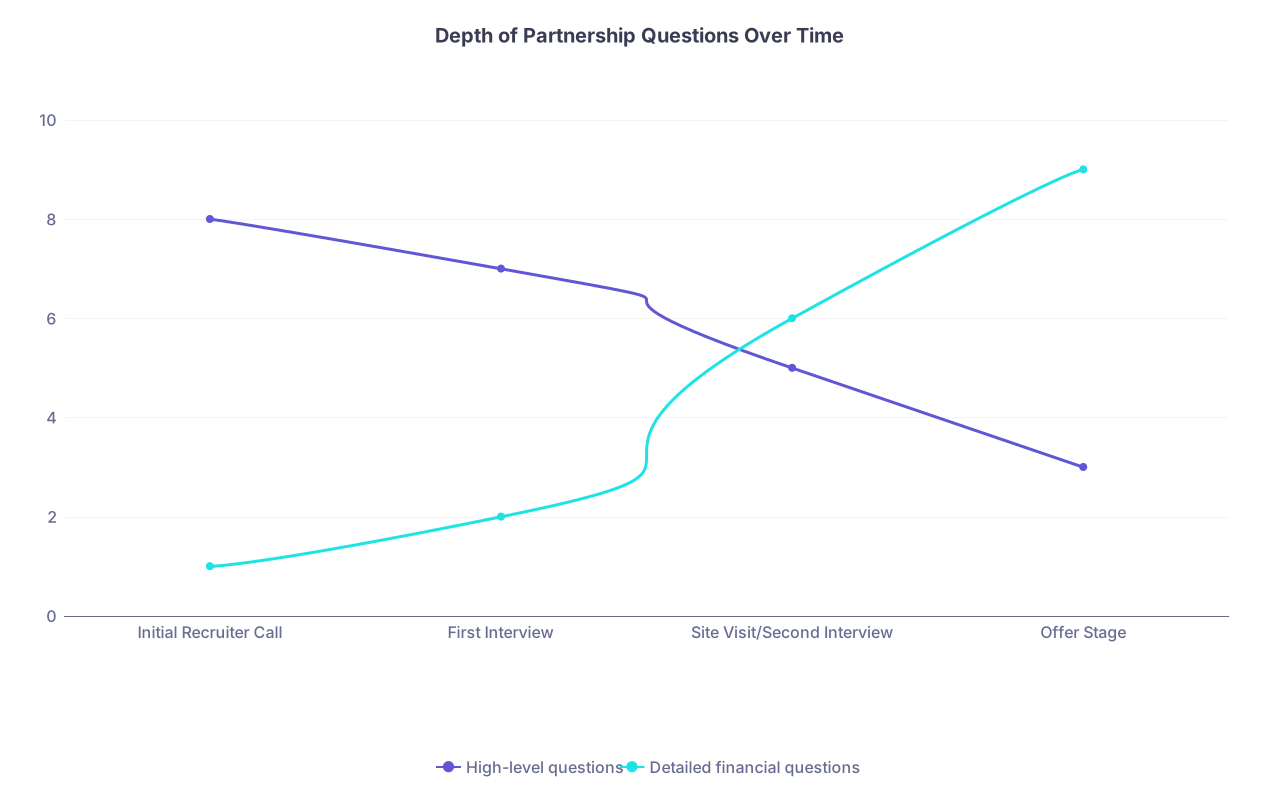
| Category | High-level questions | Detailed financial questions |
|---|---|---|
| Initial Recruiter Call | 8 | 1 |
| First Interview | 7 | 2 |
| Site Visit/Second Interview | 5 | 6 |
| Offer Stage | 3 | 9 |
Numbers are just relative intensity (1–10). The idea: big picture early, spreadsheets later.
FAQs
1. If a job ad says “partnership track,” do I still need to ask about it in the first interview?
Yes. “Partnership track” in a posting can mean almost anything. At minimum, confirm in the first interview: Is this specific role actually intended to lead to partnership? What’s the typical length of that track? Has anyone hired in the past 3–5 years actually reached partnership yet? You’re cross-checking the marketing language with real-world outcomes.
2. I’m worried asking about partnership will hurt my chances. Should I wait until I get an offer?
Waiting until the offer stage is how people get blindsided by “oh, partnership is by invitation only and we haven’t made a new partner in 10 years.” If you keep it high-level—track, timeline, written criteria—early, you will not hurt your chances with any group you actually want to join. The only groups offended by that are the ones hiding something.
3. What if they tell me, “We’ll talk about partnership once you’ve been here a year”?
That’s a yellow-to-red flag. They don’t need to give you the full contract now, but they absolutely can and should tell you: Is there a defined track? How long is it? Do most people make it? Having to work there before you learn the rules of the game is a great way for them to keep leverage and keep you in limbo.
4. I’m joining a hospital-employed group with no equity. Should I still ask about partnership?
You should shift the language. Instead of “partnership,” ask about advancement: leadership roles, section chief positions, medical directorships, and compensation tied to those. Traditional buy-in partnership probably does not exist in a straight hospital-employed model, so obsessing over it there is wasted energy.
5. When exactly should I get the partnership terms in writing?
Once they’re serious enough to extend an offer—or immediately before, if they’re courting you hard—you should ask for the partnership-track details in writing. That can be a separate policy document or integrated into your employment contract. Do not rely on verbal promises like “everyone makes partner in 2 years.” If it’s not written somewhere, it’s not real.
Key takeaways: Bring up whether and when partnership happens in your first serious conversation. Save the deep dive—buy-in numbers, detailed compensation, financials—for once there’s mutual interest and you’re near the offer stage. And if their answers are vague, defensive, or undocumented, that’s not a mystery. That’s your warning.


