

It’s January. Your last year of residency. You’ve got one verbal job offer from a hospitalist group, a recruiter is “sure” another offer is coming next week, and your PD keeps asking, “So, where are you signing?” You’re exhausted, your loans are looming, and part of you just wants to grab the first reasonable offer and be done.
Here’s the real question you’re wrestling with: How many job offers should you collect before you sign as a new attending—and how do you know when it’s “enough”?
Let’s answer that directly, then I’ll walk you through the logic and the traps.
The Short Answer: Aim For 3, Consider Signing At 2, Avoid Signing At 1
If you want a simple rule:
- Ideal target: 3 real offers (written or detailed formal verbal)
- Good enough: 2 strong, well-understood offers
- Risky: Signing after only 1 offer, unless you have a very specific reason
“Real” offers means:
- There’s a written contract or detailed term sheet
- You know compensation structure (base, bonus, wRVU rate, call pay, benefits)
- You know your schedule, call expectations, and location details
- You’ve had at least one conversation specifically about expectations and culture
If all you have is “We’d love to have you, we’ll put something together soon,” that’s not an offer. That’s noise.
The point of multiple offers isn’t to hoard contracts. It’s to:
- Benchmark compensation and expectations
- Give yourself negotiation leverage
- Avoid getting trapped in a bad first-job fit because you had no comparison
Now let’s get more concrete.
How Many Offers You Really Need: By Situation
Not everyone needs the same number. You’re not a spreadsheet; you’re a person with constraints.
1. If You’re in a Competitive Specialty or Tier-1 City
Think derm, ortho, plastics, ENT, or big-name metros (Boston, San Francisco, NYC, Seattle).
Here’s my take:
- You should push for at least 3 offers
- You should compare them in detail on: comp model, schedule, path to partnership, call, and non-compete
- You should not sign the first attractive thing you see, because in these spaces the spread between “average” and “excellent” can be 30–60% of your income and a huge difference in lifestyle
If you’re trying to get into a very specific niche (e.g., advanced heart failure in one particular city), you may not get three offers. Fine. But if you reasonably can, you should.
2. If You’re Open on Location and Specialty Is In-Demand
Hospitalist, outpatient IM, primary care, EM in non-coastal areas, anesthesia in many regions.
You have leverage. Use it.
- Three offers is very realistic if you start early (6–12 months before graduation)
- You should be comparing: RVU expectations, how honest the volume estimates are, and how stable the group/hospital is
- You can and should say to recruiters, “I’m actively considering multiple offers and plan to make a decision once I have 3–4 in hand.”
Here, if by the time you have 2 excellent offers that both fit your life and numbers, it’s reasonable to sign without waiting for a third. Especially if the third is from a weaker market or known lower-paying system.
3. If You’re Tied to One Geography (Family, Visas, Custody, Illness)
You’re pinned to one metro or region. Maybe two hospitals control everything there.
Your target changes:
- Goal: 2 offers if possible
- Reality: Sometimes 1 offer is what you get
If you’re stuck at 1, that doesn’t mean you roll over. It means you:
- Squeeze as much information as you can out of interviews and colleagues
- Compare that offer to national and regional MGMA data, even if you don’t have a direct competing offer
- Negotiate terms that matter most (schedule, call, non-compete, CME, loan repayment), even if salary is somewhat fixed
In this scenario, you compensate for fewer offers with better intel and a more aggressive contract review.
What Changes as You Go From 1 to 3+ Offers
| Offers in Hand | Leverage | Risk of Underpayment | Clarity on Market Fit |
|---|---|---|---|
| 1 | Low | High | Low |
| 2 | Moderate | Moderate | Moderate |
| 3+ | Strong | Lower | High |
Here’s what each step really gives you.
One Offer: You’re Flying Blind
With only one offer:
- You have no idea if your comp is in the 20th percentile or 80th
- You don’t know if the RVU targets are standard or unrealistic
- You can’t tell if their “this is what everyone else offers” line is truth or sales
You can still negotiate with one offer. But your confidence is lower because you’re guessing.
Two Offers: You Finally Have a Reference Point
With two solid offers:
- Huge red flags become obvious. If one job wants 12–14 shifts/month and the other wants 20+ for the same pay, you see the game.
- You can say (truthfully), “I have another competitive offer with higher base pay/lower call; can we adjust X?”
- You start to see what’s “normal” for your region and specialty
At two offers, the decision is usually:
“Do I sign one of these now, or wait for the potential third and risk losing one?”
If one offer clearly checks your boxes, it’s often smart to sign rather than drag out the process purely to hit some arbitrary “3 offers” goal.
Three or More Offers: You’re Playing Offense
With 3+ real offers:
- You stop asking, “Am I getting screwed?” and start asking, “Which good option fits me best?”
- You gain confidence to push on specifics—RVU thresholds, partnership track details, protected time, relocation, signing bonus structure
- You can walk away from nonsense without fear
At this stage, the main risk is analysis paralysis. Do not get stuck because job A pays $15K more but job B has 1 fewer call per month and job C is closer to your in-laws. At some point, you choose.
What Actually Matters More Than the Number
Whether you have 2 or 4 offers matters less than whether you’ve answered these five questions clearly.
1. Do You Actually Understand the Money?
Not just base salary. The structure.
Things you need clearly defined for each offer:
- Base salary and how long it’s guaranteed
- Bonus model: RVU-based? Collections-based? Quality incentives?
- Expected RVUs or volume and what current physicians actually achieve
- Call pay—per shift, per hour, or not at all?
- Partnership track: buy-in amount, realistic timeline, what partners actually earn
You want to compare apples to apples. A $260K outpatient IM job with no call and no weekends in the Midwest might be better than a $300K job with heavy call and Saturdays in a high COL city.
2. Do You Know the Schedule and Call Reality?
Schedule is where people get burned.
For each offer, you should know:
- Clinic days or shift count per month
- Call structure: nights, weekends, in-house vs beeper
- How often you’ll actually be on call (not the fantasy, the real schedule)
- Expectations for adding clinics/OR blocks when “volume grows”
The right number of offers is the number that makes you confident about this comparison. For many people, that’s 2–3.
3. Have You Done Backdoor Reference Checks?
You don’t sign based solely on what the recruiter and chair told you.
You:
- Talk to at least 2 current physicians there—ideally one junior, one senior
- If possible, talk to someone who left in the last 1–3 years
- Ask blunt questions: “Are you hitting target RVUs? Would you sign here again? What surprised you in a bad way the first year?”
If a place won’t let you talk informally with current physicians, that’s a yellow flag. If you have multiple offers and one is cagey about this, they drop in your ranking.
4. How Bad Is the Non-Compete?
As a new attending, non-competes feel theoretical. They are not.
You should know:
- Radius and duration of the non-compete
- Whether it applies to all locations in the system or just your site
- Whether they’ve enforced it against physicians in the last few years
If you’re staying in a region long-term, a brutal non-compete is a big strike against that job. This is where having multiple offers lets you say, “I’d like this clause modified, because another offer I have is far less restrictive.”
5. Does This Job Move You Toward or Away From Your 5-Year Life?
Forget the brochure. Think about you in 5 years.
Do you:
- Want academic promotion and protected time? Then community RVU mill may kill your goals.
- Plan to start a family soon? Heavy call + evenings might wreck your home life.
- Want to build a niche clinic or procedural skillset? You need explicit support for that.
Multiple offers don’t magically answer this. But comparing them forces you to be honest about your priorities.
Common Traps New Attendings Fall Into
Let me be blunt about the mistakes I see over and over.
Trap 1: Signing the First “Decent” Offer Out of Fatigue
You’re tired of interviews. Tired of waiting. Loans feel heavy.
So you sign after one offer that’s “fine,” without comparison. A year later, you hear what your co-residents signed for and realize you’re working harder for less money and worse call.
You don’t need to drag this out forever, but you should almost never sign after only one offer—with no benchmark—unless you’re geographically boxed in and understand that trade.
Trap 2: Believing Recruiter Urgency
Classic lines:
- “We have other candidates interested, so we really need an answer by next week.”
- “Our compensation model is standard for the region; nobody else is doing it differently.”
- “We can’t hold this signing bonus open past X date.”
Sometimes this is real. Often, it is scripted pressure.
You defuse this by calmly saying:
“I’m actively interviewing at several places and will be in a position to make a final decision once I have all offers in hand. I don’t make career decisions based on artificial deadlines.”
If they pull the offer over that, you dodged a bullet.
Trap 3: Waiting for a Unicorn Fourth or Fifth Offer
On the other side, some people get six interviews, three strong offers, and then freeze because “maybe something better is coming.”
You don’t need the global optimum. You need a good fit that won’t make you miserable or underpaid.
Once you have:
- 2–3 strong offers,
- A clear front-runner, and
- Clarity on your top 3 priorities (location, money, schedule, academic vs community, etc.),
it is completely reasonable to pick one and move on with your life.
A Simple Framework: When to Stop Collecting Offers
Use this as a sanity check.
Stop chasing more offers when:
- You have at least 2 offers that:
- Meet your baseline financial needs
- Do not trigger any major red flags (toxic culture, insane call, insane RVUs, brutal non-compete)
- One offer is clearly better for your actual life, not just on paper salary
- You’ve:
- Talked to current docs there
- Reviewed the contract with someone who understands physician contracts
- Asked for 2–3 reasonable changes (even if they say no)
- Waiting longer is driven more by fear of missing a hypothetical “perfect” job than by real doubts about these offers
If all four are true and your gut is more relieved than anxious when you imagine signing—sign. You’re done.
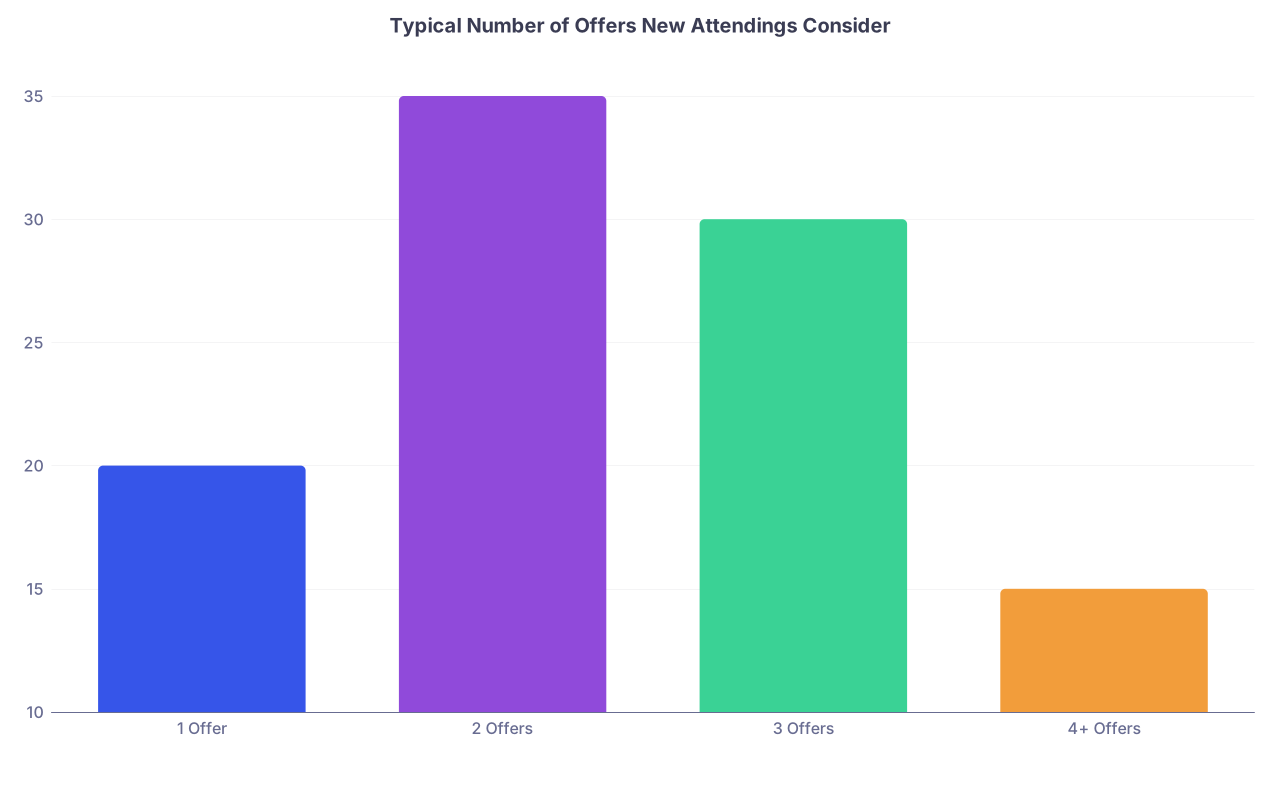
| Category | Value |
|---|---|
| 1 Offer | 20 |
| 2 Offers | 35 |
| 3 Offers | 30 |
| 4+ Offers | 15 |

| Step | Description |
|---|---|
| Step 1 | Start Job Search |
| Step 2 | First Offer Received |
| Step 3 | Try to secure more interviews |
| Step 4 | Wait for additional offers |
| Step 5 | Second Offer Received |
| Step 6 | Consider more applications |
| Step 7 | Compare money, schedule, non compete |
| Step 8 | Clarify priorities and negotiate |
| Step 9 | Contract review and sign |
| Step 10 | Any other interviews active |
| Step 11 | At least 2 good offers |
| Step 12 | Clear front runner |

What You Should Do Right Now
Today, not “after boards,” not “when interview season calms down.”
Write down your minimum requirements on one page:
- Minimum total comp you’ll accept
- Maximum call burden you’ll tolerate
- Regions you’re truly okay living in
- Deal-breakers (e.g., non-compete radius over X miles, no path to partnership)
Commit: I will not sign after only one offer unless I have a very specific geographic or visa constraint—and I will make that a conscious decision, not a default.
If you already have one offer:
- Schedule at least 2–3 more interviews this month, even if you suspect you’ll end up at offer #1. You need the reference points.

FAQ: New Attending Job Offers
1. Is it ever okay to sign after just one job offer?
Yes, but only in constrained situations: very tight geography, visa limitations, or a truly unique niche position. If you do sign after one offer, compensate by doing extra due diligence: speak with multiple current physicians, compare the contract to MGMA data, and have an attorney or experienced attending review it. Do not sign a single-offer contract blind.
2. How long should I wait for additional offers before deciding?
In most cases, give your job search a defined window: 6–8 weeks from your first real offer. During that time, aggressively schedule remaining interviews and ask about their decision timelines. If you have 2–3 offers by the end of that window and one clearly fits, sign. If you’re still at one offer after an honest push, reassess your criteria or geography.
3. Can I tell one employer I’m waiting on other offers?
Yes, and you should. A simple, professional version: “I’m very interested in this position. I’m also in advanced stages with a couple of other groups and expect offers soon. I plan to make a final decision once I have all offers in hand so I can compare them fairly.” Reasonable employers respect that. If they react poorly, that’s data.
4. How much more money can multiple offers realistically get me?
Depends on specialty and region, but I’ve seen new attendings improve their total comp by 10–30% just by having competing offers and being willing to walk. That might be a higher base, better RVU conversion, sign-on bonus adjustments, or loan repayment. More importantly, multiple offers often buy you better schedule terms and a less toxic workload, which is worth more than a small salary bump.
5. What if the best-paying job clearly has the worst lifestyle?
Then you decide what season of life you’re in. For some people, doing a 2–3 year “hard grind” job to pay down loans aggressively makes sense, as long as the non-compete doesn’t trap you. For others, that’s a fast track to burnout and resentment. Use multiple offers to quantify the trade: “Job A is $40K more but 5 more calls/month and 2 weekends. Is that worth it to me right now?”
6. Should I ever sign a contract before seeing it in writing?
No. A verbal offer is not a contract. “We’ll add that in later” is not a contract. You wait for a full written contract or at least a detailed term sheet. You review it. You ask questions. You negotiate 1–3 specific points that matter to you. Only then do you sign. If they pressure you to sign quickly without that step, walk.
Open the best current offer you have—email or paper. Right now, jot down on a blank page: “Better/Worse/Same” columns for money, schedule, and non-compete. If you don’t have at least one other concrete opportunity to compare against it, your next step today is simple: send 3 more CVs or emails to targeted employers before you go to bed.


