What if the “$50,000 loan repayment” in your offer letter is actually worth less than a single extra RVU tweak in your contract?
Let’s go straight at it: loan repayment is one of the most abused, overhyped, and poorly understood parts of physician contracts. I’ve watched new attendings obsess over a flashy “loan forgiveness” line while ignoring the compensation structure that will cost or make them six figures over a few years.
You want the truth? In many contracts, the loan repayment language is either:
- Mostly marketing
- Tax-inefficient
- Structured to trap you, not help you
Let’s break the myths one by one and talk about what actually matters.
Myth #1: “$X in Loan Repayment” = Free Money
The phrase “We offer $30,000 in loan repayment” sounds simple. It is not.
Here’s what most people miss: that number is almost never the true value to you. It’s often pre-tax, stretched out, conditional, or offset by something else in the contract.
Common realities behind that shiny number:
It’s taxable income
The hospital pays your lender (or sometimes you), issues it as income, and you owe federal + state + FICA on it. That “$30,000” might be more like $18,000–$21,000 after taxes, depending on your bracket and state.It’s paid over multiple years
You see $50,000 and think, “Nice signing bonus for my loans.”
The contract says: $10,000 per year for 5 years, contingent on continued employment. Leave in year 3? You may keep what you got, but the rest evaporates.It’s offset somewhere else
Lower base salary, weaker RVU rate, fewer raises, or a smaller sign-on bonus. I’ve literally seen offers where one hospital offered “$40K in loan repayment” but their total 3-year take-home was lower than a competitor with no repayment but better base + productivity structure.
Here’s the move: stop evaluating loan repayment in a vacuum. You have to compare total after-tax compensation over time.
| Offer | Base Salary | Loan Repayment | Structure | 3-Year After-Tax Difference* |
|---|---|---|---|---|
| A | $300,000 | $0 | Higher base, no strings | Baseline |
| B | $280,000 | $60,000 | $20K/yr for 3 yrs, taxable | ~+$12K vs A |
| C | $270,000 | $90,000 | $30K/yr for 3 yrs, taxable | ~+$18K vs A |
*Very rough, assuming high-tax attending bracket. The point isn’t the exact number. It’s that the headline “loan repayment” value shrinks fast after taxes and structure.
In many cases, the best “loan repayment program” is just: higher salary, fewer strings, and you sending your own aggressive payments to your loans.
Myth #2: Loan Repayment > Salary & Productivity Structure
I’ve watched people turn down better jobs because “the other hospital doesn’t offer loan repayment.” This is backwards.
Loan repayment is a one-time, limited benefit. Your pay structure affects every paycheck for as long as you stay.
I’ll give you a real pattern I’ve seen:
Offer 1:
$260K base, $40K loan repayment spread over 4 years
RVU threshold slightly high, low per-RVU bonus rateOffer 2:
$290K base, no loan repayment
Lower RVU threshold, strong per-RVU bonus, plus a $20K sign-on
Once you run actual numbers, Offer 2 blows Offer 1 out of the water in most realistic productivity scenarios. The doc who chose Offer 1 because it “helps with loans” effectively traded tens of thousands in income for maybe $20–25K real value of loan assistance.
Do the math on scenarios:
- Conservative productivity
- Expected productivity
- Slightly optimistic productivity
Even a small $5–10 per RVU difference, or a lower threshold, can eclipse $20-40K loan repayment over a few years.
Loan repayment is a small rock. Salary structure and productivity are boulders.
Myth #3: “We’ll Help With Your Loans” Means They Understand Student Debt
Any time I see vague language like “loan assistance available” or “we support loan repayment,” my guard goes up.
Here’s what that often really means:
- They don’t have a standardized, transparent program
- Every doc “negotiates” something different, mostly based on how hard they push
- Admin will happily dangle the phrase “loan help” knowing you might stop asking real questions
You want specifics in writing:
- Exact dollar amount
- Whether it’s lump sum vs annual
- Paid to you or directly to lender
- Timeline
- Vesting or clawback conditions
- Tax treatment (sometimes they’ll gross up; often they will not)
If the recruiter can’t answer those immediately and precisely, they don’t have a real program. They have a buzzword.
Myth #4: All Loan Repayment Programs Are Basically the Same
No. And this is where thousands get left on the table.
Let’s break the main structures you’ll see:
1. Direct annual payments to your lender
Employer sends $X per year directly to your servicer. Counted as taxable income to you.
- Pro: You actually see loan balances go down.
- Con: Still taxable. Typically small relative to total debt.
- Hidden catch: Often contingent on “active full-time employment,” so leave early and it stops instantly.
2. Lump-sum “signing bonus” earmarked for loans
Sometimes they call it “loan repayment,” but it’s literally just a sign-on bonus with suggested use.
- Pro: More flexible. You can throw it at high-rate loans or even keep as cash (though not ideal).
- Con: Definitely taxable; may have clawback if you leave within 1–3 years.
3. Forgivable loan structure
The hospital “loans” you $X (sometimes a large number, like $100K) and forgives it over Y years of service.
- Example: $100K forgiven at $20K/year over 5 years.
- Pro: Bigger headline number.
- Con: If you leave early, you technically “owe back” the unforgiven portion. That’s a golden handcuff dressed as generosity.
Here’s the kicker: many docs emotionally overweight a big forgiveness number and mentally lock themselves into staying even when the job becomes miserable or stagnant.
Myth #5: “It’ll Really Move the Needle on My Debt”
Let’s be blunt. For many attendings, loan repayment in contracts is a rounding error compared with:
- Specialty income over time
- How long you stay in a low-paying vs high-paying setting
- How aggressively you pay your loans once you’re an attending
Look at the math.
Say you owe $300,000 at ~6–7% interest. You get $20,000/year in loan repayment for 3 years, taxable, so maybe you net around $12–14K each year.
That’s helpful. It’s not life-changing. Over three years, maybe $36–42K real benefit.
Compare that to:
- A $25K salary delta every year between two jobs
- A better productivity deal netting you an extra $30–40K per year
- Simply deciding to throw an extra $3–4K per month at your loans for 3–4 years
That’s the reality: your income level and your spending decisions dominate the outcome. Loan repayment in your contract is just a small accelerator.
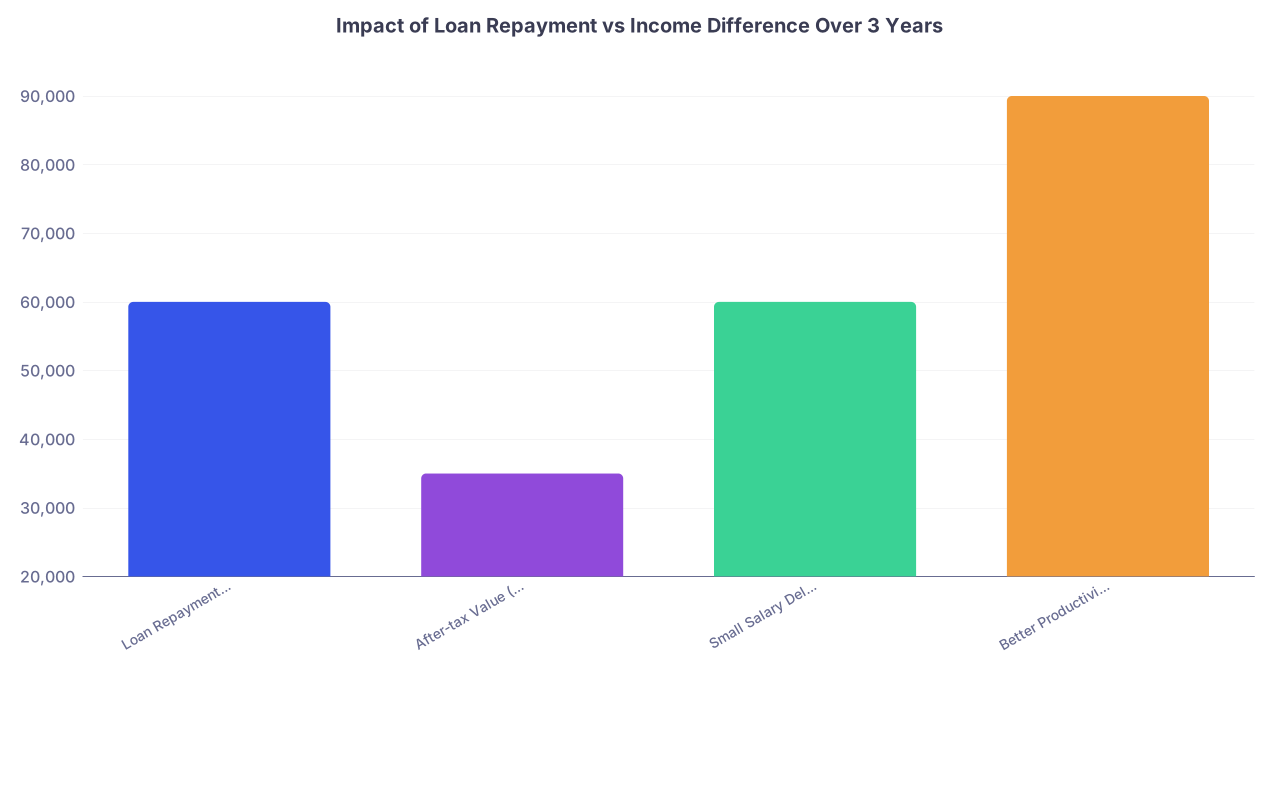
| Category | Value |
|---|---|
| Loan Repayment (headline $60K) | 60000 |
| After-tax Value (~$35K) | 35000 |
| Small Salary Delta ($20K/yr) | 60000 |
| Better Productivity ($30K/yr) | 90000 |
The chart is the punchline: a modest change in salary or productivity beats most loan repayment packages.
Myth #6: Contract Loan Repayment Plays Nicely With Federal Programs
This one burns people.
Many new attendings think:
“I’ll take PSLF or IDR and just let this employer loan repayment knock down my principal too.”
You need to be very careful here.
First, most hospital-based “loan repayment” is just taxed income that gets sent to your lender. It doesn’t magically bypass your own qualifying payments for PSLF.
Second, if you’re early in PSLF or on an income-driven plan, aggressively paying extra principal with employer money can reduce the value of eventual forgiveness. You’re essentially pre-paying dollars that might have been forgiven later.
For people truly committed to PSLF at a qualifying employer:
- High salary + making qualifying payments is usually more important than employer “help”
- Extra principal payments may not be ideal if you’re likely to see forgiveness at year 10
I’ve watched people at PSLF-eligible, academic centers fixate on a relatively small institutional loan repayment while ignoring the massive tax-free forgiveness at the end of 10 years.
To be clear: sometimes employer repayment still helps. But don’t assume more principal reduction is always optimal in a PSLF path. It’s not that simple.
Myth #7: The Strings Don’t Really Matter—“I’m Going to Stay Anyway”
Dangerous thinking.
Loan repayment benefits are designed to keep you put. That’s the whole point. Administrators know recruiting is expensive, and turnover is painful. The forgivable loan is their leash.
Typical strings:
- Minimum years of employment to vest
- Prorated clawbacks if you leave early
- Non-compete + clawback combo (my personal favorite flavor of handcuffs)
Picture this:
You sign a contract with a $100K “forgivable loan,” forgiven over 5 years. After 2 years, the hospital becomes a nightmare. Leadership changes, volumes spike, staffing craters.
You want to leave.
On paper, you “owe back” $60K. Plus there’s a non-compete that forces you 30–50 miles away if you leave. I’ve seen people stay in terrible jobs because the psychological pain of writing a $60K check felt worse than the daily misery.
That’s not free money. That’s an anchor.

| Step | Description |
|---|---|
| Step 1 | Year 0 - Sign contract |
| Step 2 | Receive forgivable loan |
| Step 3 | Yearly forgiveness portion |
| Step 4 | Stay until fully forgiven |
| Step 5 | Owe back unforgiven portion |
| Step 6 | Financial and emotional pressure |
| Step 7 | Want to leave early? |
When you evaluate loan repayment, you’re also evaluating: how okay am I being locked into this environment for that duration?
Myth #8: You Don’t Need a Lawyer for “Standard” Loan Repayment Language
“I had my friend skim it; it’s all boilerplate.”
That’s exactly how people sign up for repayment obligations they never really understood.
Loan repayment clauses are where:
- Clawback triggers hide
- Definitions of “cause” vs “no cause” termination matter
- Whether you owe back money if they fire you becomes critical
I’ve seen contracts where:
- If the employer terminates you without cause, you still owe back unforgiven loan amounts.
- If you go part-time for any reason (including health or parental leave), repayment halts and can even trigger payback.
- “Geographic radius” in a non-compete interacts with the clawback in nasty ways.
A competent physician contract attorney can:
- Reword or soften clawback terms
- Cap how much you’d owe back if you leave
- Tie repayment to your cause versus theirs
- Convert a “forgivable loan” into a more favorable structure in some cases
Is a few hundred to a couple thousand dollars for legal review annoying? Yes. But if you’re playing with $50K–$200K of possible obligations, it’s laughable not to have someone scrutinize every line.
Myth #9: The “Best” Job Is the One With the Biggest Loan Repayment Line
The best job is the one with:
- Sustainable workload
- Fair, transparent compensation
- Autonomy and growth
- A leadership culture you can stomach
Loan repayment can be part of that. But it is never the pillar.
Here’s how smart attendings actually use loan repayment when negotiating:
First, they build a clear comparison of total comp (salary, bonus, call pay, benefits) between offers. Then, if two offers are roughly equal, they use loan repayment as a lever:
- “Can you add a $20–30K one-time loan repayment bonus?”
- “Can you structure this as a lump sum instead of stretched over 5 years?”
- “Can you gross this up to offset some taxes?”
In other words, they treat it as a nice-to-have sweetener or a tiebreaker. Not a leading factor.
FAQs
1. Is loan repayment ever a reason to pick one job over another?
Sometimes, but only when everything else is very close. If two jobs are nearly identical in pay, culture, location, and growth, then a clearly structured, reasonably generous loan repayment package can break the tie. But picking a worse job purely because of a bigger loan repayment number is almost always a bad move.
2. Should I prioritize PSLF over employer loan repayment?
If you’re at a qualifying 501(c)(3) or government employer and you’re serious about staying in that world for 10 years, PSLF is usually the main engine and employer repayment is a side bonus at best. For non-PSLF paths (private practice, for-profit groups), employer loan repayment can help, but your income and your own repayment aggressiveness matter far more.
3. Can I negotiate loan repayment terms, or are they fixed?
You can almost always negotiate something: the total amount, how it’s paid (lump sum vs annual), clawback conditions, or even turning a “forgivable loan” into a simple bonus. You’ll get farther when you’ve already done your homework on RVUs, salary data, and competing offers. A contract attorney can often squeeze real value here with a few edits.
4. What’s the single biggest mistake physicians make with loan repayment clauses?
They focus on the headline dollar amount and ignore structure, taxes, and strings. The $100K forgivable loan that ties you down for 5 miserable years can be worse than no loan repayment and full freedom. The grown-up way to look at it: total after-tax comp, real job quality, how strong the handcuffs are, and whether you’d still take the job if the loan repayment disappeared.
Key takeaways:
Loan repayment in physician contracts is usually smaller, messier, and more restrictive than it looks. Structure, strings, and taxes matter more than the headline number. And over the long run, your salary, productivity terms, and ability to walk away from a bad job will make or save you far more money than any “loan assistance” line item ever will.