
New attendings who think they have no leverage are getting played. By recruiters, by large systems, and sometimes by their own fear.
You have more power than you think—especially right now. The people who benefit from you thinking otherwise are the ones writing the first draft of your contract.
Let’s walk through what the data actually shows, not the doom-and-gloom stories you heard from that one bitter senior resident in the call room at 2 a.m.
The Market Reality: You’re Not Powerless, You’re Just Uninformed
Here’s the blunt truth: outside of a few ultra-competitive metros and hyper-desired specialties, this is one of the best times historically to be a new physician entering the job market.
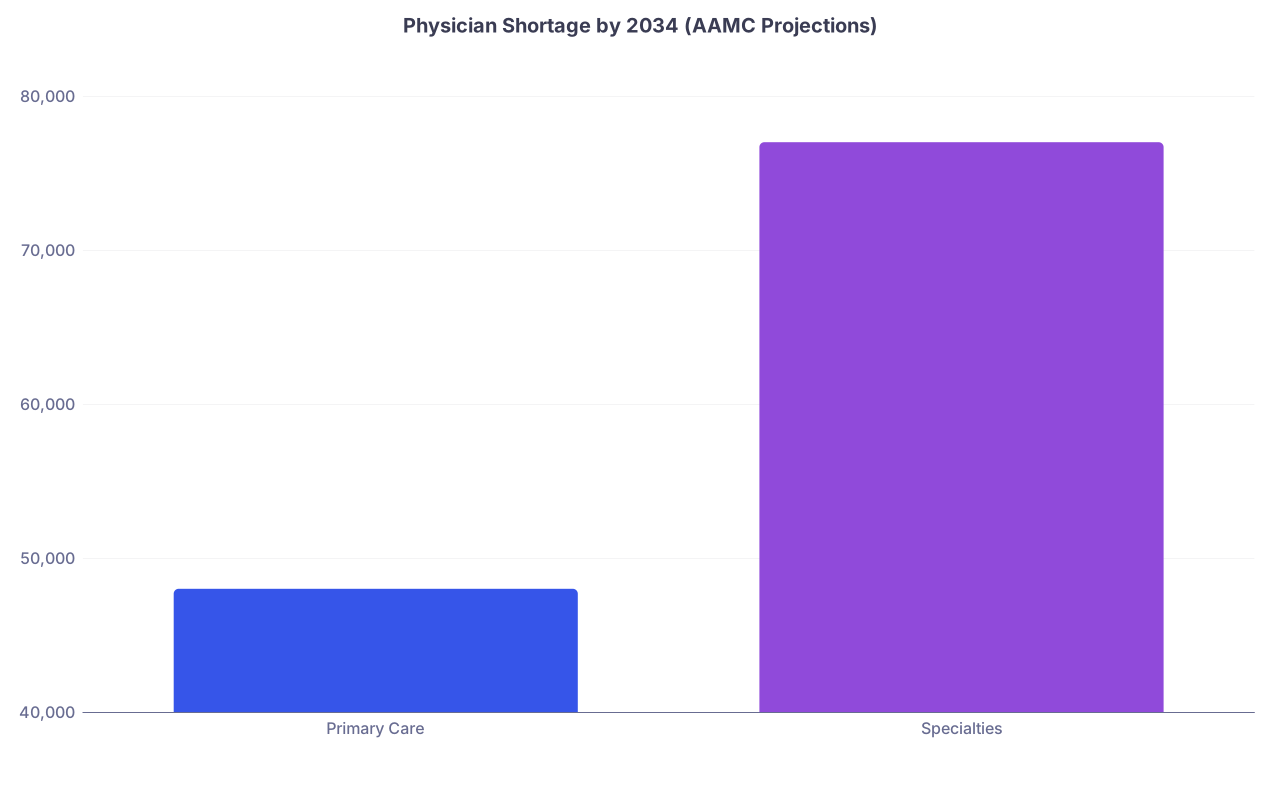
We’re not guessing. Look at workforce data:
| Category | Value |
|---|---|
| Primary Care | 48000 |
| Specialties | 77000 |
The AAMC projects a shortage of up to:
- 48,000 primary care physicians
- 77,000 non-primary care specialists
Translation: hospitals, groups, and systems need you. Badly.
But here’s the catch: institutions are very good at acting like they’re doing you a favor. I’ve watched recruiters tell brand‑new hospitalists, “This is our standard contract; everyone signs this,” while quietly increasing the sign‑on bonus and RVU rates for the one candidate who pushed.
Same job. Same FTE. Different paycheck. Why? One believed they had leverage, the other didn’t.
Let’s get precise about where that leverage actually exists.
Where You Actually Have Leverage (And Where You Don’t)
You do not control the whole market. You do control your own replaceability and timing.
1. You Have Leverage On: Location Flexibility
If you’re “NYC or nowhere,” yes, your leverage drops. If you’re “within 1 hour of a major airport in the Midwest or South,” completely different story.
Rural, exurban, and many midsize-city systems are desperate. I’ve seen:
- $50k–$100k sign‑on bonuses for hospitalists and outpatient IM in non-coastal regions
- Loan repayment on top of that
- RVU rates bumped after one counteroffer
| Setting | Typical Sign-on | Schedule | Extra Perks |
|---|---|---|---|
| Big coastal academic | $0–$10k | Heavy, often >1.0FTE | Prestige, research |
| Suburban community | $20k–$40k | 0.9–1.0 FTE | Some flexibility, CME |
| Rural/regional hospital | $40k–$100k | 0.8–1.0 FTE | Loan repay, housing, CME |
The myth is: “I’m a new grad, so they’re doing me a favor hiring me.”
Reality: in half the country, they’re terrified you’ll sign somewhere else.
2. You Have Leverage On: Job Structure
New physicians often think schedule is non‑negotiable. That’s wrong more often than it’s right.
You can frequently negotiate:
- Shift length (10 vs 12 hours for hospitalists)
- Number of clinic days per week
- Protected admin time
- Call frequency
- Start date (huge for sign-on and relocation planning)
Recruiters love to say “This is how we structure it for everyone.” I’ve directly seen that change when a candidate says, “I’m fine with the comp, but the schedule doesn’t work unless call is q4 instead of q3. If we can’t move that, I probably need to pass.”
Magically, “policy” becomes “flexible.”
3. You Have Limited Leverage On: Core Compensation Benchmarks
If a system pegs comp to MGMA or AMGA percentiles, they’re not going to jump you from 35th percentile to 95th as a new grad. But within that band, there’s wiggle room: higher base with lower bonus, or vice versa; slightly better RVU rate; better guarantee period.
You do not have infinite leverage. You have bounded leverage within a market range. Knowing that range is half the battle.
The Biggest Lie: “New Grads Can’t Negotiate”
I’ve heard this exact line from both sides of the table:
- Senior physicians tell residents: “You have no leverage; just be grateful.”
- Admin says: “We don’t negotiate with new grads; it wouldn’t be fair.”
Nonsense. Here’s what actually happens in practice.
How Employers Really View New Grads
Admins and recruiters evaluate new physicians on a few levers:
- How hard they are to recruit to this location
- How urgent the need is (open panel, backlog, call burden)
- How many viable candidates they already have
- Whether you seem reasonable or a potential problem
They absolutely negotiate with:
- Candidates willing to go where others won’t
- Candidates with specific skills (procedures, niche clinic, leadership, language skills)
- Candidates who signal they know the market and won’t sign a bad deal
What they will not do is negotiate with someone who seems:
- Desperate
- Completely uninformed
- Afraid to walk away
That’s not “no leverage.” That’s you handing your leverage away.
Concrete Places You Can Push (Backed By Reality)
Let’s move from theory to specifics. Here’s where I’ve repeatedly seen new attendings successfully negotiate without being rock stars or fellowship‑trained unicorns.
1. Sign-on Bonus and Repayment Terms
Most people just ask, “Can you increase the sign‑on?” and stop there. Weak.
A stronger approach:
- “I’ve received offers in the $40k–$60k range. Where can you land?”
- “This 5‑year clawback on the bonus is long. Can we shorten to 3 years, or at least prorate yearly instead of all-or-nothing?”
Many contracts are written as: leave before X years, you owe 100% back. You can often get that changed to prorated. That’s real money and real freedom.
2. Non-Compete Clauses
The myth: “Non‑competes are standard; nothing to be done.”
The reality: terms are often negotiable, and enforcement varies wildly by state.
You can push for:
- Shorter duration (1 year instead of 2–3)
- Smaller radius (10 miles instead of 25–50)
- Specialty‑specific scope (you can’t do cardiology, but you can do general IM, etc.)
- Exclusion if they terminate you without cause
I’ve literally watched a non‑compete go from 35 miles / 3 years to 10 miles / 1 year because a candidate said: “This is a deal‑breaker for me.”

| Step | Description |
|---|---|
| Step 1 | Receive Offer |
| Step 2 | Review Details |
| Step 3 | Request Changes |
| Step 4 | Compare With Other Offers |
| Step 5 | Sign Contract |
| Step 6 | Counter Again or Walk |
| Step 7 | Walk Away |
| Step 8 | Deal Breakers? |
| Step 9 | Employer Response |
3. Schedule and FTE
You know what’s cheaper than a 20% raise? Giving you 0.8 FTE with 0.8 salary but 1.0 benefits. Admins hate raising ongoing comp. They’re more open to changing FTE, shifts, or call.
New attendings have successfully negotiated:
- 4‑day clinic weeks instead of 5
- Every 3rd weekend instead of every 2nd
- No OB call for FM physicians with higher clinic volume instead
You don’t have to demand everything. You need to know what matters most to you and push there.
Why New Physicians Constantly Undersell Themselves
If the market is this tight, why are new grads still signing garbage contracts? Three big reasons.
1. Training Culture Teaches Dependency
For 7–10 years you’ve needed permission for everything—orders, plans, time off, even which pen to use on rounds. Overnight, someone says, “You’re an attending, go negotiate a contract.” No wonder people freeze.
You carry the same “I’m lucky to be here” energy into a situation where that mindset costs you tens of thousands of dollars and your sanity.
2. Misinformation From Older Docs
You will hear a lot of:
- “When I started, I made X. You’re already getting more than we did.”
- “First jobs are always bad. Just suck it up for a few years.”
That’s not wisdom. That’s projection from a different market and often from people who never negotiated themselves. Many older docs trained in a time of partnership tracks and small groups. You’re in a consolidating, corporate, metrics‑driven world. Different game.

| Category | Value |
|---|---|
| 2012 | 41 |
| 2016 | 47 |
| 2020 | 53 |
Physician employment (vs independent practice) has climbed from ~41% in 2012 to over 50% by 2020. Your leverage points—and risks—are not the same as theirs were.
3. Fear of Losing the Offer
The biggest psychological trap: “If I negotiate, they’ll rescind the offer.”
Is that theoretically possible? Sure. In practice, it’s extremely rare if you’re professional and reasonable. I’ve seen hundreds of negotiations. The typical “worst” outcomes:
- They say no to some requests.
- They move slightly, not dramatically.
- They stand firm, but the offer stays on the table.
If someone pulls an offer because you calmly asked about comp, schedule, or non‑compete language, you just got valuable information: you would have been miserable there.
How To Use Your Leverage Without Being “That Doctor”
You do have leverage, but you can burn it fast if you come off as arrogant, ignorant, or disorganized.
Here’s how to use your market power like an adult, not a diva.
1. Get Real Market Data Before You Talk Numbers
Do not “go with your gut.” Get benchmarks.
Sources:
- MGMA or AMGA data (often via mentors or professional societies)
- Specialty society surveys (e.g., SHM for hospitalists)
- Talking to 3–5 recent grads in your specialty and region
- Recruiters—but triangulate, they’re not neutral
Have a rough band in your head: “In this region, new outpatient IM makes $X–$Y base, plus incentives.” You’re not asking for 500k base as a new FM doc. You’re asking to be in the fair range, with sane terms.
2. Negotiate the Package, Not Just the Salary
Smart new attendings think in total value, not just the headline salary.
Look at:
- Base salary and length of guarantee
- Bonus structure (RVU thresholds, quality metrics, “all or nothing” traps)
- Sign‑on bonus and structure
- Relocation assistance
- Loan repayment
- CME time and money
- Call burden
- Non‑compete terms

A slightly lower base with no call and a weak non‑compete may be far better than a flashy salary with brutal call and a 3‑year, 50‑mile restriction.
3. Use Time As Leverage
When you say, “I’d like to sign this week,” you announce that you’re desperate.
Instead:
- Interview at multiple places
- Signal that you’re comparing offers
- Take a few days to review each contract
Systems hate open positions. Every month without a doc is lost revenue and angry patients. Your “I’m taking a week to review with counsel” is not an annoyance; it’s expected from serious candidates.
What I’d Tell Any PGY-3 or Fellow About Leverage
If I had 60 seconds with every resident before graduation, I’d tell them this:
You have more leverage than you feel—but less than internet bravado would have you believe. The trick is to understand exactly where it is and use it deliberately.
To collapse that down:
- The market is short on physicians, especially outside big coastal metros. That’s leverage.
- Within any given offer, you can almost always move sign‑on, non‑compete terms, some schedule details, and sometimes RVU/bonus structure.
- The person who walks in with data, multiple interviews, and a clear sense of priorities almost always does better than the one who signs the “standard” contract out of fear.
You are not powerless. You are inexperienced. That’s fixable.
FAQ: New Physician Leverage After Residency
1. Will negotiating my first contract make me look difficult and hurt my career?
Not if you do it correctly. Asking clear, specific questions and making a few targeted requests is normal for any professional job at your training level. You become “difficult” when you make uninformed, aggressive demands (“I want chief salary as a new grad”) or change your mind every 48 hours. Calm, data‑driven negotiation actually signals you understand your value—and systems often respect that.
2. What if I genuinely only have one offer—do I still have leverage?
You have less leverage, but not zero. You can still ask about non‑compete radius and duration, schedule tweaks, CME support, and sign‑on structure. You can also use time and clarity: “I like this offer overall but I’m concerned about the 3‑year non‑compete. If we can shorten that to 1 year, I’d be comfortable signing.” They might say no, but you don’t automatically lose the offer by asking.
3. Is it worth paying a lawyer to review my contract as a new grad?
Usually yes, with one condition: use someone who regularly reviews physician contracts, not a random general attorney. They’ll spot landmines—non‑competes, termination clauses, opaque bonus language—that you and a non‑specialist will miss. The goal is not to “lawyer up and fight” but to know exactly what you’re signing and where to push. A few hours of legal time can save you years of pain.
4. How many places should I realistically interview before choosing a job?
For most people, 3–5 serious interviews is a good target. That gives you a sense of the market, different structures (academic vs community vs hospital‑employed vs private), and compensation ranges. One interview is almost always too few; 12 is probably overkill unless you’re unusually picky or in a niche field. You do not need to see every possible job—you need enough data to recognize when an offer is clearly good, clearly bad, or in the “fixable with negotiation” middle.