It’s October of your final year of residency. Your co-resident strolls into the workroom and casually mentions they just got a hospital-employed offer: $420k base, $40k sign-on, $20k relocation, 4-day week, protected admin time, and an RVU structure that actually makes sense.
You look at your email.
Your “offer” is $290k, no sign-on, “call shared equally,” RVU expectations that clearly require you to be in two rooms at once, and the contract has “non-negotiable” written between the lines.
Same training level. Same specialty. Their Step scores weren’t better. They weren’t chief. What happened?
Let me walk you through what actually happened — the part nobody writes on MedTwitter and your PD will never fully spell out.
Some new doctors get better job offers for reasons that are very real, very predictable, and very fixable. But only if you stop believing the fairy tale that “the market will just reward good clinicians.”
It does not. It rewards leverage, timing, signaling, and relationships.
Let’s pull the curtain back.
How Groups Actually Evaluate a New Grad (It’s Not Your CV)
No recruiter will say this out loud, but here’s the ranking system I’ve heard behind closed doors in hiring meetings more times than I can count:
- Known quantity
- Safe bet
- Desperate filler
You want to be #1 or #2. Most of you accidentally present as #3.
A “known quantity” is not the smartest resident, or the one with the most publications. It’s:
- “That fellow Dr. G already worked with us during their elective”
- “Dr. L’s PD called me personally – said they’d rehire them in a heartbeat”
- “That’s the one who did a locums stint here last year and everyone liked them”
A “safe bet” is:
- Trained at a place we trust
- Has references we know and respect
- Looks stable, not flighty
- Seems to understand the business side at least a little
A “desperate filler” is:
- Generic CV
- No one knows them
- References are vague or lukewarm
- Sound eager but naive on the phone
- Willing to accept anything
Guess who gets the strong offers? You already know.
Here’s the uncomfortable truth: by the time the contract hits your inbox, the real decision has already been made about what “tier” you’re in for that group. The money and perks flow from that tiering.
CV polish matters far less than who is willing to stake their reputation on you.
The Invisible Currency: Who Will Vouch for You
The single most valuable asset in your first job search is not your publication list. It’s whose phone number is on your reference list — and whether those people actually pick up and advocate for you.
Let me give you an example I’ve watched play out:
Two hospitalist candidates, same year out of residency.
Candidate A:
- Solid but quiet resident
- Did their job, didn’t cause problems
- PD barely knows them personally
- Generic “strong work ethic” letters
Candidate B:
- Took the time to show up at division meetings
- Asked the business medical director about throughput, length of stay, metrics
- Volunteered once to help with schedule re-design (not glamorous, but noticed)
- When B applied to a job, the hospitalist chief picked up the phone and called the hiring chief, unprompted: “This one is a stud. You want them.”
Candidate B starts with:
- Higher base
- Better schedule
- Earlier partnership track / leadership opportunities flagged from day one
Candidate A gets the “standard” package and is told “we pay all new grads the same.”
That last line is important.
Programs and groups will tell you “this is our standard offer for new grads.” That is rarely the full truth. What they mean is: this is the standard range for people we consider interchangeable. Once you’re in the “we really want them” category, things move.
You do not create that category in the interview. You create it 1–2 years before, when you’re “just” a resident asking smart questions in front of the right people.
Market Power Is Hyper-Local (And Some Of You Ignore That Completely)
I’ve sat in strategy meetings with CMOs and service line directors where we literally had a heatmap of specialties and regions: where we’re desperate and where we can be picky.
Your leverage is not “I’m a doctor.” Your leverage is “I’m this specialty willing to work in this market with this skill-level and personality.”
If you’re an outpatient psychiatrist willing to work in a secondary or rural market? You’re gold. They will throw money, schedule flexibility, telehealth options, and loan repayment at you.
If you’re a fresh grad dermatology attending trying to land in a saturated urban market with a dozen private groups and an academic center? Very different world.
Groups look at supply and demand brutally. No emotion. No fairness.
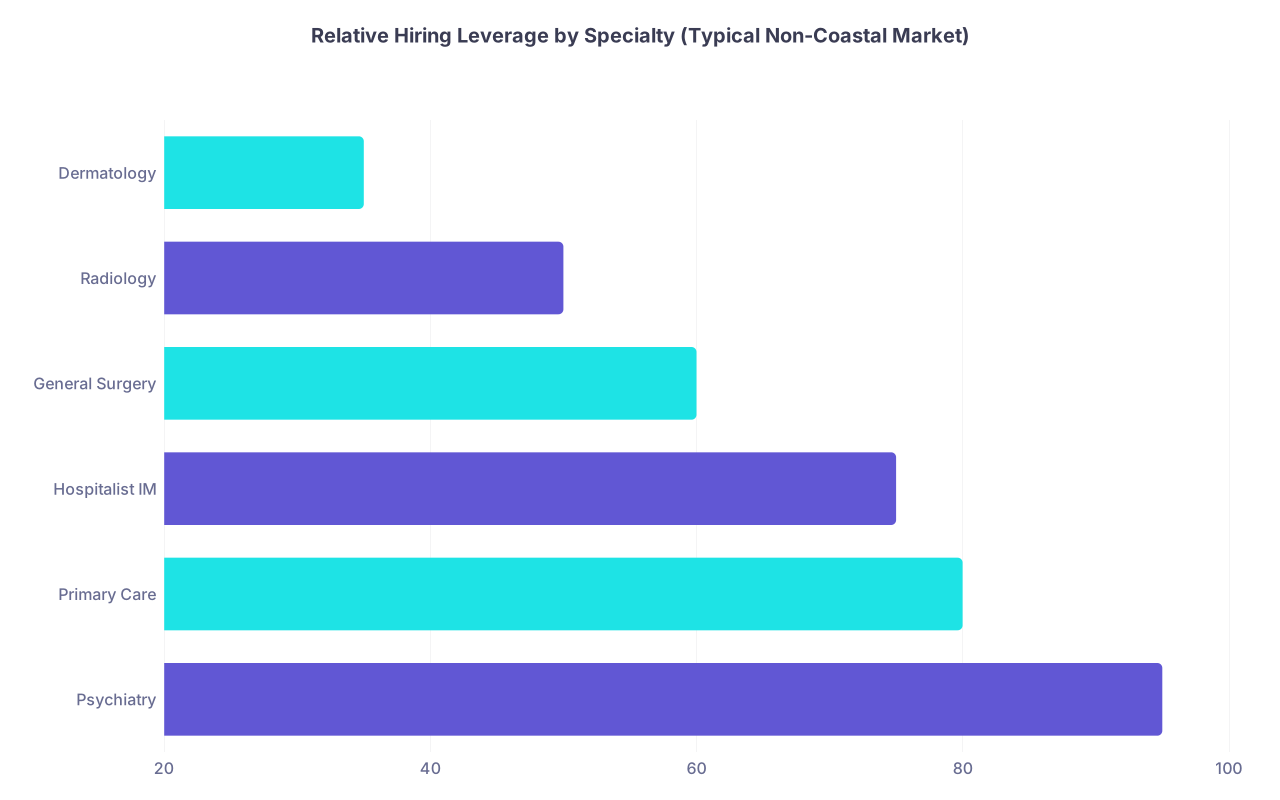
| Category | Value |
|---|---|
| Psychiatry | 95 |
| Primary Care | 80 |
| Hospitalist IM | 75 |
| General Surgery | 60 |
| Radiology | 50 |
| Dermatology | 35 |
Here’s the quiet part: within the same specialty, different skills change your leverage.
The cardiologist who’s comfortable with structural imaging or advanced imaging? More leverage than the one who wants a pure general clinic with no call in a desirable city.
The anesthesiologist who actually likes cardiac or OB, and is okay with some nights? More leverage than the one trying to do 8–4 Monday–Friday, no call, in an oversupplied metro.
Most new grads never ask the key question early enough: “Where is my skill set scarce?” They just apply where they emotionally want to live, then act shocked when the offers are weak.
The residents who get strong offers understand two things early:
- Job market is local
- Scarcity drives numbers
And they’re willing to flex—not on everything, but on something that makes them harder to replace.
The Uncomfortable Truth About “Fit” (How People Really Talk About You)
Behind closed doors, hiring conversations about new grads are blunt. Sometimes ugly.
I’ve literally heard:
- “Too academic, will hate our volume.”
- “They asked about vacation three times in 20 minutes, hard pass.”
- “Honestly, felt like they just want a lifestyle job, we need workhorses right now.”
- “Perfect on paper, but weird vibe. I do not see them lasting.”
You might think this is opinionated and unfair. It is. But it’s how the room talks.
The candidates who get better offers project three things very clearly:
- They understand this is a clinical and business relationship.
- They sound like they know how to plug into an existing system.
- They do not sound like they’re interviewing the job as a “temporary gig” until something better shows up.
“Fit” is shorthand for:
Will this person make my life easier, stay at least a few years, and not blow up the culture?
That’s why you see wildly different offers to two people with similar CVs. One comes across as “plug-and-play grown-up.” The other as “smart but risky.”
You don’t get paid for your potential. You get paid for how little risk and how much revenue you represent in the next 24 months.
The Residents Who Start “Too Early” Always Win
Let me tell you about timing. Because this is one of the most persistent blind spots.
Most residents think job search looks like:
- Late PGY-3/4: Decide on city
- Send out some CVs
- Interviews
- Negotiate a contract
Here’s what the residents who end up with clearly better offers actually do:
- Late PGY-2 / early PGY-3: They’re already quietly collecting intel.
- They ask attendings:
- “If you had to start over, which groups here would you avoid?”
- “Who has the best partnership track or wRVU structure?”
- “Which hospitals are expanding vs. bleeding money?”
- They go to dinner talks not for the drug rep, but to see which private groups show up, who the power players are.
By mid-residency, they have a mental map of:
- Which systems are growing
- Which chairs are leaving
- Where there’s political turmoil
- Which service lines are understaffed and panicking
So when they’re finally ready to ask, they aren’t sending cold emails into the void. They’re texting someone they already met at a CME event: “Hey, I’m finishing in June, heard you may be expanding your group — any chance we can talk?”
Those people almost always skip the “standard HR screen” step and go straight to “let’s get you in for a visit.”
The big delta: they behaved like future colleagues, not just trainees, well before graduation.
How You Accidentally Signal “Cheap, Replaceable, and Desperate”
You’d be amazed how many new grads tank their leverage before the first formal interview.
I’ll be blunt. These are phrases I’ve heard that immediately drop someone into the “we don’t need to stretch for this one” bucket:
- “I’m pretty open to anything, I just need a job in [major city].”
- “Compensation isn’t really my main concern, I just want a good fit.”
- “I don’t really know much about RVUs or collections, but I’m sure I’ll learn.”
- “I’ll do whatever you need, I just don’t want to do nights or weekends.”
Contrast that with the residents who get strong offers and serious respect:
- “I’ve reviewed MGMA ranges for this region and specialty; I’m looking for something competitive with realistic RVU expectations.”
- “I’m comfortable with high volume, but I’d like some transparency on how productivity and bonuses are structured.”
- “I’m interested in contributing both clinically and eventually in quality or operations — can you tell me who owns those domains now?”
- “I understand everyone does some nights/weekends. I’d like to understand how the call is structured so I can see how sustainable it feels long term.”
You do not have to be an expert. But you must sound like you’re entering a business relationship with your eyes open.
Groups pay more for people they believe:
- Will stay
- Will understand the rules
- Will produce
If you present as someone who “just wants a nice place to work,” you’re implicitly saying: “You can probably underpay me. I’m not going to compare carefully.”
They will take you up on that.
Why Some Offers Magically “Improve” After the First Draft
You’ve heard this story: one resident gets a contract, signs it as-is. Another resident pushes back and gets 10–20% better total comp and a few key protections added.
Same group. Same starting template.
What changed? Two things: information and how seriously the group takes losing them.
Here’s what happens behind the scenes when a good candidate pushes back:
Hiring doc to admin: “We might lose this one. They have another offer. Can we sweeten the sign-on or adjust the RVU threshold?”
Admin: “What’s their ask?”
If you’ve demonstrated throughout the process that:
- You’re well-liked by the team
- You’re not a diva
- You’re realistic and understand the market
- You’re asking for specific things, not random greed
Then suddenly there is “flexibility.” Stipends appear. Call buy-downs appear. Minor schedule concessions appear. Equity/partnership timelines get clarified or shortened.
On the other hand, if they see you as easily replaceable or not that serious, the answer inside that same admin office is: “They don’t like it? Let them walk. We’ll pull from the stack.”
The real reason your co-resident’s offer improved with one email and yours didn’t?
The group simply believed they could not afford to lose them.
They looked “in demand,” even if they weren’t swimming in offers.
Which brings us to another unspoken rule.
The Multi-Offer Illusion (Yes, They Care Who Else Wants You)
No group wants to feel like your last resort. They absolutely care if others are courting you.
Am I saying you should lie? No. But you should strategically cultivate multiple options.
The candidates who get the best offers usually have:
- At least 2–3 serious processes moving in parallel
- One or two “stretch” opportunities (maybe better market, better pay, or more academic than they thought they could get)
- A willingness to walk if the red flags pile up
When you can genuinely say, “I’m also talking with Group X and Y, both in advanced stages,” the tone of conversation shifts. Even if those groups aren’t offering more money, the signal is clear: other grown-ups consider you a catch.
That doesn’t mean ultimatums. It means calm, factual statements like:
- “Given what I’m seeing from similar positions in this region, I was expecting base comp closer to X.”
- “Another offer I’m considering has no non-compete and a more transparent wRVU structure. Can we address those parts here?”
They hear:
“This person has options and knows the landscape. If we lowball them, they’ll walk.”
The offer changes.
Where You Trained Still Matters, But Not How You Think
Yes, the name of your residency or fellowship still matters. But the way residents think it matters is often wrong.
Programs sort new grads mentally into buckets like this:
- “Big academic, brutal training, high volume, lots of complexity”
- “Well-known private/academic hybrid, good clinically, knows community realities”
- “Smaller, unknown program — question marks, but could be fine”
The first category buys you credibility fast. They assume you can handle volume and chaos. Sometimes that helps your initial offer; more often, it just gets you in the door and over the doubt curve quickly.
But there’s another variable they weigh heavily: how your program’s graduates have behaved in the real world.
If your residency has a track record of producing attendings who:
- Complain constantly
- Leave jobs quickly
- Struggle clinically in their first couple of years
You pay for that. Your starting point is suspicion.
Flip it: some no-name community residencies quietly produce rock-solid, low-drama, clinically strong attendings. Word gets out. Your program director may not know it, but the regional CMO does.
That’s why a mid-tier grad can out-earn a “big name” grad in the same market: the people writing checks trust that kind of training pipeline more for their type of job.
You can’t change where you trained. You can absolutely change how you present your training:
- Specific volumes
- Call responsibilities
- Breadth of pathology
- Autonomy level
Speak their language: “In our ICU months we were first call on vents and lines overnight with one attending covering multiple units across the system.” That tells them more about your readiness than your hospital’s US News rank.
The Quiet Side Deals You Don’t Hear About
You know how some co-resident suddenly shows up with a “special” arrangement? Extra admin time. CME money earmarked for a leadership course. Protected research day in an otherwise clinical job.
You hear: “Wow, the group is so generous.”
What actually happened: they asked — specifically — and they asked the right person.
Most new grads negotiate exclusively with HR or the recruiter. Rookie move.
The deals that actually change your day-to-day life almost always come from the physician leadership side:
- Section chief
- Service line director
- Medical director
If those people want you, they can carve out:
- Half-day admin for QI or committee work
- Title bump (assistant medical director, associate something)
- Defined path to leadership responsibilities
- Protected clinic template that’s slightly more humane than the standard
Those perks don’t always show as huge money on day one, but they radically change your life and your growth trajectory. They’re also the thing that separates you from the “standard” hire.
The resident who looks like a future leader gets that. The one who only asks: “How much PTO?” does not.
If You’re Still in Training, Here’s What Actually Moves the Needle
No fluff. If you’re reading this before signing a contract, here’s what will truly shift the quality of your job offers over the next 6–18 months:
Stop acting like a transient trainee. Start acting like a future colleague.
That means:
- Put yourself on the radar of at least 2–3 attendings who have real influence. Not just the nice ones. The ones whose names keep coming up in meetings.
- Ask them occasionally about their own job searches. What they’d do differently. Where the landmines are. People love to tell war stories.
- Learn the basics of RVUs, collections, payer mix, and how your specialty tends to be paid. Enough to not sound naive.
- Ask to sit in (even quietly) on a scheduling meeting, quality committee, or operations discussion once or twice. Watch how decisions actually get made.
And importantly: when you’re on away rotations or electives in places you might want to work, treat every interaction like it’s a three-month interview — because it is.
I’ve watched entire jobs get created or held off market because, “Remember that resident who rotated here? Let’s call them first before we post this.”
Those are the best offers. The ones nobody else ever sees.
Years from now, you won’t care that someone offered you $10k more or less in base salary. You’ll care whether you landed in a place that valued you, respected you, and gave you room to grow — and whether you had the leverage to shape that first attending job into something sustainable.
The job market isn’t fair, but it is predictable. Some new doctors get better offers not because they’re better clinicians, but because they learned early how the game is actually played — and refused to walk into it blind.
You still have time to do the same.