

Most residents underestimate how different telemedicine attending work really is. That is a mistake.
If you treat telemedicine like “clinic but on Zoom,” you will get burned—on licensure, on malpractice coverage, or on workflow expectations that do not remotely match what you trained for.
Let me walk through what telemedicine attending jobs actually look like once you are post‑residency: the licensure maze, malpractice traps, and the day‑to‑day mechanics that determine whether this is a dream flexible job or a miserable grind.
1. The Telemedicine Job Landscape Post‑Residency
Telemedicine is not one thing. It is a cluster of very different models that all get lazily lumped together. If you do not distinguish them, you will make bad decisions.
Here are the big buckets I see residents and new attendings fall into:
Large national virtual‑only companies
Think Teladoc, Amwell, MDLive, Doctor on Demand, Amazon Clinic, etc. High volume, protocol‑driven urgent care / primary‑care‑lite. Often 1099 independent contractor. Frequently multi‑state licensure.Health‑system based telemedicine
You are employed by a brick‑and‑mortar system (e.g., Mayo, Kaiser, large academic centers) but do a portion or majority of visits virtually. Often W‑2 employment, benefits, more integrated EHR, but less geographic flexibility.Niche subspecialty telehealth
Sleep medicine, psychiatry, endocrinology (diabetes/weight management), dermatology (asynchronous store‑and‑forward), cardiology follow‑ups, etc. Usually lower volume, more continuity, often better pay per hour.Direct‑to‑consumer, cash‑pay startups
Think virtual-only clinics for ADHD, TRT, GLP‑1 weight loss, hair loss, ED, online contraception, tele‑derm, etc. These can be well‑run or absolutely reckless. You must scrutinize protocols, risk, and coverage.Hospital tele-services
Tele‑ICU, telestroke, inpatient ID consults, nocturnist tele‑hospitalist coverage. More traditional hospitalist/specialist work, just remote. Typically robust credentialing and malpractice, but more stringent scheduling and higher acuity.
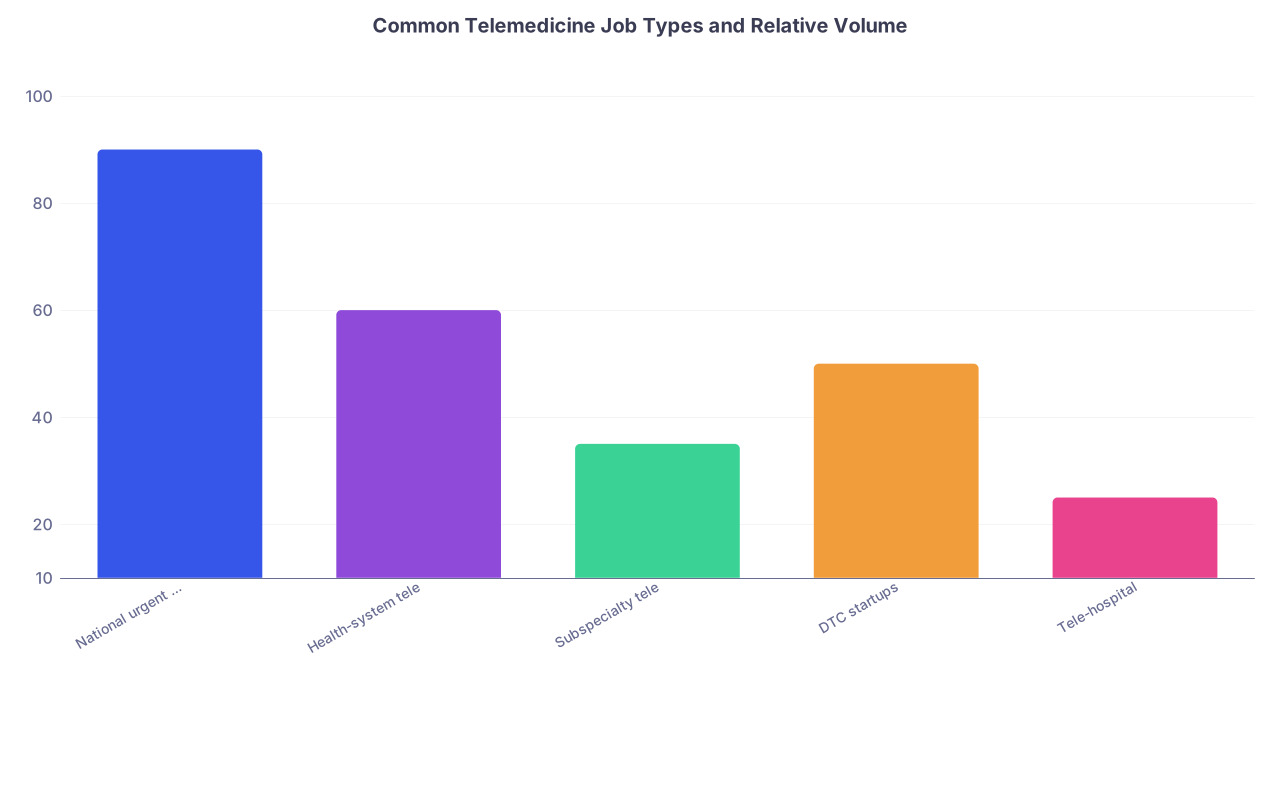
| Category | Value |
|---|---|
| National urgent care | 90 |
| Health-system tele | 60 |
| Subspecialty tele | 35 |
| DTC startups | 50 |
| Tele-hospital | 25 |
Key point: “Telemedicine attending” tells me almost nothing until you specify which of these categories you are talking about. Licensure, malpractice, and workflow all change with that context.
2. Licensure: Where People Get Screwed First
Licensing is the first landmine in telemedicine. The rules are simple, but people ignore them and assume the company will “handle it.” That is how you end up in front of a medical board for unlicensed practice.
The basic rule: Where is the patient?
For almost all U.S. states, you must be licensed in the state where the patient is physically located at the time of the encounter. Not where you are sitting. Not where your employer is incorporated.
So if you are in Colorado covering a shift where patients are in Texas, Florida, and New York, you need Texas, Florida, and New York licenses (or the company must route only patients in your licensed states to you).
Compact licenses: IMLC, PSYPACT, and friends
For telemedicine‑heavy work, compacts matter a lot.
Internal medicine, family medicine, EM, etc.:
- Interstate Medical Licensure Compact (IMLC) lets you streamline additional state licenses if your home state is a member and you meet their criteria.
- It does not magically grant 30 licenses at once. It lowers the friction and time.
Psychiatry:
- PSYPACT allows practicing telepsych across participating states with a single E. Passport + APIT setup.
- Massive advantage if you want a multistate telepsych career.
Other compacts:
- Nursing (for NPs with multistate RN/NP roles)
- Various specialty‑specific telecompacts are slowly emerging, but most MD/DO telework is still navigating state‑by‑state rules.
| Tool | Who it helps | Practical Benefit |
|---|---|---|
| IMLC | MD/DO in member states | Faster licensing in multiple states |
| PSYPACT | Psychologists / Psychiatrists (where applicable roles) | Multistate telepsych under one framework |
| NLC | RNs, some NPs | Practice in multiple compact states |
Who pays for licenses and renewals?
This is where the job offer gets real.
Good employers:
- Pay initial license fees for target states.
- Cover renewals as long as you remain employed.
- Provide admin support for paperwork, CME tracking, and state‑specific requirements.
Bad or exploitative setups:
- Expect you to pay out of pocket for 5–10+ state licenses.
- Do not cover renewals.
- Offer no support with state‑specific CME or jurisprudence exams.
You want, very explicitly, in writing:
- Which states they want you licensed in.
- Who pays initial fees.
- Who pays renewal fees.
- Whether they provide administrative support.
If a company vaguely says, “We’ll help you expand over time” but will not commit to paying, assume they want you to subsidize their business.
Watch for scope and prescribing restrictions
Telemedicine is not just about “Do you have a license.” It is about “What can you legally do in that state over telemedicine.”
You must know, per state:
- Are there specific telemedicine statutes or parity laws?
- Are there restrictions on establishing a patient‑physician relationship via tele only?
- Are there rules for initial vs follow‑up visits by tele?
- Any state‑specific consent or documentation requirements?
Prescribing controlled substances:
- Ryan Haight Act (federal) historically required in‑person evaluation before prescribing controlled substances, with limited exceptions.
- COVID‑era flexibilities changed the landscape temporarily; extension timelines and permanent frameworks are evolving.
- Some states layer their own stricter rules on top of federal law.
- ADHD tele‑startups ran straight into this wall—many were operating on thin legal ice.
You need this crystal clear:
- Who owns the prescribing protocols?
- Are they updated to current federal and state law, especially around Schedule II stimulants, benzodiazepines, opioids, and testosterone?
- Do you have final clinical discretion, including saying “no,” without penalty?
If they pressure you to “find a way” to prescribe controlleds in gray‑zone situations: walk away. That is how you lose licenses.
3. Malpractice Coverage: The Non‑Negotiables
Telemedicine feels “safer” to some people. No procedures, no trauma resuscitations. That is naïve. Misdiagnosed PE, missed appendicitis, failure to recognize sepsis, missed suicidality—those are telemedicine cases I have seen land in malpractice discussions.
Claims‑made vs occurrence policies
Most telemedicine setups (especially 1099) use claims‑made malpractice coverage. You must understand:
- Claims‑made: Covers you only while policy is active and for claims made during the period. When you leave, you usually need tail coverage.
- Occurrence: Covers any incident that occurred during the policy term, even if the claim is made after the policy ends. No tail needed.
For telemedicine:
- Many national companies provide a group claims‑made policy that names you.
- Tail coverage responsibility varies. Some cover it if they terminate you, but not if you resign. Some never cover it.
You want answers in writing:
- Type of policy (claims‑made vs occurrence).
- Policy limits (per claim / aggregate).
- Who pays for tail if:
- They terminate you without cause.
- They terminate you for cause.
- You resign.
Policy limits and state spread
Telemedicine often involves multiple states. One malpractice policy may cover all your telemedicine work. Good. But you must check:
- Limits: Many telemed companies use 1M / 3M or 1M / 4M policies. For high‑volume urgent care‑style work, 1M/3M is bare minimum.
- Whether the policy explicitly covers:
- Telemedicine encounters.
- All states where you are seeing patients.
- Asynchronous care (inbox messages, image review, store‑and‑forward) if part of your work.
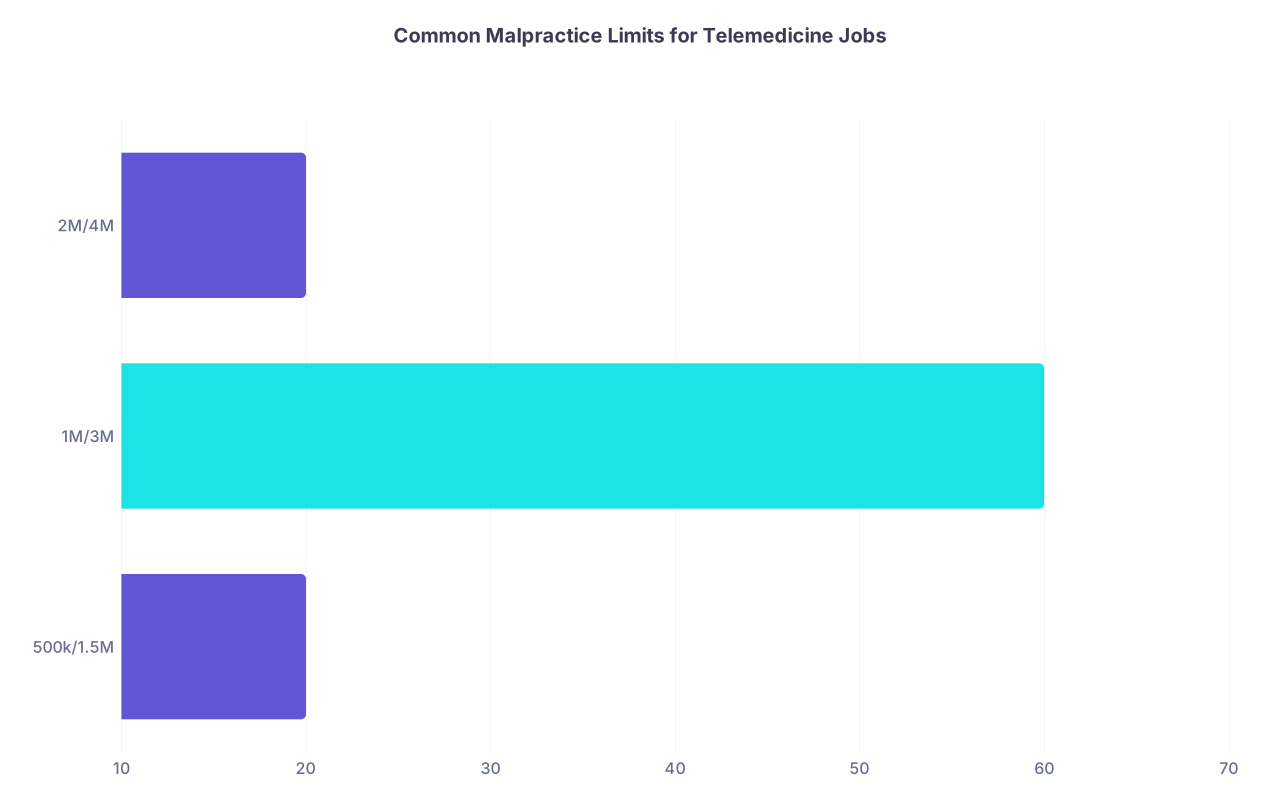
| Category | Value |
|---|---|
| 500k/1.5M | 20 |
| 1M/3M | 60 |
| 2M/4M | 20 |
If they hand‑wave malpractice as “Yeah, yeah, we have coverage, do not worry about it,” that is your cue to start worrying.
Individual vs shared coverage and defense
Another key detail: Are you named individually, or are you under one giant shared group policy?
Questions to ask:
- Is the policy written in the company’s name with you as additional insured, or do you have an individual policy?
- Who chooses defense counsel if you are sued?
- Do they provide legal representation for board complaints, or only for civil malpractice suits?
A malpractice claim is bad. A board complaint can be worse for your long‑term career. Many telemedicine physicians discover too late that their “coverage” does not include board defense.
You want:
- Explicit confirmation that board investigation support is provided, or
- A plan to carry your own supplemental coverage that includes board defense.
4. Day‑to‑Day Workflow: What the Job Really Feels Like
This is where expectations die. Residents picture a quiet home office, sipping coffee, seeing 2–3 motivated patients per hour. Some jobs are like that. Many are not.
Visit volume and time per patient
Telemedicine urgent care / primary‑care‑lite:
- Typical expectation: 3–6 visits per hour. Some push higher.
- Mix of:
- URI, UTI, skin rashes, medication refills
- Anxiety/depression follow‑ups
- “I saw something on my labs” questions
- COVID, flu, strep, work notes
- The constraint: You are time‑boxed, yet still responsible for safe triage and documentation.
Subspecialty tele:
- Volume more like 1–3 per hour.
- More complex visits, often with labs/imaging review.
- Often closer to traditional outpatient clinic pacing, but without physical exam.
Tele‑hospital or tele‑ICU:
- Workflow is consults, cross‑coverage orders, rapid response oversight, or unit rounding done remotely.
- Volume highly variable; acuity much higher.
Do not take a job without:
- A clear written expectation of average visits per hour.
- Clarity on whether that is a hard minimum, average, or cap.
If they pay per‑visit and dangle wildly optimistic volumes, assume actual volume will be lower and your effective hourly rate will shrink.
Scheduling, shifts, and autonomy
Telemedicine selling point: flexibility. Reality: depends heavily on the model.
Common patterns:
- “Log in whenever you want” 1099 models: Sounds great. But patient volume follows demand curves. Nights/weekends are busy. Mid‑weekday can be dead. Your income becomes unpredictable.
- Fixed shifts (e.g., 4‑hour blocks, 8‑hour blocks): More stable income, less flexibility. Late evenings and weekends often pay better or are mandatory early on.
- Hybrid: Minimum guaranteed hours plus optional extra “flex pool” shifts.
Ask specifically:
- How are shifts assigned? Seniority? First‑come first‑serve?
- Is there a minimum commitment (hours/month)?
- Are there penalties for dropping or swapping shifts?
- What is the call expectation, if any?
EHR, tech stack, and support
You are not just choosing patients. You are choosing software and tech support quality. That matters when you are 20 minutes into a complex tele‑ICU consult and the video freezes.
Common set‑ups:
- Health‑system telemedicine: Epic, Cerner, etc. You already know the pain.
- National urgent care telemed: Custom platforms integrated with lightweight EHRs, or something like Athena, eClinicalWorks, etc.
- Direct‑to‑consumer startups: Home‑grown platforms with varying maturity, plus in‑app messaging and automated refill logic.
You want to know:
- What documentation system is used?
- Integrated e‑prescribing?
- Access to external records (HIE, CareEverywhere, SureScripts history)?
- Are protocols, decision support, and order sets embedded?
And support:
- Do they provide hardware (laptop, camera, headset)?
- IT support hours and response times?
- Backup plan if your internet goes down mid‑shift?

5. Clinical Scope and Protocols: How Much Autonomy Do You Actually Have?
Telemedicine is protocol‑heavy. That can be a blessing or a cage.
Standardized protocols vs physician judgment
Most large telemedical employers rely on standardized clinical pathways:
- UTI protocols (age, gender, symptoms, red‑flags → treat vs refer vs test)
- URI and COVID algorithms
- Rule‑out chest pain and shortness of breath scripts
- Mental health screening pathways (PHQ‑9, GAD‑7, C‑SSRS)
Good protocols:
- Are evidence‑based.
- Are regularly updated (e.g., new COVID guidelines).
- Allow physician override with documented justification.
Bad protocols:
- Force fit every encounter into rigid trees.
- Penalize you informally for “over‑referring” or “undertreating.”
- Are written by non‑clinicians or by clinicians who have never actually done telemedicine at scale.
When you interview, ask to see:
- Example clinical guidelines for 3–4 common visit types.
- How often they are updated.
- How disagreements are handled when your judgment conflicts with “the protocol.”
Asynchronous care, messaging, and unbounded work
This is a pain point that surprises many new telemedicine attendings.
Some platforms expect:
- Asynchronous messaging (secure chat, portal messages).
- Reviewing intake questionnaires and labs before/after the “visit.”
- Handling follow‑up questions without additional compensation.
You want clear policies:
- Are you paid for message time?
- Is messaging bundled into the visit rate?
- Is there an upper limit on post‑visit messaging before you can convert it to a new billable encounter?
For asynchronous tele‑derm or image review:
- How many cases per hour are expected?
- What is the expected turnaround time?
- Are you responsible for follow‑up result notifications?
This is where your “20 hours a week” can quietly become 25–30.
6. Compensation Structures: How the Money Actually Flows
You are post‑residency. You care about the numbers. Good. Telemedicine compensation is all over the map, and the structure determines your actual hourly rate more than the headline.
Common models
Per‑visit payment
Example: $25–$40 per standard urgent care visit; more for longer visits or higher acuity specialties.
Effective hourly rate depends entirely on volume.Hourly rate (W‑2 or 1099)
Example: $90–$200 per hour, varying by specialty and time of day.
Often lower upside than high‑volume per‑visit models, but stable.Salary with productivity bonus
More common in health‑system telemedicine or integrated roles. Traditional RVU‑based or panel‑size models, just with a telemedicine overlay.Hybrid
Low base hourly plus add‑on per‑visit, or floor + productivity kicker.
| Model | Typical Use Case | Pros | Cons |
|---|---|---|---|
| Per-visit | DTC urgent care, startups | High upside, flexible | Unpredictable income |
| Hourly | Tele-hospital, systems | Stable, predictable | Less incentive upside |
| Salary+bonus | Health-system employed | Benefits, stability | Less flexibility, bureaucracy |
| Hybrid | Mixed tele / clinic roles | Balance of risk/reward | More complex to track income |
Effective hourly rate reality check
Example scenario:
- You are paid $30 per urgent care visit.
- Promised “3–4 visits per hour average, higher on weekends.”
- Actual average over a month: 2.2 visits/hour.
Your real hourly rate: $66/hour. Before taxes. Before unpaid inbox work if there is any.
Do not ever just look at the per‑visit number. You want:
- Historical data from current physicians (per‑hour volume distribution, not cherry‑picked max days).
- Clarity on no‑show or short‑encounter payment (some platforms do not pay if the patient drops).
For tele‑psychiatry or subspecialty:
- Rates might be $150–$300/hour, sometimes more, but often with expectations of full panels, controlled‑substance management, and high liability.
- Make sure that high rate is not compensating for legal risk you should never accept.
7. Practical Due Diligence Before Signing
This is where I see residents fail most often. They ask about “culture” and “flexibility,” but not the items that will keep them out of trouble.
Here is a tight list of what to verify before you sign:
Licensure:
- Exactly which states you are expected to hold.
- Who pays for initial and renewal fees.
- Whether they support IMLC or PSYPACT processes where applicable.
Malpractice:
- Policy type (claims‑made vs occurrence).
- Limits and multistate coverage.
- Tail coverage responsibility.
- Inclusion of board complaint defense.
Clinical:
- Visit volume expectations and caps.
- Types of cases you will be seeing—and which you are not expected to manage via telemed.
- Protocol samples for core conditions and controlled prescribing.
- How often protocols are updated and who owns them.
Workflow:
- EHR/platform demo or screenshots.
- Scheduling model and minimum commitment.
- Compensation for asynchronous work and messaging.
- Expected response times for patient messages or refill requests.
Compliance and support:
- Who handles credentialing and privileging, if applicable.
- Who monitors legal/regulatory changes across states.
- How clinical incidents, complaints, and QA reviews are handled.

| Step | Description |
|---|---|
| Step 1 | Review Offer |
| Step 2 | Clarify States and Fees |
| Step 3 | Negotiate or Decline |
| Step 4 | Adjust Expectations or Walk |
| Step 5 | Renegotiate Terms |
| Step 6 | Accept Job |
| Step 7 | Licensure Clear? |
| Step 8 | Malpractice Adequate? |
| Step 9 | Workflow Reasonable? |
| Step 10 | Compensation Fair? |
8. Who Actually Thrives in Telemedicine Attending Roles?
Not everyone. Some people absolutely hate it.
Telemedicine tends to work well for:
- People who are comfortable with diagnostic uncertainty and safety‑netting.
- Attendings who communicate clearly and efficiently without overtalking.
- Those who tolerate structured workflows and templates without feeling micromanaged.
- Specialists whose work genuinely translates well to remote care (psych, sleep, endo, derm follow‑ups, ID, some cardiology).
It works poorly for:
- People who need extended time per patient and hate time pressure.
- Those who rely heavily on physical exam to feel confident and safe.
- Physicians who are casual about documentation—telemedicine relies heavily on documented thought process to defend care.
- Anyone who thinks “work from home” means “less responsibility.”
Telemedicine does not make you less of a doctor. It just puts your judgment under a different kind of microscope.

FAQ (Exactly 6 Questions)
1. Do I really need a separate license for every state I see telemedicine patients in?
Yes. For almost all U.S. jurisdictions, you must hold an active license in the state where the patient is physically located at the time of the visit. The Interstate Medical Licensure Compact (IMLC) streamlines getting multiple licenses, but it does not replace them. Any company suggesting you can see “nationwide” patients with only one or two licenses is either misinformed or reckless.
2. Should I carry my own malpractice insurance for telemedicine if the company provides coverage?
In many cases, yes. At minimum, you must see the policy details in writing. If the company policy is claims‑made, has low limits, does not include board defense, or could vanish if the company folds, consider a supplemental individual policy. The cost is usually modest compared with the risk of being uncovered during a claim or board action.
3. Can I safely prescribe controlled substances (like stimulants or benzodiazepines) via telemedicine as a new attending?
You can, but you must be extremely deliberate. You need current knowledge of the Ryan Haight framework, any extended flexibilities in place, and each state’s specific tele‑prescribing rules. You also want robust internal protocols, PDMP checks, and clear documentation standards. If a telemedicine company pushes aggressive controlled‑substance prescribing with minimal guardrails, that is a red flag, not an opportunity.
4. What is a realistic patient volume for telemedicine urgent care work?
Realistically, you should expect 3–5 visits per hour during busy times, with slower stretches pulling the average down. Anything consistently above 6 visits/hour is pushing the boundaries of safe care for typical urgent care presentations, especially if you are also responsible for messaging, lab follow‑up, and documentation. When a company advertises “easy 8–10 visits per hour,” they are telling you their priority is throughput, not safety.
5. Are telemedicine attending jobs viable as a full‑time career, or are they better as side gigs?
Both are viable, but with different trade‑offs. Full‑time telemedicine can provide good income, flexibility, and geographic freedom, especially in psych, sleep, or tele‑hospital roles. The downside is potential professional isolation, screen fatigue, and dependence on a single corporate platform. As a side gig, telemedicine is often ideal—3–10 extra hours per week, evenings or weekends, using your existing skillset without additional commuting or call.
6. What are the biggest “contract traps” in telemedicine offers for new attendings?
The big ones: vague or shifting visit volume expectations (which destroy your effective hourly rate), unclear malpractice and tail coverage responsibility, broad non‑compete clauses that limit your future telemedicine work across multiple states, requirements to obtain and self‑fund many additional licenses, and compensation structures that do not pay for asynchronous work or post‑visit messaging. If any of those are present and the company is evasive when questioned, you should walk away.
Bottom line:
Telemedicine attending work is not “clinic on a laptop.” It is its own ecosystem with specific licensure demands, malpractice pitfalls, and workflow realities.
If you want it to be sustainable, you need three things: clear multistate licensure planning, airtight malpractice coverage (including tail and board defense), and a ruthless understanding of how the workflow and compensation will feel on an ordinary Tuesday—not just the day they recruited you.


