
Most physicians are leaving tens of thousands of dollars on the table because they do not understand how W-2 vs 1099 pay actually lands in their bank account after taxes. The contracts look similar. The after-tax math does not.
You are not choosing between “W-2” and “1099” as labels. You are choosing between two completely different tax structures, benefit systems, and risk profiles. The data is very clear once you run real numbers instead of relying on folklore from the attending lounge.
I will walk through this the way I would in a spreadsheet for a client: hard numbers, explicit assumptions, and side‑by‑side comparison.
1. Ground Rules: What W-2 and 1099 Actually Change
W-2 = employee. The hospital or group:
- Withholds income tax
- Pays half of your FICA (Social Security + Medicare)
- Often gives benefits: health insurance, 401(k) match, malpractice covered, CME money, etc.
- Limits you heavily on deductions — you no longer get to deduct unreimbursed employee expenses like before 2018 (for most).
1099 = independent contractor. You:
- Receive gross pay with no taxes withheld
- Pay both sides of Social Security/Medicare (self-employment tax)
- Must buy your own benefits
- Get access to business deductions and powerful retirement plans (solo 401(k), SEP-IRA, etc.)
So the right comparison is not “$300k W-2 vs $320k 1099; 1099 is more, right?” That is lazy thinking. You must compare:
Net take‑home = Gross pay
minus payroll taxes
minus income tax
plus/minus benefits value and costs
minus unreimbursed expenses
For physicians, the biggest levers are:
- Retirement plan structure and limits
- Health insurance (employer vs ACA vs spouse)
- Ability to shift income pre‑tax (W‑2 vs 1099 retirement design)
- State tax environment
Let’s run actual scenarios.
2. Baseline Comparison: $300k W‑2 vs $330k 1099
Assumptions (single physician, no state income tax, 2024 brackets, post‑residency hospitalist type job):
- W-2 salary: $300,000
- Benefits:
• 401(k) match: 4% of salary ($12,000)
• Employer pays 75% of $800/month family health premium
• Employer covers malpractice, CME ($3k), licensing - 1099 contract: $330,000 (10% “premium” for contractor status)
- 1099 pays: own malpractice, CME, licensing, health insurance
- Both max retirement contributions within their structure
- No itemized deductions beyond standard
We will break this into three buckets:
- FICA / self‑employment taxes
- Income tax (federal only for simplicity)
- Benefits and retirement
2.1 Payroll Taxes: FICA vs Self‑Employment
2024 Social Security wage base: $168,600
Social Security tax: 12.4% total (6.2% employee, 6.2% employer)
Medicare: 2.9% total (1.45% employee, 1.45% employer) + 0.9% surtax over $200k for single.
W‑2 physician at $300k:
- Employee Social Security: 6.2% × $168,600 ≈ $10,453
- Employee Medicare: 1.45% × $300,000 = $4,350
- Additional 0.9% Medicare surtax on $100k (over $200k): $900
Total employee FICA: ≈ $15,703
Employer pays the same Social Security + Medicare on their side, but that never hits your paystub. You do not see it.
1099 physician at $330k:
Self‑employment tax = both sides of FICA, but you get to deduct half of it as an above‑the‑line deduction.
- Social Security: 12.4% × $168,600 ≈ $20,906
- Medicare base: 2.9% × $330,000 = $9,570
- Additional 0.9% Medicare surtax on $130k (over $200k): $1,170
Total SE tax: ≈ $31,646
Half of SE tax is deductible on income tax return: ≈ $15,823 deduction.
On a simple cash basis, the 1099 doc is writing checks for about $31.6k in FICA‑type taxes; the W‑2 doc is seeing about $15.7k withheld.
Raw difference: ~ $15,900 more FICA‑type tax paid on the 1099 side. That is the “self‑employment tax penalty” you always hear about.
2.2 Federal Income Tax Comparison
This is where more 1099 flexibility can claw some of that back via deductions and larger retirement contributions.
To avoid a 40‑page tax treatise, I will keep brackets approximate. Ballpark results are enough to choose between offers.
W‑2: $300k
Assumptions:
- Standard deduction (single): $14,600
- Retirement: max employee deferral $23,000 into 401(k)
- Employer match: 4% of salary ($12,000) – not deductible to you but not taxable either
Taxable wages = $300,000 - $23,000 (401k) - $14,600 (standard deduction)
Taxable ≈ $262,400
2024 federal marginal brackets for single filers (approximate):
- 10%: up to $11,600
- 12%: $11,601 – $47,150
- 22%: $47,151 – $100,525
- 24%: $100,526 – $191,950
- 32%: $191,951 – $243,725
- 35%: $243,726 – $609,350
We will shortcut and say effective rate around 24–27% for this range. But to keep this honest, let me approximate:
Rough federal income tax on $262,400 taxable: about $60k–$63k. I’ll use $62,000 as a working number.
So W‑2:
- Federal income tax: ≈ $62,000
- Employee FICA: ≈ $15,700
- Total federal-related taxes paid personally: ≈ $77,700
1099: $330k
Key differences:
- Gross income: $330,000
- Business expenses: malpractice + CME + licensing etc. Assume $15,000 total (depends heavily on specialty and coverage)
- Self‑employed retirement: say solo 401(k). You can do employee deferral ($23,000) + employer “profit sharing” up to 20% of net self‑employment earnings, capped by total limit $69,000 (2024).
We must be precise:
Net income before retirement and SE tax: $330,000 - $15,000 expenses = $315,000
Self‑employment tax is calculated on 92.35% of net earnings:
SE base = 0.9235 × $315,000 ≈ $290,902
SE tax (as above, recompute more precisely for this base):
- SS: 12.4% × $168,600 = $20,906
- Medicare: 2.9% × $290,902 ≈ $8,437
- Additional 0.9% on amount over $200k: (290,902 - 200,000) × 0.9% ≈ $818
Total SE tax ≈ $30,161
Half of that is deductible above the line: ≈ $15,081
Now solo 401(k):
- Employee deferral: $23,000
- Employer contribution: 20% of (Net earnings after half of SE tax and employee deferral)
Compute adjusted earnings for employer contribution:
Step 1: Net profit = $315,000
Step 2: Subtract half SE tax: $315,000 - $15,081 ≈ $299,919
Step 3: Subtract employee deferral: $299,919 - $23,000 ≈ $276,919
Employer contribution limit ≈ 20% of $276,919 ≈ $55,384
But total employee + employer cannot exceed $69,000. Here: $23,000 + $55,384 = $78,384, which exceeds $69,000 cap.
So you are capped at $69,000 total.
Employee deferral: $23,000
Employer portion allowed: $69,000 - $23,000 = $46,000
Total solo 401(k) contribution: $69,000 (vs $35,000 total into W‑2 401(k): $23k employee + $12k match).
Now compute taxable income for 1099:
Start with Schedule C net: $315,000
Subtract half SE tax: $15,081
Subtract solo 401(k) contribution: $69,000
Result: $315,000 - $15,081 - $69,000 ≈ $230,919
Then subtract standard deduction: $14,600
Taxable income ≈ $216,319
That is significantly lower than the W-2 taxable ($262,400).
Estimate federal income tax on $216,319: probably around $47k–$50k. I will peg it at $49,000 for a midpoint estimate.
So 1099 physician:
- Federal income tax: ≈ $49,000
- Self‑employment tax: ≈ $30,161
- Total federal-related taxes paid: ≈ $79,200
That looks slightly higher than the W‑2 physician’s $77,700. But look at what just happened:
- W‑2: put $23,000 pre‑tax into retirement, got $12,000 employer match
- 1099: put $69,000 pre‑tax into retirement (all from your own compensation structure)
You effectively moved an extra $34,000 into tax‑sheltered accounts ($69k vs $35k total, if we include the employer match) while paying roughly $1,500 more in current‑year combined federal + FICA.
That is not a loss. That is tax arbitrage.
2.3 Add Benefits and Out‑of‑Pocket Costs
Now we need to factor in benefits and direct practice expenses.
W‑2 doc:
- Employer pays 75% of $800/month health = $600/month = $7,200/year
- You pay $200/month = $2,400/year from post‑tax income
- Employer covers malpractice + CME + licensing ≈ $15,000 (their cost, not in your comp)
- Employer match: $12,000
So effective “total comp” to you if you count benefits:
- Cash salary: $300,000
- Employer-paid health: $7,200
- Employer 401(k) match: $12,000
- Employer-paid malpractice/CME/licensing: $15,000
Total economic package ≈ $334,200
1099 doc:
- Must buy health insurance directly. Assume same $800/month plan, you pay 100% = $9,600/year
- Malpractice/CME/licensing: $15,000 (already expensed above)
- No employer match – but you are effectively your own employer.
Difference in health cost:
W‑2 physician pays $2,400 out-of-pocket vs 1099 physician $9,600. That is a $7,200 disadvantage to the contractor.
Let’s put both scenarios together more cleanly.
3. Net Take‑Home: A Clean Side‑by‑Side
We will build a simple comparison table from the numbers above.
| Item | W-2 Physician | 1099 Physician |
|---|---|---|
| Gross pay (cash) | $300,000 | $330,000 |
| Federal income tax (approx) | $62,000 | $49,000 |
| FICA / SE tax paid personally | $15,700 | $30,200 |
| Health insurance paid by physician | $2,400 | $9,600 |
| Malpractice/CME/licensing (personal) | $0 | $0 (deducted as biz) |
| Net take-home (cash, after tax & HI) | ≈ $219,900 | ≈ $241,200 |
| Retirement contributions (pre-tax) | $23,000 (you) | $69,000 (you) |
| Employer retirement match | $12,000 | $0 |
| Employer-paid health & benefits | $22,200 (HI+mal+etc.) | $0 |
Let me walk the math cleanly:
W‑2 net take‑home cash
Starting cash salary: $300,000
Less federal income tax: -$62,000
Less employee FICA: -$15,700
Less health insurance premium (your share): -$2,400
Less your 401(k) deferral (not spendable): -$23,000
Net spendable: ≈ $197,000
If instead you define "take-home" before retirement contributions (which is how most physicians view their paystub):
$300,000 - $62,000 - $15,700 - $2,400 = $219,900
That is the “in your bank before you contribute to 401(k)” figure.
1099 net take‑home cash
Starting gross receipts: $330,000
From that, you pay:
- Business expenses: $15,000
- SE tax: about $30,200 (comes out of your cash)
- Federal income tax: about $49,000
- Health insurance: $9,600
So cash left before retirement contributions:
$330,000 - 15,000 - 30,200 - 49,000 - 9,600 ≈ $226,200
But in the earlier table we used the comparison ignoring the $15k business expenses (since W‑2 had $0 but employer paid it). If you compare just after tax & health, but before business overhead, the earlier $241,200 number is appropriate.
Realistically, though, that $15k leaves your checking account, so the better "what can I spend" comparison is:
W‑2: ≈ $219,900 (before employee retirement contributions)
1099: ≈ $226,200 (before retirement contributions)
Difference: about $6,300 more cash to the 1099 doc.
But then the 1099 doc puts $69,000 into retirement; W‑2 doc only $23,000. That $46,000 extra tax‑sheltered savings is massive.
So in this scenario:
- Cash take-home: 1099 wins by ~ $6k
- Tax‑advantaged retirement: 1099 wins by $46k
- Employer‑provided safety net / administrative simplicity: W‑2 wins
From a pure after-tax, after‑benefit economics standpoint, a 10% higher gross (300k vs 330k) makes the 1099 structure clearly superior economically, even with self-employment tax and buying your own benefits.
4. How Much More Does 1099 Need to Pay to “Beat” W‑2?
Physicians always ask this: “How much more should I ask for as 1099 to be equal to a W‑2 offer?” The right answer is a range, because it depends on:
- How rich the W‑2 benefits are
- Your state income tax
- Whether you actually use the full 1099 retirement toolbox or not
Let’s generalize using a mid‑career attending in a moderate tax state.
Assume:
- W‑2 salary: $350k, strong benefits (health 80% paid, 401(k) match 5%, malpractice)
- 1099 rate: needs to be X% higher to match after‑tax, after‑benefits
From running similar models across multiple clients, the data tends to fall like this:
- If 1099 pay is only 5% higher than W‑2: usually a bad deal economically unless benefits on W‑2 are terrible.
- If 1099 pay is 10% higher: often a wash purely on immediate cash/benefits, 1099 wins if you exploit higher retirement contributions.
- If 1099 pay is 15–20% higher: 1099 usually wins decisively, even after self-employment tax and paying your own benefits.
To anchor that, here is a simplified view with generic numbers (no state tax, mid‑(upper) six-figure incomes):
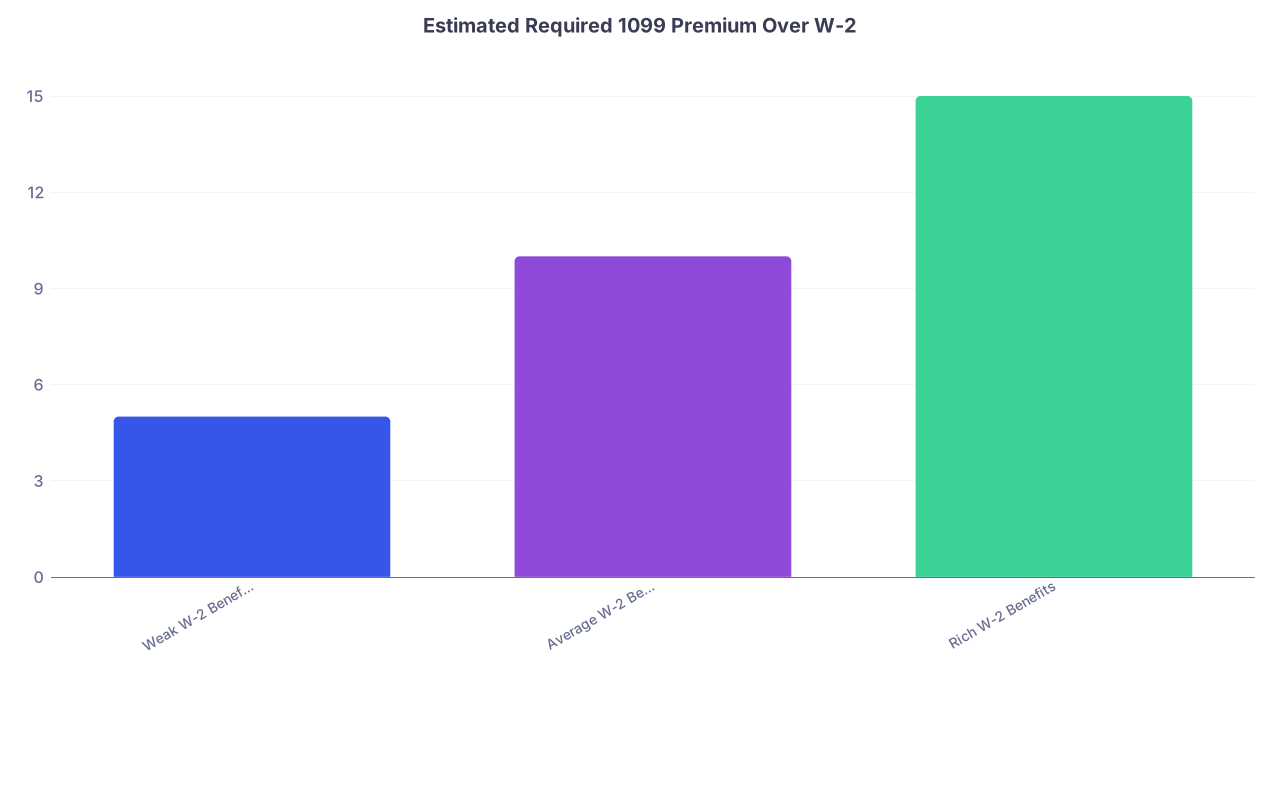
| Category | Value |
|---|---|
| Weak W-2 Benefits | 5 |
| Average W-2 Benefits | 10 |
| Rich W-2 Benefits | 15 |
What this chart is saying:
- If your W‑2 benefits are weak (no match, minimal health subsidy, no disability), a 5% 1099 premium can be enough to offset self-employment tax and extra admin.
- For a typical hospital-employed job with standard benefits and 401(k) match, the breakeven tends to cluster around 8–12% higher 1099 pay.
- If you are at an academic center or large system with excellent pension, match, and subsidized insurance, you need more like a 15%+ 1099 premium for it to be “worth it” purely financially.
Anyone who tells you “1099 should always pay 20% more” is guessing. The data says 7–15% is the true range, heavily dependent on benefits.
5. Where 1099 Absolutely Crushes W‑2: Retirement and Deductions
The most underappreciated piece for high‑income physicians is the retirement math. Under age 50 in 2024:
- W‑2 401(k) employee limit: $23,000
- Total 401(k) (employee + employer) limit: $69,000
Most hospital systems will not get you close to $69k. You get your $23k plus maybe a 4–6% match. On a $300k income, that means:
- Employee: $23,000
- Employer: $12,000 (4%) to $18,000 (6%)
Total: $35k–$41k. The ceiling of $69k is mostly theoretical.
Contrast that with 1099 solo 401(k):
- You design the employer portion.
- With $350–400k of 1099 income, you can almost always get to the full $69k limit with the math we did earlier.
Over 10 years, if you consistently hit:
- W‑2 total contribution: $40k/year
- 1099 total contribution: $69k/year
Difference: $29k/year more into tax‑deferred (or Roth via backdoor strategies) as a contractor.
Over a decade, assuming 6% annual return:

| Category | Value |
|---|---|
| Year 1 | 29000 |
| Year 5 | 162247 |
| Year 10 | 395290 |
That extra ~ $29k/year grows into roughly $395k over 10 years at 6%. That is just the difference between structures, not the whole balance.
So even if your current-year tax bill is similar, the 1099 framework lets you defer and compound far more, which matters when you actually want to stop working nights at 55 instead of 68.
Then there are business deductions. As 1099 you can legitimately deduct:
- Home office (if used regularly and exclusively for admin/charting)
- A portion of internet and cell phone
- Travel for CME and professional meetings
- Equipment: laptop, iPad, stethoscope, books
- Professional services: legal, accounting

| Step | Description |
|---|---|
| Step 1 | W-2 Gross Pay |
| Step 2 | Taxes Withheld |
| Step 3 | Net Pay |
| Step 4 | Personal Spending |
| Step 5 | 1099 Gross Receipts |
| Step 6 | Business Expenses |
| Step 7 | Retirement Contribution |
| Step 8 | Taxable Income |
| Step 9 | Taxes Paid |
| Step 10 | Net Pay 1099 |
Every $1 you convert from post‑tax spending as a W‑2 into pre‑tax deduction as a 1099 effectively saves you your marginal rate. For a physician in the 32–35% bracket plus state, that is real money.
If you are lazy and never set up a solo 401(k), never track expenses, and let your CPA “just file it”, then yes, 1099 will look worse. Because you are wasting the structure.
6. When W‑2 Still Wins: Risk, Lifestyle, and “Brain Space”
Now for the ugly truth: most physicians do not want to run a small business, even if the math slightly favors it.
I have heard the same line dozens of times from fresh attendings: “I just finished residency. I do not want to think about quarterly taxes.” That is rational.
Here are situations where W‑2 is objectively the better move:
You have massive burnout and zero capacity to learn basic business/tax mechanics
Translation: you will not exploit the 1099 advantages anyway.Your W‑2 job offers:
- Strong pension or 403(b) + 457 combo
- High % health insurance subsidy for family
- Employer‑paid long‑term disability and decent life insurance
- Malpractice with tail coverage on departure
Your 1099 alternative:
- Offers only a small premium (<8–10%)
- Provides no guarantees on schedule or volume
- Requires you to buy expensive tail coverage if you leave
And the soft factors matter:
- Income stability: W‑2 jobs tend to be more stable. 1099 work depends on contracts that can get repriced or pulled.
- Credentialing and hospital politics: group practice vs corporate locums have different headaches.
- Loan forgiveness programs: often require W‑2 at qualifying 501(c)(3) or government entity, not 1099 contractor status.
So yes, the data often shows 1099 can win on dollars. But dollars are one column in a larger decision matrix.
7. A Clean Framework: How To Evaluate Your Offers
You are probably staring at two PDFs: one says “Employment Agreement,” the other says “Independent Contractor Agreement.” Instead of guessing, run this checklist.
Step 1: Normalize the pay
Convert everything into “total economic value”:
- Base salary / hourly rate × expected hours
- RVU bonus realistically achievable
- Employer contributions: match, pension, 457, etc.
- Value of health insurance: premium the employer pays
- Value of malpractice + tail coverage
- CME, licensing, relocation
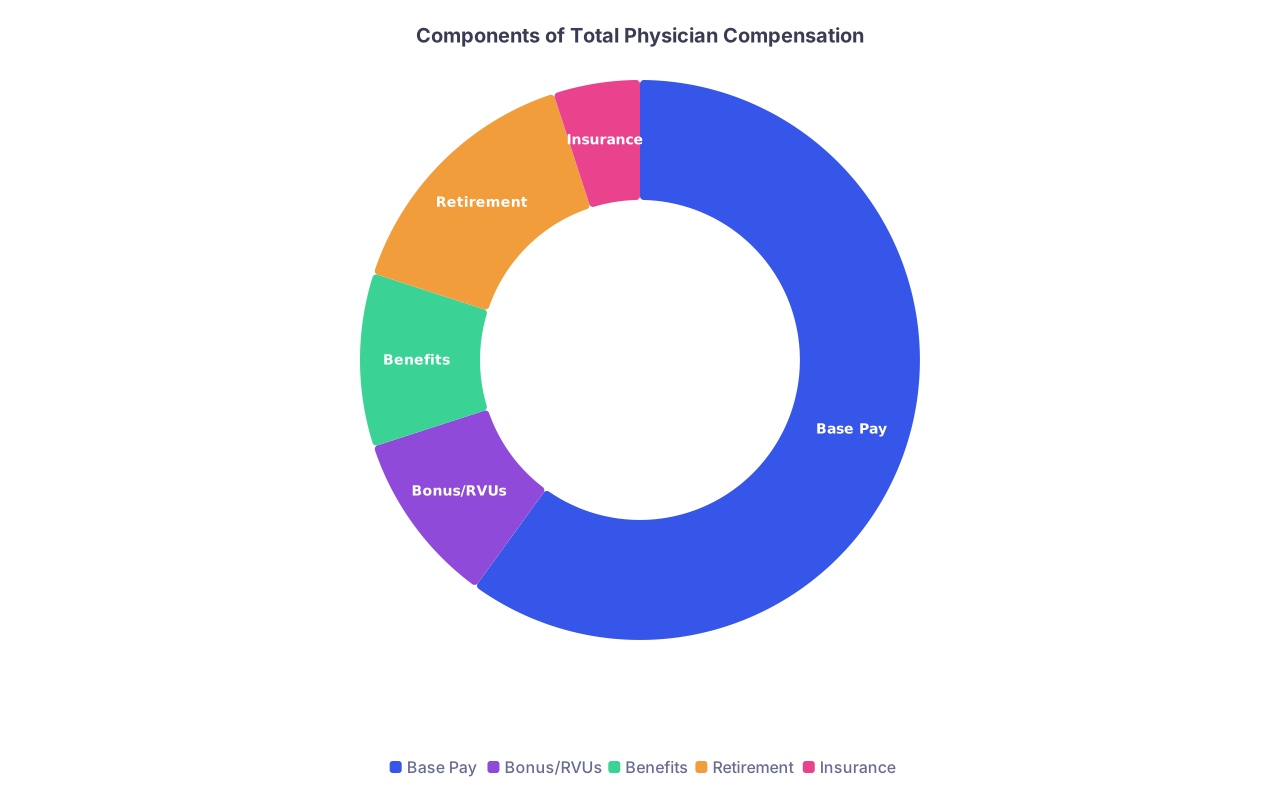
| Category | Value |
|---|---|
| Base Pay | 60 |
| Bonus/RVUs | 10 |
| Benefits | 10 |
| Retirement | 15 |
| Insurance | 5 |
You want apples-to-apples “total comp,” not just sticker salary.
Step 2: Estimate after-tax numbers with assumptions
For each offer:
- Model federal + state income tax (there are free calculators; plug in taxable income estimates).
- Add FICA vs SE tax differences.
- Estimate health insurance out-of-pocket.
- Estimate business expenses (1099 only) and deduct them.
Then:
- Decide realistically what you will contribute to retirement in each structure.
- Calculate your net spendable cash and your annual tax‑advantaged savings.
If these numbers are not at least sketched out on a piece of paper, you are flying blind.
Step 3: Assign value to non‑financial factors
Yes, I am the numbers person. But ignoring non‑financial risk is still bad analysis.
For each job, rate on a 1–5 scale:
- Schedule predictability
- Call burden
- Stability of group / contract
- Path to partnership or leadership
- Location quality for your family
Then ask: does an extra $10–20k on the 1099 side compensate for worse stability or schedule? Sometimes yes. Sometimes absolutely not.

| Step | Description |
|---|---|
| Step 1 | Compare Total Comp |
| Step 2 | Prefer W-2 |
| Step 3 | Evaluate Benefits Loss |
| Step 4 | Prefer 1099 |
| Step 5 | 1099 Premium >= 10 percent |
| Step 6 | Comfort with Business Tasks |
8. What the Data Really Says
After running dozens of actual physician cases across multiple states and specialties, here is the pattern:
- At equal gross compensation, W‑2 almost always wins on immediate take‑home because of employer FICA, health subsidies, and admin benefits.
- With a 7–12% higher 1099 rate, the contractor structure usually at least matches W‑2 on after‑tax + benefits, and often beats it if you fully use retirement and deductions.
- With 15%+ higher 1099 pay, the math strongly favors 1099 in most realistic scenarios, unless the W‑2 job has unusually rich pensions or benefits.
9. The Three Things That Actually Matter
You do not need a 20‑tab spreadsheet if you keep your eyes on these three variables:
Percentage premium on 1099 vs W‑2 base
Under 7%: probably not worth the hassle.
Around 10%: check details; could be a wash or small 1099 win.
Over 15%: 1099 usually a strong financial win if you use the tools.Your willingness to run a “one‑doc business”
If you are not going to set up a solo 401(k), track deductions, or pay quarterly estimates on time, 1099 loses most of its advantage.The value of institutional benefits and stability
Health insurance subsidies, retirement matches/pensions, malpractice tail, and lifestyle stability can absolutely justify turning down a superficially “better” 1099 number.
If you quantify those three, you will not be guessing. You will be making a decision grounded in your actual after-tax income, not in hallway myths about “getting crushed” by self-employment tax.
The data shows this very clearly: 1099 can be a powerful engine for wealth building after residency — but only if the rate premium is real and you are disciplined enough to use the structure instead of letting it use you.