
It’s July. Your Step score is back and it’s lower than you hoped. Not a disaster, but clearly below the average for your dream specialty. On top of that, your med school does not even have a home department in that field. No built-in mentors. No home rotation. No “our chair will call for you.”
You’re staring at ERAS, the specialty list open on one screen and your score report on the other. You keep hearing: “This is a connections game” and “Programs like to see strong home support.” You have neither.
Here’s what you do. Step by step. No fluff.
1. Get Real About Your Position (and Your Options)
Start with clear, unemotional facts. You cannot plan well if you’re lying to yourself.
Three questions to answer today:
- How low is “low” for this specialty?
- How competitive is your chosen field really?
- Are you willing to adjust plans now or only if you go unmatched?
Look up the most recent NRMP Charting Outcomes data for your specialty. Pay attention to:
- Mean Step scores for matched applicants
- Interquartile ranges
- Match rates for US MD, DO, and IMGs
Stop guessing. Put your score in a table like this:
| Metric | Your Data | Specialty Mean (Matched) |
|---|---|---|
| Step 1 (if numeric) | 220 | 235 |
| Step 2 CK | 233 | 245 |
| Research Experiences | 2 | 3–4 |
| Abstracts/Posters/Pubs | 1 | 5 |
If you’re 10–15 points below the matched mean in a hyper‑competitive specialty (derm, ENT, plastics, ortho, neurosurgery), that is a problem. Not fatal, but you don’t get to play this like a 250 applicant.
If you’re aiming for something moderately competitive (EM, anesthesia, radiology) and you’re just under the mean, that’s different. You still have a real shot if you play it strategically.
No home department makes everything harder:
- No default letter from a chair
- No “home” away rotation where people already know your dean
- Less built‑in advocacy
So your mindset has to be: I will manufacture what other people get automatically. On purpose. Early. Aggressively.
2. Fix What You Still Can: Step 2, Narrative, and Signals
You cannot raise Step 1 now. You can change how programs perceive you.
A. Crush Step 2 (if you haven’t taken it yet)
If Step 2 is still ahead of you, this is non‑negotiable: it becomes your rehab.
You are not “aiming to pass.” You’re aiming to show a clear upward trend.
Set a score target: at least 10 points above your Step 1 if numeric; if Step 1 was pass/fail but borderline prep, aim to be at/above the matched mean for your specialty.
Build a 6–8 week plan focused on:
- UWorld (full pass, timed, random, with obsessive review)
- NBME practice exams every 1–2 weeks, adjusting as needed
If your school allows: push back the test if your practice tests are trash. I’ve seen students save their entire application by taking 4 extra weeks to move from projected 225 to 240+.
B. Rewrite your story: your “reason for this specialty” must be airtight
With a low score and no home department, your narrative has to carry more weight. You cannot sound like: “I liked the rotation; I think I’d be good at it.” Everyone says that.
You need:
- A clear, specific origin point: a patient, a moment, a mentor, a project
- Evidence of sustained interest (not just one rotation)
- A sense that you understand the field beyond the medical school brochure version
If you’re going for, say, anesthesia without a home department, you better be able to talk real cases, intra‑op challenges, pre‑op clinic, post‑op pain management, and the ugly sides of the job. Show you’ve done the homework.
3. Replace the “Home Department” You Don’t Have
You don’t have a home department. So you build a surrogate one.
This means three things:
- Find a “home program” at another institution.
- Build at least one strong external champion.
- Accumulate concrete specialty‑specific experiences that signal commitment.
A. Find a surrogate home program
You need a place you can rotate where:
- There is a full department in your chosen specialty
- They are accustomed to taking outside rotators
- They are not so elite that they ignore anyone with a less‑than‑perfect record
Look for:
- Mid‑tier university programs
- Large community programs with an academic feel
- Places where at least some of your school’s graduates have matched historically
Reach out early. For competitive fields, away rotation slots are gold and they go fast.
Your email should not be a generic “do you take rotators?” message. It should:
- Name the specialty explicitly
- State your school and year
- Make clear you have no home department and this is effectively your only chance at a true home‑like rotation
- Use respectful, direct language; do not sound like you’re begging, just explaining your situation
Something like:
I’m a rising M4 at [School], which does not have a [Specialty] department. I’m strongly committed to pursuing [Specialty] and am looking for a 4‑week rotation that will serve as my primary home experience in the field. I’m especially interested in [one or two specific aspects that match their program]. Would your program consider an away rotation applicant in [months]?
You want one program that knows: “We’re basically their home base.”
B. Get at least one real specialty mentor
You can’t have a home chair. You can have a faculty mentor who acts like one.
Tactics:
- Use your surrogate rotation to identify one attending who likes teaching, remembers your name, and doesn’t treat you like wallpaper
- Show up early, ask smart questions, read about their patients, and then quietly follow up: “I read about X last night after our case; does that align with how you practice?”
When the rotation is going well, say this out loud:
I don’t have a department in [specialty] at my home school, so this rotation is really my primary exposure. I’m very serious about applying into the field. Would you be willing to keep in touch as I go through the application process? I’d really value your guidance.
Say it. People don’t read your mind.
This is the person you eventually ask for:
- A strong departmental letter
- Advocacy emails or calls if they know PDs elsewhere
- Feedback on your rank list
C. Stack specialty‑specific proof
Programs are asking, “Does this person actually want our field or are they just shopping around because they’re nervous about their score?”
Your job is to answer that before they ask.
You want:
- At least 1–2 away rotations in the actual specialty (not just its neighbor field)
- A small but focused research project: case report, chart review, retrospective study, something with the department’s name on it
- One abstract/poster at a relevant regional or national meeting
Do not chase a random bench research gig “because research looks good.” It doesn’t help as much as being able to say:
I worked with Dr. X at [Program] on a retrospective review of [specific topic]. I presented it at [Specialty] regional meeting.
That reads like: “This person is living in our world already.”
4. Letters of Recommendation: You Must Over‑Perform Here
With no home department and a low score, your letters matter more than for the average applicant. You need letters that sound like someone is putting their reputation behind you.
Minimum goals:
- 2 strong letters from your chosen specialty (ideally from your surrogate / away programs)
- 1 letter from a related field or core clerkship where you shined
- If your specialty expects it: a departmental or chair letter from somewhere (your home school in related field or your surrogate program)
Do not:
- Use generic letters from faculty who barely remember you
- Assume “nice student, worked hard” is enough
When asking for a letter, be blunt (but respectful):
I’m applying to [Specialty]. I had a lower Step score than I hoped for, and my school doesn’t have a home department in the field. I’m working hard to build a strong application in other areas. After working together, do you feel you could write me a strong letter that speaks to my potential as a [Specialty] resident?
If they hesitate even slightly: thank them and move on. You can’t afford lukewarm.
And when someone agrees, help them help you:
- Send your CV
- Draft a short summary of cases or projects you worked with them
- Remind them of specific moments where you handled responsibility well
You aren’t writing the letter for them, but you’re jogging their memory.
5. Target Your Application Strategy Like a Sniper, Not a Shotgun
You’re not a perfect‑stats applicant. You do not just spray 80 applications at every big‑name program and hope.
You have to be smart about where you apply.
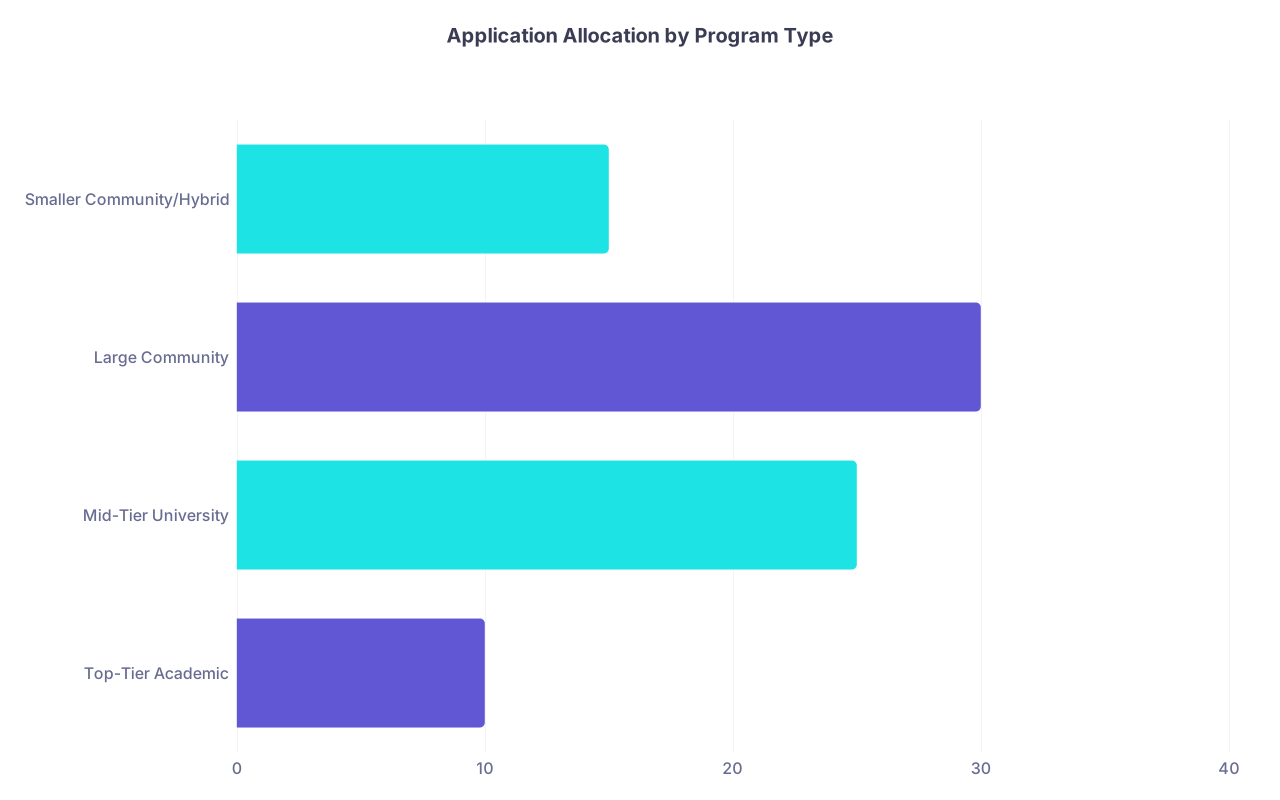
| Category | Value |
|---|---|
| Top-Tier Academic | 10 |
| Mid-Tier University | 25 |
| Large Community | 30 |
| Smaller Community/Hybrid | 15 |
For a lower score / no home department applicant in a competitive field, a reasonable breakdown might look like that. Adjust numbers by specialty competitiveness.
You should:
- De‑emphasize top‑5 name‑brand powerhouses that worship Step scores
- Heavily target mid‑tier university and strong community programs that are known to take a range of scores
- Include geographically diverse regions; don’t lock yourself to one coast or city
Also: study program websites and recent residents. If they never take anyone from a school like yours and their residents are all 260s from top‑10 schools, you already know the answer.
If your specialty uses preference signals (e.g., ERAS signals), treat them like currency. Use them on:
- Programs where you rotated
- Programs your mentors know and can contact
- Mid‑tier programs that actually might move you from “maybe” to “interview”
Not “I love Big Famous Name Program”; save your signal for places that might realistically rank you.
6. Build Relationships Before You Hit Submit
You lack home‑grown connections. So you compensate with pre‑existing relationships elsewhere.
This is where most lower‑score applicants mess up. They assume their application will “speak for itself.” It won’t.
You need people.
Tactics that actually work:
Conferences and regional meetings
Go to your specialty’s regional or national meeting if you can possibly afford it. Even for a day.
Do not just stand by the snack table. Go to smaller sessions, introduce yourself briefly to speakers afterward:I’m a med student from [School] interested in [Specialty]. My school doesn’t have a department, so I’m building my exposure externally. I really appreciated your talk on [X].
You’re not asking for a job. You’re planting seeds.
Email follow‑ups to faculty you’ve actually met
Anyone you meet at a rotation, conference, or virtual session: send a 2–3 sentence follow‑up. No life story, no big ask. Just a reminder that you exist.Ask your mentors who they know
Your away rotation mentor probably knows PDs and faculty elsewhere. Be explicit:Are there any programs you think might be a good fit for me, given my background and scores?
Would you be comfortable reaching out to them on my behalf once my application is in?
Most students never ask this out loud. Then they’re surprised no one made any calls.
7. How to Talk About Your Low Score If It Comes Up
Do not volunteer your Step score story in every paragraph of your personal statement. But when you’re asked—on an ERAS prompt, in an interview, or in a letter request—you need a clean, mature response.
The basic structure:
- Brief acknowledgment, no drama
- Concrete explanation if there is a reason (illness, family crisis, study strategy mistake) without sounding like excuse‑making
- Evidence of improvement or adjustment (Step 2, clerkship honors, research productivity)
- Reassurance that your current performance is a better indicator of residency readiness
Example:
My Step 1 score was below my expectation. I underestimated the exam and relied too heavily on passive study methods. I corrected that approach for Step 2, using a more structured question‑based plan, and increased my score by 13 points. The way I prepared for Step 2, and the consistency of my clinical evaluations since then, are much more representative of how I now approach learning and patient care.
Short. Direct. Responsible.
If there was a genuine crisis (hospitalization, major family issue), you can mention it briefly once. Not as your entire identity.
8. Have a Real Backup Strategy (Not Magical Thinking)
This part’s uncomfortable, but pretending you don’t need it is childish.
You need to decide before ERAS opens:
- Will you dual‑apply?
- If not, what’s your plan if you don’t match?
Dual‑applying makes sense when:
- Your dream specialty is extremely competitive for your stats
- There’s a related specialty you could see yourself in long‑term or through a fellowship path (e.g., IM → cards/crit care, gen surg → some subspecialties)
- You can realistically build a plausible application for both (letters, rotations, story)
It does not work well if you send 15 half‑baked apps to a random backup specialty without letters, rotations, or interest.
If you decide against dual‑applying, then commit to:
- A clear SOAP strategy (which programs, which backup specialties)
- A plan for a research year or preliminary year if totally unmatched
- Knowing in advance what you’d do differently in a reapplication
You don’t have to love thinking about this. You do have to do it.
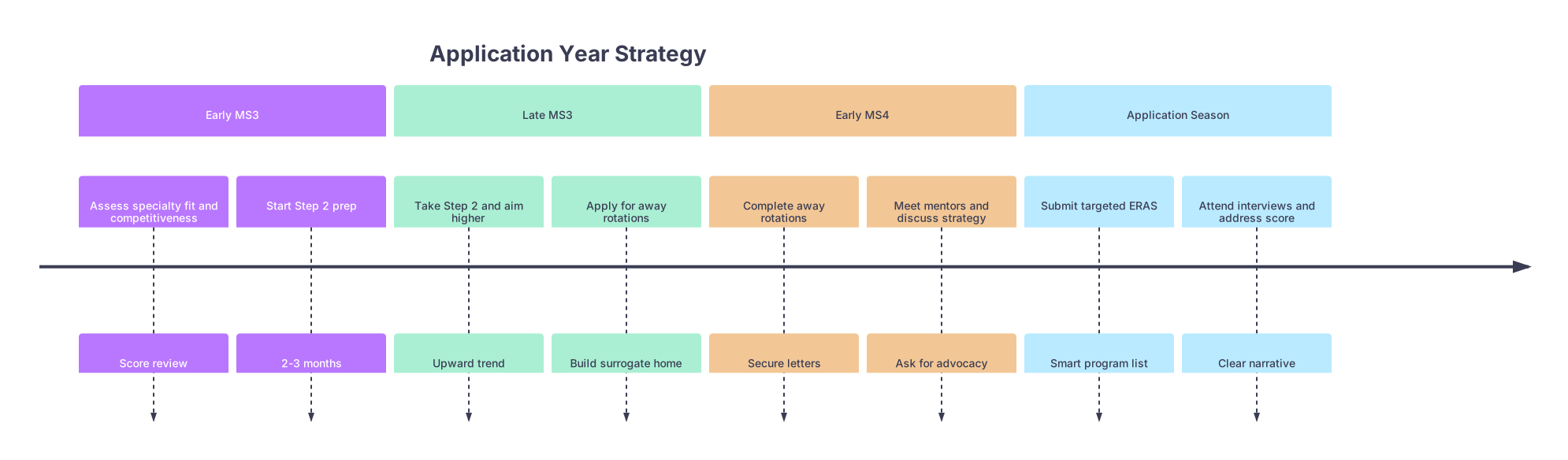
| Period | Event |
|---|---|
| Early MS3 - Assess specialty fit and competitiveness | Score review |
| Early MS3 - Start Step 2 prep | 2-3 months |
| Late MS3 - Take Step 2 and aim higher | Upward trend |
| Late MS3 - Apply for away rotations | Build surrogate home |
| Early MS4 - Complete away rotations | Secure letters |
| Early MS4 - Meet mentors and discuss strategy | Ask for advocacy |
| Application Season - Submit targeted ERAS | Smart program list |
| Application Season - Attend interviews and address score | Clear narrative |
9. What You Can Do This Week
This doesn’t get fixed by vague “I’ll work on my application” energy. You need specific moves.
If it’s more than 3 months before ERAS:
- Clean, hard Step 2 plan if you’ve not taken it
- Email 3–5 programs about away rotations in your specialty
- Identify 1–2 potential mentors—even at other institutions—and send thoughtful, brief emails
If it’s within 3 months of ERAS:
- Finalize program list with someone who knows actual match data (advisor, mentor, not just classmates)
- Draft a tight, honest personal statement that doesn’t obsess over your score
- Decide on dual‑apply vs. single‑specialty and actually commit
If you’re already in interview season:
- Practice a 60‑second Step‑score explanation out loud, until you can say it without sounding defensive
- Email your strongest letter writers with your interview list and ask if they know anyone at those programs
- Be visibly prepared and deeply engaged on interviews. You don’t get the benefit of the doubt; you have to earn it in real time.