
What do you do when your Step score comes back lower than you needed—and your school flat-out refuses to let you delay graduation, delay fourth year, or take extra time before applying?
This is not a theoretical problem. I’ve seen schools say, almost word for word: “We don’t allow deceleration for board scores. You will proceed with your cohort.” Translation: you’re moving forward whether you’re ready or not.
You’re sitting with:
- A low Step 1 or Step 2 score
- A rigid administration
- A looming ERAS season
And no built‑in extra time to “fix” the number.
Let’s walk through what to do next, in order.
Step 1: Get Extremely Clear on How Bad the Damage Is
You cannot make good decisions on vibes. You need numbers, context, and targets.
Start with three questions:
- How low is “low” relative to your target specialty?
- Do you have any red flags (fails, multiple attempts, remediation, LOA)?
- When exactly are you forced to move forward (no delay) by your school?
Use data, not panic. For your specialty, look up recent average matched Step 2 scores and percent unmatched. You’ll see patterns like this:
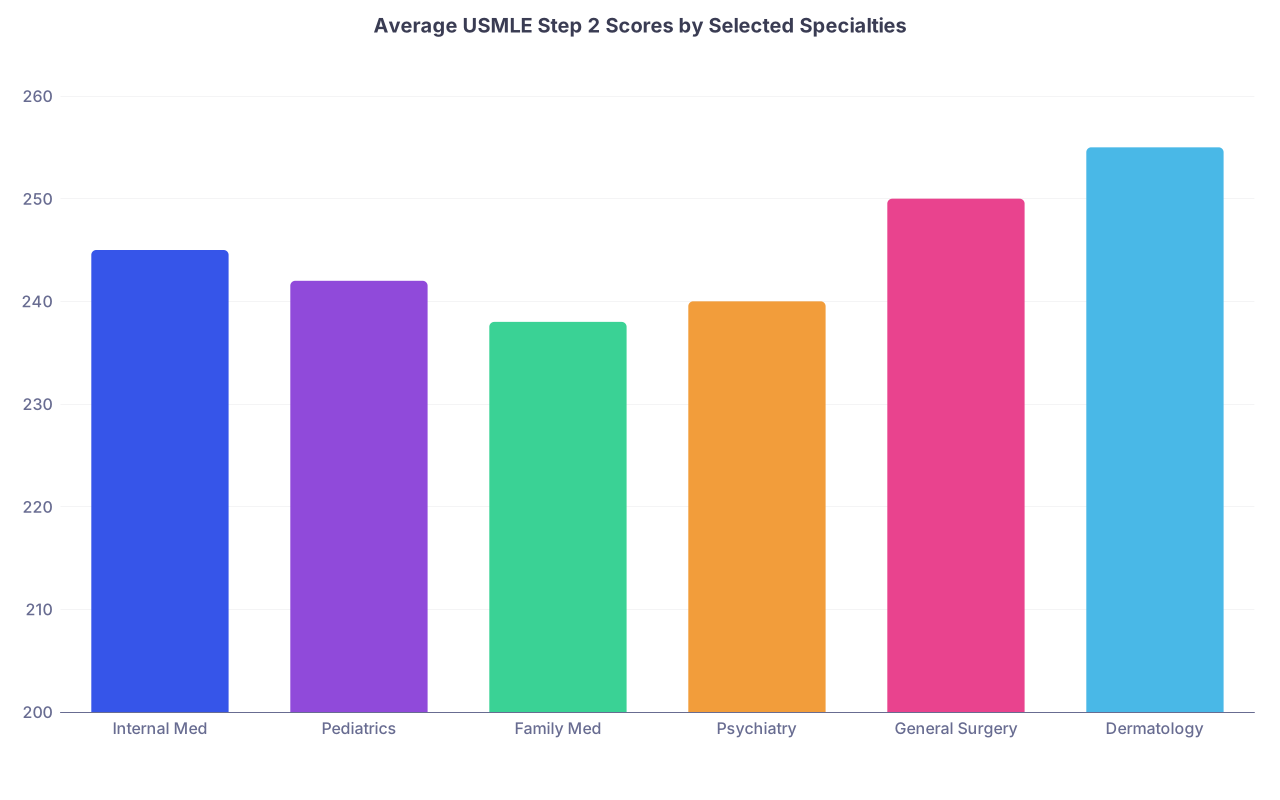
| Category | Value |
|---|---|
| Internal Med | 245 |
| Pediatrics | 242 |
| Family Med | 238 |
| Psychiatry | 240 |
| General Surgery | 250 |
| Dermatology | 255 |
Now compare your score:
- If you’re within ~5–7 points of the average for your chosen specialty, you’re bruised, not broken. You’ll need a smart application strategy, but the door isn’t closed.
- If you’re 10–15+ points below average, especially in a competitive specialty, that original plan may be fantasy at this point. Not impossible. But bordering on reckless if you don’t adjust.
- If you have a fail on record, you’re dealing with a different problem entirely: red‑flag management. Programs will look at that before they look at anything else.
Be brutally honest with yourself in writing. I like to use a simple table so you can see the mismatch:
| Metric | You | Target Competitive | Target Back-up |
|---|---|---|---|
| Step 1 (if scored) | |||
| Step 2 | |||
| Research projects | |||
| Honors/HP in cores | |||
| Home program? (Y/N) |
Fill it out honestly. Don’t “manifest.” Math it.
Once you see the gap, you can decide whether you need:
- A modified strategy in the same specialty
- A different specialty
- Or a different timeline (even if the school says “no delay,” there are still ways to effectively “slow roll” some things—more on that later)
Step 2: Clarify Exactly What “No Delay” Means at Your School
Schools love vague policy language. “We don’t allow delays for boards.” That can mean a lot of different things in practice.
You need to pin down specifics.
Here’s what you should literally ask your dean’s office / academic affairs:
- “Can I delay my Step 2 exam date at all, or is there a hard deadline?”
- “Am I required to apply to residency this upcoming cycle, or could I graduate without matching and apply the following year?”
- “Can I take a research year or leave of absence for non–board reasons?”
- “Can I schedule rotations in a way that gives me more time for Step studying or application prep?”
- “Is there any internal appeals process if I feel my situation is unique?”
Do this in writing. Email, not hallway conversation.
Some schools mean:
- You must take Step on time, but if you match late or decide to apply later, that’s on you.
Others mean:
- You are expected to submit ERAS with your class and they will be annoyed (but not actually forbid) if you don’t.
And a few are truly rigid:
- No LOA, no research year, no off‑cycle graduation, no separate timeline.
Most students never push on the specifics. They just hear “no delay” and assume they’re chained to one outcome. You’re not. There are usually small levers you can pull.
Step 3: Decide — Stick with the Specialty or Pivot?
This is the uncomfortable part. If your dream was dermatology and your Step 2 is 218, you’re not “manifesting” that away. You either:
- Pivot specialties
- Or accept an extremely low probability of matching derm and build an iron‑clad back-up plan
Same for ortho, plastics, ENT, neurosurgery, etc.
On the other hand, if you were aiming for internal medicine, pediatrics, family medicine, or psychiatry and you’re sitting on a 220-ish Step 2, you still have realistic options, especially at community programs, new residencies, or in less popular regions.
Let me be specific.
| Specialty Tier | Example Fields | Low Score Effect |
|---|---|---|
| Ultra-competitive | Derm, Ortho, ENT, Plastics | Often fatal without major offsets |
| Competitive but workable | EM, Anesthesia, Gen Surg | Requires strong compensating factors |
| Broad-access specialties | FM, IM, Peds, Psych | Often still matchable with strategy |
If your school won’t let you delay, your “rescue options” inside the same specialty are limited. You can improve the rest of your app, but you can’t magically create a new score.
I’ve seen people in this exact position do three main things:
Double‑apply: dream specialty + realistic backup (same year)
- Example: Apply to anesthesiology + internal medicine.
- Upside: You stay in the running for the dream.
- Downside: Expensive, stressful, and programs can smell when they’re clearly your backup.
Pivot outright to a more forgiving specialty
- Example: Planned ortho → switches to FM or IM.
- Upside: Much higher match probability.
- Downside: Mourning the original dream; must genuinely sell the new choice in your personal statement and interviews.
Apply in a slightly less competitive version of your field
- Example: Wanted academic IM at big names → aim for community IM, less desirable locations, smaller name programs.
There’s no universal “right” answer. But here’s my honest rule:
If your score is >10–12 points below the average matched score in a hyper‑competitive specialty and you have no home program, no massive research, and no unique angle, you’re burning time and money if you refuse to pivot or double‑apply.
Step 4: Build a Ruthless, Realistic Application Strategy
Your school refusing to delay means you don’t get the luxury of “I’ll just retake or do more research first.” You have to work with what you already have and what you can add in a short window.
Your strategy revolves around four things:
- School List
- Timing
- Letters and Rotations
- Narrative
1. School List: Stop Being Romantic
Weak Step score? You can’t casually apply to 15 brand‑name academic centers and hope.
You need to over‑apply. And yes, it’s expensive. But being “efficient” with a weak score is a nice way of saying “unmatched.”
Think in tiers:
Tier 1 – Safest bets
Community programs, newer residencies, less popular geographic regions, programs known to accept lower scores or IMGs. You should have the most applications here.Tier 2 – Reasonable reaches
Solid programs that aren’t top‑10 flashy, maybe mid‑tier university programs, or strong community‑academic hybrids.Tier 3 – Fantasy schools
The big names where even strong applicants get rejected. Have a few if you must, but not many.
If you’re IM/Peds/FM/Psych with a low Step and no delay option, I’d rather see you apply to 60–80+ programs in realistic and safe tiers than 25 “dream” places because you’re trying to save $1,000.
2. Timing: Submit Early, Not Perfect
You don’t have the luxury of perfectionism. You need:
- ERAS done and submitted early in the opening window
- Letters uploaded ASAP
- MSPE and dean’s letter clean (or at least not explosive)
If your school won’t delay, do not add self‑sabotage by being late on top of low scores. Being early does not cure a low score, but being late with a low score is a self‑inflicted gunshot.
Step 5: Max Out Rotations and Letters — Fast
You can’t change the score. You can change the strength of your advocates.
You want:
- Home institution letters from people who actually know your work
- At least one credible “this person will be a solid resident despite the score” narrative
If you’re still in M3/M4 rotations when the score comes out:
Identify attendings who like you and explicitly tell them:
“I had a weaker Step score than I hoped. I care a lot about [specialty]. I’m working hard clinically. Would you feel comfortable writing a strong letter commenting on my work ethic, clinical reasoning, and how you see me performing as a resident?”Do NOT ask people who are lukewarm. A generic letter from a big name is less useful than an enthusiastic letter from a mid‑name who clearly knows you.
If you’re already in late M4 and rotations are mostly done:
- See if you can add a short sub‑internship or elective in your target specialty early enough that the letter can be written for ERAS.
- If not, go back to prior letter writers and ask them to update prior letters with your most recent experiences and commitment to the specialty.
I’ve seen low‑Step applicants match because a PD told me directly: “The score worried us, but every letter said this person is one of the hardest‑working, safest students they’ve had. We believed the humans over the number.”
That doesn’t happen by accident.
Step 6: Fix Your Story — How You Talk About the Low Score
You will be asked, directly or indirectly, about your score.
Do not:
- Blame the test
- Blame the school
- Infantilize yourself (“I’m just a bad test taker”)
Program directors hate excuses. They do not hate weakness if it’s handled like an adult.
Your basic framework should be:
- Brief explanation (if relevant)
- Clear ownership
- Concrete changes and evidence
- Forward‑looking confidence
Something like:
“My Step 2 score was below where I wanted it. I underestimated how much time I needed during a heavy rotation block and didn’t adjust early enough. Since then, I’ve changed how I study — more question‑based, tracking weak areas weekly, and getting feedback from attendings. On rotations, I’ve consistently gotten strong feedback about my clinical reasoning and work ethic, and I feel those better reflect how I function as a learner than that one score.”
If you had legitimate life events (illness, family emergency), you can mention them briefly, but don’t camp on them. Ten seconds, then move back to what you changed and how you’re performing now.
Step 7: Quietly Create a “Soft Delay” Without Breaking School Policy
Your school might not allow formal delays, but there are usually ways to create breathing room in practice.
Here are a few strategies I’ve seen work:
Maximize lighter rotations during ERAS season
Schedule electives or less intensive rotations when you’ll be writing personal statements, managing applications, or maybe still studying for Step 2 if that’s not done.If allowed, graduate but don’t apply that cycle
Some schools don’t force you to apply. You can graduate, do a research job or prelim year, then apply the following cycle with more meat on your CV. Yes, this means a year “off.” It may still be better than going unmatched.Take a research or personal LOA for non–board reasons
Some schools say “no delay for boards” but will allow a research year, family medical leave, or a mental health LOA if genuinely needed. You’re not gaming the system; you’re acknowledging reality. If you’re burning out, this is legitimate.Apply strategically light the first year
I’ve seen students “token apply” to a tiny number of top programs while planning mentally to really apply the next cycle with more work done. It’s expensive and a bit clumsy, but sometimes it buys them time at home to do more research or work.
Be honest with yourself. A one‑year “soft delay” to strengthen your file is vastly better than launching a weak application, going unmatched, and then trying to explain that to programs.
To visualize your options over two potential cycles:
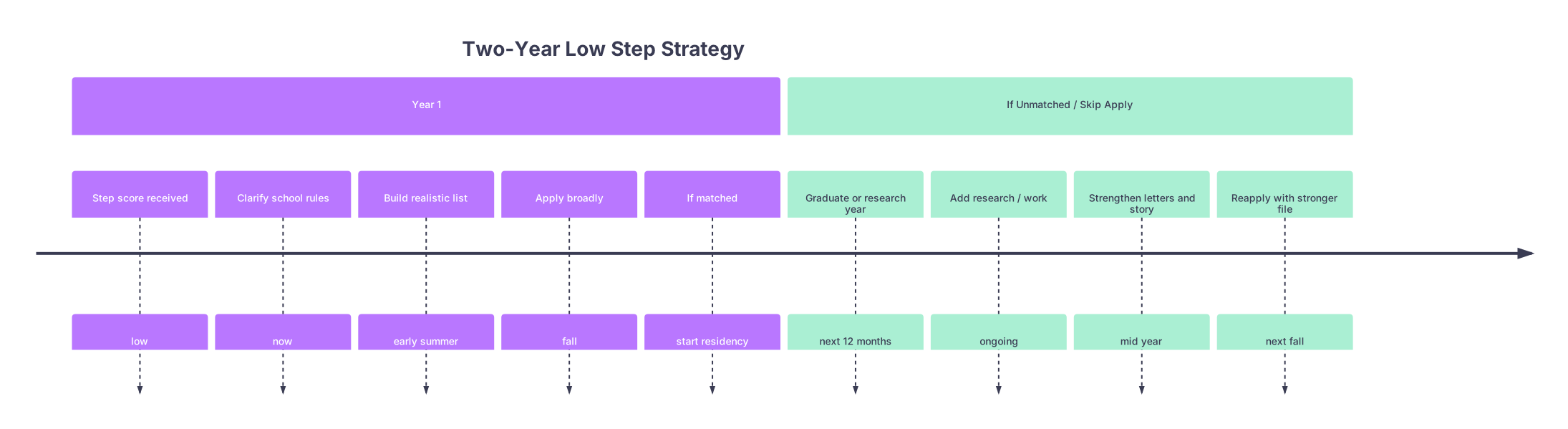
| Period | Event |
|---|---|
| Year 1 - Step score received | low |
| Year 1 - Clarify school rules | now |
| Year 1 - Build realistic list | early summer |
| Year 1 - Apply broadly | fall |
| Year 1 - If matched | start residency |
| If Unmatched / Skip Apply - Graduate or research year | next 12 months |
| If Unmatched / Skip Apply - Add research / work | ongoing |
| If Unmatched / Skip Apply - Strengthen letters and story | mid year |
| If Unmatched / Skip Apply - Reapply with stronger file | next fall |
Step 8: If You Go Unmatched — Do Not Panic, Do Not Disappear
Worst‑case scenario: you follow this plan, still go unmatched because the combination of low score + school rules was just too much.
You’re not done. You are, however, in a different game now.
Immediate next steps:
Scramble/SOAP aggressively
Have your SOAP list ready. Know in advance which fields and locations you’d be willing to join. Low Step applicants sometimes land decent categorical positions here because they’re more flexible and prepared than everyone else.Secure a clinically relevant job or research role
Don’t go home and sit for a year. Work as a research fellow, a clinical research coordinator, or in a position attached to a residency program in your desired specialty or backup specialty.Get a PD mentor
Even if they didn’t rank you, some PDs are surprisingly willing to mentor reapplicants who show maturity and persistence. They can tell you exactly how your file looked to them.Plan your reapply year with structure
Lay out quarters: when you’ll publish, when you’ll get new letters, when you’ll re‑take any necessary tests, when you’ll do observerships or externships if needed.
Step 9: Protect Your Sanity While Being Honest About Risk
This situation is demoralizing. Your classmates are gloating about 250s and 260s. You’re sitting with a score that makes every conversation feel like a landmine.
Two things you need to keep in mind:
Your score is data, not your worth
Programs use it as a filter. That’s reality. But the same system that over‑values test scores also produces plenty of miserable residents who scored well and still fall apart. Do not tie your entire identity to one exam.You’re allowed to adjust your dream without “quitting”
Choosing FM, IM, or Psych instead of Derm or Ortho because of a low score is not failure. It’s adulthood: matching your actual options to the world you live in, not the one you imagined at 22.
If your school won’t delay, they’ve already shown you their priority is policy over nuance. Don’t expect emotional support there. Build it elsewhere:
- Trusted attendings
- Residents you’re close to
- Peers who are actually honest about their own struggles
Key Takeaways
- Get brutally clear on where your score sits relative to your specialty and accept the math. Then decide if you’re sticking, pivoting, or double‑applying.
- If your school won’t allow delays, build your own version of a “soft delay” where possible, and construct a ruthless, realistic application: over‑apply to safe programs, maximize strong letters, and fix your story.
- Have a Plan B (SOAP, reapply year, or specialty pivot) ready before you submit ERAS so if things go badly, you move fast instead of freezing.