
The worst residency application mistakes do not happen on ERAS opening day. They happen three months later when you finally notice the fine print: “Step 1 required 220+,” “Applications with Step 2 CK < 235 will not be reviewed.” After you already applied. After you already paid. After the invites went out to everyone but you.
If that’s you right now, I’ll be blunt: the cycle is wounded, not dead. You still have moves. But you do not have the luxury of denial or vague “hope for the best” thinking.
Here is exactly what to do if you discovered program cutoffs late and your scores sit below them.
1. First, Stop Guessing: Get Clear on Where You Actually Stand
Most people in your situation make one of two bad moves:
- They spiral and decide “I’m not matching anywhere.”
- They stick their head in the sand and wait for magic interview emails.
Both are passive. You do not have time for passive.
You need a fast, cold assessment.
Start with three numbers:
- Your Step 1 (or “Pass” + the actual numeric score if you know it)
- Your Step 2 CK
- Your number of applications sent
Then categorize your programs. Use your ERAS list and quickly tag them:
| Category | Description |
|---|---|
| Hard Excluded | You are below stated cutoff and program historically enforces it |
| Soft Excluded | You are slightly below cutoff or cutoff is vague / unofficial |
| Possible | No posted cutoff or historically flexible with low scores |
| Friendly | Specifically noted as IMG/low score friendly or holistic |
Now actually do the work:
- Go to each program’s website.
- Look for:
- “Minimum Step 2 score”
- “Competitive applicants typically have…”
- “Applications with Step 2 < X will not be reviewed.”
- Cross-check with:
- Residency Explorer
- FREIDA
- Reddit/SDN program-specific threads (with skepticism, but still useful trends)
Yes, this sucks. Yes, it takes hours. Do it anyway. I’ve watched people salvage a cycle purely because they realized, “I only have 25 realistic programs; I need to add 20 more this week.”
You want a rough breakdown like:
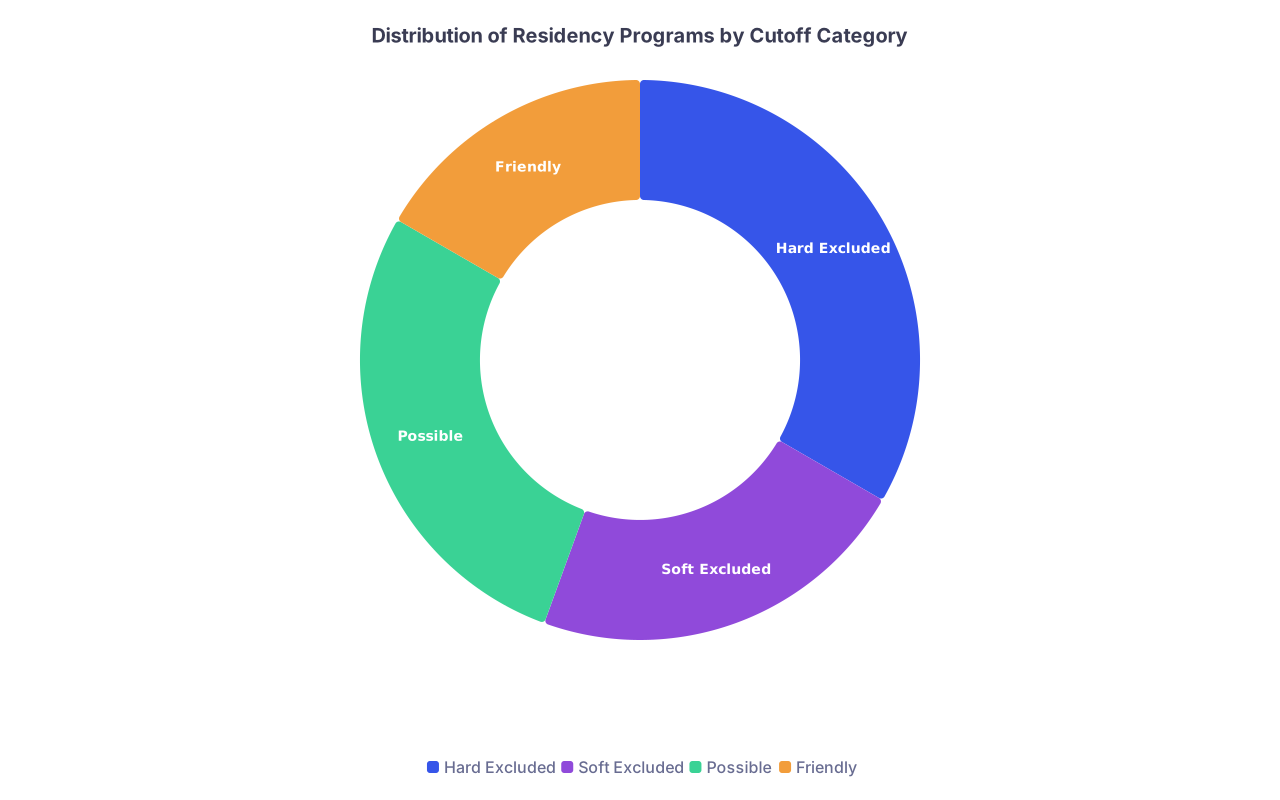
| Category | Value |
|---|---|
| Hard Excluded | 30 |
| Soft Excluded | 20 |
| Possible | 25 |
| Friendly | 15 |
If half or more of your list is “Hard Excluded” and it’s October/November and you have 0–2 interviews, you are in salvage mode. Not routine mode.
Good. Now we know what game you’re playing.
2. Decide: Salvage This Cycle vs Quietly Plan for Next
You are allowed to fight for this cycle and still quietly set up Plan B. Mature people can hold both thoughts at once.
Here’s the brutal but useful decision tree:

| Step | Description |
|---|---|
| Step 1 | Low Step score discovered late |
| Step 2 | Focus on maximizing current cycle |
| Step 3 | Push hard to add realistic programs |
| Step 4 | Consider concurrent reapp plan |
| Step 5 | Salvage with targeted outreach |
| Step 6 | Any interviews yet |
| Step 7 | Month now |
| Step 8 | Score gap small |
Translated to real life:
- If it’s September/early October:
- You still have time to add programs, email coordinators, and get on radars.
- If it’s late November or later and you have:
- 0 interviews: you fight, but you also start quietly planning a reapplication year.
- 1–3 interviews: you treat those as gold and go all-in on prep, while still exploring a backup plan.
- 4+ interviews: your focus shifts to crushing interviews and not doing anything desperate.
The mistake I see too often: people with no interviews by December doing absolutely nothing but “wait and pray.” That is not a strategy. That’s an emotional coping mechanism.
You need a two-track mindset:
- Track A: Do everything reasonable to squeeze interviews out of this cycle.
- Track B: Start building a clear, structured “If I do not match” plan that is more than vague “I’ll improve my application.”
We’ll handle both.
3. Salvage Moves You Can Still Make This Cycle
A. Expand your program list (but not randomly)
You probably applied like this:
- 15–20 “reach” university programs with clear cutoffs you don’t meet
- 10–15 mid-tier programs
- 5–10 community programs
If you discovered cutoffs late, your list is likely top-heavy and delusional.
You need to:
- Shift toward community and lower-tier academic programs.
- Include more “holistic” and “IMG-friendly” places if you’re an IMG/low score applicant.
- Season with some new geographic regions you ignored because they weren’t “ideal.”
Use Residency Explorer and filter for:
- Lower average Step 2 CK
- Higher proportion of IMGs (if you’re IMG)
- Larger program size (more categorical spots)
Then cut ruthlessly:
- Stop wasting time on programs that literally state “below 230 will not be reviewed” if you have a 215. That’s not “manifesting,” that’s ignoring English.
This can change your list from:
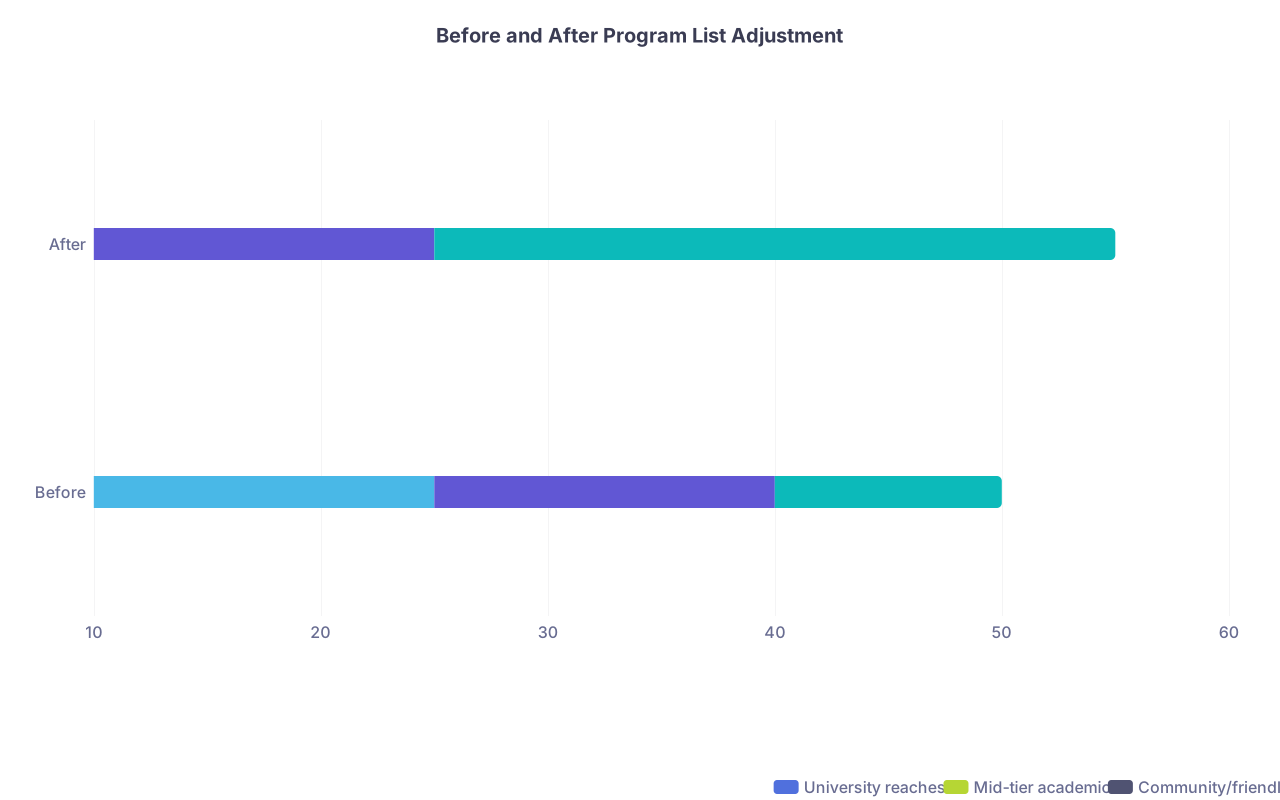
| Category | University reaches | Mid-tier academic | Community/friendly |
|---|---|---|---|
| Before | 25 | 15 | 10 |
| After | 10 | 15 | 30 |
Do not worry that it’s “too late” to add more programs in October/November. People get interviews from late applications every year. Not many. But some. You’re playing for “some,” not “statistically optimal.”
B. Targeted, non‑needy outreach to programs
This is where people either do it smart or embarrass themselves.
You do not email every program director with a three-paragraph sob story about your sick grandparent and “my Step 2 does not reflect my abilities.”
You do:
Focus on:
- Programs where your score is near their range (e.g., they usually take 225–230, you’re a 220).
- Programs with no stated rigid cutoffs.
- Places connected to your region, med school, or rotations.
Send short, focused emails to:
- Program coordinators primarily.
- Occasionally the PD or APD if you genuinely have a tie to the program.
Something like:
Subject: Application Update – [Your Name], [AAMC ID], [Specialty]
Dear [Coordinator Name],
I wanted to express my continued strong interest in [Program Name]. I recently noted that many programs use Step scores as an initial screening tool. While my Step 2 CK of 218 is below the typical range, I’ve been consistently performing well clinically (Honors in my [relevant rotation], strong evaluations attached).
I completed my ERAS application to your program on [date]. If there’s an opportunity for my file to be reviewed in full, I’d be grateful. I’m especially drawn to [1 specific, real feature of program – community focus, schedule design, teaching structure].
Thank you for your time and consideration,
[Name]
[AAMC ID]
[Med School]
Notice what’s missing:
- No begging.
- No 500-word life story.
- No “I know I’d be a great fit” without backing it up.
It won’t magically fix a 195 Step 2 at a 250+ program. But at the margins, this is sometimes the difference between “auto filter” and “fine, I’ll glance at it.”
C. Leverage every real connection you have
I mean actual connections. Not “I saw the PD speak on YouTube once.”
Options:
- Attendings you rotated with who trained there.
- Alumni from your school currently at that program.
- Faculty advisors with PD friends.
You ask for something concrete and small:
- “Would you be comfortable sending a brief email to the PD or APD flagging my application?”
- “Would you mind if I listed you as someone who can directly comment on my clinical performance?”
You do not ask:
- “Can you get me an interview?”
- “Can you make sure I match there?”
One of the most common phrases I’ve heard from PDs: “I wasn’t going to look at this app, but [trusted faculty] emailed me, so I pulled it out of the pile.” That’s literally your play here.
D. Fix everything else in your file
With low scores, you don’t have the right to have a sloppy application elsewhere. That’s harsh but accurate.
Quick audit:
- Are all your letters uploaded and assigned correctly to each program?
- Have you updated with any new grades/awards?
- Is your personal statement generic and flat? If yes, rewrite it targeted to your specialty and why patients/residents like working with you.
- Is your experiences section full of vague fluff or specific, concrete contributions?
You can’t change your score. You can absolutely make the rest of your file scream: “I’m low risk, decent to work with, and will show up.”
4. If You Get a Few Interviews: Maximize Every Single One
Here’s the uncomfortable reality: a candidate with 8 interviews and a 250 can screw around, be average, and still match.
You can’t.
If you squeak out 1–4 interviews with low scores:
- Treat each like it determines your entire career. Because it might.
- Do focused prep:
- “Tell me about yourself” – polished but not robotic
- “Explain your Step score” – short, honest, not defensive
- “Why this program?” – specific, researched, non-generic
When asked about your score:
- Own it in 1–2 sentences
- Give one concise factor (if relevant)
- Immediately pivot to what’s changed
Example:
“I underperformed on Step 2 with a 214. I struggled with timing and didn’t respect how different it was from school exams. Since then I’ve consistently honored my medicine and surgery rotations, and my attendings will tell you I prepare hard and follow through. I’m confident my day-to-day performance is much stronger than that number.”
No:
- Over-explaining
- Blaming
- Crying mid-answer (yes, I’ve seen this)
You’re not there to relitigate the score. You’re there to make them forget about it by the end of the day.
5. Quietly Building the “If I Don’t Match” Safety Net
You cannot control if a miracle interview shows up in January. You can control whether March’s bad news ruins a year or just re-routes it.
If by late November you have:
- 0–1 interviews, and
- A lot of hard cutoff programs on your list
You should start acting like a reapplicant in training. Not officially. Quietly.
Options that actually help next cycle with low Step scores:
Prelim/TY year in a related field (especially IM or surgery)
- Shows: you can function as a doctor, you’re reliable, and attendings trust you.
- Make sure you’re somewhere with faculty who are supportive of residents matching out.
Research year with a well-connected PI in your specialty
- Not random lab work. You want:
- Clinical research with publications/abstracts
- A PI who knows PDs and will advocate for you
- Not random lab work. You want:
Home or away sub-internships
- Especially powerful if your biggest weakness is “we don’t know if this person can handle clinical work.”
- You need to be the best-prepared, most reliable sub-I on the team. Word travels.
Step 3 (selectively)
- If your Step 2 is low but you think you can crush Step 3, that can help for IM/FM/psych, especially for reapps and IMGs.
- Do not take Step 3 casually. A second low score destroys the “I just had a bad test day” narrative.
As you consider these, be realistic about visa needs, money, and time. But start planning before Match Day.
6. Common Score-Specific Scenarios (And What To Actually Do)
Different score profiles need different salvage tactics.

Scenario 1: Step 1 Pass, Step 2 CK 205–215, applying IM/FM/Psych
- Add a heavier mix of:
- Community IM/FM programs
- Programs with reputation for holistic review
- Strong moves:
- Early communication with programs in less desirable geographic areas
- Emphasize strong clinical comments and any honors
- If you end with 0–1 interviews:
- Strongly consider a research year + aggressive reapp to community programs next cycle
- Or a prelim IM year with intent to reapply
Scenario 2: Step 1 190s, Step 2 CK 220s, applying prelim IM or TY to later go into competitive field
- Forget about dermatology/ortho/anesthesia dreams this cycle. You’re playing the prelim game now.
- Focus on:
- Large academic IM programs with many prelim spots
- Community TY programs
- Priority:
- Match somewhere safe for intern year
- Spend intern year proving yourself and then building a realistic story for future application
Scenario 3: Older grad, IMG, Step 2 CK < 220
Tough love: most “name” university programs are not options this cycle. Stop donating money to them.
Your shot:
- Heavy application to:
- Community programs
- Programs historically taking IMGs with low scores
- Aggressively:
- Email coordinators
- Use alumni from your med school now in US programs
- If cycle is dead:
- Get US clinical experience with strong, recent letters
- Consider Step 3 before next cycle
- Reapply early and broadly
Scenario 4: Step 1 strong, Step 2 unexpectedly low
This is slightly easier to spin.
Message:
- You’re not fundamentally weak. You had a specific misfire.
- “Step 1 240, Step 2 218” story:
- Briefly explain: illness, burnout, mismanaged timing.
- Then back it up with:
- Honors in demanding rotations
- Strong letters emphasizing knowledge and work ethic
- Salvage move:
- Outreach to programs near your original target competitiveness explaining that you’d still love to be considered, highlighting your Step 1 and clinical performance.
7. Mindset: Don’t Let Shame Run the Show
You’re going to be tempted to disappear. Not answer emails. Avoid faculty. Ghost group chats.
That kills applications.
Every PD I know values:
- Reliability
- Ownership
- Trajectory (are you improving or stagnating?)
Low scores + disappearing act? That’s exactly the pattern they’re scared of.
So you:
- Respond to things on time.
- Show up to rotations engaged.
- Ask faculty directly, “Given my scores, what can I do in the next 6–12 months to be a strong resident candidate?”
Is it uncomfortable? Yes. Do it anyway.
FAQ (Exactly 5 Questions)
1. Is it even worth emailing programs if they state a clear cutoff and I’m below it?
If the website explicitly says “Applications with Step 2 CK < 225 will not be reviewed” and you have 210, emailing is almost always wasted effort. Put that time into finding programs without rigid cutoffs or those describing a “holistic” review. Exceptions exist if you have a very strong connection (did a rotation there, direct faculty advocate), but in general, respect their own stated rules.
2. Can a strong Step 3 really make up for low Step 2 in the next cycle?
It can help. It does not erase Step 2, but seeing a solid Step 3 (e.g., 230+ after a 210 Step 2) reassures PDs you’re moving in the right direction and can pass boards. This is more impactful in IM/FM/psych and for reapplicants or IMGs. Do not take Step 3 unless you’re fully prepared; another low score makes your narrative worse.
3. Should I apply to a different specialty mid‑cycle if I realize cutoffs are killing me?
Mid‑cycle specialty switching almost always looks desperate and unfocused. The only reasonable version is pivoting from a competitive advanced specialty (like anesthesia) to a prelim IM or TY track within the same ERAS season. Applying cold to something like psych or PM&R in November with no prior signals usually fails. If you’re considering a true specialty switch, it’s better to plan it properly for the next cycle.
4. My advisor says to just “wait and see.” Is that bad advice?
“Wait and see” as the only plan is lazy advice. You absolutely should not panic or spam programs, but if you have low scores, few or no interviews by late fall, and lots of hard-cutoff programs, you need to be doing something: expanding your list intelligently, reaching out selectively, and quietly preparing a potential reapplication plan. Waiting is fine; waiting without action is not.
5. If I think I might not match, when should I start building a reapplication plan?
Start in late November or early December if your interview numbers are clearly low for your specialty (0–1 interviews for IM/FM/psych, 0–2 for more competitive fields). That doesn’t mean you’ve given up. It means you’re protecting your future self. Reach out to mentors, explore research or prelim options, and sketch a 12‑month plan. If you do match, great—you spent a few hours planning for a scenario that never happened. If you don’t, you’re weeks ahead instead of months behind.
Open your ERAS program list today and do a hard audit: tag every single program as Hard Excluded, Soft Excluded, Possible, or Friendly, and then add at least 5–10 realistic programs to the Possible/Friendly column before the week is over.