
Your nightmare interview scenario is not unique. And it’s survivable.
Let me say the fear out loud: What if every single interview question somehow circles back to my low Step score and I just slowly bleed out in front of the program director?
That’s the loop in my own head. Heart racing before interviews, brain running worst-case scripts:
- “Why is your Step 2 so low?”
- “Does this score reflect your true ability?”
- “We’re worried you’ll fail boards.”
And then I imagine myself freezing, rambling, or sounding defensive. Interview over. Rank list death.
Here’s the uncomfortable truth: if you have a low Step score, it will probably come up at least once at many programs. Some will be gentle. Some will be blunt. A few might be borderline rude.
But here’s the other truth people don’t say enough: you can absolutely walk out of those conversations looking strong, mature, and matchable if you prep the right way.
This isn’t about pretending your score isn’t low. It’s about controlling the narrative so the interviewer walks away thinking, “Yeah, the score sucks, but I trust this person.”
Let’s break this down like someone who’s already spent too many nights staring at their ERAS PDF.
Step Scores Are a Red Flag… Not a Death Sentence
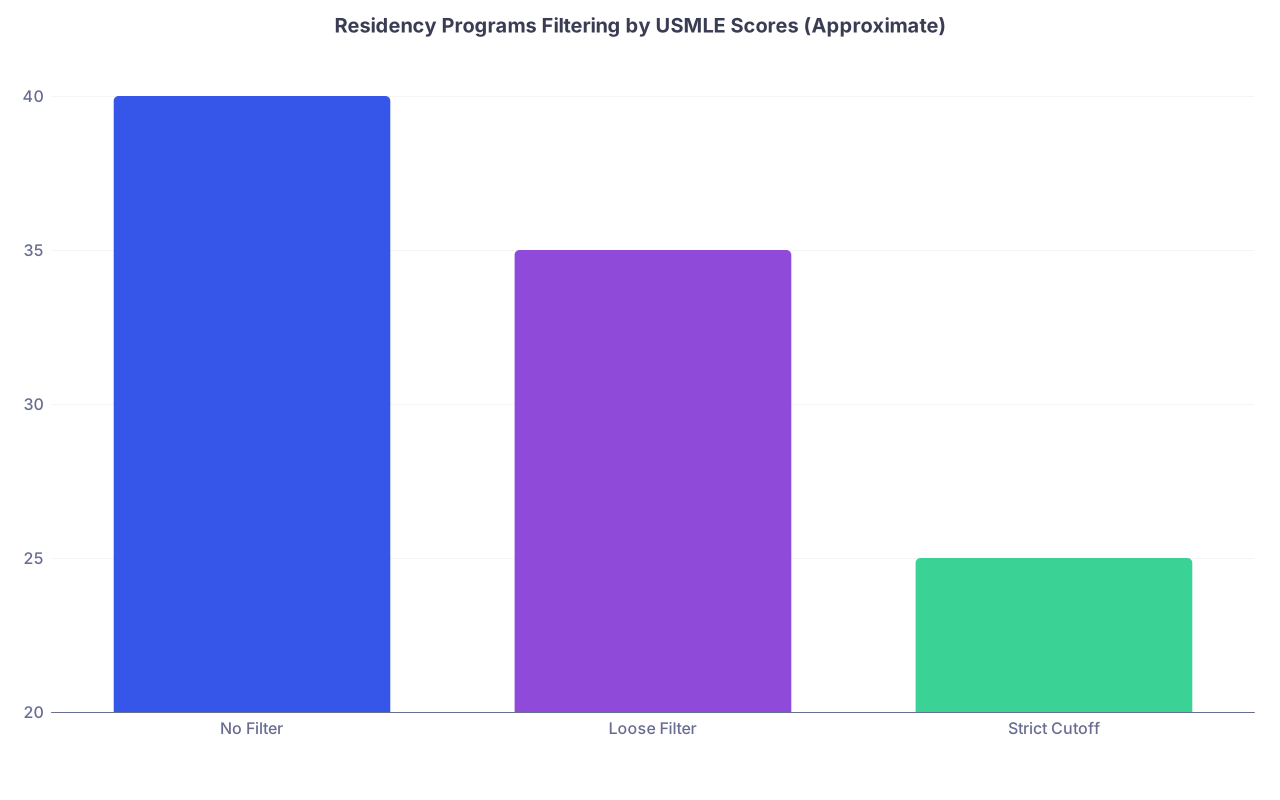
| Category | Value |
|---|---|
| No Filter | 40 |
| Loose Filter | 35 |
| Strict Cutoff | 25 |
I’m not going to sugarcoat it. Low Step scores are a red flag for programs. They trigger three big fears in faculty minds:
- You’ll fail boards (Step 3/ITE/ABIM/etc.)
- You’ll struggle with the intensity and speed of residency
- You’re not consistent or reliable academically
Is that always fair? No. But that’s the pattern.
So when an interviewer hones in on your score, they’re not trying to humiliate you. They’re stress-testing one question:
“If I stake my program’s board pass rate and my team’s workload on this person, will I regret it?”
That’s the game. You’re not defending a number. You’re reassuring them about risk.
Once you see it that way, the “low Step score” conversation stops being:
“Explain why you’re bad at tests.”
and becomes:
“Show me you’ve changed, learned, and won’t crash in residency.”
Very different energy.
You Need One Core Script. Then You Customize It.
The worst mistake? Trying to wing this.
If you have a low Step score and you go into interviews without a rehearsed, tight, honest explanation that you’ve said out loud 50 times… you’re asking to spiral.
You need a script. Not to sound robotic, but to avoid panic-brain. Think of it as your “Step story,” with 4 parts:
- A brief, clear acknowledgment
- A concrete explanation (no drama, no excuses)
- Evidence of change and improvement
- Forward-looking reassurance
Here’s the structure:
1. Acknowledge
- “You’re right, my Step 1 score is below average and I know that raises concerns.”
Not:
“I mean, it’s not that low if you look at XYZ…”
or
“Honestly, I think Step is a terrible exam and—”
You take the hit. Calmly.
2. Explain without whining
Think context, not excuses. One or two sentences max.
- “At that time, I was still figuring out how to study efficiently for massive standardized exams.”
- “I didn’t adjust quickly enough to question-based learning and active recall, and it showed.”
- “I made the mistake of relying too much on passive studying and not enough timed practice.”
Avoid the messy stuff unless it’s truly critical and documented (serious illness, major life event). And even then, keep it short and clinical, not a 5-minute sob story.
3. Show what changed (this is the money part)
This is where you either win them back… or you don’t.
You want very specific, measurable changes:
- “After that score, I met weekly with our learning specialist and completely rebuilt my study strategies.”
- “I increased my question bank volume from ~500 questions for Step 1 to over 3,000 timed questions for Step 2.”
- “I went from barely passing early shelf exams to scoring in the top quartile on my last three.”
Tie it to results whenever you can:
- Higher Step 2 / COMLEX Level 2
- Rising shelf scores
- Strong ITE if you already have it (for prelims/transition)
- Honors in heavy-cognitive rotations (IM, Surgery, etc.)
4. Reassure them about the future
End with confidence, not apology.
Something like:
- “Because of that process, I’m now much more structured and data-driven in how I learn. I’m confident I can handle in-training exams and Step 3, and my recent performance reflects that.”
- “The score was a wake-up call. It forced me to fix things I’d been getting by on for years, and I’m genuinely better for it now.”
Not fake bravado. Just calm, earned confidence.
Exact Phrases You Can Steal (Because My Brain Also Goes Blank)
Let me give you some word-for-word responses you can adapt. Say them out loud. See what feels like you.
If they ask directly: “Why is your Step score low?”
- “You’re right, my Step 1 score is lower than I would’ve liked. At that point, my study approach was still very passive. I was reading a lot but not doing enough timed questions or spaced repetition. After that, I completely overhauled my approach—met with our learning specialist, switched to heavy question-based learning—and that’s reflected in my later performance: I improved significantly on Step 2 and my last several shelf exams were all above the 75th percentile.”
If they say: “Does this score reflect your true ability?”
- “I don’t think it reflects where I am now. It does reflect that at that time, my approach to standardized exams wasn’t good enough. I took that seriously. Since then, I’ve changed how I learn: using Anki consistently, doing thousands of timed questions, and tracking my weaknesses. The improvement you see in my Step 2 and shelf scores is directly from that process.”
If they’re harsh: “We’re worried about you passing boards.”
- “That’s absolutely a fair concern, and it’s something I’ve taken seriously since that score. I used it as a signal to change, not something to ignore. Since then, I’ve shown I can perform at a higher level: [insert evidence here—Step 2, shelves, coursework]. I also now have a very structured system for preparing for exams that I’d use for in-training exams and boards, and I’d be proactive about checking in with faculty early if I felt I wasn’t on track.”
If they ask: “What did you learn from that experience?”
- “That coasting on intelligence isn’t a strategy. I’d gotten through undergrad and pre-clinicals without really having to optimize how I learned. Step forced me to get serious about systems—daily schedules, accountability, data on my performance. It was painful at the time, but it’s made me much more disciplined, which I think is actually an asset now.”
Practice these so they sound like you, not like a script you memorized 10 minutes ago.
What If They Keep Pushing? (The Truly Awkward Scenario)
This is the real fear, right? Not just one question. But they won’t let it go.
“Ok, but why didn’t you fix this sooner?”
“Why should we believe you now?”
“What if you fall behind here too?”
That’s when the panic voice in my head starts: They hate me. I’m done. I should crawl out the side door.
You need a plan for that too.
Strategy for when they keep circling back
Stay emotionally flat. The more defensive, flustered, or desperate you sound, the worse it looks. You answer like you’ve talked about this before and you’re not ashamed of it anymore.
Go back to your framework. Acknowledge → explain → show change → reassure. Over and over if needed, just with slightly different words.
Gently broaden the conversation. This is key. You start to link your “low score” story to broader strengths.
For example:
- “You’re right to press on this. I’d be worried too if I were in your position. What I can say is that the same process I used to improve—being coachable, using feedback, tracking my data—is exactly how I’ve approached clinical work. On my medicine rotation, for example, my attending commented that I ‘consistently improved week-to-week’ and ‘responded very well to direct feedback.’ That’s the kind of learner I’d be here as well.”
You’re basically saying:
“Yes, I had a weakness. No, I didn’t ignore it. Yes, I know how to grow.”
What If My Step 2 / Level 2 Isn’t Great Either?
This is the darker version of the nightmare. Not just one low score. Maybe both are mediocre or low.
You can’t pretend your way out of that. But you still have options.
You shift from:
“Look, I improved the numbers”
to:
“Look, I improved the process and I’ve proven myself in other ways.”
You lean heavily on:
- Strong clinical evaluations
- Comments about work ethic, reliability, teamwork
- Concrete examples of handling heavy workloads
- Letters that explicitly address your performance and growth
And you say something like:
- “My standardized test scores are not the strongest part of my application, and I understand the concern that raises. Where I feel I add value—and where I’ve consistently gotten positive feedback—is in the clinical environment: taking ownership of patients, following through, and being a dependable team member. For example, on my sub-I in internal medicine, my attending specifically noted that I ‘functioned at the level of an intern’ in terms of reliability and follow-up.”
You’re not hiding your weakness. You’re saying, “This is a known issue, but the real-world version of me is someone you can trust on the wards.”
Use Your Application to Pre-Soften the Blow
You can’t stop programs from noticing your score. But you can control whether they’re surprised by it or walk in thinking, “Okay, I already understand this story.”
Two places to pre-empt the conversation:
- Personal statement (short, 1–2 sentences — don’t make it the whole essay)
- Additional information / “anything else you want us to know” sections
Example:
- “During my Step 1 preparation, I realized too late that my study approach—heavy on reading and light on question practice—wasn’t effective, and my score reflects that. I’ve since overhauled my learning methods, leading to stronger performances on clerkship exams and Step 2, and I now approach challenges with a much more structured and reflective mindset.”
You’re doing two things here:
- Showing insight and ownership
- Making it less awkward in the interview because they’re not “catching you off guard”
Quick Reality Check: Programs Aren’t Obsessed With Your Score Forever

There’s this illusion that every interviewer is sitting there with your Step score burned into their brain like a neon sign.
They’re not.
They see dozens of applicants. They forget numbers. What they remember are impressions:
- Confident or shaky?
- Blame-y or accountable?
- Growth-minded or stagnant?
- Someone I’d want at 3 a.m. on call, or someone who feels risky?
If you handle your low score conversation like an adult, they’ll remember:
“Yeah, their score was low. But they owned it and they’ve clearly grown.”
If you crumble, get defensive, over-explain, or spiral into self-flagellation, they remember:
“Score was low and I don’t really trust them to handle pressure.”
Same score. Different story.
Tiny Tactical Things That Help When You’re Anxious

| Step | Description |
|---|---|
| Step 1 | Interviewer asks about low score |
| Step 2 | Pause and breathe once |
| Step 3 | Acknowledge score calmly |
| Step 4 | Give brief explanation |
| Step 5 | Describe changes you made |
| Step 6 | Share objective results or feedback |
| Step 7 | Reassure about future performance |
| Step 8 | Transition to related strength or experience |
Because my brain loves spinning out, I rely a lot on small, stupid-sounding tactics to stay functional.
A few that actually help:
- Micro-pause before answering. One slow breath. It keeps you from blurting something defensive.
- Hands on your lap, not gripping the chair. It keeps your body from showing how much you’re freaking out.
- Anchor sentence in your head. Something like: “Low score, I learned, I improved, I’m okay now.” Use that as your mental roadmap.
- Have one “transition story” ready. For after you answer, you can say, “That experience really shaped how I approached my sub-I in medicine…” and then tell a short success story. It moves the conversation away from just numbers.
Programs That Will Hammer You vs Programs That Won’t
| Program Type | Likely Behavior with Low Scores |
|---|---|
| Top academic, super competitive | More likely to press hard |
| Mid-tier academic | Mixed, depends on individual |
| Community, high service | Often more focused on work ethic |
| Home program / known to you | More context, potentially softer |
| Programs with low board pass stress | Generally less obsessed |
Not all programs will grill you.
Some will ask once and move on. Some won’t bring it up at all. A few will hammer it.
Weirdly, the programs that press you the hardest might actually be the ones that rank you higher—because they cared enough to test the risk, and you passed.
And yes, there will be one or two that feel awful. Where the interviewer’s face never softens, and you walk out convinced you just witnessed them mentally dragging your application to the recycling bin.
That will happen. To basically everyone.
It doesn’t mean every program will treat you that way. It doesn’t mean interviews are going terribly overall. It definitely doesn’t mean you’re doomed to not match.
It just means… that one sucked.
How to Practice Without Melting Down

Rehearsing this stuff in your head doesn’t count. Because in the actual interview, your mouth is what betrays you, not your brain.
Do this:
- Write your Step story out. One paragraph. Acknowledge → explain → change → reassure.
- Say it out loud. You’ll hate it at first. You’ll sound stiff and fake. Keep going.
- Record yourself on your phone. Cringe. Rewrite. Say it again.
- Have someone you trust ask the question 5 different ways. Not just the nice version. Include:
- “Why did you do so poorly?”
- “Are you going to fail boards?”
- “This is a red flag. Convince me otherwise.”
If you can answer those, calmly, while your friend is staring at you, the real thing gets easier.
Your Worst Fear vs Reality
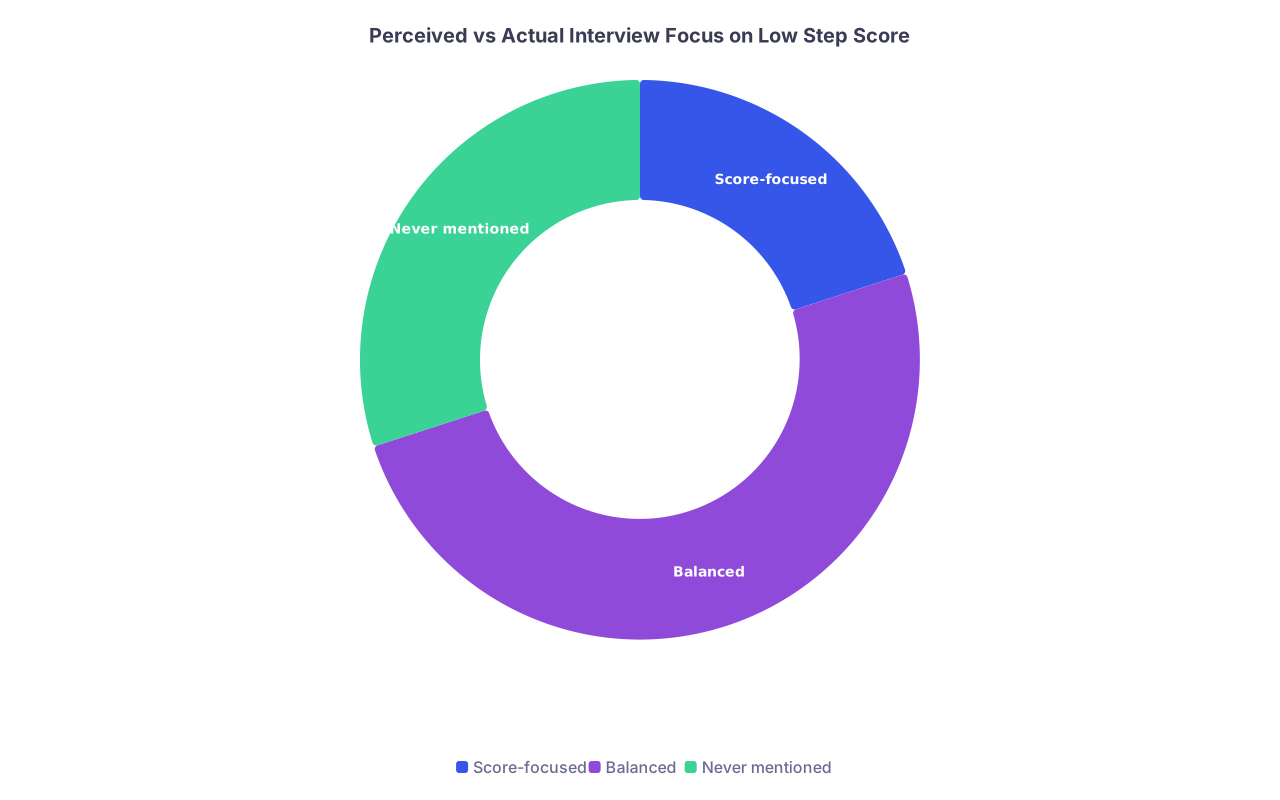
| Category | Value |
|---|---|
| Score-focused | 20 |
| Balanced | 50 |
| Never mentioned | 30 |
The fear in your head:
“Every interview will be an interrogation about my Step score.”
The reality for most people with low scores tends to be closer to:
- A few programs really dig in (maybe 1–3)
- Several ask one or two questions and move on
- A surprising number never bring it up explicitly
But because our brains are wired for shame, we remember the worst one and let it define everything.
Your job is not to prevent anyone from ever mentioning your score. You can’t.
Your job is to make sure that when they do, you look like someone who can take a hit, learn, and keep going.
That’s literally residency.

FAQs
1. Should I bring up my low Step score myself if they don’t ask?
Usually no. If your Step 2 is significantly higher and you want to highlight that improvement, you can briefly mention the contrast when they ask about strengths, challenges, or growth. But don’t randomly open with, “So my Step score is low…” if they weren’t going there. Let your pre-written application and score report tell that part unless there’s a natural hook.
2. What if I get emotional when talking about it?
You’re human. If you feel yourself getting emotional, pause, take a breath, and say something like, “It was a tough experience at the time, but I’m actually grateful for how much I learned from it.” That reframes it. If you tear up slightly but stay composed, most interviewers won’t hold it against you. What matters more is that you recover and finish your answer clearly.
3. Is it okay to blame external factors, like family issues or school chaos?
You can mention real external factors briefly, especially if they were significant and documented (major illness, death, serious personal crisis). But you still need to show ownership: “These things were happening, and I didn’t yet have the skills or support to manage them and keep my studying where it needed to be.” Pure blame without self-reflection reads badly.
4. What if my score is below the program’s usual cutoff—am I wasting my time interviewing there?
If they invited you, they already decided you were worth a closer look despite the score. That means something else in your application is compelling: letters, clinical performance, unique background, research, something. You’re not a mistake. You’re a calculated risk they’re willing to explore. Your job is to justify that risk, not apologize for existing.
5. How do I stop obsessing over the low score before every interview?
You probably won’t stop completely. But you can contain it. Have your Step story printed on a notecard. Read it before each interview. Do one or two practice runs out loud the morning of. Then mentally say, “Okay, that’s handled. If it comes up, I know what to say.” After that, focus on everything else you bring: your rotations, your patients, your interests. You’re not just a number unless you let yourself act like one.
Key points, quickly:
- You need a tight, honest, rehearsed Step story: acknowledge → explain → show change → reassure.
- Interviewers care less about the number than about whether you look like a risk or a learner who’s grown.
- One awful, score-focused interview doesn’t define your cycle. You only need enough people to see the stronger version of you, not the number on the PDF.