
The blunt advice you got – “You should probably give up on that specialty” – is not the final verdict on your career. It’s one data point. And often a lazy one.
If your Step score is lower than you wanted and advisors are telling you to walk away from your preferred specialty, you’re in a very specific, high‑stress situation. This isn’t theoretical. This is: rank list season, ERAS decisions, soap-or-no-soap, and the feeling in your gut that you’re being pushed off the path you actually want.
Let me walk you through what to do, step by step, as someone who’s watched this exact movie play out hundreds of times.
Step 1: Translate “Give Up” Into Actual Numbers
Most advisors speak in vibes, not data. You need numbers.
First, lock down how far off you really are from your specialty’s norms.
| Specialty | Typical Matched Step 2 CK | “In Range” If You Are… |
|---|---|---|
| Dermatology | ~255–260+ | Within 10–15 points |
| Orthopedics | ~250–255 | Within 10–12 points |
| ENT | ~250–255 | Within 10–12 points |
| General Surgery | ~245–250 | Within 10–12 points |
| Internal Med (university) | ~240–245 | Within 10 points |
| Family Med | ~225–235 | Within 15 points |
These numbers move slightly year to year, and Step 1 being pass/fail reshuffles things, but the idea stands.
Here’s what you do:
- Look up the most recent NRMP “Charting Outcomes in the Match” for your specialty.
- Check:
- Mean Step 2 CK score of matched applicants in your specialty.
- Match rate for applicants in your score range.
- Compare your situation honestly:
- If you’re within ~10 points of the average for a moderately competitive specialty, you’re not dead in the water.
- If you’re 15–20+ points below a hyper-competitive specialty (derm, plastics, ortho, ENT, neurosurgery), you’re in “long‑shot, must have other major strengths” territory.
- If you failed Step or have multiple attempts, your strategy is different (we’ll get there).
The big question: are you slightly below, significantly below, or completely out of range?
Most “you should abandon this” comments don’t distinguish that. You will.
Step 2: Figure Out Which Kind of Advisor You’re Dealing With
Not all advisors are equal. Some are trying to protect you from a scramble nightmare. Some are projecting their own fear. Some are just out of date.
You’re usually dealing with one of these:
The numbers‑only gatekeeper
They see your score, think “below median,” and immediately steer you to backup fields. They’re not trying to hurt you – but they’re risk‑averse and don’t want your no‑match on their stats.The brutally honest mentor
They know your preferred specialty well. They’ve seen dozens of cycles. When they say, “With your Step and no research, matching derm is extremely unlikely,” they’re probably right.The conflict‑of‑interest advisor
They’re tied to a specific department that wants only high‑stat residents. Their perspective is skewed by their own program’s competitiveness, not the broader national landscape.The disengaged form‑filler
They’ll check a box on your dean’s letter template and move on. Their “advice” is generic.
Your job: identify which you have.
If your advisor:
- Cannot quote basic benchmark Step scores for your specialty.
- Cannot differentiate between community vs university vs top 10 programs.
- Immediately suggests backup specialties after seeing your score without asking about anything else (research, prior career, away rotations, connections)…
…you should not let this person be the primary architect of your career.
You still listen. But you double‑check everything with a second and third opinion, ideally:
- A program director or APD in your target specialty (even at a smaller/community program).
- A recent resident or fellow who matched into that specialty with less‑than‑perfect stats.
- Someone at your school who actually tracks match data and can pull “students with your score who matched X.”
Step 3: Clarify What “Preferred Specialty” Actually Means For You
Before we map a strategy, you have to be honest about why you want this.
There’s a big difference between:
- “I shadowed Ortho 3 times, looks cool, makes money.”
versus - “I’ve spent 2 years in neurology clinic, did research, co‑founded a stroke education project. I think about this work all the time.”
Here’s a quick self‑audit. Answer these for yourself, on paper:
- How many weeks have you actually spent in this specialty (core, elective, sub‑I, away)?
- Have you worked on any projects (research, QI, education) in the field?
- Can you name 2–3 mentors in the specialty who’d recognize your name and vouch for you?
- If you picture doing a different but related specialty (e.g., IM instead of cards, gen surg instead of ortho), does it feel:
- Devastating
- Disappointing but tolerable
- Basically fine?
If your interest is deep and tested, you’re more justified taking a higher‑risk path to chase it.
If your interest is shallow and mostly based on reputation/income, a lower‑risk pivot might actually be smarter and less painful long term.
This matters because the advice shifts:
- Deep, durable interest → design a dual‑path strategy that keeps the dream specialty alive while protecting you from a no‑match catastrophe.
- Mild, flexible interest → strongly consider shifting to an adjacent or less competitive field sooner rather than later.
Step 4: Build a Dual‑Path Strategy (Dream + Safety)
Never let an advisor box you into “either you chase your dream and risk disaster, or you give it up entirely.” False choice.
What you want is a structured dual‑path plan:
- Primary path: Your preferred specialty, targeted and realistic.
- Protective path: A related or compatible specialty where your chances are much higher.
Let’s make that concrete with a few common scenarios.
Example 1: Ortho with a 232 Step 2
- Data: Your score is well below the typical matched ortho candidate.
- Real talk: Matching ortho will be difficult unless you have:
- Strong ortho research with pubs/abstracts.
- Great home/away rotation performance.
- Heavy faculty advocacy.
Dual‑path strategy:
- Apply to a small, realistic list of ortho programs: places you’ve rotated, programs where faculty will call, community programs, less geographically competitive regions.
- Simultaneously apply broadly in general surgery or a prelim surgery year.
- Decide before rank list:
- If you don’t get enough ortho interviews, rank gen surg/prelim aggressively and mentally commit to possibly reapplying to ortho later or staying gen surg if you like it.
Example 2: EM with a 220 Step 2 in a tightening market
EM has compressed. Scores matter more now.
- Dual‑path:
- EM as primary: regional, community‑heavy list, plus any programs where you’ve done away rotations.
- Backup: IM or FM, depending on your true tolerance for inpatient/heavy continuity care.
Example 3: Radiology or Anesthesia with a low score
These sit in the middle – competitive, but not derm/ortho level.
- If you’re ~10–15 points below the average, you can:
- Apply a mix of rads/anesthesia and IM/FM as backup.
- Use faculty who believe in you to push you over the line at a few programs.
The point: you do not choose between “all‑in on impossible” or “completely abandon.” You structure your list and application content so you have:
- A believable narrative for your preferred specialty.
- A coherent narrative for your backup that doesn’t sound like a cheap afterthought.
Step 5: Decide Whether to Delay Graduation or Take a Research Year
Some specialties, if your Step score is weak, practically require an extra leg up:
- Dermatology
- Plastic surgery
- ENT
- Neurosurgery
- Sometimes ortho
If your advisor says “give up” for one of these and your score is clearly below standard, the alternatives are:
- Accept reality and move to a related specialty (IM → cards, FM, gen surg with niche interests).
- Extend med school or take a dedicated research year to offset the score.
Here’s when I’d say a research year is actually worth it:
- Your Step isn’t catastrophic, but it’s clearly below average for the field (say, 240 in derm).
- You’re at an institution with real research infrastructure in that specialty.
- You can get on multiple projects with high‑yield mentors (people whose names show up on resident publication lists for that specialty).
- You’re willing to fully commit another 12–18 months, mentally and financially.
And when it’s usually a bad idea:
- You’re chasing a prestige heavy specialty mostly for status or income.
- You have no strong prior involvement in the field.
- Your school has weak research connections in that specialty and you’d be fabricating your own path from scratch during a gap year.
- You already have professionalism concerns or marginal clinical performance – those matter more than an extra pub list.
Sometimes the bravest move is: “I’m not going to drag this out two more years for a 10% chance at derm when I’d be very happy in rheum or heme/onc via IM.”
Step 6: Rewrite Your Story – On Paper and In Your Head
A low Step score changes how you have to present yourself. If you don’t control that narrative, your advisors will – and they’ll usually spin it pessimistically.
You need a clean, confident story that:
- Acknowledges the elephant in the room without obsessing over it.
- Redirects attention to what actually makes you a strong fit.
If you failed Step or barely passed:
- Personal statement: one concise paragraph explaining what happened, what changed, and how your later performance (clerkships, sub‑Is, Step 2 improvement, or shelf scores) shows growth.
- Letters: ask faculty who can comment on your work ethic, reliability, and clinical reasoning. Many PDs will value a glowing letter over a 5‑point higher score.
If your score is just “meh”:
- Don’t over‑apologize. Do not turn every essay into Step therapy.
- Lift up your strengths:
- Consistently strong clerkship comments.
- Long‑term engagement with a patient population or disease area.
- Leadership or tangible outcomes: QI project, protocol rollout, curriculum work.
You also need to rewrite your internal story. If all you hear in your head is your advisor’s voice saying “you should give up,” you will interview badly. You’ll sound half‑convinced you belong.
Replace that with something like:
“I’m not the 260 candidate. I’m the candidate who knows this field’s work, shows up early, does the unglamorous tasks well, and has 4 letters that say I make teams better.”
That’s not delusion. That’s focusing on the parts of your file that are actually persuadable.
Step 7: Adjust Your School List Like an Adult, Not a Fantasist
This is where many students blow it: they either only apply to dream programs or only to “safeties” and then hate their options.
Use a realistic distribution:
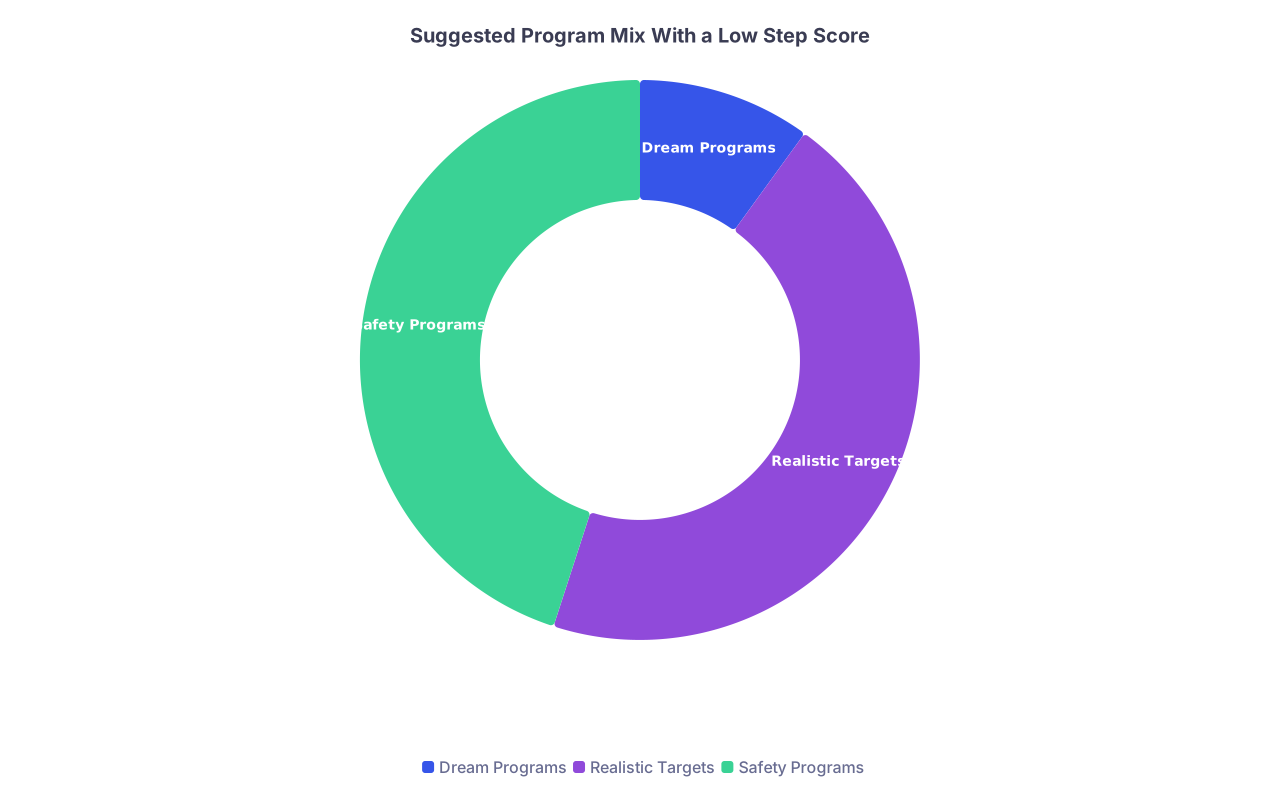
| Category | Value |
|---|---|
| Dream Programs | 10 |
| Realistic Targets | 45 |
| Safety Programs | 45 |
With a lower Step score in a competitive field, your ratios should tilt:
- 5–10% “reach” programs (big‑name academic centers, top tier locations).
- 40–50% realistic mid‑tier programs (regional academic, strong community).
- 40–50% safety‑leaning programs (community, less popular locations, new programs with decent track record).
To operationalize:
- Identify programs historically friendlier to lower scores:
- Look at program websites for minimum score cutoffs.
- Ask upperclassmen where people with similar stats matched.
- Be honest about geography:
- If you’re insisting on only West Coast or only NYC with a low score in a competitive specialty, you are artificially cutting your chances.
You don’t have to scattershot 100+ applications. You do have to stop pretending you’re in the same competitiveness bracket as your 260 peers.
Step 8: Get a Second Opinion – But Structure It
Random opinions will just confuse you. You need structured external advice.
Here’s the minimum set of people you should talk to:
- A program director or APD in your preferred specialty (doesn’t have to be at your dream program).
- A program director or senior resident in your likely backup specialty.
- One faculty mentor who actually knows you well as a person, not just as a Step score or CV.
When you talk to them, don’t just say “what do you think?” Ask:
- “Given my Step 2 score of X and Y experiences, if I apply to [specialty], what kind of program list would give me at least a 50–60% realistic shot?”
- “Would you consider writing a strong letter that directly addresses my clinical performance compared to peers?”
- “If you were in my shoes, would you dual‑apply? If yes, what second specialty would you pair with this one?”
Then compare their views with what your school advisor said.
If three separate people in your field – especially those who like you – all say, “This is not going to happen, even with a research year,” that’s very different from one generic advisor who waved you off after scanning your score.
Step 9: Decide How Much Risk You’re Actually Willing to Take
At the end of all the advice and data, it comes down to risk tolerance.
Some people would genuinely rather:
- Risk a no‑match or SOAP into something else, knowing they shot their shot at their dream field.
Others would:
- Sleep better choosing a close‑enough specialty with a high chance of matching this cycle.
Both are valid. But you must decide explicitly, not drift into one.
To make it concrete, ask yourself:
- If I don’t match this year in my preferred specialty, what happens to my finances? My visa status (if applicable)? My mental health?
- Am I okay with potentially SOAPing into a very different field or a prelim year?
- Would I consider reapplying after a prelim year or research year, or would I rather just move on?
I’ve seen:
- A student with a 225 who insisted on only EM, didn’t dual‑apply, no‑matched, SOAPed into prelim surgery, and then eventually shifted happily into anesthesia. Rough 2 years, but they don’t regret taking the shot.
- Another with a 230 desperate for ortho, who dual‑applied, matched categorical gen surg at a solid community program. Two years later, they realized they loved gen surg more than they loved the idea of ortho anyway.
There is no universally right answer. There is only “right for you, given your reality.”
Step 10: Handle the Emotional Fallout Without Letting It Wreck Your Cycle
Being told to dump your dream hurts. It feels like judgment on your intelligence and worth. That can bleed into everything – your essays, interviews, how you show up on rotations.
You don’t have to be a robot. But you can’t carry visible bitterness into interviews.
Practical things that help:
- Vent once, properly. With someone who gets it – a trusted classmate, therapist, partner. Say the ugly parts out loud: “I feel like they decided I’m stupid based on one test.”
- Then switch to action mode: specialty research, list building, email drafting. Behavior pulls emotion forward.
- On interviews, if your Step comes up: keep your tone matter‑of‑fact. One sentence of context, one sentence of growth, then pivot hard to strengths.
Example answer:
“Step 2 didn’t go as I’d hoped. I had some personal circumstances that year and I didn’t adjust well. Since then, my sub‑I evaluations and my work on the ICU rotation better reflect what I can do – especially in high‑acuity settings, which is where I see myself in this field.”
No whining. No oversharing. Just aligned with your new, grown‑up narrative.
A Visual Snapshot: Your Decision Flow
Use this to sanity‑check your situation:

| Step | Description |
|---|---|
| Step 1 | Low Step Score |
| Step 2 | Consider moderate risk |
| Step 3 | High risk |
| Step 4 | Dual apply plus focused list |
| Step 5 | Shift to related specialty |
| Step 6 | Plan funded gap year |
| Step 7 | Proceed with cycle |
| Step 8 | How far below specialty mean |
| Step 9 | Deep commitment to field |
| Step 10 | Research year needed? |
And remember: none of these boxes say “advisor’s first comment = final answer.”
Two Closing Truths To Keep In Your Pocket
- A low Step score limits your options; it does not erase all of them. Especially if you get strategic, not reactive.
- Advisors are allowed to be blunt. They are not allowed to be the only voice you listen to. You’re the one who has to live the career, not them.
Use their caution where it’s justified. Ignore their fatalism where it’s lazy.