
Dermatology is one of the most competitive specialties in medicine. If you didn’t match into dermatology, you are far from alone—and you’re not out of options. Many excellent dermatologists were once an unmatched applicant. What matters now is how strategically and deliberately you respond.
This guide will walk you through a structured recovery plan after a failed match in dermatology: how to understand what happened, what to do immediately, how to rebuild your application, alternative pathways, and how to protect your mental health along the way.
Understanding a Failed Derm Match: What It Really Means
Not matching dermatology is painful, but it is not a judgment on your worth as a future physician. It’s a reflection of:
- The extreme competitiveness of dermatology residency
- Numbers (too many strong applicants for too few positions)
- The specific strengths and weaknesses of your current application
- Sometimes, sheer luck and randomness in rank lists
Why Dermatology Residency Is So Competitive
Key factors:
- Limited spots: Far fewer positions compared to internal medicine or pediatrics.
- High applicant quality: Many applicants have strong scores, research, AOA, and advanced degrees.
- Lifestyle appeal: Predictable hours, procedural focus, and diverse pathology.
- Program risk aversion: Programs may favor “proven” candidates (home students, known rotators, strong home mentors).
This means an objectively strong applicant can still fail to match dermatology, especially if one or two major elements of the application are misaligned.
Common Reasons Applicants Don’t Match Dermatology
Use this list not to blame yourself, but to diagnose. Most unmatched applicants fall into one or more of these categories:
Academic metrics below the average matched derm applicant
- Lower USMLE/COMLEX scores
- Remediation, leaves of absence, or failed exams
- Weaker clinical grades or a transcript without honors in core rotations
Limited or unfocused dermatology research
- Little to no derm-specific research
- Projects not resulting in publications/posters
- Weak or nonexistent connection to derm investigators who can advocate for you
Insufficient dermatology exposure
- Few or no dermatology rotations
- No away rotations at academic derm departments
- Minimal evidence you truly understand the field and its realities
Letters of recommendation that lack impact
- Letters from non-dermatologists when derm letters were expected
- Generic or lukewarm letters without strong, specific praise
- No letter from a well-known derm faculty member who can “pick up the phone” for you
Application strategy issues
- Applied to too few programs
- Overly regional or selective list
- Did not target a mix of academic, community, and hybrid programs
- Poorly tailored personal statement or misaligned messaging
Interview and ranking pitfalls
- Few or no interviews received (application red flags or weak application)
- Poor interview performance (rigid answers, poor communication, limited insight)
- Risky rank order list strategy (ranking too few programs, “ranking with your heart” instead of realistically)
Your recovery starts with an honest assessment of which of these played a role for you.
First 30 Days After Not Matching Dermatology
Your immediate steps depend on whether you are completely unmatched or matched into a preliminary or transitional year but not a dermatology advanced spot.
Step 1: Stabilize Emotionally and Practically
- Give yourself a few days to process. Grief, anger, and embarrassment are normal.
- Avoid impulsive decisions like changing specialties overnight, sending emotional emails to programs, or withdrawing from medicine.
- Lean on trusted support: close friends, family, mentors, or a counselor. Burnout and depressive symptoms after a failed match are common and serious.
Step 2: Clarify Your Match Outcome and Options
There are typically three scenarios:
Didn’t match anywhere (no PGY-1)
You will use SOAP (if in the US) or your country’s equivalent, or prepare for a gap year.Matched into a preliminary or transitional year but not derm (or didn’t match the advanced dermatology position)
You’ll complete your PGY-1 year and then reapply, either for a PGY-2 derm spot or full-track positions in the next cycle.Unmatched applicant with an existing categorical offer in another specialty (e.g., IM, peds) but yearning for derm
You can:- Proceed with that specialty and keep derm as a long-shot goal later, or
- Decide to pivot fully into that specialty and let go of dermatology.
Each path is viable; what matters is aligning it with your values and realistic chances.
Step 3: Use SOAP Strategically (If Applicable)
If you’re in the US and enter SOAP as an unmatched applicant:
- Be pragmatic, not perfectionistic.
Securing any PGY-1 position (prelim medicine/surgery, transitional year) can be powerfully helpful for your derm match recovery. - Don’t expect derm positions in SOAP.
Dermatology rarely has SOAP positions; if they exist, they are extremely limited and filled fast. - Prioritize programs that:
- Have a strong academic environment
- Offer research opportunities
- Historically send residents into derm or other competitive subspecialties
This year’s SOAP outcome can significantly influence your derm match story and timeline.

Deep-Dive Application Autopsy: Why You Didn’t Match
Once the initial shock subsides, it’s time for a structured, honest application review—your personal “derm match autopsy.” Done well, this is the single most important part of your failed match recovery.
Step 1: Gather Input From Multiple Mentors
You need feedback from:
- At least one dermatology faculty member
- Your medical school’s dean or academic advisor
- Possibly a program director (derm or your prelim specialty)
- Someone skilled in CV and personal statement review (could be the same people)
If you didn’t have a derm mentor during your initial application, make securing one a top priority now.
Actionable step:
Email 2–3 potential mentors with:
- A brief, honest summary of your situation
- Your CV, personal statement, and ERAS application
- Your score report and transcript
- A specific ask: “I’d be grateful for a frank assessment of why I might not have matched dermatology and how I could realistically strengthen my application over the next 12–24 months.”
Step 2: Review the Core Components Objectively
Have your mentors—and yourself—rate each of these areas as strong / average / weak / concerning:
USMLE/COMLEX and grades
- Were your Step 1 (if numeric), Step 2 CK, and COMLEX levels in or near the typical matched derm range?
- Any fails or repeats? These are not fatal, but they require explanation and offsetting strengths.
Dermatology-specific engagement
- Rotations: home derm, away rotations, sub-internships?
- Evidence of genuine, sustained interest rather than late-switch or superficial exposure.
Research and scholarly productivity
- Number and quality of derm publications, abstracts, posters, or QI projects.
- Your role: first author vs. minor contributor.
- Ongoing, active projects vs. one-off efforts.
Letters of recommendation
- At least 2–3 derm letters?
- Do any come from nationally recognized or regionally influential dermatologists?
- Were there any red flags or tepid comments?
Personal statement and narrative
- Clear, compelling story about why derm and why you?
- Any potential off-putting themes (e.g., overly focused on lifestyle, sounding entitled, or vague)?
Interview performance (if you had interviews)
- Did you feel comfortable, authentic, and well-prepared?
- Any interviews where you felt you “bombed” or miscommunicated?
- Did mentors conduct mock interviews with you beforehand?
Application and ranking strategy
- How many derm programs did you apply to?
- Did you submit early and completely?
- How many programs did you rank and what was your rationale?
Step 3: Identify Your “Primary Limiter”
Most unmatched dermatology applicants have one primary limiter plus 1–2 secondary weaknesses. Typical primary limiters include:
- Score/academic metrics below average derm standards
- Minimal derm research and no academic productivity
- Weak letters or mentorship
- Poor interview skills
Naming your main limiter is powerful because it should shape your strategy for the next 1–2 years.
Building a Comeback Plan: 12–24 Month Strategy
Once you understand your application’s deficiencies, you can design a structured recovery plan. For many, this plan spans 1–2 application cycles.
You essentially have three main paths:
- Reapply dermatology strongly, with a significantly improved application
- Pursue a derm-adjacent or preliminary year, then reapply
- Transition to another specialty while keeping derm research or connections alive
Below are key components you can mix and match.
1. Derm Research Year or Fellowship
For many unmatched applicants, a dedicated research year is the single most effective step—especially if your main limitations were research, mentorship, or networking.
Ideal derm research position:
- At an academic dermatology department
- With a known faculty mentor who publishes regularly
- In a program that has historically taken their research fellows into derm
- Offering exposure to clinics, conferences, and resident education
Your goals during a derm research year:
- 2–3+ abstracts/posters and at least 1–2 peer-reviewed publications
- Strong, detailed letters from derm faculty who have seen your work ethic
- Expanded network of program directors and faculty who know you by name
- Clear evidence of commitment to dermatology and academic productivity
If you didn’t match and have no derm research yet, a research year can transform your candidacy from “generic unmatched applicant” to “serious, academically inclined future dermatologist.”
2. Maximizing a Prelim or Transitional Year
If you SOAPed into or already matched a preliminary or transitional year:
Excel clinically
- Aim for glowing evaluations; program directors talk.
- Seek leadership roles (chief prelim, resident committees).
Stay actively involved with derm
- Continue ongoing research remotely with a derm mentor.
- Take electives in dermatology if available at your hospital or nearby.
Leverage your PD and faculty
- Ask your prelim PD for a supportive letter highlighting your work ethic, professionalism, and clinical skill.
- Explain your derm aspirations honestly and respectfully.
This strategy shows derm programs you function well in residency, can handle clinical demands, and are not solely focused on “chasing derm” at the expense of patient care.
3. Strengthening Letters and Mentorship
For unmatched dermatology applicants, letters often make or break the second attempt.
Action steps:
- Work closely with at least one derm faculty member on research, clinics, or teaching.
- Demonstrate reliability: show up early, meet deadlines, volunteer for extra tasks.
- Explicitly ask for feedback: “How could I improve as a future dermatology resident?”
- When timing is right, ask for a strong letter of recommendation (not just “a letter”).
A letter that says, “I would rank this applicant at the top of my own program’s list” is far more powerful than a generic endorsement.
4. Repairing Academic Concerns
If your central issue is a low score or academic red flag:
- Aim for a strong Step 2 CK or Level 2/3 performance (if still pending).
- If exams are done, focus on:
- Honors in key rotations (IM, surgery, derm electives)
- Clear explanation of past academic issues in your personal statement and dean’s letter
- Consistent pattern of improvement over time
Derm programs will consider applicants with blemishes who show a convincing upward trajectory, maturity, and self-awareness.
5. Refining Your Application Narrative
You must control the story of your failed derm match:
- Don’t ignore it entirely in your application; programs will see the timeline.
- Do frame it as:
- A challenge that forced you to grow
- An opportunity that deepened your commitment to dermatology
- Evidence of resilience, humility, and perseverance
In your personal statement and interviews, move from “I didn’t match” to:
“This is how I responded, what I learned, and why I’ll be a better resident because of it.”
Alternative Pathways: When and How to Pivot
Not everyone who doesn’t match dermatology should reapply. For some, the better path is a related specialty or a longer-term, indirect route into derm.
Early Signs You May Need to Pivot
Consider pivoting away from derm as the primary goal if:
- You have multiple failed derm attempts with minimal interview invitations.
- You have persistent academic red flags that cannot realistically be offset.
- Derm mentors you trust consistently advise that your odds remain very low despite improvement.
- The process is harming your mental health to the point where you no longer enjoy medicine.
Pivoting is not failure; it’s good career triage.
Derm-Adjacent Career Paths to Consider
If you love skin, procedures, or aesthetics, there are many rewarding alternatives:
Internal Medicine or Pediatrics → Dermatology-adjacent
- Rheumatology (connective tissue diseases, vasculitis, psoriasis-related arthritis)
- Allergy/Immunology (urticaria, atopic dermatitis)
- Infectious disease (HIV derm manifestations, tropical derm conditions)
Family Medicine
- With additional training, many FM physicians focus heavily on dermatologic care in underserved areas.
- Can pursue procedural training in skin biopsies, excisions, cosmetic procedures.
Pathology (Dermatopathology focus)
- Path residency followed by dermpath fellowship.
- Very skin-focused, heavy on morphology and diagnostics.
Plastic Surgery or Mohs-focused surgery (for those who truly love procedures)
- Much more competitive, but for some, a better overall fit.
Non-residency aesthetic and cosmetic pathways
- Depending on your country/region, some physicians build careers in cosmetic dermatology-like practices via regulatory-compliant routes, CME, and procedural training.
A fulfilling career in or around skin disease is absolutely possible without a traditional dermatology residency.
Protecting Your Mental Health and Professional Identity
A failed match in dermatology can shake your confidence and identity. Many applicants define themselves by their dream specialty; when that falls through, it can feel like a personal collapse.
Normalize the Experience
- Many excellent physicians didn’t match their first-choice specialty.
- At competitive derm programs, faculty quietly know multiple colleagues with non-linear paths.
- The fact that you are reading and planning a recovery already sets you apart.
Practical Mental Health Strategies
- Seek counseling or therapy if you experience persistent low mood, anxiety, or thoughts of worthlessness.
- Stay connected: Isolation magnifies shame. Confide in trusted classmates, co-residents, or mentors.
- Limit social comparison: Take breaks from social media around Match season.
- Maintain non-medical activities: Exercise, hobbies, relationships—these protect against total identity fusion with career outcomes.
Reframe Your Professional Story
Over time, your narrative can become:
“I faced a major setback early in my career, learned from it, worked hard to grow, and came out the other side as a more resilient, thoughtful physician.”
Whether you ultimately achieve a derm match or pursue a different path, that story is powerful.
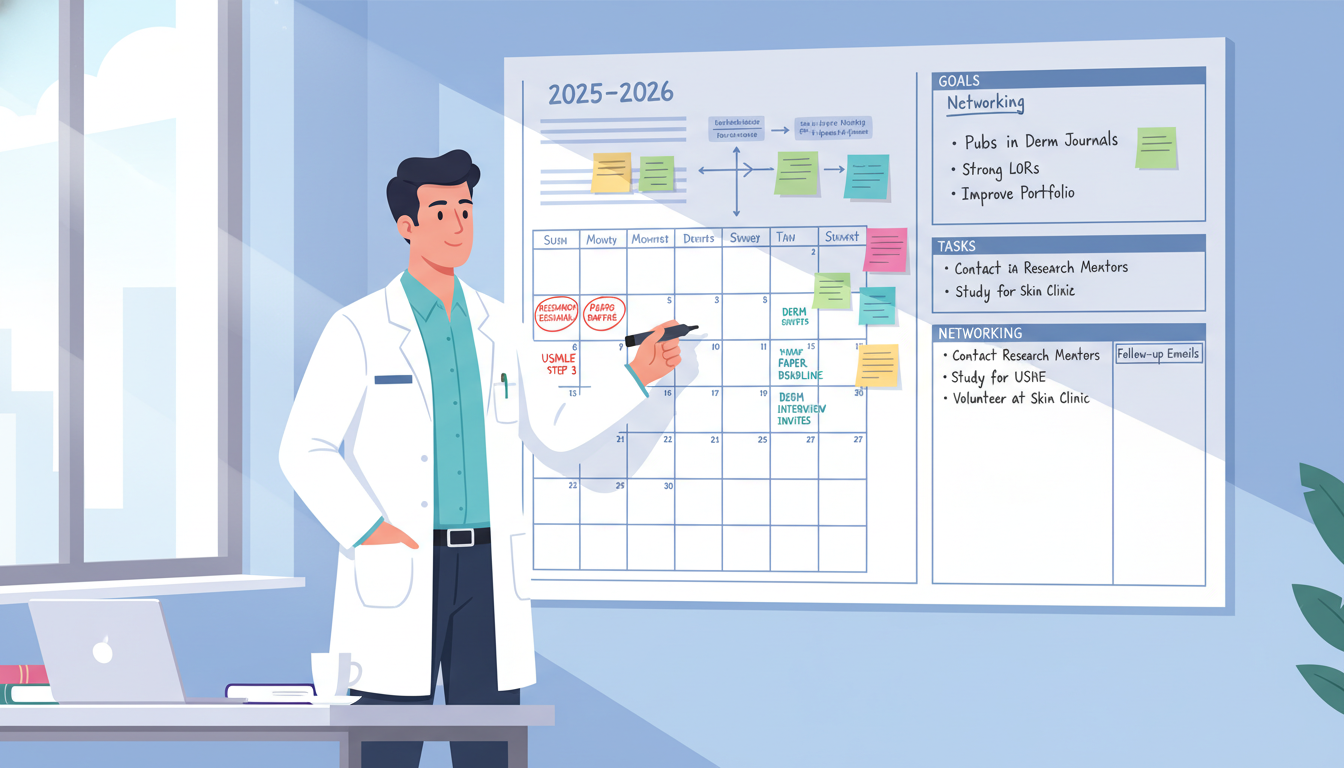
Practical Timeline for a Derm Match Comeback
Below is an example timeline for an unmatched applicant who will spend a research year and then reapply:
March–April (Immediately after you didn’t match)
- Debrief with mentors; perform application autopsy.
- Decide whether to reapply derm or pivot.
- Apply for derm research positions or secure a plan for the upcoming year (research, prelim, etc.).
May–July
- Begin research position or prelim year.
- Map out publication goals and clinical opportunities.
- Start drafting a revised personal statement and updating your CV.
August–October
- Submit ERAS early with a stronger application.
- Request updated letters from derm mentors and your current PD or supervisor.
- Start mock interviews with mentors or peers.
November–January
- Interview season: refine your story about your derm interest and how you grew after not matching.
- Be candid but confident; emphasize growth, not excuses.
February–March (Rank and Match)
- Make a realistic rank list with your mentors’ input.
- Prepare emotionally and practically for all outcomes, including another unmatched scenario.
If you need two years, stretch this timeline accordingly with a second research year, additional clinical work, or a more formal pivot.
FAQs: Failed Match Recovery in Dermatology
1. I didn’t match dermatology. Should I try again or give up?
It depends on your profile and your tolerance for risk and delay. If your main weaknesses can be realistically improved (research, letters, narrative, strategy) and you’re willing to invest 1–2 more years, reapplying can be reasonable. If you have serious consistent red flags, multiple failed attempts, or mentors strongly advise against another derm cycle, pivoting may be wiser. Use honest mentoring feedback to guide this decision.
2. Will being an unmatched applicant permanently hurt my chances?
Being an unmatched applicant is a red flag only if it’s not addressed. Programs want to know:
- What happened?
- What did you do afterward?
- What did you learn?
If you respond with a clear, growth-oriented plan—strong research, excellent clinical performance, improved letters—your previous failed match can become part of a compelling resilience story, not a permanent mark.
3. How important is doing a derm research year for a derm match comeback?
For many candidates who didn’t match dermatology, a dedicated derm research year is one of the most impactful interventions. It can:
- Generate publications and posters
- Provide strong, detailed letters from derm faculty
- Deepen your understanding of the field
- Expand your network with programs and PDs
It’s not mandatory for everyone, but if your derm engagement and research were limited, it significantly improves your derm match odds.
4. What should I say in interviews about why I didn’t match the first time?
Use a concise, honest, and growth-focused framework:
- Briefly state the fact: “I applied to dermatology previously and did not match.”
- Identify the key issue(s): “In retrospect, my research and mentorship were not as strong as they needed to be, and my application strategy was narrow.”
- Describe your response: “I undertook a dedicated derm research year, worked on multiple projects, and received focused mentorship. I also completed a strong prelim year where I excelled clinically.”
- End with growth: “This experience has made me more resilient, self-aware, and committed to dermatology and to my patients.”
Avoid blaming others or sounding bitter. Focus on your accountability and growth.
A failed derm match is a painful experience, but it can also be a turning point—either toward a stronger, more informed dermatology reapplication or toward a different specialty where you can thrive. With honest reflection, strategic planning, and robust mentorship, you can build a meaningful and satisfying career in medicine, whether or not dermatology is ultimately part of it.