Understanding a Failed Match in Alaska & Hawaii
A failed Match—learning you didn’t match into residency—is emotionally and professionally jarring. When you add the unique geography and limited number of training positions in Alaska and Hawaii, the stakes can feel even higher. Yet every year, many strong candidates recover from an initial failure to match and go on to secure excellent positions, including in Alaska residency or Hawaii residency programs.
This article is designed specifically for applicants targeting programs in Alaska and Hawaii who:
- Didn’t match at all
- Partially matched (e.g., advanced but no prelim, or vice versa)
- Are reconsidering their strategy after a disappointing SOAP outcome
You’ll find a structured recovery plan, region-specific considerations, and practical steps to improve your candidacy for the next cycle—or to pivot productively if your goals change.
Why Applicants Don’t Match – Especially in Small Markets
Before you decide what to do after a failed match, you need to understand why it likely happened. This isn’t about blame; it’s about building a realistic strategy for recovery.
Common Causes of Not Matching
Overly narrow program list
- Only ranking a few programs, sometimes exclusively in “dream locations” like Hawaii and Alaska.
- Not applying broadly enough in your specialty, or only to very competitive specialties.
Application strength issues
- Low USMLE/COMLEX scores or multiple failures
- Limited or weak clinical evaluations
- Lack of recent U.S. clinical experience (especially for IMGs)
- Major professionalism concerns or red flags
Mismatch in specialty competitiveness
- Applying to highly competitive fields (e.g., Dermatology, Orthopedics, ENT) without a competitive profile.
- Not having a realistic backup specialty (e.g., Internal Medicine, Family Medicine, Pediatrics, Psychiatry).
Suboptimal application strategy
- Weak personal statement or poorly tailored experiences
- Generic or lukewarm letters of recommendation
- Poor interviewing skills or communication issues during virtual interviews
- Applying late or missing key deadlines
Geography-specific factors: Alaska & Hawaii
- Fewer total residency positions compared to mainland states
- Programs often prefer applicants with a clear, long-term commitment to underserved and rural communities
- Strong emphasis on community fit, cultural competence, and adaptability to island or frontier life
For unmatched applicants focusing on Alaska residency or Hawaii residency programs, limited slots + intense interest from across the U.S. means that even solid candidates can fall short if they rely only on these locations.
Immediate Steps After You Learn You Didn’t Match
Your first actions in the days and weeks after a failed match will shape your trajectory for the next year. Here’s a stepwise response plan.
1. Process the Emotions—but Set a Time Limit
Feeling shock, embarrassment, or grief is normal. Many residents and attendings have walked this path.
- Give yourself 48–72 hours to process, talk with trusted people, and step away from email and ERAS.
- Avoid posting about your status on social media; your professional brand still matters.
After that short window, commit to shifting from distress to analysis.
2. If You’re Still in the Same Cycle: Use SOAP Strategically
If you discover you didn’t match during the main NRMP Match Week, you may be eligible for the Supplemental Offer and Acceptance Program (SOAP).
Briefly:
SOAP basics
- Unmatched applicants can apply to unfilled positions in participating programs.
- Choices are often more limited in specialty and geography.
- Moves quickly; you’ll need organized support.
Alaska & Hawaii context
- Because these regions are small, they may have few or no unfilled positions in SOAP some years.
- Still, monitor the unfilled list; occasionally, positions open unexpectedly (e.g., categorical FM or transitional year).
SOAP strategy tips:
- Prioritize any clinically appropriate position that keeps you in the system—e.g., preliminary medicine or surgery, transitional year, or categorical IM/FM/Peds/Psych.
- Don’t restrict yourself only to Alaska residency or Hawaii residency programs during SOAP.
- Consult your dean’s office or advising team early; many schools have SOAP “war rooms” to help with applications and communications.
If SOAP concludes and you remain unmatched, you’re now planning for a gap year and the next application cycle.
3. Conduct a Thorough Post-Match Analysis
Treat this like a clinical case review. You need a clear diagnosis before prescribing treatment.
Key questions:
Scores & exams
- Any Step/COMLEX failures or below-average scores?
- All exams completed in time for programs to review?
Clinical experience
- Recent U.S. clinical experience?
- Strong core clerkship grades? Honors?
- Any failed or repeated rotations?
Letters of recommendation
- Specialty-specific letters from attendings who know you well?
- Any letters that might be lukewarm or generic?
Specialty choice and competitiveness
- Did your chosen specialty match your profile realistically?
- Did you have a credible backup plan?
Program list & geography
- How many programs did you apply to?
- Did you apply broadly enough beyond Alaska and Hawaii?
- Did you limit yourself to primarily competitive coastal or destination cities?
Interviews & professionalism
- How many interviews did you receive and attend?
- Any clear interview missteps or awkward moments?
- Any concerns about communication skills, punctuality, or professionalism?
Get external input:
- Dean, advisor, or student affairs dean
- Program faculty mentors
- A trusted attending in your target specialty
- For IMGs, possibly a professional application review service with a track record of working with unmatched applicants
Ask for unfiltered feedback; you need honest, specific critiques more than reassurance.

Designing a 12-Month Recovery Plan After a Failed Match
Once you understand why you didn’t match, create a structured 6–12 month plan to repair deficiencies and enhance your application, with Alaska and Hawaii goals clearly in mind.
1. Clarify or Reassess Your Specialty Targets
If you’re committed to practicing in Alaska or Hawaii long term, understand that:
- There are limited residency specialties in these states.
- Alaska has historically relied heavily on partnerships with programs in the Pacific Northwest; the local GME footprint is growing but remains small.
- Hawaii (especially Oahu) has more established programs, primarily in Internal Medicine, Family Medicine, Pediatrics, Psychiatry, and some subspecialties, often linked to the University of Hawaiʻi.
Ask:
- Does my profile fit the typical match metrics for my target specialty?
- Do my interests align with primary care, rural health, or community-based practice, which are often prioritized for Alaska residency and Hawaii residency programs?
You may need to:
- Shift from a surgical to a primary care or psychiatry track
- Add a backup specialty with a strong presence in Alaska or Hawaii (e.g., Family Medicine)
- Prioritize specialties that align with rural or underserved care, as these are more valued by local programs
2. Strengthen Academic and Exam Credentials
If exam performance contributed to your failed match:
- Retake failed exams as soon as feasible, after a serious, structured study plan
- Complete Step 3/COMLEX Level 3 (especially for IMGs or reapplicants to competitive specialties), if timing and rules allow
Study strategies:
- Set a weekly schedule with dedicated blocks for UWorld, question banks, and review books.
- Use NBME/COMSAE practice exams to gauge readiness.
- Consider a tutor or structured prep course if you’ve failed an exam before.
For borderline scores without failures:
- Focus more on clinical strength, letters, and narrative than obsessing over minimal score improvements.
- Programs in Alaska and Hawaii may accept mid-range scores if the applicant demonstrates clear commitment, cultural fit, and community-mindedness.
3. Obtain Strong, Recent Clinical Experience
For candidates focused on Alaska or Hawaii, clinical exposure in these regions—or in similar underserved or rural settings—is particularly valuable.
Options:
Sub-internships or audition rotations
- If still eligible, arrange visiting rotations in Alaska- or Hawaii-affiliated programs or in Northwest/West Coast programs that send residents to Alaska/Hawaii rotations.
- Emphasize interest in rural, indigenous, or underserved populations.
U.S. clinical experience for IMGs
- Hands-on electives or observerships in family medicine, internal medicine, pediatrics, psychiatry, or community-based specialties.
- Seek sites with existing or historical ties to Alaska or Hawaii if possible (e.g., Northwest regional programs, community health centers with Pacific Islander or Native American/Alaska Native patient populations).
Goals:
- Earn strong, detailed letters of recommendation.
- Demonstrate reliability, teamwork, and patient-centered communication.
- Develop concrete stories that show you understand the realities of remote or island medicine.
4. Repair or Upgrade Your Letters of Recommendation
If your previous letters may have been generic or weak:
- Request new letters from attendings who have recently supervised you and can speak to growth and maturity since your failed match.
- Aim for:
- At least 2–3 specialty-specific letters for your primary target
- One letter from someone who can speak to your resilience, professionalism, and adaptability (e.g., faculty advisor, department chair)
For Alaska or Hawaii interest:
- A letter from a mentor who can authentically state that you are suited for and committed to frontier or island practice can be very persuasive.
5. Fill the Gap Year with Relevant, Explainable Experience
Programs will look closely at what you did after you didn’t match. Your activities should show:
- Productivity
- Clinical relevance
- Commitment to underserved care or your targeted region
High-value gap year options:
Research positions
- Especially in primary care, rural medicine, telehealth, indigenous health, or Pacific Islander/Alaska Native health disparities.
- Try to secure research that could result in posters, abstracts, or publications before the next cycle.
Clinical or quasi-clinical work
- Clinical research coordinator
- Medical assistant or scribe in primary care, psychiatry, or community clinics
- Telehealth coordinator, especially in rural or remote patient populations
Public health or community health roles
- Work with Federally Qualified Health Centers (FQHCs), tribal health organizations, or rural outreach programs.
- Volunteering or staff roles in communities with comparable challenges to Alaska/Hawaii (e.g., Native American reservations, remote rural towns, Pacific Islander communities in the continental U.S.).
Teaching and mentoring
- MCAT/Step tutor, medical school teaching assistant, anatomy lab instructor.
- Show leadership and communication skills.
Always be ready to explain your gap year succinctly:
“After I didn’t match, I chose to work as a clinical research coordinator in a rural family medicine clinic serving a largely indigenous community. This taught me… and further affirmed my interest in practicing in Alaska/Hawaii.”
6. Revise Your Application Narrative
After a failed match, your story is critical. Programs will ask:
- What happened?
- What did you learn?
- Are you now a stronger candidate?
Update:
Personal statement
- Acknowledge the setback briefly and focus more on growth and insight.
- Highlight experiences that connect you to frontier, island, rural, or underserved care.
- For Alaska and Hawaii, include persuasive reasons why you want to train and remain in those environments.
CV and experiences section
- Clearly include gap year positions, new research, rotations, volunteering, and any Alaska/Hawaii-related experience.
- Use bullet points that emphasize impact and responsibility, not just duties.
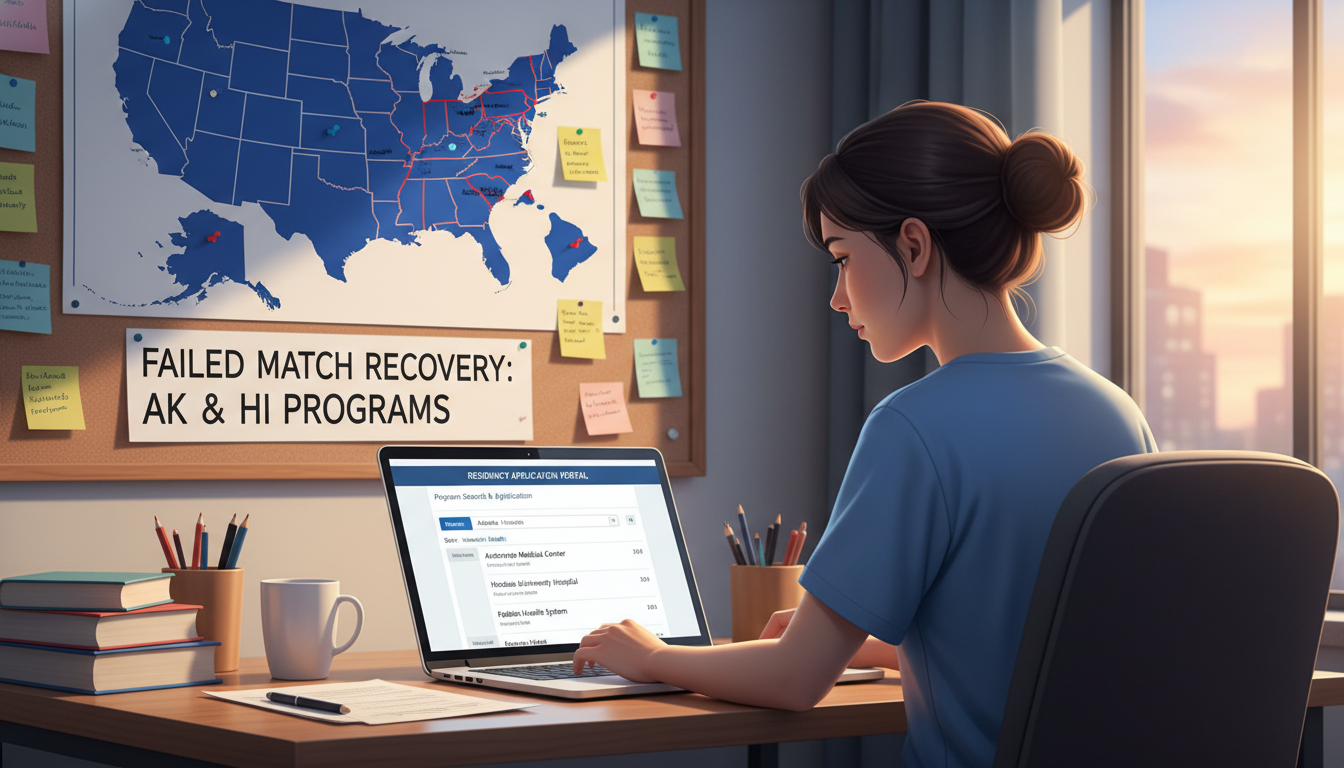
Targeting Alaska & Hawaii Residency Programs as an Unmatched Applicant
If your long-term goal is to live and work in Alaska or Hawaii, you’ll need a dual strategy: apply broadly enough to match somewhere, while still honoring your regional goals.
1. Know What Programs in Alaska & Hawaii Typically Look For
Across many Alaska residency and Hawaii residency programs, common themes include:
Commitment to underserved communities
- Interest in Native Hawaiian, Pacific Islander, and Alaska Native health
- Willingness to work in remote and resource-limited settings
Adaptability and resilience
- Comfort with travel, weather extremes (Alaska), or island isolation (Hawaii)
- Openness to cultural diversity and community collaboration
Primary care orientation
- Strong interest in family medicine, internal medicine, pediatrics, psychiatry, and community-based specialties
- Emphasis on continuity of care and community relationships
Show this in your application via:
- Experiences in rural clinics, community health centers, or tribal health systems
- Long-term volunteer projects focused on marginalized or underserved populations
- Statements and letters that explicitly connect your values to these missions
2. Apply Broadly—Not Only to Alaska & Hawaii
A key mistake many unmatched applicants make is doubling down solely on dream locations.
For the next cycle:
- Yes, absolutely apply to relevant Hawaii residency programs and emerging Alaska residency opportunities if they fit your profile.
- But additionally:
- Apply to a wide range of programs nationwide in your target specialty, especially those that share similar missions (rural health, underserved, community focus).
- Include a reasonable number of “safe” and “middle-tier” programs where your scores and experiences are at or above the program’s historical averages.
Think strategically:
- Programs in smaller Western or Midwestern communities may look very favorably on applicants who show genuine interest in frontier-style or remote practice, giving you both a robust chance to match and training that is valued in Alaska or Hawaii later.
3. Build Genuine Ties to the Region
Programs in both states often look for evidence that you’ll stay—or at least remain connected to similar communities.
Concrete ways to demonstrate this:
Previous time spent in Alaska or Hawaii
- Growing up, family ties, or long-term stays
- Prior work or service in these states
Regional research or projects
- Capstone projects focused on Pacific Islander health, indigenous health, climate change and health in frontier settings, etc.
Networking with regional physicians
- Attend virtual or in-person conferences related to Pacific health, indigenous health, rural medicine, or AAFP/ACP rural tracks.
- Reach out politely to faculty at Hawaii-based or Alaska-affiliated institutions for informational interviews (not to ask for favors, but to learn about their priorities and paths).
Mention these ties explicitly in your:
- Personal statement
- Supplemental ERAS program signals (if available)
- Program-specific communications, where permitted
4. Master the Interview, Especially for Mission-Driven Programs
As an unmatched applicant, your interview becomes the chance to reframe your narrative:
Key messages to convey:
- You understand why you didn’t match and have concrete evidence of growth.
- You have a realistic view of training and living in Alaska or Hawaii.
- Your values align with their mission: serving underserved communities and embracing team-based, resourceful care.
Prepare for questions like:
- “Tell us about a major setback and what you learned.”
- “What draws you specifically to Hawaii/Alaska?”
- “How do you manage stress and isolation?”
- “Where do you see yourself practicing in 5–10 years?”
Have specific, honest answers ready, grounded in your experiences during the gap year and beyond.
Long-Term Perspective: If You Still Don’t Match
Sometimes, even after an improved application cycle, an unmatched applicant may still not secure a position—especially if restricted to certain specialties or geographic preferences. If you end up in this situation again:
1. Reassess Your Non-Negotiables
Ask yourself:
- Is training specifically in Alaska or Hawaii essential, or is practicing there later the true goal?
- Would you be open to training in a similar program elsewhere and then relocating after residency?
- Is your chosen specialty so competitive that it repeatedly limits your chances?
You may decide to:
- Broaden to a less competitive specialty closely aligned with your skills and interests.
- Train in a mainland program known for sending graduates to Alaska or Hawaii to practice.
- Build an alternative clinical or public health career adjacent to direct patient care.
2. Explore Alternative Clinical Pathways
For some unmatched applicants, alternative options may become necessary:
- Additional degrees (MPH, MBA, MEd) leading to roles in:
- Public health
- Health systems management
- Medical education
- Careers in health policy, global health, or community health organizations, particularly those serving indigenous or Pacific populations.
This may still lead to fulfilling work in Alaska or Hawaii, even if not through traditional residency.
FAQs: Failed Match Recovery for Alaska & Hawaii Residency Programs
1. I didn’t match and really want to train in Hawaii or Alaska. Should I only apply there next year?
No. While you should absolutely include Hawaii residency programs and emerging Alaska residency opportunities in your application, limiting yourself to those states significantly increases your chance of remaining an unmatched applicant. Apply broadly across the U.S. to similar mission-driven programs, while still highlighting your special interest in Alaska or Hawaii in your personal statements and interviews.
2. Does being an unmatched applicant automatically disqualify me from residency programs in Alaska and Hawaii?
Not at all. Many programs have accepted reapplicants who previously failed to match, especially when they demonstrate clear growth, strong new letters, improved exam performance (if needed), and a mature explanation of their prior cycle. For mission-driven programs, your resilience and renewed commitment can be powerful positives.
3. I failed a Step/COMLEX exam. Can I still be competitive for Alaska or Hawaii residency programs?
Yes, but you’ll need to show clear academic recovery. That usually means passing on a retake with a comfortable margin, avoiding further failures, and strengthening the rest of your portfolio—especially clinical performance, letters of recommendation, and community or rural health experience. Many programs will still consider you if the narrative is one of growth and reliability.
4. I didn’t match and couldn’t secure a SOAP position. What is the single most important thing to do in my gap year?
There is no one-size-fits-all answer, but generally the most impactful move is to secure relevant, explainable, and productive work that aligns with your target specialty and the missions of Alaska and Hawaii programs: e.g., clinical research in primary care, work in a rural or indigenous-serving clinic, or a role in community/public health. Make sure you can obtain strong, recent letters and concrete accomplishments from this year.
By approaching a failed match with deliberate analysis, strategic gap-year planning, and a clear narrative that aligns with the realities and missions of Alaska and Hawaii residency programs, you can convert a major setback into a launchpad for a resilient, purpose-driven medical career.