The notice that you didn’t match can feel like the floor just dropped out from under you—especially in a competitive region like the Texas Triangle. But an unsuccessful Match is not the end of your path to residency. Many excellent physicians began their careers as an unmatched applicant; the difference is that they approached “Failed Match Recovery” strategically and systematically.
This article focuses on how to recover from a failed Match specifically with an eye on Texas residency programs across the Houston–Dallas–San Antonio “Texas Triangle.” You’ll learn what to do in the first 72 hours, how to leverage Texas-specific opportunities, how to rebuild your application, and how to return to the Match stronger the next cycle—or find alternative pathways.
Understanding a Failed Match in the Texas Triangle Context
A failed Match can mean different things:
- You applied, ranked programs, and didn’t match at all.
- You partially matched into a preliminary or transitional year, but not a categorical spot.
- You withdrew or were ineligible and effectively failed to participate in the Match.
In all cases, your core task is the same: understand why you didn’t match, then create a practical plan anchored to the realities of Texas residency programs.
Why is the Texas Triangle so competitive?
The Houston–Dallas–San Antonio corridor combines:
- Multiple large academic centers (e.g., UT System, Baylor, Methodist, HCA, CHRISTUS)
- Rapidly growing community programs
- Attractive cost of living relative to many other states
- Strong specialty training (IM, FM, EM, Surgery, Anesthesiology, Psych, etc.)
This draws thousands of applicants each year, including many from out of state and international medical graduates (IMGs). For you, that means:
- Higher bar for interviews at major systems
- More scrutiny of US clinical experience, letters, and exam performance
- Strong competition for every unfilled position during SOAP
The good news: the Texas Triangle also offers a wide range of program types—academic, community, safety-net hospitals, and hybrid systems—creating multiple points of re-entry if you regroup correctly.
Step 1: Immediate Response After a Failed Match
The first 72 hours after learning you didn’t match are critical. Your actions during this period can determine whether you secure a position during SOAP or set yourself up for a strong reapplication.
1.1 Regulate emotions, but don’t disengage
Feeling devastated, embarrassed, or angry is completely normal. A failed match is a major emotional hit. However:
- Don’t ignore your email or NRMP/ERAS accounts.
- Don’t make impulsive decisions like sending angry messages to programs or deleting your application.
- Do give yourself a few hours to process—then treat this like a time-sensitive clinical problem.
1.2 Confirm your status and understand SOAP
Log into NRMP to verify whether you:
- Are fully unmatched
- Matched to a prelim/TY only
- Are eligible to participate in SOAP
SOAP (Supplemental Offer and Acceptance Program) is your primary safety net. For Houston–Dallas–San Antonio residency positions, SOAP is often the only realistic way to start PGY-1 locally in the same year if you didn’t match.
Key points about SOAP:
- You can only apply to programs listed as unfilled.
- There is a strict limit on the number of programs you can apply to per SOAP round.
- Communication rules are strict; you may not contact programs outside ERAS during SOAP.
Action items:
- Read the current year’s NRMP SOAP guidelines carefully.
- Coordinate with your medical school’s Student Affairs/Dean’s Office immediately; they usually have a SOAP playbook.
1.3 Rapidly Audit Your Application
Before SOAP or planning a reapplication, you must understand the probable causes of the failed Match. Common issues:
Scores & exams
- Step 1 (even Pass/Fail) narrative: fails, multiple attempts, late passing.
- Step 2 CK below program cutoffs.
- Failing or missing Step 3 as an IMG applying to competitive specialties.
Application strategy
- Too few applications, or too many to highly competitive specialties.
- Over-concentration in top-tier university programs in Houston/Dallas without community “safety” programs.
- Limited geographic flexibility (e.g., only applied in Texas and nowhere else).
Clinical credentials
- Minimal or no US clinical experience, especially for IMGs.
- Weak letters of recommendation (generic, not specialty-specific, or missing from US physicians).
- Lack of continuity in clinical activity (gaps, no recent hands-on experience).
Personal statement & professionalism
- Generic or red-flag-laden personal statement.
- Interpersonal concerns raised on away rotations or sub-I’s.
- Unexplained academic or professionalism issues.
Try to get real feedback quickly:
- Ask your Dean, advisor, or program director from a sub-I for a frank assessment.
- If you applied in Texas, see if your school has informal contacts at Houston, Dallas, or San Antonio programs who can give candid impressions.
This diagnostic step shapes all the next moves.

Step 2: SOAP Strategy for Texas Residency Programs
If you are participating in SOAP, you have a short window to position yourself for any available PGY-1 spot, including in Texas residency programs around Houston, Dallas, and San Antonio.
2.1 Reality check about Texas SOAP positions
Historically, SOAP spots in the Texas Triangle cluster in:
- Primary care: Internal Medicine, Family Medicine, Pediatrics
- Transitional Year / Preliminary Medicine or Surgery
- Occasionally: Psychiatry, Pathology, Neurology, less often EM or categorical Surgery
The more competitive specialties (Derm, Ortho, ENT, IR, etc.) essentially never have viable SOAP slots in major Texas centers.
You must emotionally separate your ideal pathway from your immediate need for a PGY-1 position.
2.2 Prioritizing specialties and locations
Rank your SOAP priorities:
- Primary goal: Getting any ACGME-accredited PGY-1 spot (especially for IMGs or those with exam issues).
- Secondary goal: Maximizing chances to re-specialize or transfer later (e.g., starting in IM or TY if you plan to pursue another specialty).
- Tertiary goal: Geographic preference within Texas (Houston, Dallas, San Antonio, Austin, or elsewhere).
Key trade-offs:
- If you insist on Houston Dallas San Antonio residency only, you may end up with nothing.
- If you’re flexible about other Texas cities (El Paso, Lubbock, McAllen, Tyler, etc.) or even out-of-state, your odds improve.
Strategic advice:
- For most unmatched applicants, it’s safer to prioritize a position anywhere over a very narrow geographic focus.
- If you’re strongly tied to Texas long-term (family, visa issues, state loyalty), still consider any Texas program during SOAP, not just the Triangle.
2.3 Tailoring SOAP applications in hours, not weeks
SOAP requires highly targeted, rapid adjustments:
Revise your personal statement for:
- Flexibility in specialty if applying outside your original field.
- Genuine interest in primary care or broad-based training if targeting IM/FM/TY.
- Ties to Texas or local communities where appropriate.
Update your CV and ERAS:
- Add any new electives, research, or volunteer work.
- Clearly indicate ongoing or recent US clinical experience.
Identify Texas-specific selling points:
- Bilingual ability (e.g., Spanish) is a major asset in many Texas communities.
- Prior work/rotation in Houston/Dallas/San Antonio or rural Texas.
- Commitment to underserved populations, border health, or community medicine.
Example SOAP focus for an unmatched IMG who originally applied to Internal Medicine:
- Prioritize unfilled IM and FM programs anywhere in Texas, not just Houston/Dallas/San Antonio.
- Secondary list of IM/FamMed programs in neighboring states (OK, NM, LA, AR).
- Update personal statement to emphasize long-term commitment to primary care and serving diverse Texas populations.
2.4 Communicating within SOAP rules
While you cannot cold-email programs during SOAP, you can:
- Ask your Dean’s office to advocate for you via permitted channels.
- Use existing faculty connections to express support within NRMP rules.
- Ensure your ERAS application is error-free, coherent, and complete before each wave of offers.
Even if you don’t land a Texas-based position in SOAP, securing a PGY-1 anywhere allows you to:
- Build US-based clinical credibility.
- Potentially transfer or reapply to Texas residency programs later.
Step 3: If You Remain Unmatched After SOAP
If SOAP concludes and you are still an unmatched applicant, the focus shifts from crisis management to long-term recovery planning. This is where many future success stories begin.
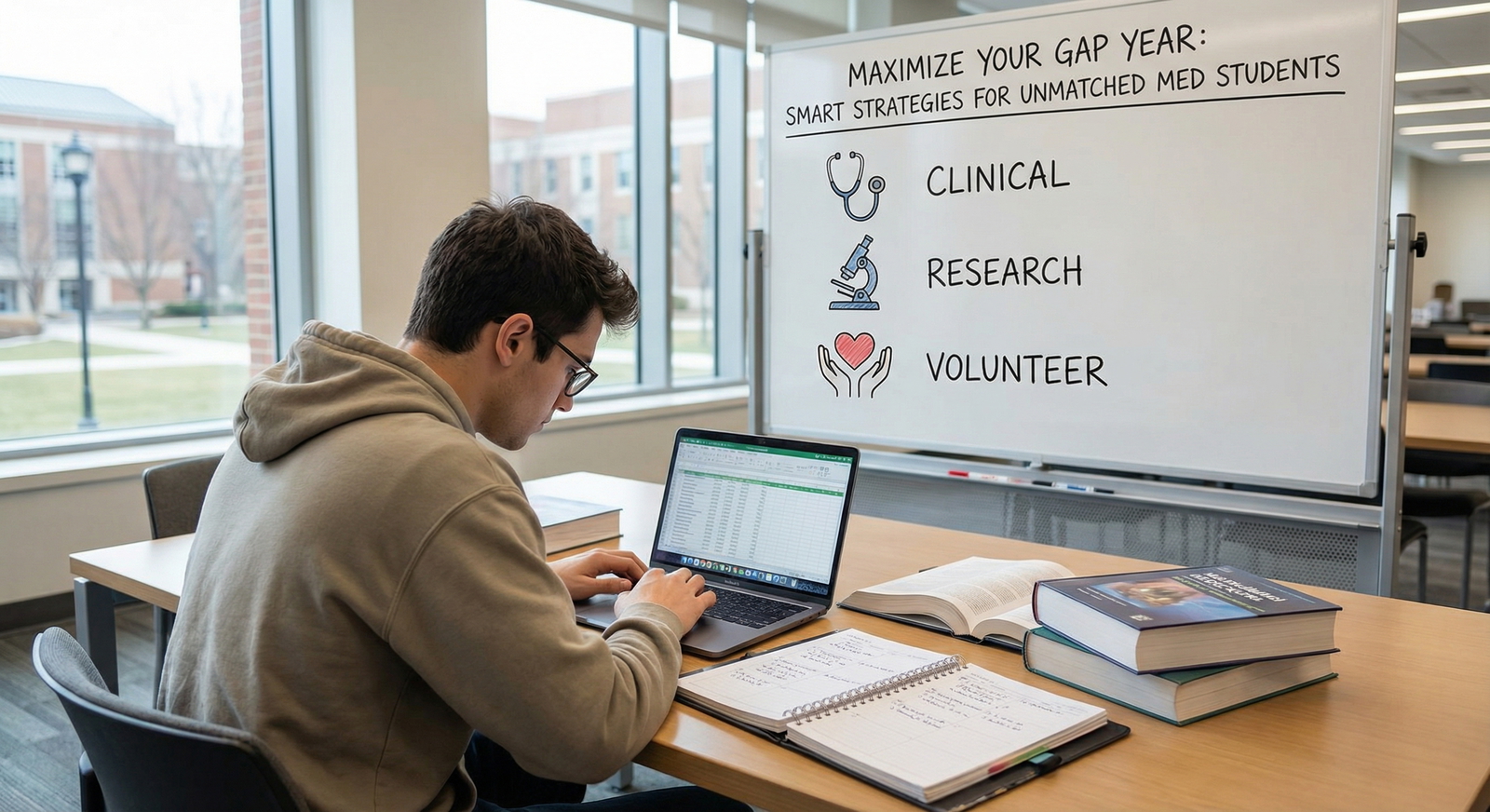
3.1 Accepting a “rebuild” year
You now effectively have 8–12 months to transform your profile before the next application cycle. The goal is not to “wait it out,” but to show programs:
- Continued clinical engagement
- Maturity and professionalism
- Focused improvement in previously weak areas
Common rebuild-year pathways in or near the Texas Triangle:
Research positions (paid or unpaid) at:
- Houston: Texas Medical Center institutions, Baylor, UT Houston.
- Dallas: UT Southwestern, Baylor Scott & White.
- San Antonio: UT Health San Antonio, VA-based research groups.
Non-ACGME fellowships or clinical research roles:
- Quality improvement
- Outcomes research
- Population health, especially in underserved Texas communities.
US Clinical Experience (USCE) and observerships:
- Especially crucial for IMGs who didn’t match.
- Seek hands-on (or as close as allowed) roles: externships, pre-residency fellowships, or structured observerships in internal medicine, family medicine, or your target specialty.
Clinical employment (where legally permissible):
- Scribe positions in Texas hospitals or clinics.
- Clinical research coordinators in Houston/Dallas/San Antonio.
- Allied health or educational roles that keep you in clinical environments.
3.2 Addressing academic and exam issues
If a key driver of your failed match was test performance:
Step 2 CK (or OET/PLAB if you’re also looking abroad):
- Strong performance can partially offset Step 1 concerns.
- Consider a structured prep course if you previously struggled.
Step 3:
- Particularly useful for IMGs and those aiming at community internal medicine or family medicine programs.
- Passing Step 3 before reapplying can reassure Texas residency programs that you can handle licensing hurdles.
Remediation for academic/professionalism issues:
- Seek formal documentation of remediation completed.
- Obtain letters from faculty affirming improved performance and reliability.
3.3 Rebuilding your narrative
Texas programs care about your story as well as your metrics. After a failed Match, your narrative should:
- Acknowledge setbacks without sounding bitter or blaming.
- Emphasize resilience, reflection, and action.
- Show how experiences in the rebuild year clarified your goals (e.g., commitment to primary care, passion for underserved populations, or dedication to hospital medicine).
Example narrative shift:
“I was initially focused on a narrow set of academic programs in a single specialty. After not matching, my year working as a research coordinator at a safety-net clinic in Houston has shown me how much I value longitudinal relationships with patients and multidisciplinary collaboration. This has solidified my commitment to Family Medicine, particularly in Texas communities with limited access to care.”
Programs in the Texas Triangle—often serving diverse and underserved populations—respond well to applicants who show maturity, service orientation, and cultural humility.

Step 4: Targeted Reapplication to Texas Triangle Programs
When you’re ready to re-enter the Match, your application strategy must be sharper and more realistic than before.
4.1 Refining specialty choice
Ask yourself honestly:
- Did my original specialty choice align with my academic profile and experiences?
- Was I applying to a specialty that’s significantly more competitive than my metrics support?
- Am I willing to switch to a less competitive field with strong opportunities in Texas (e.g., IM, FM, Psych, Peds)?
In the Texas Triangle context:
- Internal Medicine and Family Medicine remain the most common entry routes, especially for IMGs and prior unmatched applicants.
- Psychiatry and Pediatrics are moderately competitive but may still be attainable with a strong rebuild year.
- Re-attempting highly competitive specialties (Derm, Ortho, Plastics, etc.) from a failed Match position is very challenging unless you’ve made dramatic improvements and have heavyweight institutional support.
4.2 Right-sizing your program list
For a previously unmatched applicant, aim for:
- A broad list of programs (often 80–150+, depending on specialty and competitiveness).
- A realistic mix of:
- Academic centers (UT systems, Baylor, large university hospitals).
- Community and hybrid programs in the Texas Triangle and beyond.
- Smaller or newer programs across Texas and the US that may be more IMG- or reapplicant-friendly.
Tactical considerations:
- For Houston Dallas San Antonio residency targets, don’t limit yourself to only the most prestigious sites; include community programs, VA-affiliated programs, and newer training sites.
- Pair Triangle applications with other Texas cities and neighboring states to avoid another all-or-nothing scenario.
4.3 Highlighting your “recovery year” achievements
In ERAS and interviews, clearly showcase:
New letters of recommendation from your rebuild year:
- From US-based attendings in your target specialty.
- From research mentors at Texas institutions, if applicable.
- From supervisors who can vouch for improved reliability, teamwork, and professionalism.
Concrete outcomes:
- Publications, abstracts, or posters—especially if presented in Texas or on topics relevant to local populations.
- Quality improvement projects (e.g., improving diabetes management in a clinic serving San Antonio’s South Side or Houston’s East End).
- Leadership roles (clinic coordinator, project lead, teaching roles for students).
This transforms your label from “unmatched applicant” to “applicant who responded to adversity with growth and productivity.”
4.4 Preparing for interviews in Texas
If you secure interviews in the Texas Triangle:
Research each program’s:
- Patient demographics (e.g., large Hispanic populations, refugee communities).
- Safety-net role or subspecialty strengths.
- Educational philosophy and recent program expansions.
Be ready to discuss:
- Why you especially value training in Texas (family ties, prior experiences, language skills, long-term practice plans).
- How you processed and learned from being unmatched without sounding defensive.
- Examples of resilience—particularly from your rebuild year.
Programs will often ask, directly or indirectly: “What’s different this year?” Your answer should be specific, measurable, and sincere.
Step 5: Alternative and Long-Term Pathways
Not everyone who fails to match in the Texas Triangle will ultimately train there—or even in the US. It’s wise to remain open to alternate pathways in case a US residency remains elusive.
5.1 Considering non-US options
Some applicants, especially IMGs, may:
- Return to their home country for residency training.
- Seek training opportunities in Canada, the UK, or other countries.
- Later return to Texas or the US through fellowship, additional exams, or practice pathways (where allowed).
This is highly individual and depends on:
- Citizenship/visa status
- Financial resources
- Long-term career goals
5.2 Long-range Texas goals without Texas training
You can still ultimately practice in Texas without completing residency there, by:
- Training in another US state and applying for a Texas license and Texas jobs afterward.
- Building Texas connections via:
- Conferences in the Texas Medical Center.
- Collaborative research with Texas-based faculty.
- Locum or telemedicine work once board-certified (subject to state law).
This broader perspective can relieve some pressure: missing a Texas program now does not permanently close Texas to you.
5.3 Protecting your well-being
Repeated failed matches and rebuild years can take an emotional toll. Protect your mental health:
- Seek counseling through your medical school, EAP, or community resources.
- Build a non-judgmental support network of peers, mentors, family.
- Separate your self-worth from Match outcomes; many excellent physicians, researchers, and leaders had unconventional training paths.
Long-term success in medicine is measured in decades, not in one March email.
FAQs: Failed Match Recovery in the Texas Triangle
1. I didn’t match and SOAP didn’t work—should I give up on residency?
Not necessarily. Many physicians matched successfully on a second or even third attempt. The key is to honestly diagnose why you didn’t match, commit to a structured recovery year, and be flexible about specialty and geography. If your heart is set specifically on Texas residency programs, you may need to consider starting residency elsewhere and later returning to Texas for practice or fellowship.
2. As an IMG who didn’t match, do I still have a realistic chance in Houston, Dallas, or San Antonio?
Yes, but the bar is high. To improve your chances in the Texas Triangle:
- Strengthen US clinical experience, ideally in internal medicine or family medicine.
- Pass Step 3, if eligible.
- Obtain strong, recent US letters.
- Consider targeting community-based programs in or near the Triangle rather than only flagship academic centers.
- Be prepared to widen your net to other Texas regions and other states while maintaining Texas as a long-term goal.
3. How do I explain being an unmatched applicant during interviews?
Be brief, honest, and forward-focused:
- Acknowledge the setback: “I did not match on my first attempt.”
- Identify key factors without blaming others: “In retrospect, I applied too narrowly to academic programs in a highly competitive specialty.”
- Highlight what you did about it: “Over the past year, I completed full-time clinical research at a Houston safety-net hospital, gained US letters in internal medicine, and passed Step 3.”
- Emphasize growth: “This experience has made me more reflective, resilient, and committed to providing excellent patient care.”
Programs want to see insight and maturity, not perfection.
4. Can a preliminary or transitional year in Texas help me later match categorically?
Yes. A preliminary or transitional year in Texas—especially within the Houston Dallas San Antonio residency ecosystem—can:
- Provide strong local letters of recommendation.
- Demonstrate your ability to function at a US residency level.
- Allow networking with other program directors who may have future openings.
However:
- There is no guarantee of an automatic categorical spot.
- You must still reapply strategically and broadly, often both within Texas and nationally.
- Performance during that PGY-1 year (evaluations, exam completion, professionalism) becomes crucial.
Recovering from a failed Match, especially in a competitive region like the Texas Triangle, is challenging but absolutely possible. With clear-eyed self-assessment, targeted improvements, and strategic reapplication, you can convert this setback into a powerful story of resilience that Texas residency programs—and future patients—will respect.