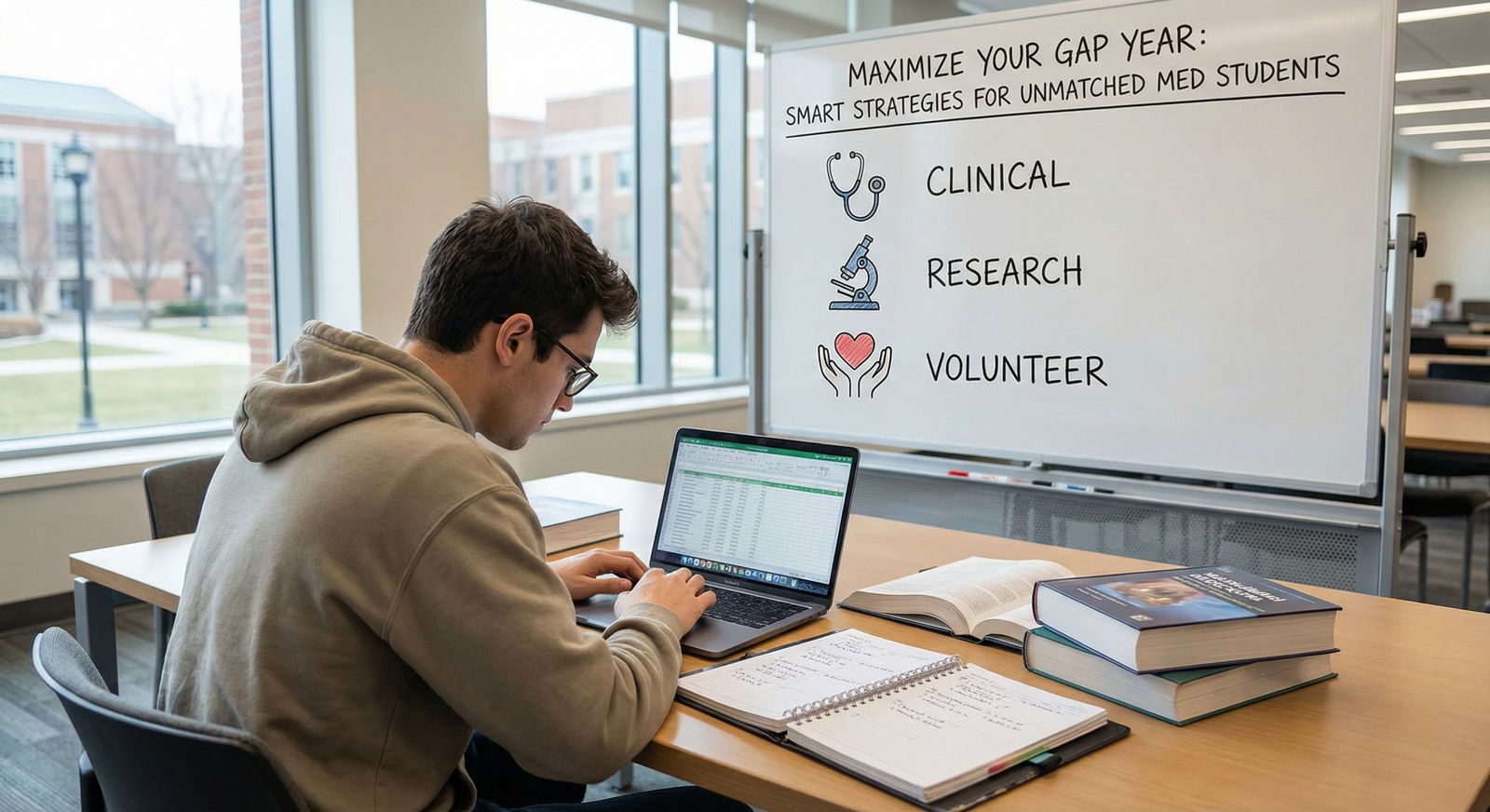
Making the Most of a Gap Year After Not Matching: Strategic, Productive Activities for Unmatched Candidates
Not matching into residency is one of the most emotionally difficult moments in medical training. After years of studying, exams, and clinical rotations, seeing “unmatched” can feel like a personal and professional failure.
It is not.
In today’s competitive environment, many highly qualified applicants do not match in their first cycle. A Gap Year between application cycles can be a powerful period of Medical Career Development—if you approach it intentionally. Instead of “time off,” think of it as a structured, purpose-driven year to strengthen your candidacy, clarify your goals, and grow as a future physician.
This guide outlines concrete, high-yield strategies unmatched candidates can use to make the most of a Gap Year, from Volunteering and research to skill enhancement, networking, and personal development.
Understanding the Strategic Value of a Gap Year in Residency Applications
Reframing the Gap Year: From Setback to Strategy
A Gap Year after not matching is neither rare nor career-ending. Program directors routinely see applicants who matched successfully after one or more cycles—many with stronger profiles because of how they used this time.
Think of your Gap Year as a 12-month personalized fellowship in “Becoming the Best Future Resident You Can Be.”
This period allows you to:
- Close specific gaps in your application (scores, clinical experience, letters, research).
- Acquire new clinical and non-clinical skills.
- Demonstrate resilience, maturity, and commitment to medicine.
- Clarify your specialty choice and target programs more strategically.
Key Benefits of an Intentional Gap Year
1. Skill Development and Enhancement
You can deliberately work on:
- Clinical skills: history taking, physical exams, procedures (where appropriate).
- Systems skills: quality improvement, patient safety, workflow optimization.
- Soft skills: communication, teamwork, leadership, time management, cultural competency.
2. Enhanced Competitiveness for Residency Applications
A purposeful Gap Year can help you:
- Add U.S. clinical experience (USCE) or more direct patient care roles.
- Produce research outputs (abstracts, posters, publications).
- Earn new certifications (e.g., BLS, ACLS, PALS, EMT).
- Strengthen letters of recommendation from recent supervisors.
3. Expanded Professional Network
Residency is highly relational. During this year, you can:
- Work with attending physicians who may later advocate for you.
- Connect with program coordinators and faculty at target institutions.
- Meet mentors who can guide your Medical Career Development long term.
4. Personal Growth and Resilience
The emotional impact of not matching is real. A structured Gap Year can:
- Rebuild confidence through meaningful work.
- Help you process disappointment and refocus your goals.
- Provide space for self-reflection and long-term planning.
- Prevent burnout by addressing well-being proactively.
Step One: Assessing Your Application Before Planning Your Gap Year
Before you decide what to do, you need to understand why you likely didn’t match. This self-audit is critical to making your Gap Year productive and targeted.
Conducting a Candid Application Review
Consider:
- Scores: USMLE/COMLEX performance, number of attempts, timing.
- Clinical Experience: Recency and relevance of rotations, U.S. vs. international, specialty alignment.
- Letters of Recommendation: Strength, specificity, and who wrote them (academic vs. community attendings).
- Personal Statement & ERAS Application: Clarity of your story, red flags, gaps in timelines.
- Specialty Choice & Application Strategy: Number of programs applied to, competitiveness of specialty, geographic preferences, timing of application.
Getting External Feedback
If possible, seek objective input from:
- Faculty advisors or deans.
- Program faculty who know you.
- Residents who have been on selection committees.
- Formal advising services or institutional career offices.
Ask specific questions:
- “If you were a PD, what would concern you most in my application?”
- “What would you advise I prioritize in the next 6–12 months to be more competitive?”
Your Gap Year plan should directly address the weaknesses identified in this review.

High-Yield Gap Year Activities to Strengthen Your Residency Application
Once you understand your needs, you can choose activities that directly support your goals. Most unmatched candidates benefit from a portfolio of activities rather than just one role.
1. Clinical Volunteering and Hands-On Patient Care
Clinical Volunteering is one of the most direct ways to demonstrate ongoing engagement with medicine during a Gap Year.
Types of Clinical Volunteering
Free or Low-Cost Community Clinics
- Roles: patient intake, vitals, health education, scribing, care coordination.
- Benefits: exposure to underserved populations, continuity with patients, strong letters.
Hospital-Based Volunteer Programs
- Roles: patient support, transport, unit assistant, discharge planning.
- Benefits: understanding hospital systems, interacting with interdisciplinary teams.
Nonprofit or Faith-Based Clinics
- Roles: health screenings, chronic disease education, outreach events.
- Benefits: leadership opportunities in small organizations, program development experience.
Making Clinical Volunteering Count
To turn Volunteering into a strong residency asset:
- Aim for consistent commitment (e.g., 8–15 hours/week over many months).
- Seek roles with progressive responsibility (start in intake, move to coordinator or trainer).
- Ask for feedback and mentorship from supervising clinicians.
- Document cases or experiences (de-identified) for future interview examples.
2. Research Positions and Scholarly Productivity
For many specialties, research is a significant advantage—and in some fields (e.g., dermatology, radiation oncology, academic internal medicine), it’s almost essential.
Options for Research Engagement
Full-Time Research Assistant or Coordinator
- Settings: academic medical centers, VA hospitals, research institutes.
- Duties: data collection, IRB paperwork, patient recruitment, manuscript prep.
Part-Time or Remote Research Roles
- Useful if you are balancing clinical work or exam prep.
- Can include statistical analysis, literature reviews, or helping with ongoing projects.
Quality Improvement (QI) and Patient Safety Projects
- Often easier to initiate and complete within a year.
- Highly valued in many residency programs and directly relevant to modern practice.
Practical Tips to Maximize Research Impact
- Try to align with your target specialty when possible (e.g., cardiology projects if aiming for internal medicine).
- At the outset, ask:
- “What are realistic publication or presentation opportunities within 12 months?”
- Target at least one of the following:
- Abstract/poster at a regional or national conference.
- Co-authorship on a manuscript.
- Contribution to a QI initiative with measurable outcomes.
Be prepared to discuss your role in detail during interviews—programs can distinguish real engagement from “name on paper.”
3. Enhancing Clinical Skills and Gaining Certifications
Skill enhancement during a Gap Year sends a strong message: you are actively preparing to be a better intern, not just waiting for the next cycle.
Key Certifications to Consider
- BLS (Basic Life Support) – Often required, but ensure it’s current.
- ACLS (Advanced Cardiac Life Support) – Particularly relevant for internal medicine, emergency medicine, anesthesia, and critical care–oriented fields.
- PALS (Pediatric Advanced Life Support) – Important if you’re targeting pediatrics or family medicine with strong pediatric exposure.
- ATLS (Advanced Trauma Life Support) – Useful for surgery, emergency medicine, and trauma-focused fields.
Additional Skill-Based Programs
EMT (Emergency Medical Technician) Certification
- Provides direct patient care experience and prehospital perspectives.
- Can lead to paid positions while you study or conduct research.
Ultrasound / Point-of-Care Ultrasound (POCUS) Training
- Increasingly valued in emergency medicine, internal medicine, critical care, OB/GYN.
Wilderness or Disaster Medicine Courses
- Show versatility and interest in public health, emergency preparedness, and leadership under pressure.
When describing these in your application, highlight specific skills learned and how they translate to residency performance.
4. Networking, Mentorship, and Informational Interviews
Networking is not just socializing—it’s strategic career building. Many unmatched candidates underestimate how influential relationships can be in residency selection.
Where and How to Network
Professional Societies (Specialty and General)
- Join national organizations (e.g., ACP, AAFP, ACEP) and participate in local chapter meetings.
- Present posters or case reports to increase visibility.
Conferences and Workshops
- Attend sessions, introduce yourself to speakers, and follow up by email.
- Prepare a brief “pitch” of who you are and what you are seeking.
Mentorship Programs
- For IMGs and others, structured mentorship programs can be invaluable in navigating the system.
- Look for:
- Medical school alumni networks.
- Formal society mentorship tracks.
- Hospital-based mentorship initiatives.
Conducting Effective Informational Interviews
Reach out to physicians or residents in your desired specialty and ask for 20–30 minutes of their time. Come prepared with specific questions like:
- “What characteristics stand out in successful applicants to your program?”
- “What activities during a Gap Year do you find most convincing?”
- “If you were in my position, how would you prioritize the next 6–12 months?”
Take notes, follow up with a thank-you email, and maintain occasional contact with meaningful updates.
5. Community Service, Humanitarian Work, and Global Health
Program directors often look for applicants who are not only clinically capable but also service-oriented and socially conscious. Community service and humanitarian roles can showcase these qualities.
Local Community Engagement
- Health fairs, screening drives (BP, diabetes, cancer).
- Teaching health education in schools or community centers.
- Volunteering with organizations that support refugees, homeless populations, or people with chronic illnesses.
Global Health and International Service
If resources allow and visa/immigration status permits:
- Participate in structured, reputable global health programs or medical missions.
- Ensure there is ethical oversight and sustainable partnership with local communities.
In your application and interviews, emphasize:
- How these experiences deepened your understanding of health disparities.
- Lessons in cultural humility and communication.
- Concrete examples where you adapted care to limited-resource settings.
6. Internships in Healthcare Administration, Quality, or Public Health
Not all valuable experiences are at the bedside. Non-clinical internships can significantly broaden your perspective on healthcare systems.
Potential Roles
- Healthcare Administration Intern
- Exposure to hospital operations, staffing, budgeting, and strategic planning.
- Public Health Department Intern
- Work on epidemiology, outbreak response, health promotion campaigns.
- Health Policy or Advocacy Intern
- Gain insight into legislation, advocacy strategies, and population-level health.
These experiences are especially impactful if:
- You are considering combined careers (e.g., clinical plus administration or public health).
- You can participate in or lead a defined project with measurable impact.
7. Pursuing a Master’s Degree or Supplemental Coursework
A Gap Year (or more) can be an opportunity to pursue additional formal education that complements clinical training.
Common Degree Options
- Master of Public Health (MPH)
- Ideal for those interested in population health, epidemiology, health policy, or global health.
- Master of Science (e.g., in Clinical Research, Health Informatics, or Biomedical Sciences)
- Helpful if you want a stronger academic or research foundation.
- Certificate Programs
- Bioethics, quality improvement, health informatics, medical education, or leadership.
Considerations Before Enrolling
- Time: Will the degree be completed before or during residency?
- Cost: Is there tuition support or part-time options?
- Relevance: Does the program clearly support your long-term goals and specialty interests?
You do not need an additional degree to match, but if chosen thoughtfully, it can strengthen your profile and expand career possibilities.
8. Self-Reflection, Well-Being, and Personal Development
Residency demands resilience. A Gap Year can be a crucial time to rebuild and reinforce your mental health and sense of purpose.
Healthy Processing and Reflection
- Journaling about your experiences, challenges, and growth.
- Meeting with a counselor/therapist familiar with medical trainees.
- Participating in resilience, mindfulness, or stress-management workshops or retreats.
Use this time to ask:
- “Why do I want to be a physician?”
- “Is my target specialty still the best fit for my strengths and interests?”
- “What kind of career and life do I envision 10 years from now?”
Programs value applicants who can articulate insightfully how they have learned from setbacks.
9. Travel and Cultural Competency (Done Thoughtfully)
Travel during a Gap Year can be more than leisure—it can be a structured way to develop cultural awareness and adaptability.
Making Travel Professionally Relevant
- Combine travel with clinical or public health projects, such as:
- Short-term observerships in different healthcare systems.
- Collaboration with NGOs on health education programs.
- Focus on:
- Language immersion that improves your ability to serve diverse patients.
- Experiences that challenge and broaden your perspectives on health and illness.
When describing travel in your application, avoid framing it as simple tourism. Emphasize what you learned and how it makes you a better, more empathetic clinician.
10. Preparing Strategically for the Next Residency Application Cycle
While you build experiences, you also need to prepare your actual application materials and exam readiness.
Strengthening Your ERAS Application
Update and Optimize Your CV
- Add all Gap Year activities with clear descriptions and outcomes.
- Quantify impact where possible (e.g., “co-developed a diabetes education program that reached 120 patients”).
Rewrite Your Personal Statement
- Integrate your Gap Year story: what happened, how you responded, what you learned.
- Emphasize growth, resilience, and renewed focus.
Refresh Letters of Recommendation
- Secure new letters from recent supervisors (clinical, research, or administrative).
- Aim for at least one letter in your target specialty.
Exam Preparation (If Retakes or Additional Steps Are Needed)
- Create a structured study plan with realistic weekly goals.
- Use updated question banks and practice exams; address specific weak areas.
- Consider a formal prep course if self-study did not work previously.
- Time any retakes so scores are available before ERAS submissions when possible.

Putting It All Together: Designing a Cohesive Gap Year Plan
To maximize the benefit of your Gap Year, avoid a scattered approach. Instead, design an integrated plan that reflects a coherent story.
Sample Gap Year Structure (for One Application Cycle)
Months 1–2: Reflection and Planning
- Comprehensive application review.
- Seek feedback from mentors or advisors.
- Decide on 2–3 primary activities (e.g., clinical volunteering + research + exam prep).
Months 3–9: Core Activities
- Maintain consistent hours in clinical volunteering or paid clinical roles.
- Engage in a research or QI project with a defined goal (poster, paper, or presentation).
- Continue networking via conferences, local society meetings, and mentorship.
Months 7–10: Application Preparation
- Draft and revise personal statement.
- Request updated letters of recommendation.
- Update ERAS CV with Gap Year activities.
- Finalize application strategy (specialties, programs, regions).
Months 10–12: Interview Season and Ongoing Work
- Continue your Gap Year commitments—they show continuity and reliability.
- Prepare for interviews using stories from your recent experiences.
- Reflect on interview feedback and adjust as needed.
By the time you reapply, you should be able to clearly articulate:
- What you did during your Gap Year.
- How it addressed your prior application weaknesses.
- How it made you more prepared for residency.
Frequently Asked Questions About Using a Gap Year After Not Matching
Q1: How do I explain my Gap Year in residency interviews and personal statements?
Be transparent and forward-looking. Briefly acknowledge that you did not match, then focus on how you responded:
- Describe your main Gap Year activities (clinical, research, education, service).
- Highlight specific skills and insights gained.
- Emphasize resilience, maturity, and improved readiness for residency.
For example:
“After not matching, I realized I needed more sustained U.S. clinical experience and structured mentorship. During my Gap Year, I worked as a clinical volunteer in a community clinic, participated in a quality improvement project on hypertension control, and completed ACLS certification. These experiences strengthened my clinical judgment, deepened my understanding of underserved care, and confirmed my commitment to internal medicine.”
Q2: How can I find clinical Volunteering or paid clinical roles during my Gap Year?
- Check hospital and clinic websites for “volunteer services,” “medical scribe,” “clinical assistant,” or “care coordinator” positions.
- Use job platforms with filters for healthcare roles (e.g., Indeed, LinkedIn, hospital career pages).
- Ask mentors, alumni, and local physicians if they know of positions or clinics needing help.
- For IMGs, look for structured observerships or externships that are recognized as U.S. clinical experience.
Always clarify scope of practice based on your credentials and local regulations.
Q3: Is it a problem if I work a non-medical job during my Gap Year for financial reasons?
No—many applicants need to work outside of medicine to support themselves. The key is to:
- Maintain some ongoing link to healthcare (e.g., weekend volunteering, part-time clinical work, research).
- Highlight transferable skills from your job (communication, leadership, time management).
- Explain your situation honestly and frame it as a demonstration of responsibility and perseverance.
For example, working as a teacher, translator, or manager can still be framed in a way that supports your residency candidacy.
Q4: Should I consider changing specialties after not matching?
It depends on:
- Competitiveness of your chosen specialty (e.g., derm vs. family medicine).
- Your exam scores, research, and clinical background.
- How strongly you feel drawn to that field.
Discuss pros and cons with trusted advisors or mentors who understand the Match landscape. If you decide to switch specialties:
- Tailor your Gap Year activities (clinical, research, courses) to the new field.
- Be prepared in your application and interviews to explain the switch thoughtfully and convincingly.
Q5: How much does a well-planned Gap Year really improve my chances of matching?
There is no guarantee—but program directors consistently report that:
- Applicants who show clear growth, recent clinical engagement, and focused effort during a Gap Year are viewed more favorably.
- A Gap Year filled with structured, relevant experiences is much stronger than unexplained inactivity.
- Applicants who can articulate specific lessons learned and skills gained from their Gap Year often stand out positively in interviews.
Used wisely, a Gap Year can convert an initial disappointment into one of the most defining and maturing phases of your Medical Career Development.
A Gap Year after not matching does not define your worth as a future physician. What defines you is how you respond. By approaching this time with intention—focusing on Volunteering, skill enhancement, research, service, and reflection—you can return to the residency application process more competitive, more confident, and more prepared to thrive in training and beyond.