The biggest mistake post-bacc students make is collecting random clinical experiences instead of building a coherent clinical portfolio.
You are not just trying to “get hours.” You are constructing evidence—deliberate, layered, and narratively tight—that you belong in medical school. One year is enough time to do this well. It is also enough time to do it very badly.
Let me show you how to do it right.
Step 1: Define the Story Your Portfolio Needs to Tell
Before you sign up for a single shift, you need a thesis for your year. Yes, a thesis.
Admissions committees do not read “300 hours ER, 150 hours hospice, 50 hours telehealth scribe” and think, “Oh good, enough hours.” They look for pattern, progression, and insight.
(See also: Post-Bacc Linkage Policies for more details.)
Your portfolio must answer four questions clearly:
- Do you understand what physicians actually do?
- Can you function reliably around patients and clinical teams?
- Have you seen enough of medicine’s ugly parts and still want in?
- Do you have a developing sense of why you belong in this work?
Those questions translate into four pillars your one-year post-bacc should cover:
- Direct patient exposure (not just observation)
- Physician-facing exposure (shadowing, scribing, clinic-based work)
- Longitudinal commitment (something you stick with all year)
- Reflection and synthesis (you can make sense of what you saw)
So when you think “coherent clinical portfolio,” do not think list of jobs. Think architecture:
- A backbone experience: 1 main role that runs most of the year
- 1–2 complementary experiences: shorter or more focused roles
- Shadowing that is chosen, not random
- Structured reflection that links it all together
Your goal: At the end of the year, you should be able to write one clean paragraph that explains your clinical journey without sounding scattered.
For example:
“Across my post-bacc year, I worked as a medical scribe in a community ED, volunteered weekly as a patient escort on the oncology floor, and shadowed a hospitalist and a primary care physician longitudinally. Together, these roles moved me from a superficial, TV-level impression of medicine to a grounded understanding of uncertainty, team-based care, and longitudinal relationships with patients.”
That is coherence. That is what we are building toward.
Step 2: Know the Constraints of a One-Year Post-Bacc
A one-year post-bacc is fast. Unforgiving. You do not have three semesters to “figure it out.”
The usable clinical timeline usually looks more like this:
- Month 0 (before you start): Research, applications to positions
- Month 1–2: Onboarding, training, getting schedule stable
- Month 3–10: The productive core of your clinical work
- Month 11–12: Finalize letters, synthesize, write about it
So your real clinical runway is 8–10 months, not 12. And that matters.
You are also juggling:
- New heavy science coursework (often after years away from school)
- Possibly the MCAT
- Maybe a job
- Maybe a commute
This means two things:
You cannot do everything. Trying to be the “maximalist” applicant (“I want ED scribing + hospice + research + homeless clinic + 4 different shadowing specialties”) usually ends with inconsistency and burnout.
Reliability beats volume. 3–6 hours per week, every week, for 9–10 months looks far better than 0–0–0–0–0–0–40–0–0–0–60.
You will be tempted to chase hours. Resist it. Design for consistency first, then layer.
Step 3: Choose a Backbone Clinical Role That Actually Makes Sense
Think of your backbone role as your “home base” clinical identity during the year. It should:
- Involve real patients (not just data or back-office)
- Be logistically realistic with your class schedule
- Last at least 6–9 months if possible
- Give you something interesting to say, not just to count
For a one-year post-bacc, the usual strong contenders:
- Medical scribe (ED, outpatient, or hospitalist)
- Medical assistant (if you can be trained quickly)
- Hospital volunteer in a high-contact role
- Clinical research coordinator with direct patient interaction
- Hospice volunteer (if the program accepts short-term volunteers)
Let me break down a few realistically.
Scribing
Pros:
- Intense physician exposure: you see their decisions, thought process, charting
- Great for learning language of medicine
- Easy to talk about in secondaries and interviews
- Flexible hours in many settings
Cons:
- Often requires a 1-year commitment starting before the post-bacc
- Training lag: you may not be productive until month 2–3
- Some companies abuse “flexibility” and over-schedule you
Best use: As the core role if you can start just before or at the very beginning of your post-bacc year. You want at least 10–12 months total for scribing to really mature.
Hospital Volunteer (but chosen carefully)
Generic “I folded blankets for 80 hours” volunteering is almost useless. But:
- ED volunteers who room patients, transport them, assist staff
- Oncology or inpatient units where you repeatedly see the same patients
- Patient escort roles where you actually talk to people, not just push beds silently
These can be meaningful backbone roles, particularly if you commit weekly for the entire year.
Clinical Research with Patient Contact
Works well if:
- You are screening patients, consenting, following them longitudinally
- You are in clinic or hospital, not just in a database
- You can stick with the project at least two semesters
This can double as both research and clinical exposure, which is very efficient in a one-year program.
Step 4: Add Complementary Clinical Experiences for Breadth and Contrast
Once you have a backbone, now you add contrast. Not random stuffing. Deliberate contrast.
You want at least one experience that differs meaningfully from your backbone in:
- Setting (inpatient vs outpatient)
- Population (adult vs pediatric; insured vs underinsured; chronic vs acute)
- Role (hands-on vs observational; team-based vs more one-on-one)
Examples that pair well:
- ED scribe + hospice volunteer → “from acute, chaotic care to longitudinal end-of-life care”
- Hospital volunteer + free clinic → “from large system-based care to resource-limited community care”
- Outpatient MA + inpatient shadowing → “from continuity in clinic to high-acuity hospital care”
These complementary roles do not need huge hours. Even:
- 2–3 hours/week for 4–6 months
- OR one “short, intense” 8–10 week block in the summer if timing allows
What matters is that you can articulate what was different and what it taught you that your main role did not.
Step 5: Structure Your Shadowing Like a Curriculum, Not Tourism
Shadowing is where people get very sloppy. Twelve specialties. One day each. No narrative.
Your one-year post-bacc portfolio benefits more from:
- 2–3 physicians followed repeatedly
- Across several months each
- With clear, intentional selection
Think about three lanes:
A primary care or longitudinal specialty
Family med, internal med, pediatrics, outpatient OB/Gyn, primary care sports medicine.A hospital-based or acute specialty
Hospitalist, ED, ICU, surgery.A field that aligns with your backstory / interests
Example: psych if you have mental health advocacy background; pediatrics if you have education background.
A coherent plan might look like:
- Shadow a hospitalist for 3–4 half-days over the year
- Shadow a primary care physician for 3–4 half-days, spread out
- Shadow one specialty that interests you (e.g., peds cardiology) 2–3 times
This gives you:
- Continuity (“I watched how Dr. X followed her panel across three visits.”)
- Comparison (“I saw the contrast between inpatient decisions under time pressure and primary care’s slower work of behavior change.”)
- Specific scenes you can use in essays and interviews
Do not waste your time shadowing in settings where you never speak and never see charts or plans explained. You want physicians who teach while they work.
Step 6: Time Management—How Many Hours Actually Make Sense?
Here is the practical question I get constantly: “How many hours do I need?”
For a one-year post-bacc, assuming you are starting with minimal clinical exposure before the program, a solid, realistic target:
Total clinical (excluding pure shadowing): 150–300 hours over the year
More if you started before the year. Less if your previous life already had deep clinical work.Shadowing: 30–60 meaningful, structured hours
Spread across the year, not a single shadowing binge week.
The more important detail is distribution, not the raw number.
You want your hours to look like this:
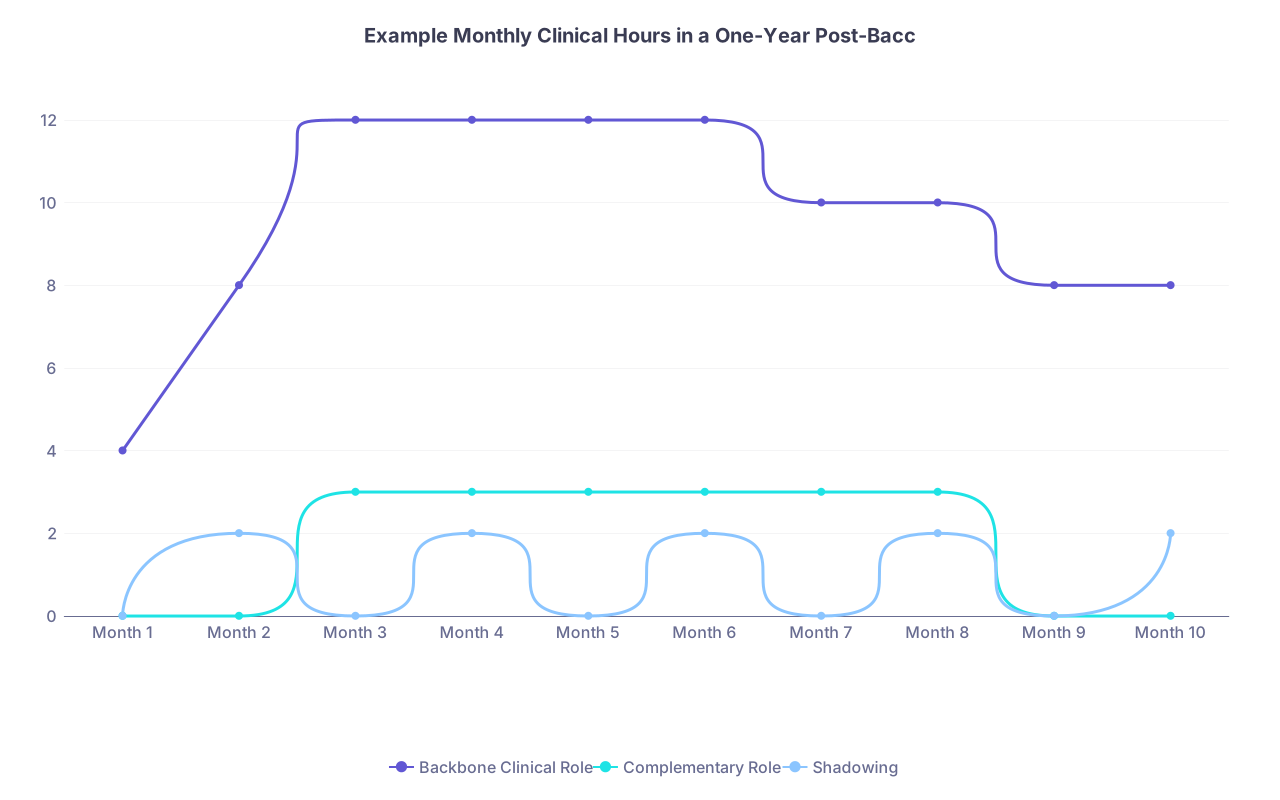
| Category | Backbone Clinical Role | Complementary Role | Shadowing |
|---|---|---|---|
| Month 1 | 4 | 0 | 0 |
| Month 2 | 8 | 0 | 2 |
| Month 3 | 12 | 3 | 0 |
| Month 4 | 12 | 3 | 2 |
| Month 5 | 12 | 3 | 0 |
| Month 6 | 12 | 3 | 2 |
| Month 7 | 10 | 3 | 0 |
| Month 8 | 10 | 3 | 2 |
| Month 9 | 8 | 0 | 0 |
| Month 10 | 8 | 0 | 2 |
That pattern shows:
- A ramp-up as you get trained
- Steady, sustainable weekly commitment
- Intermittent but ongoing shadowing
Trying to maintain 20–25 clinical hours per week on top of a serious post-bacc course load is a good way to tank your GPA. And nothing in your application is more important than that GPA.
If you have to choose between an A in organic chemistry and 50 extra clinical hours? Choose the A. Every time.
Step 7: Document Everything Like You Are Already Writing Your Personal Statement
You are not just “doing” clinical work this year. You are collecting data for your future self.
If you do this right, your AMCAS activities, personal statement, and secondaries will be 10 times easier to write. If you do it wrong, you will sit in front of a blank screen trying to recall what that patient in March said to you.
Set up a simple, structured reflection system. Once a week is enough.
I usually recommend something like this:
- A single document or notebook with one entry per week
- Date + location(s)
- 3 headings: “Scenes,” “Emotions,” “Questions”
Under “Scenes”:
Brief, concrete vignettes. Not essays. Just:
- “Mr. J in ED, refused admission despite clear risk—physician’s frustration vs respect for autonomy.”
- “Oncology patient asking volunteer if she would be remembered after she died.”
Under “Emotions”:
- “Felt useless in trauma bay; more of an observer than team member.”
- “Weird mix of sadness and admiration watching family accept hospice.”
Under “Questions”:
- “How do physicians balance honesty vs hope when prognosis is poor?”
- “Where is the line between ‘noncompliance’ and our system failing people?”
You are building raw material. Later, when you write your personal statement, you will not be inventing “impactful stories.” You will be pulling from actual scenes you already recorded.
This weekly reflection also forces coherence. It makes you see connections:
- Between your ED shifts and your hospice shifts.
- Between your hospitalist shadowing and that free clinic physician running on fumes.
And that is exactly what admissions committees want: someone who can synthesize, not just collect.
Step 8: Align Your Portfolio With Your Academic and Personal Constraints
You cannot design your clinical portfolio in a vacuum. It has to live inside your real life.
Start with a brutally honest audit:
- Are you working for income outside of school?
- How many science credits are you taking each term?
- Are you studying for the MCAT this same year?
If you are:
- Full-time post-bacc (12–16 credits)
- Working 10–15 hours per week for income
- And trying to do MCAT prep
Then your clinical plan must be lean and ruthless:
- 3–4 hours/week backbone clinical, max
- 2 hours/month shadowing
- Heavy reliance on any pre-existing clinical experience you had before the post-bacc
If you are:
- Full-time post-bacc
- Not working
- Already took (or will take later) the MCAT
Then you have room for:
- 6–8 hours/week backbone clinical
- 2–3 hours/week complementary role during one semester
- Regular shadowing
The tragedy I see too often: students load their calendars with idealistic clinical plans in August, then drop half of them by October under stress. That looks worse than starting smaller and sustaining.
Design from your worst week, not your best. If your “perfect” schedule only works on weeks with no exams, it is not realistic.
Step 9: Use the Portfolio to Build Relationships and Letters, Not Just Experiences
A coherent portfolio is not just about what you did. It is also about who saw you do it.
From day one, think about:
- One physician who might write for you (from scribing, research, or shadowing)
- One non-physician clinical supervisor (nurse manager, volunteer coordinator, clinical research lead)
- One academic letter from your post-bacc coursework
Your clinical portfolio should put you in situations where:
- You work with the same people repeatedly
- They see you over months, not weeks
- You have chances for short conversations about your goals and reflections
This is another reason I prefer:
- Longitudinal shadowing with 2–3 physicians
- Long-term volunteer or scribe roles in one primary setting
By spring of your post-bacc year, you should be able to say:
“I have three people who know me well enough to say, in detail, how I behave around patients, how I respond to feedback, and why they think I belong in medicine.”
If you cannot say that, your portfolio might be too scattered.
Step 10: Synthesize It All Into a Clean, Defensible Narrative
By the end of your one-year post-bacc, your clinical portfolio should let you answer the following clearly, out loud, without rambling:
“Why medicine, not just ‘helping people’?”
You should be able to pull from specific clinical moments you have actually lived this year.“How do you know you can handle the hard parts of medicine?”
You should have real encounters with death, uncertainty, noncompliance, frustrating systems.“What have you learned about your own limitations?”
Not fake humility. The real stuff: boundaries, burnout signals, emotional blind spots.“How have your clinical experiences changed you?”
If your answer is “I realized I want to help people,” you wasted your year. You need to talk about how your view of patients, physicians, or health systems has matured.
One exercise I use with students:
Write a one-page “clinical year summary” with these paragraphs:
- Paragraph 1: Your backbone role—what it was, what you did, what you saw
- Paragraph 2: Your complementary role(s)—what contrasted, what surprised you
- Paragraph 3: Shadowing—what you learned about physicians specifically
- Paragraph 4: Across all of it—what stayed with you, what solidified your choice
If you can do that cleanly, your portfolio is coherent. If it reads like a schedule dump, it is not.
Example: Two Coherent One-Year Portfolios
To make this concrete, here are two profiles that actually work. These are composites of students I have advised.
Example 1: Career-Changer, No Prior Clinical
- Starting point: Consulting background, zero patient exposure
- Post-bacc structure: Full-time classes, no external job, MCAT after the year
Portfolio:
Backbone: ED scribe, 8–10 hrs/week, August–June
Got to see undifferentiated complaints, physician reasoning, system issues.Complementary: Hospice volunteer, 3 hrs/week, October–May
Deep exposure to end-of-life, families, non-curative care, interdisciplinary teams.Shadowing:
- Hospitalist: One 4-hour block every 2 months
- Family medicine: Four half-days spread across the year
Narrative coherence:
- “From first contact in the ED to long-term decline in hospice”
- “From short, intense physician-patient interactions to slow, repetitive family conversations”
- “Seeing where rapid diagnostic thinking matters, and where listening and presence matter more”
Example 2: Former EMT, Needs Academic Repair + Updated Clinical
- Starting point: Hundreds of EMT hours from 4–5 years ago, now in office job
- Post-bacc: Part-time, working 20 hrs/week, MCAT planned midway
Portfolio:
Backbone: Hospital volunteer on med-surg, 4 hrs/week, August–June
Consistent presence, basic patient contact, staff interaction.Complementary: Free clinic volunteer, 2 hrs/week, January–May
Front-desk + basic vitals in a low-resource setting.Shadowing:
- Internal medicine clinic: Monthly half-days for 6 months
- Cardiology (ties to personal interest): 3–4 sessions over the year
Narrative coherence:
- “Updating my clinical exposure from pre-hospital to in-hospital and clinic”
- “Seeing chronic disease longitudinally instead of just acute calls”
- “Linking former EMT experience with a more system-level understanding of care”
These are not hour-stuffed CVs. They are portfolios with a visible through-line.
Process Overview: From Zero to Coherent Portfolio
If you want the whole thing as a rough process roadmap:

| Step | Description |
|---|---|
| Step 1 | Month 0: Pre-start |
| Step 2 | Identify constraints & schedule |
| Step 3 | Choose backbone clinical role & apply |
| Step 4 | Start post-bacc + begin clinical onboarding |
| Step 5 | Month 2: Stabilize weekly backbone schedule |
| Step 6 | Add 1 complementary clinical experience |
| Step 7 | Begin structured, longitudinal shadowing |
| Step 8 | Weekly reflection & documentation |
| Step 9 | Month 6–7: Reassess balance & adjust |
| Step 10 | Identify strong letter writers |
| Step 11 | Month 10–12: Synthesize portfolio into application narratives |
You are not improvising this year. You are following a plan.
FAQ: Post-Bacc Clinical Portfolio
1. I already have 500+ clinical hours from before my post-bacc. Do I still need new clinical during the year?
Usually yes, but the intensity can be lower. You want recency and context that matches your current maturity level. If you were a CNA, EMT, or MA years ago, a 3–4 hours/week longitudinal role during your post-bacc can bridge that older experience to your present self and give fresh material for your application.
2. What if I cannot get a “fancy” job like scribing or MA during my one-year post-bacc?
Then you optimize what you can access. A well-chosen hospital volunteer role with real patient contact, combined with thoughtful shadowing and consistent attendance, is far better than a prestigious title you could not sustain. Commit, show up reliably, seek out roles with genuine interaction, and mine them for insight.
3. How late is too late to start clinical work during a one-year post-bacc?
If you are starting from zero, anything beyond month 3 of your program starts getting dicey for that application cycle. You want at least 6–8 months of consistent exposure before you submit. If you miss that window, you may need to push your application back a cycle or rely more heavily on pre–post-bacc experiences.
4. Can virtual shadowing or telehealth experiences meaningfully contribute to my portfolio?
They can supplement but should not anchor your portfolio. Virtual exposure can help you understand telemedicine workflows and provider thinking, but it is weaker on patient contact, nonverbal cues, and team dynamics. Use it to add nuance, not as a replacement for in-person clinical work.
5. How do I explain a portfolio that looks disjointed because I had to change roles mid-year?
You own it directly and connect the dots yourself. Example: “When my initial ED volunteering program closed to students mid-year, I transitioned to a primary care clinic. The shift forced me to see the contrast between acute and longitudinal care, and I realized I was drawn more toward ongoing relationships with patients than one-time encounters.” Disjointed experiences are survivable; incoherent explanations are not.
With a year-long post-bacc, you are not just proving you can pass organic chemistry. You are proving you can build a thoughtful, sustainable clinical life around your academics. Once you have done that, you will be ready for the next step—turning this clinical portfolio into a compelling personal statement and activity list. But that is a conversation for another day.