Financial Pitfalls: Post-Bacc Debt Decisions Premeds Regret Later
What if the “dream” post-bacc you’re about to enroll in is the very thing that quietly kills your future options by burying you in debt before you even take your first Step exam?
Plenty of smart, driven premeds walk straight into financial traps with post-bacc programs. Not because they’re careless. Because nobody warned them what questions to ask before signing for $40,000–$80,000 of debt on a promise of “linkage,” “prestige,” or “best chance for med school.”
You’re here to avoid being one of them.
This isn’t about scaring you away from all post-baccs. Some are absolutely worth it. The danger is treating this as a “whatever it takes” decision instead of a calculated financial move that will shape:
(See also: GPA Repair Gone Wrong for common mistakes that don’t impress admissions committees.)
- Where you can apply to medical school
- Whether you can choose primary care or need a higher-paying specialty
- When (or if) you can buy a home, have kids, or even feel okay taking a day off
Let’s walk through the specific financial mistakes premeds repeatedly make with post-bacc programs—and how you can avoid each one.
Mistake #1: Treating Post-Bacc Debt Like “Just Another Student Loan”
If you only remember one thing, remember this:
Post-bacc debt stacks on top of medical school debt. It does not replace it.
Plenty of students convince themselves: “Well, I’ll be in debt anyway for med school, so what’s another $50,000?”
That thinking is exactly how people end up at residency graduation with:
- $60,000–$120,000 from undergrad/post-bacc
- $250,000–$400,000 from med school
Total: $310,000–$520,000+ before interest.
At that level, you are not just “in debt.” Your career and life choices are tethered to those loans.
How this mistake plays out
Scenario:
You’re considering a 1-year formal post-bacc at a private university in a major city:
- Tuition: $35,000
- Fees: $3,000
- Living (bare minimum): $20,000
- Total cost for the year: ~$58,000
Most students borrow the entire amount. At 7% interest, by the time you finish a 4-year med school and a 3–7 year residency, that post-bacc debt has grown.
Now add med school:
- Med school tuition + living over 4 years: $250,000–$350,000 (very realistic range)
You’re now looking at $300,000–$400,000+ total debt before you earn an attending salary.
Don’t make the mistake of mentally rounding $300k and $400k to “both lots of debt, kinda the same thing.” They are not the same. The difference between $300k and $400k in loans can be:
- Several extra years of repayment
- Needing a second job or heavy moonlighting
- Less freedom to choose residency and job location
How to avoid it
- Run actual loan calculators, not vibes. Plug in:
- Post-bacc cost
- Projected med school debt
- 6–8% interest
- 10–25 year repayment
- Look up realistic attending starting salaries in the specialty you actually might choose, not your “if everything goes perfectly, I’ll be a dermatologist” fantasy.
If the numbers only barely work assuming a very high-paying specialty, that’s a red flag.
Mistake #2: Paying Private-School Prices for Public-School Outcomes
Another trap: assuming higher tuition means better outcomes.
Plenty of private universities market post-baccs with glossy websites, custom advising, and “small cohort” branding. Tuition: $40,000+ for 1 year. Sometimes more.
Then you look closer and realize:
- No guaranteed interviews
- No formal linkage
- No better med school admit rates than cheaper programs
- Same courses you could have taken at a state school for 1/3 the price
But by the time most applicants see that, they’ve already signed the promissory note.
The prestige mirage
Programs at places like:
- Columbia
- Tufts
- Boston University
- Northwestern
- Johns Hopkins
can be excellent—for some people. The mistake is assuming the name alone justifies the price.
A $50,000 post-bacc that gets you into a medical school is not necessarily “better” than a $15,000 program that also gets you into a medical school. Your MD/DO degree will not carry your post-bacc’s brand name.
Residency program directors are not poring over your transcript thinking, “Oh wow, you took orgo at Fancy Private Post-Bacc U.” They care far more about:
- MCAT
- Med school performance
- Letters of recommendation
- Clinical experiences
How to avoid this
Before paying private-school prices, ask:
- What are your last 3 years’ med school acceptance rates, and how many students is that based on?
- Beware of programs boasting “90% acceptance!” when that’s based on 9 people.
- What percentage of students get into MD programs? DO programs? After how many cycles?
- How do your outcomes compare to local state or extension programs?
If you cannot get straight answers, assume the outcomes are nothing special. Don’t pay “elite” prices for average results.
Mistake #3: Ignoring Cheaper, Flexible Alternatives
Many premeds go straight to the formal post-bacc programs that pop up first on Google. They skip over quieter, cheaper options that would have given them:
- The same prerequisites
- The same GPA repair
- A fraction of the debt
Because those alternatives don’t have fancy websites, they get dismissed as “less serious.”
Huge mistake.
Underused options that save a fortune
Local state university as a non-degree student
- Pay per-credit, usually far cheaper than private schools
- Same exact courses (same orgo, same physics, same bio)
- Often taught by the same professors teaching the majors
Public university extension / continuing ed programs
- Evening or part-time schedules while you work
- Sometimes open-enrollment
- Lower tuition and more flexibility
DIY Post-Bacc
- You assemble the needed prereqs yourself at local schools
- You work part-time or even full-time to offset costs
- You avoid expensive “program fees” and bundled services
Does this require more initiative? Yes. Is that worth potentially saving $20,000–$60,000? Almost always.
How to avoid the “I need a formal program” trap
Consider a formal post-bacc only if:
- You need structured GPA repair with committee support
- You need tight advising and letters to compensate for a very weak academic record
- The program’s outcomes are demonstrably better than what you could do on your own
If you already have:
- Decent study skills
- Ability to research requirements
- Willingness to email professors and advisors yourself
Then a low-cost DIY route can be financially much safer.
Mistake #4: Over-borrowing for Lifestyle During Post-Bacc
There’s a quieter, more personal trap: borrowing for a lifestyle you can’t actually afford—yet.
You tell yourself, “It’s only for a year,” and:
- Rent a solo apartment you don’t truly need
- Live near campus in an expensive city
- Eat out because “I don’t have time to cook”
- Upgrade your phone, laptop, etc. because “I need it for school”
Those decisions can add $10,000–$20,000 of extra loan principal easily. And remember: that’s before you take on full med school debt.
The hidden cost of every extra $10,000
Take $10,000 at 7% interest over 20 years:
- Payments: About $77/month
- Total repaid: ~$18,500
Double that for $20,000: ~$155/month, ~$37,000 total.
That’s a used car. Or a year of daycare. Or a down payment on a starter home. All gone to fund one year of takeout and a slightly nicer apartment.
How to avoid this lifestyle inflation
- Choose roommates over living alone when possible.
- Live slightly farther from campus if it drops rent by hundreds per month.
- Build a strict monthly budget before you accept loans and adjust how much you borrow based on that, not the other way around.
- Apply for part-time remote work, scribing, or tutoring if your schedule allows even 5–10 hours/week. Small earnings can keep you from over-borrowing.
Do not let “I’ll pay it off when I’m a doctor” justify every impulse.
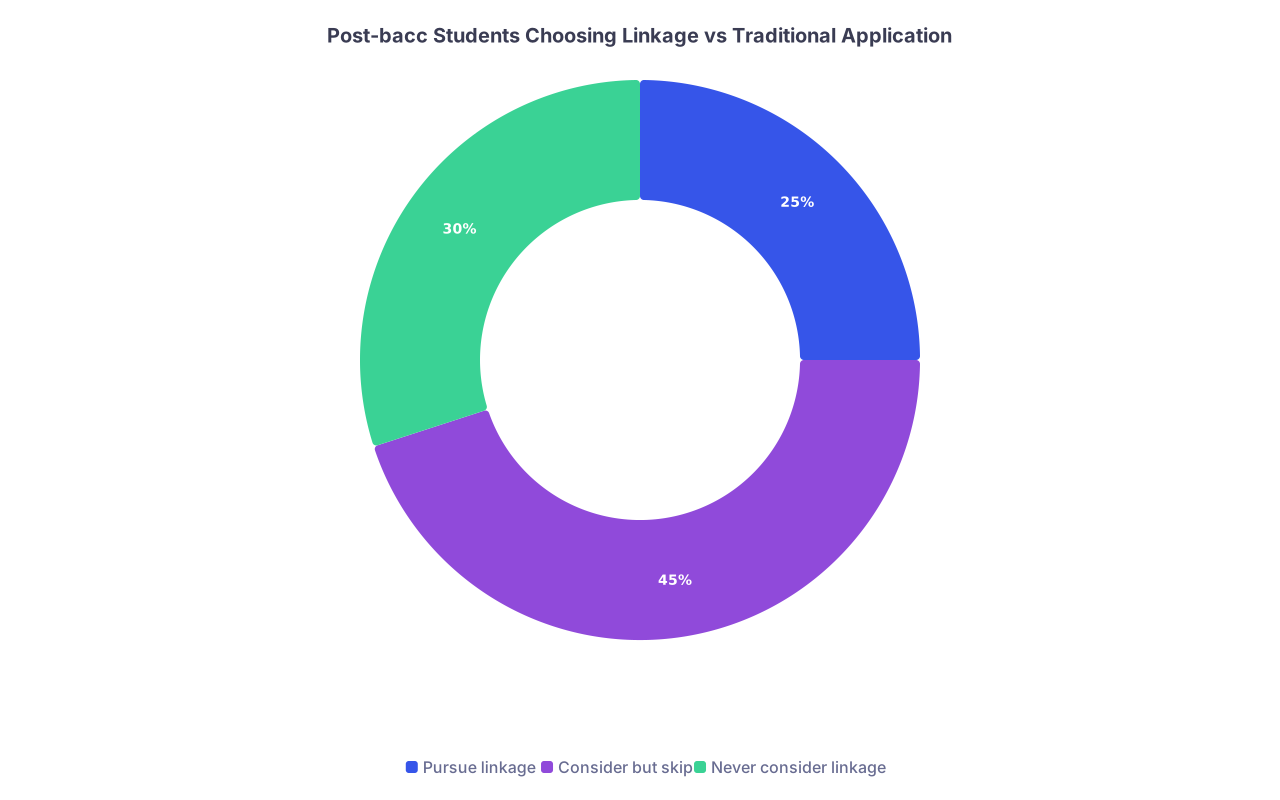
Mistake #5: Believing Linkage = Guaranteed Shortcut (and Justifies Any Cost)
Some post-baccs dangle “linkage” like a golden ticket. Finish our program, hit a threshold GPA/MCAT, and you might get:
- A guaranteed interview at a partnered med school
- Sometimes even conditional acceptance
Students then rationalize absurd costs because “I’ll make it back once I’m in med school early.”
Here’s the problem:
Linkage is almost never automatic or guaranteed for everyone. It usually comes with:
- Minimum GPA (often 3.6+ in the program)
- Minimum MCAT (often 510+ for MD linkages)
- No application blemishes or professionalism concerns
- Tight timelines, sometimes forcing you into the MCAT earlier than ideal
If you miss any of those, you’re back in the regular applicant pool with regular applicants—just with more debt.
Concrete example
A prestigious 1-year post-bacc might advertise a linkage with an MD program:
- Program tuition/living: $60,000
- Linkage minimums: 3.7 post-bacc GPA, 512+ MCAT
You end with:
- 3.5 GPA
- 508 MCAT
You no longer qualify for the linkage. You still paid the premium price. Now you’re applying broadly like everyone else, competing with students who spent half what you did on their coursework.
How to avoid “linkage blindness”
- Ask specifically:
- How many students start the program each year?
- How many qualify for linkage criteria?
- How many actually matriculate via linkage?
- Treat linkage as a potential bonus, not guaranteed value.
- Do not pay an extra $20,000–$40,000 on the assumption that you’ll hit aggressive GPA/MCAT cutoffs.
Mistake #6: Not Planning for a “What If I Don’t Get In?” Year
Here’s the scenario many students never think about:
You finish your post-bacc.
You apply.
You don’t get in this cycle.
Now what?
You have:
- New loan payments coming due (after your grace period ends)
- No med school spot yet
- Maybe no job lined up because you assumed you’d be a student
This is where panic borrowing, scrambling into credit card debt, or taking any job that appears starts happening.
Why this is dangerous
If you assume a straight path—post-bacc → acceptance → med school—you’ll often borrow the maximum, live like a temporary student, and fail to build any savings or backup plan.
Then:
- A bad MCAT
- Weak personal statement
- Thin clinical experience
can cost you a cycle, and that extra year gets very expensive without planning.
How to avoid this failure-to-plan trap
Before you start the post-bacc, ask yourself:
- If I don’t get in right away, how will I support myself the following year?
- What kind of job can I reasonably get with my existing degree + new science coursework?
- Could I work part-time during the post-bacc to build a small emergency cushion?
Do not borrow as if the path is guaranteed. Borrow as if there’s a realistic chance you’ll need one or two “bridge” years.
Mistake #7: Ignoring Scholarship, Work, and School Choice Levers
Many premeds treat post-bacc cost as fixed: “This is the tuition, period.” They miss three major levers:
- School choice lever – picking a state school vs a private university can be a $20,000–$40,000 difference for the same credits.
- Work lever – working even 8–10 hours/week as a scribe, tutor, or medical assistant can shave thousands off your annual borrowing.
- Scholarship / discount lever – some programs quietly offer:
- Need-based aid
- Merit discounts
- In-state rates after a residency year
But those are often not advertised loudly, and you have to ask.
Practical steps to reduce what you borrow
- Email the program director or financial aid office:
- “Do you have any institutional grants or scholarships specifically for post-bacc students?”
- “Does anyone in the program work part-time successfully, and if so, in what roles?”
- Ask if any nearby hospitals or clinics offer tuition reimbursement for part-time employees taking classes.
- Run the numbers comparing:
- High-cost, full-time formal program with no work
- Lower-cost, part-time DIY option with 10–15 hours/week of work
You might discover that the “slower” option leaves you tens of thousands less in debt without significantly harming your application.
Mistake #8: Not Matching Program Type to Your Actual Problem
The most expensive mistake is misdiagnosing what you actually need.
People with very different problems all run toward the same shiny post-baccs:
- Career changers with no science background
- Students with a 2.5 science GPA needing major repair
- Students with a 3.4 GPA but no clinical experience or poor MCAT
- Nontraditional applicants who mostly need structured advising and a strong committee letter
They don’t all need the same solution—or the same price tag.
Matching problem to program
Career changer, good prior GPA, no science
- You often do not need the most expensive program.
- A structured but affordable program or DIY at a state school may be enough.
Low GPA (e.g., <3.0 science), need serious repair
- Here, a solid, reputable formal post-bacc or SMP (special master’s program) might be worth the cost.
- This is where faculty advocacy and strong institutional support can matter.
Decent GPA but MCAT/experience weak
- You may not need a full-blown post-bacc at all.
- Taking a few targeted upper-division courses plus a dedicated MCAT prep period and serious clinical volunteering could be a far cheaper fix.
How to avoid overbuying the wrong solution
Be brutally honest:
- Is your main weakness GPA, MCAT, lack of clinical exposure, poor narrative, or something else?
- Are you paying $30,000 for advising and structure that you could get from a premed advising service or mentor at a fraction of the cost?
You don’t want to spend one or two years and $40,000 solving the wrong problem.
FAQs
1. Is an expensive formal post-bacc ever worth the debt?
Yes—but only when the price is matched to a real need and strong outcomes. It can be worth it if:
- Your GPA is significantly low and you need structured repair
- The program has transparent, strong placement into med schools over several years
- You’ve compared it to cheaper alternatives and the added benefits are concrete (e.g., real committee letter support, proven linkage with realistic criteria, intensive advising)
It’s not worth it just because it’s prestigious or highly marketed.
2. How much post-bacc debt is “too much”?
There’s no single number, but once your combined projected debt (post-bacc + med school) is pushing into the $350,000–$450,000 range, you need to be extremely cautious. Use loan calculators, look at realistic attending salaries in the specialties you might choose, and ask whether you’re comfortable with payments under different repayment plans. If the total only works assuming a best-case scenario career, that’s a warning sign.
3. Should I work during my post-bacc, or will that hurt my grades?
Working can be a smart way to limit debt if you’re realistic about your capacity. Many students successfully work 5–15 hours/week in roles like medical scribe, tutor, or medical assistant. If your academic history shows struggle, you might need to prioritize grades over work. A compromise is working part-time in lighter semesters or during summers to build a small cushion so you can borrow less.
4. How do I compare formal post-bacc vs DIY in a fair way?
Line up the key elements side by side:
- Total cost (tuition + fees + living)
- Med school acceptance rates and sample size
- Availability of committee letter or structured recommendation support
- Flexibility to work while studying
- Class sizes and access to advising
If the outcomes are similar but the formal program costs double, you’re mostly paying for convenience and branding. If the formal program has demonstrably stronger outcomes and real support systems you actually need, the extra cost may be justified—but it should be a deliberate choice, not an assumption.
5. What if I already finished a pricey post-bacc and feel overextended financially?
You can’t undo the loans, but you can avoid compounding the problem. Focus on:
- Applying strategically to a balanced list of MD and DO schools to reduce reapplication cycles
- Keeping living expenses lean through med school
- Learning about income-driven repayment, PSLF, and loan forgiveness programs early
- Considering scholarships, HPSP (military), NHSC, or service-based programs that can offset med school debt
You made one expensive decision; don’t let that push you into more high-cost, low-benefit choices. From here on, every financial move should be examined twice.
Key takeaways:
- Don’t treat post-bacc debt as “just part of the process”—stack it realistically on top of med school debt and see if the math still works.
- Never pay premium prices for average outcomes; compare formal programs to cheaper DIY or state options with the same rigor you’d use choosing a med school.
- Match the cost and intensity of the program to your actual weakness (GPA vs MCAT vs experience), and resist over-borrowing for lifestyle or prestige you can’t afford yet.