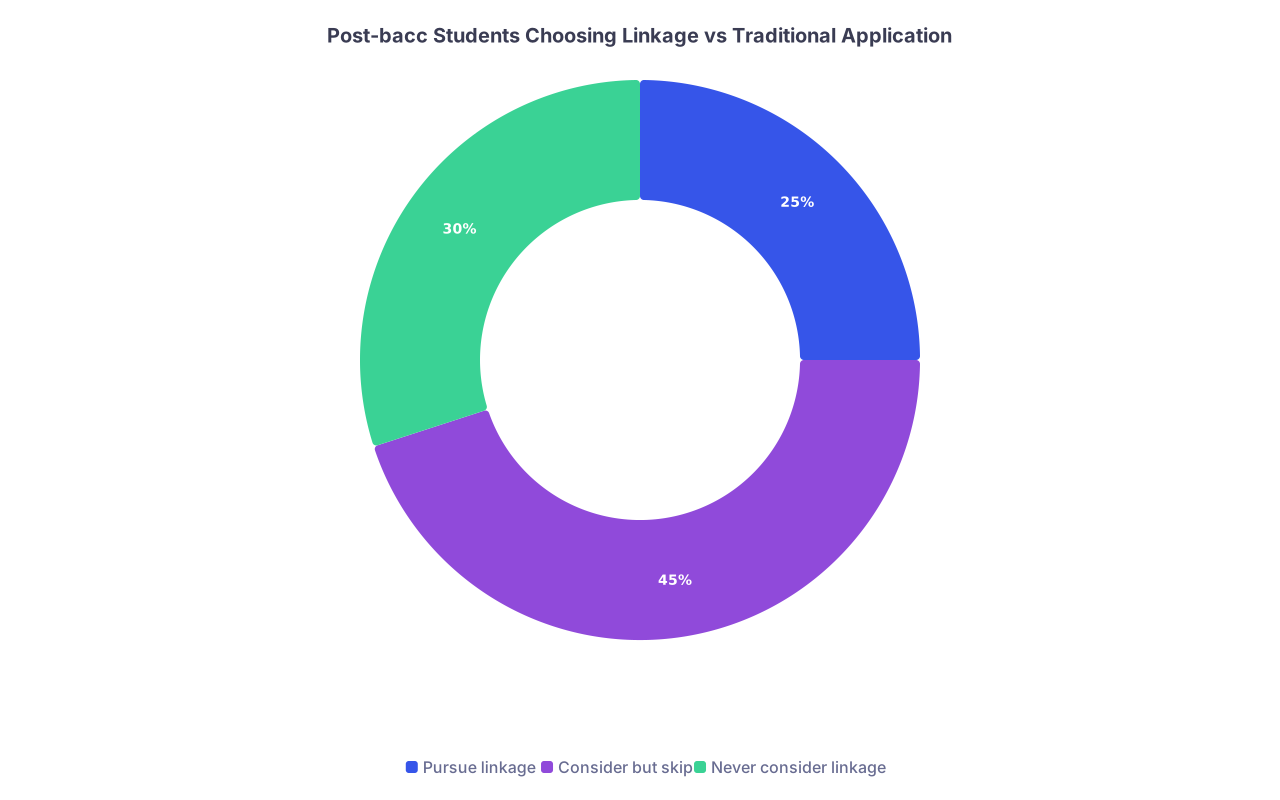
Most premeds are misreading linkage agreements—and some are gambling away their medical school chances without realizing it.
If you are considering a postbac or already in one, a linkage agreement can look like a golden ticket: no glide year, a direct path, faster MD or DO. But that “shortcut” can quietly lock you into higher risk, tighter timelines, and less flexibility than you think.
You need a clear, step-by-step protocol to decide if a linkage agreement is worth the risk for you. Not for a generic applicant. For you, with your GPA, MCAT prospects, personal obligations, and risk tolerance.
This guide will walk you through that evaluation process the way a cautious, strategic advisor would. You will finish with a yes/no decision framework—not vague pros and cons.
Step 1: Strip Away the Hype and Define What a Linkage Really Is
Before you can evaluate risk, you need precise definitions.
A linkage agreement is:
- A formal arrangement between a postbac program and one or more medical schools
- That allows eligible postbac students to:
- Apply during or immediately after the postbac
- Potentially skip the traditional “glide year”
- Often receive a conditional acceptance contingent on:
- Completing specific courses
- Hitting GPA thresholds
- Achieving minimum MCAT scores
- Sometimes demonstrating professionalism and “fit”
Critical point:
A linkage is usually not a guarantee of admission. It is an expedited, constrained application pathway with higher minimums and less flexibility.
Common realities programs rarely emphasize:
- You often must:
- Commit to a single medical school before you even know your MCAT score
- Apply through linkage instead of the regular cycle (or severely limit regular applications)
- Accept that if you miss GPA/MCAT cutoffs, your timeline and strategy may be damaged
Your mindset shift:
Treat linkage like an early decision contract with strict academic conditions and real downside risk—not like a “bonus opportunity.”
Step 2: Map Your Current Academic Position Honestly
Linkage only makes sense if your academic trajectory can reliably meet the bar. Not “if everything goes perfectly.” Realistically.
Create a simple academic snapshot:
Undergraduate GPA (uGPA)
- Overall GPA
- Science GPA (BCPM: biology, chemistry, physics, math)
Trend
- Last 60 credits GPA
- Any recent postbac or graduate work and those GPAs
Postbac Context
- Are you in:
- A career-changer postbac (no or few prereqs done)?
- A record-enhancer program (repairing GPA)?
- Are grades so far in postbac:
- ≥3.7
- 3.4–3.69
- <3.4
- Are you in:
MCAT readiness
- Taken MCAT already? Score and breakdown.
- Practice test scores (AAMC specifically).
- Realistic test date if not yet taken.
Now compare this to typical linkage thresholds.
Common linkage minimums (varies by program, but representative):
- Cumulative postbac GPA: 3.5–3.7 minimum
- Science postbac GPA: 3.5–3.7 minimum
- Overall uGPA: Often 3.3–3.5 minimum, some higher
- MCAT: 509–515+ for MD linkages, 503–507+ for many DO linkages
- No course grades below B or B+ during the postbac
If your current performance is:
- Well above these (e.g., 3.9 postbac with strong test scores)
- Linkage becomes more plausible.
- Just at or slightly below these (e.g., 3.5 with a mixed trend)
- Linkage becomes risky and fragile.
- Clearly below, hoping for a wild improvement
- Linkage is almost certainly not worth the risk.
Action:
Write down in two columns:
- “My current numbers”
- “Target linkage thresholds for my specific program(s)”
If you are not close today, do not assume future perfection under maximum stress.
Step 3: Decode the Specific Rules of the Linkage Agreement
Not all linkages are created equal. Before you even think of “Is this worth it?”, you must decode the fine print.
Obtain and answer these, in writing, for each linkage option:
3.1 Eligibility Rules
- Does the linkage:
- Require U.S. citizenship or permanent residency?
- Exclude students with previous medical school applications?
- Exclude those who already completed some or all prereqs?
- Have a minimum number of credits completed within the postbac before applying?
3.2 Academic Requirements
- Minimum cumulative GPA during postbac?
- Minimum science GPA during postbac?
- Minimum overall undergraduate GPA?
- Any “no grade lower than B” rules?
- Are MCAT scores required before applying or can they be pending?
3.3 Timing and Application Restrictions
- When does the linkage application occur?
- Fall of your postbac? Spring? After completion?
- Can you:
- Apply to only the linkage school that cycle?
- Apply to the linkage and also apply broadly, if linkage fails?
- Apply broadly the following cycle without penalty if you do not match through linkage?
3.4 Consequences of Missed Cutoffs
Ask bluntly:
- What happens if:
- I apply through the linkage and do not get accepted?
- I get a conditional acceptance but then:
- Fall short on GPA in a subsequent semester?
- Fall short on the MCAT?
- Will:
- The affiliated medical school view me negatively in a future regular cycle?
- Other schools see linkage participation on my record (through committee letters or timing)?
If the program staff give vague answers, persist with specific scenarios:
“If a student with a 3.6 postbac GPA and a 507 MCAT applied through this linkage last year, how often were they accepted versus not?”
You want data and patterns, not just reassurance.
Step 4: Quantify the Real Upside of the Linkage for YOU
Now you know the rules. Next, you must quantify the upside—not generically, but based on your specific situation.
Upsides that matter:
Skipping the glide year
- Saves:
- 12–15 months of time
- One year of living expenses
- One year of application-cycle anxiety
- For nontraditional students in their late 20s–30s, this can be substantial.
- Saves:
Early, conditional clarity
- Knowing your likely destination earlier may:
- Reduce stress
- Simplify relocation decisions
- Help with planning for family, partner, or job transitions
- Knowing your likely destination earlier may:
Potentially higher acceptance probability at that specific school
- Some linkage programs report higher acceptance rates for their applicants compared to national averages.
- Example: A postbac may say:
- 60–80% of linkage applicants who meet thresholds receive an acceptance or waitlist decision.
Structured guidance and focused support
- Many linkage pathways provide:
- Dedicated advising
- Guaranteed committee letters
- Built-in MCAT support
- Many linkage pathways provide:
However, do not exaggerate this upside:
- The true comparison is not:
- “Linkage vs no medical school admission”
- It is:
- “Linkage vs applying broadly after completing the postbac + glide year”
Action:
Write three bullet lists:
- “Upsides of linkage in my case”
- “Upsides of a standard cycle in my case”
- “What I personally value most (time, flexibility, prestige, location, reduced stress, etc.)”
If skipping the glide year is not that valuable to you (for example, you welcome time to earn money, gain clinical experience, or improve your application), the linkage upside shrinks dramatically.
Step 5: Expose the Hidden Risks and Opportunity Costs
Most of the risk in linkage agreements lives in what they prevent you from doing.
5.1 Loss of Broad Application Strategy
Typical constraints:
- You may:
- Be allowed to apply only to the linkage school that year.
- Be discouraged from applying elsewhere simultaneously.
- Have application timing that makes broad applications weak or late.
Risk: If the linkage fails or you narrowly miss a cutoff, you may have:
- No acceptance that cycle
- A forced glide year anyway
- Less flexibility in improving your record before a “full” cycle
5.2 Pressure Effects on Performance
High stakes can affect performance.
Common scenarios:
- Students take:
- Full course loads in upper-level sciences
- While preparing intensely for the MCAT
- Under the knowledge that one B- can destroy linkage eligibility
This can:
- Increase anxiety
- Worsen test performance
- Lead to burnout and lower grades precisely when you need them highest
If your mental health history includes anxiety, depression, or test-taking difficulties, this compounded pressure deserves extra weight.
5.3 Lock-In to a Single School
When you choose linkage, you are often:
- Anchoring yourself to:
- One school’s curriculum style
- One geographic region
- One financial structure (tuition, aid, scholarships)
You may miss:
- Better financial packages elsewhere
- Schools that match your interests (research, primary care, specific populations)
- DO schools if you have a lower GPA profile and might be more competitive there broadly
Opportunity cost is not theoretical. A student who locks into a mid-tier private MD through linkage could potentially have gained:
- Multiple MD acceptances with scholarship offers through a full, competitive cycle
5.4 Wrong-Side-of-the-Cutoff Risk
The harshest risk: being “almost there.”
Example:
- Linkage requirement:
- Postbac GPA 3.7
- MCAT 512
- Your actuals:
- Postbac 3.65
- MCAT 510
You are a strong applicant for a broad cycle. But for linkage, you are below the bar.
If you structure your timeline around linkage and miss, you may:
- Have an awkward half-complete cycle
- Need an extra year anyway
- Have less flexibility to re-take MCAT or adjust course rigor
Action:
Write out this sentence and fill in your numbers:
“If the linkage school requires X GPA and Y MCAT, and I currently project to be at approximately A GPA and B MCAT, then my probability of missing the cutoff is ___% and my backup plan is ____________.”
Force yourself to articulate the risk and backup plan clearly.

Step 6: Use a Structured Decision Matrix
Now convert your thoughts into a semi-quantitative model. This prevents emotion and fear of time loss from driving everything.
Create a simple table with 5 criteria, each scored from 1 (very unfavorable) to 5 (very favorable).
Criteria:
Academic Fit
- How comfortably do your current and projected GPAs / MCAT align with the linkage thresholds?
- 1 = Far below; 5 = Well above with margin
Timeline Value
- How important is skipping the glide year to you based on age, finances, family obligations, and burnout risk?
- 1 = Nice but not critical; 5 = Extremely valuable, almost essential
Risk Tolerance
- How comfortable are you with a higher chance of “all or nothing” this cycle?
- 1 = Strong preference for safer, more flexible paths; 5 = Comfortable with meaningful risk for potential reward
School Fit
- How well does the linkage school align with your:
- Mission fit (urban vs rural, underserved care, research)
- Learning style (PBL vs lecture-heavy)
- Geographic and personal needs
- 1 = Would not choose this school if admitted elsewhere; 5 = This is genuinely a top-choice school
- How well does the linkage school align with your:
Alternative Options Strength
- Without linkage, how strong would your application be in a broad cycle after a glide year?
- 1 = Very weak prospects; 5 = Likely to have several competitive options
Scoring Guidance:
- 18–25: Linkage may be worth serious consideration.
- 11–17: Linkage is a borderline choice; should proceed only if very deliberate about risks.
- 5–10: Linkage is likely not worth the risk.
This is not an algorithm; it is a structured way to confront your biases.
Step 7: Stress-Test Worst-Case and Most-Likely Scenarios
Do not evaluate linkage on a “best-case” fantasy. Instead, test three specific scenarios:
Scenario A: Best-Case
- You meet or exceed all GPA and MCAT cutoffs.
- You receive a conditional acceptance that converts to full acceptance.
- You start medical school right after postbac with no glide year.
Ask:
- Does this outcome strongly improve my life relative to:
- A normal application cycle?
- Potentially applying more broadly and having more options?
Scenario B: Most-Likely Case (Be Honest)
Use your current track record.
- If your grades have historically been 3.5–3.6 in rigorous STEM:
- Assuming a 3.9 going forward under extreme pressure is unrealistic.
- If your practice MCAT tests are 504–506:
- Assuming a 513 on test day is wishful thinking.
Estimate:
- Realistic GPA under workload: ______
- Realistic MCAT based on practice trend: ______
Then ask:
- With these numbers, how likely is:
- Linkage acceptance?
- A strong application in a broad cycle?
Scenario C: Worst-Reasonable Case
Not disaster, but plausible setbacks:
- One unexpectedly harsh professor and a B- in organic chemistry
- Illness during peak MCAT prep month; test score under goal
- Family stress or job loss affecting study capacity
In this scenario:
- How badly would your linkage eligibility be damaged?
- Does your timeline implode, or do you still have solid paths forward?
If Scenario C leaves you with no good options for that entire year, the linkage risk is higher than it appears.
Step 8: Ask the Three Critical Questions Before You Commit
Before deciding, answer these three questions in writing:
If linkage did not exist, what would my ideal plan be?
- Complete postbac, take MCAT with full prep, apply broadly next cycle?
- Take extra coursework to further strengthen GPA?
- Add more clinical, research, or service experiences?
Does linkage significantly improve that ideal plan, or only shorten it?
- If linkage adds meaningful career acceleration and fits your numbers and life, it may be worth it.
- If linkage only shortens but makes everything more fragile, you are trading long-term strength for short-term speed.
If linkage fails, will I regret not having taken the safer, broader path?
- For some nontraditional students in their late 30s with family obligations, the answer might be no—they prefer the faster, riskier route.
- For many younger students or those with upward trajectories, the answer is often yes.
If your honest responses reveal that:
- Your main driver is fear of “wasting time”
- You are stretching to meet academic standards
- You are not deeply attached to the linkage school
Then the linkage is likely not worth the risk.
Step 9: Clear Red Flags—When a Linkage Is Almost Never Worth It
There are situations where the answer is straightforward: do not pursue linkage.
You are probably better off avoiding linkage if:
- Your postbac GPA is:
- Below 3.5 in a record-enhancer context
- Or you already have a history of struggling under heavy course loads
- Your MCAT:
- Is untested and your practice diagnostics are weak (<500)
- Or you have known test anxiety needing multiple attempts to reach target scores
- You:
- Value having multiple school options
- Care deeply about scholarships/financial aid comparisons
- Are not confident the linkage school is a top-choice environment
- Your life situation is:
- Unstable (caregiving responsibilities, health issues, unpredictable job hours)
- Making it difficult to guarantee sustained peak performance for 12–18 months
In these cases, the potential harm from a failed linkage usually outweighs the potential benefit of a year saved.
Step 10: When a Linkage Is Reasonably Worth the Risk
A linkage may be strategic when all of the following are true:
You are in a career-changer postbac with:
- Stable prior academic success outside of hard sciences
- Strong postbac grades (3.7–4.0) from the start
- Positive feedback from advisors that you are well above the median
Your MCAT prospects look solid:
- AAMC practice tests already at or above the linkage requirement with reasonable buffer
- You have scheduled protected time for MCAT preparation
The linkage school itself is:
- A clear top-choice based on mission, location, and curriculum
- A place you would likely attend even if you had multiple offers
Your life situation:
- Strongly benefits from avoiding an extra year (age, dependents, financial pressure)
- Is stable enough to support a demanding 12–18 month period
In this context, linkage is still a risk—but a calculated, rational one.
Concrete Next Step You Can Take Today
Open a blank page and build your own two-column comparison:
Column A: “If I pursue linkage” with:
- Required GPA and MCAT
- Timeline
- Application restrictions
- Best-case, most-likely, and worst-case outcomes
Column B: “If I skip linkage” with:
- My likely GPA and MCAT trajectory
- Timeline with a glide year
- Breadth of schools and scholarship possibilities
Write one sentence at the bottom:
“Given my numbers, personality, and life situation, I will / will not pursue a linkage because ____________.”
If you can defend that sentence logically to a skeptical advisor, your decision is probably sound.