
The idea that you must be a biology major to be a strong med school applicant is outdated—and strategically limiting.
If you are a humanities major who wants medical school, you can absolutely design a curriculum that is both intellectually honest (real humanities depth) and procedurally sound (every prerequisite, no gaps). The key is precision. Not vibes. Not “I’ll figure it out later.” Precision.
Let me break this down specifically.
Step 1: Know Exactly What “Every Med Prereq” Actually Means
Most premed misery starts with a fuzzy understanding of requirements. Let’s turn that into a concrete checklist.
Core science prerequisites (traditional MD/DO expectations)
(See also: Advanced Study Skills for Pre‑Med Organic Chemistry and Biochemistry for tips on mastering challenging courses.)
Almost every U.S. medical school expects at least:
Biology
- 2 semesters of introductory biology with lab
- Examples:
- BIOL 101 + 101L and BIOL 102 + 102L
- Sometimes upper-level biology is “recommended” (strongly). Think: physiology, microbiology, genetics.
General (Inorganic) Chemistry
- 2 semesters with lab
- CHEM 101 + 101L and CHEM 102 + 102L
Organic Chemistry
- 2 semesters with lab (some schools accept 1 orgo + 1 biochem; many still like 2 orgo)
- CHEM 201 + 201L and CHEM 202 + 202L
Physics
- 2 semesters with lab (algebra-based is usually fine)
- PHYS 101 + 101L and PHYS 102 + 102L
English / Writing
- 2 semesters of English or writing-intensive humanities courses
- This is where your major can shine; often fulfilled by your humanities requirements.
Math / Statistics
- Ranges from:
- 1 semester of statistics or
- 1–2 semesters of calculus or
- A mix of calculus and statistics
- Many med schools emphasize statistics now because it aligns with evidence-based medicine.
- Ranges from:
Biochemistry
- Increasingly required or very strongly recommended
- Usually 1 semester of Biochem (with at least orgo I as prerequisite)
“Hidden” expectations (not always on the official list)
Even if not strictly “required,” these help both applications and MCAT:
- Psychology + Sociology (1 course each strongly helps MCAT)
- Genetics (popular recommendation)
- Physiology or Cell Biology
- Humanities / ethics / philosophy courses with strong writing (you already have this)
Your target: design a 4-year humanities degree plan that:
- Meets every med prereq
- Prepares you for the MCAT content map
- Still lets you do real humanities work, not a fake “premed humanities” compromise
Step 2: Pick the Right Kind of Humanities Major
Not all humanities majors are equally “premed-friendly” from a scheduling standpoint. That does NOT mean some are “better”; it means some are structurally more flexible.
Majors that usually integrate well with premed
These often have:
- Moderate credit requirements
- Built-in writing
- Room for electives
Examples:
- Philosophy
- History
- English / Comparative Literature
- Linguistics
- Religious Studies
- Classics
- Cultural Studies / American Studies
These often allow enough free elective slots to insert 8–12 science courses without overloading every semester.

Majors that need tighter planning
These can still work, but you must be more surgical with timelines:
- Double majors (e.g., Philosophy + Political Science)
- Interdisciplinary programs with heavy requirements (e.g., PPE, International Relations with language intensity)
- Humanities majors with strict sequence or thesis-heavy senior year
If you want, say, Philosophy + French and med school, you must map every semester from the start. No improvising in junior year.
Step 3: Build a 4-Year Skeleton Before Filling in Details
The worst strategy: semester-by-semester guessing.
The best strategy: build a high-level 4-year grid first, then refine.
Think in terms of buckets:
- Major requirements
- College / general education requirements
- Premed requirements
- MCAT timing
Example: 4-year humanities premed skeleton (Philosophy major)
I will use a 120-credit degree with:
- ~36–42 credits in the major
- ~30–40 credits in general education
- Rest as electives (where you place sciences)
Year 1 – Foundation and scouting
Fall
- Intro Philosophy (major)
- First-year writing / English
- General Chemistry I + Lab
- Calculus or Statistics
- Gen Ed (language or distribution)
Spring
- Philosophy elective (logic recommended)
- English / writing course 2
- General Chemistry II + Lab
- Introductory Biology I + Lab
- Gen Ed
Goal: Test comfort with college-level science, build writing foundation, keep door fully open for med school.
Year 2 – Heavy science + mid-level humanities
Fall
- Organic Chemistry I + Lab
- Intro Biology II + Lab
- Mid-level Philosophy course (ethics, epistemology, etc.)
- Gen Ed or language requirement
Spring
- Organic Chemistry II + Lab
- Biochemistry (if allowed after Orgo I, or take next year)
- Philosophy seminar or methods course
- Gen Ed
- Optional: Intro Psychology (strong MCAT benefit)
By end of Year 2 you should:
- Have almost all core chem / bio done
- Be solidly embedded in your major
- Have enough grades to show trend
Year 3 – MCAT framing and advanced major work
Fall
- Physics I + Lab
- Biochemistry (if not taken before) or upper-level bio (physiology, genetics)
- Upper-level Philosophy seminar
- Sociology or Anthropology (MCAT psych/soc support)
Spring
- Physics II + Lab
- Upper-level Philosophy (history of philosophy, philosophy of mind, etc.)
- Statistics (if not done)
- Upper-level Biology or MCAT-targeted elective
- Light gen ed or free elective
MCAT timing:
- Many humanities premeds aim for spring of junior year or summer after junior year.
- To do that effectively, try to have at least:
- Gen Chem, Orgo, Physics, Intro Bio, and ideally Biochem done by exam time.
Year 4 – Polish the narrative and protect GPA
Fall
- Capstone or thesis in major
- Remaining upper-level humanities electives
- Any final science course (only if required; keep load manageable)
- Interview season flexibility (lighter, if possible)
Spring
- Finish major courses
- Possibly one interesting science elective (e.g., medical humanities, history of medicine, bioethics)
- Maintain GPA; avoid unnecessary risk
The structure is adaptable to English, History, or other majors with similar credit demands. The concept is what matters.
Step 4: Translate This to Your Campus’s Actual Course Catalog
Conceptual planning is useless unless it survives contact with reality. Now you need to open:
- Your school’s course catalog
- Your degree audit / major checklist
- The premed advising page
- Sample 4-year plan (if your department posts one)
Then do this systematically.
A. Map required sequences and their prerequisites
Identify:
- Which classes have strict sequences:
- Chem I → Chem II → Orgo I → Orgo II → Biochem
- Bio I → Bio II → Upper-level Bio
- Physics I → Physics II
- Which semesters they are offered:
- Some orgo or physics courses are fall-only or spring-only.
- Some labs only run in one term.
This will anchor your science timeline.
B. Understand your major’s “non-negotiables”
For a typical humanities major, list:
- Required intro course(s)
- Required theory/methods course
- Breadth vs. depth requirements (e.g., “at least 3 courses at 300+ level”)
- Any sequence (e.g., History major requiring survey courses before seminars)
- Capstone or thesis expectations
Then place those on your 4-year grid around the science anchor points.
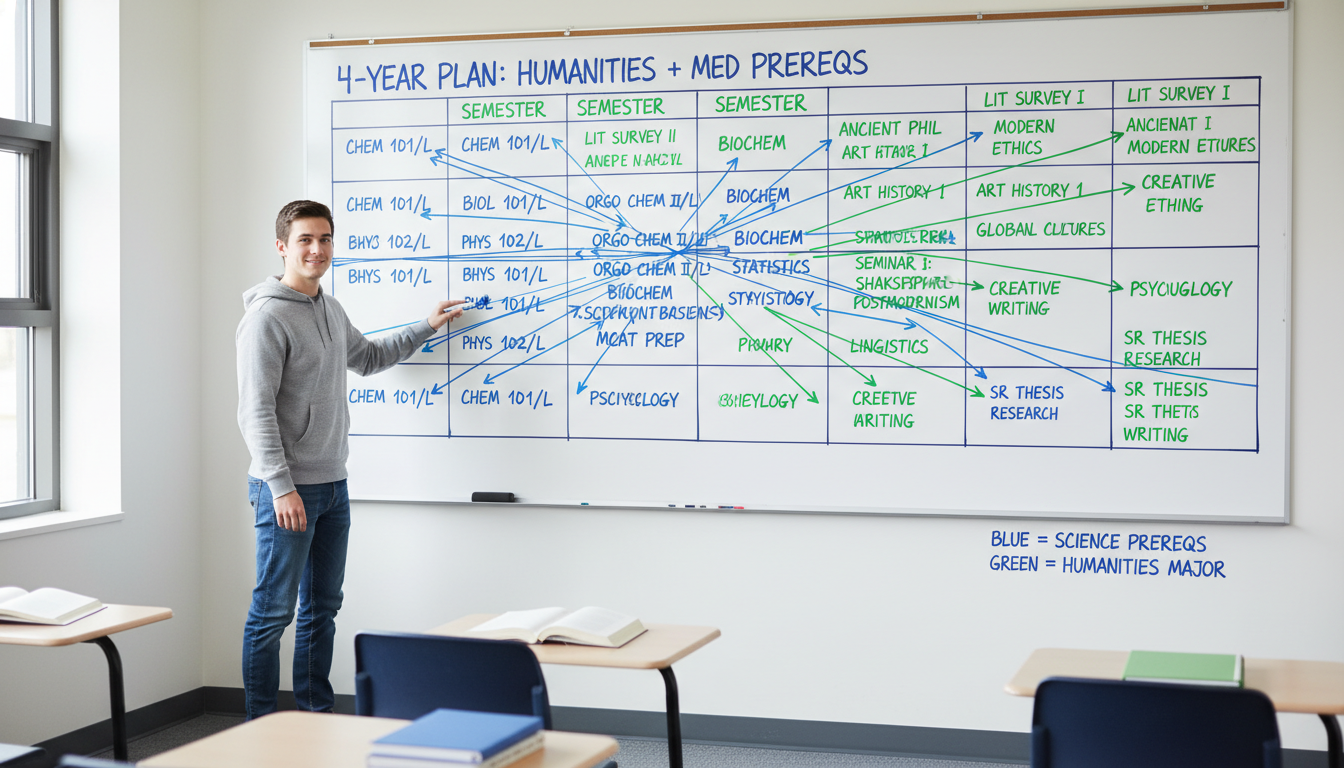
C. Watch credit load and lab clustering
Labs can be deceptive. A 4-credit course with lab often behaves like a 5–6 credit time commitment.
Rules of thumb for humanities premeds:
- In science-heavy semesters, limit humanities to:
- 1 seminar-type course (heavy reading/writing)
- 1 lighter distribution / language / core
- Avoid: Orgo + Physics + 2 upper-level seminars in the same term, unless you are already proven at that workload.
Aim for balanced cognitive load: some deep reading/writing, some problem-solving, but not maximum difficulty in both areas at once.
Step 5: Align Your Humanities Coursework With Premed Storytelling
Being a humanities premed is not simply “check the same science boxes but read more novels.” You can weaponize the humanities side to improve both your application and your clinical mindset.
How to make your humanities major do double duty
Deliberately select courses that help you:
Articulate ethical reasoning
- Philosophy of medicine
- Biomedical ethics
- Political philosophy (resource allocation, justice)
- Theology or religious studies courses on suffering, death, care
Develop narrative competence
- Courses in:
- Narrative medicine (if offered)
- Literature of illness, disability studies
- Autobiography / memoir
- These deepen your ability to interpret patient stories, not just lab values.
- Courses in:
Strengthen communication across difference
- History of race and medicine
- Postcolonial literature
- Gender and sexuality studies
- Global health humanities
Hone analytical writing
- Upper-level seminars with long-form papers
- Independent study or thesis
If you are strategic, your major will not be “extra”; it will be the backbone of your personal statement, most meaningful experiences, and interview conversations.
Step 6: Plan for MCAT Content Without Becoming a Science Major
Your challenge: cover enough content for a competitive MCAT without drowning in extra science courses.
Minimum science content for a solid MCAT shot
From the standard prerequisites, you want completed by MCAT date:
- 2 semesters Gen Chem
- 2 semesters Orgo
- 2 semesters Intro Bio
- 2 semesters Physics
- 1 semester Biochem
- Strongly recommended:
- Intro Psychology
- Intro Sociology or cultural anthropology
- At least one upper-level bio (e.g., physiology, cell biology, or genetics)
Notice: this list does not require you to become a Biology major. It requires you to be:
- Science competent
- Reading-heavy resilient
- Comfortable with integration across disciplines
Where humanities majors often excel on the MCAT
You typically have an advantage in:
- CARS (Critical Analysis and Reasoning Skills)
- Interpreting complex passages and arguments
- Synthesizing nuances across long texts
Your likely weak points:
- Speed on data-heavy passages
- Familiarity with experimental design
- Some memorization-heavy organic / biochem, if poorly sequenced
Solution:
- Start CARS practice early, not because you will struggle, but because you can turn it into a guaranteed strength.
- Choose upper-level biology courses with lab and experimental design emphasis to build that muscle.
- Make sure Biochem is taken within 6–12 months of your MCAT.
Step 7: Use Summers Intelligently (to Protect Semesters)
Humanities majors often underestimate how useful summers are for structural flexibility.
Three high-yield uses:
Summer science coursework
- Example: Take Physics I & II over two summers if your academic year is packed with major seminars.
- Caution: Do not do multiple critical prereqs in a short summer unless you have already proven you can handle fast science pacing.
Clinical experience + humanities integration
- Scribe work combined with a reading project on narrative medicine.
- Volunteer in hospice and pair it with a directed reading on end-of-life ethics.
- Then write a paper or reflection that can evolve into part of your personal statement.
MCAT preparation
- If you finish core prereqs by end of Year 3, use that summer for full-time MCAT prep.
- Particularly powerful if paired with light clinical or research work to keep your motivation connected to patient care, not just Kaplan passages.

Step 8: Protect Your GPA Without Neutering Rigor
Your GPA is not a philosophy construct. Admissions committees treat it as a quantitative screening tool.
Humanities majors often face specific traps:
- Taking writing-intensive seminars simultaneously with demanding labs
- Underestimating the grind of Orgo or Biochem
- Overloading to “finish everything on time” instead of using summers or a 5th year
Concrete strategies:
Rotate “peak difficulty”
- If you have Orgo II + lab, do not couple it with 2 capstone-level humanities seminars.
- Instead: 1 upper-level seminar + 1 lighter humanities elective + gen ed / language.
Avoid “science clumping” too heavily
- 3 lab sciences in one semester can obliterate your bandwidth for reading and writing, leading to B-/C outcomes across the board.
- Better: 2 lab sciences max per regular semester for most students, unless you have already proven high capacity.
Know when to take a W versus a C
- If you are drowning early, talk to your advisor about withdrawing and retaking.
- A single W, strategically used, is better than a permanent C in a core premed course, as long as your overall record remains strong.
Step 9: If You Are Starting Late as a Humanities Major
Plenty of students decide on medicine in junior year as English or History majors. Your situation is different but still workable.
Case: You are a junior Philosophy major who has taken:
- No chem
- One semester of Bio
- No Physics
- Strong GPA, but late to science
Options:
Post-baccalaureate route
- Finish your humanities major on schedule.
- Do a formal or informal post-bacc to complete science prerequisites after graduation (1–2 years).
- Pros: Protects your GPA, allows focused science, structured support.
- Cons: Adds time and cost.
Extended undergrad (5th year)
- Add 1–2 extra semesters as an undergraduate.
- Use them for sequenced science and MCAT prep.
- Often cheaper than formal post-bacc; more flexibility but less structure.
Aggressive in-college catch-up
- Start Gen Chem + Intro Bio immediately.
- Summer: Orgo I
- Next year: Orgo II + Physics I
- Following term: Physics II + Biochem
- MCAT after graduation.
- This path requires very high discipline and careful advisor oversight.
There is no prize for finishing “on time” if it destroys your GPA and MCAT. Medicine is a 30+ year career; taking an extra 1–2 years up front is rational, not a failure.
Step 10: Coordinate With Two Advisors, Not One
Humanities premeds need dual advising:
Major advisor (department)
- Ensures you:
- Meet all major requirements
- Are on track for thesis / capstone
- Take recommended sequences at the right levels
- Ensures you:
Premed / prehealth advisor
- Ensures you:
- Hit every science prereq
- Time your MCAT wisely
- Avoid med-school-specific landmines (e.g., schools that require 2 semesters of writing, not just 1)
- Ensures you:
You must keep these advisors in the loop together. Bring:
- A printed 4-year grid
- Your degree audit
- A tentative MCAT and application timeline
Ask them to help you identify:
- Any semester that looks overloaded
- Any missing requirement for target schools
- Any opportunity to merge requirements (e.g., a course that counts as writing + ethics + humanities distribution)

Three Common Patterns That Work Very Well
To make this concrete, here are three humanities-major archetypes who successfully cover every med prereq.
1. The Philosophy + Ethics Path
- Major: Philosophy, with concentration in ethics or political philosophy
- Key choices:
- Early logic course to help with MCAT reasoning
- Philosophy of science or mind to connect with neuroscience and medicine
- Bioethics seminar that becomes fuel for your personal statement
- Science: Standard premed sequence with Biochem and an upper-level bio (e.g., physiology)
Narrative: “I came to medicine through questions about what we owe each other and how we make decisions under uncertainty.”
2. The Literature + Narrative Medicine Path
- Major: English / Comparative Literature
- Key choices:
- Courses on illness narratives, disability, or 20th-century literature with war / trauma themes
- A thesis exploring patient stories, metaphor in illness, or representation of doctors in literature
- Science: Standard premed sequence + psych/soc, possibly a course in medical anthropology
Narrative: “I learned to attend to words, silences, and subtext—skills I now bring to the exam room.”
3. The History + Social Determinants Path
- Major: History (often with a focus on history of science, public health, or race)
- Key choices:
- History of medicine / public health
- Courses on colonialism, structural racism, or policy
- Science: Same prereqs, with strong emphasis on stats and maybe an epidemiology elective if available
Narrative: “Understanding how we got here—policies, injustices, and progress—drives my approach to future practice.”
Final Synthesis
You do not need to abandon the humanities to get into medical school. You do, however, need to be methodical.
Three key points:
- Map everything early and explicitly: Use a 4-year grid that integrates major requirements, med prereqs, and MCAT timing. Do not guess semester by semester.
- Make your humanities major do real work for your application: Select courses that deepen ethics, narrative competence, and social understanding, then connect them to your clinical experiences.
- Protect your GPA and your bandwidth: Avoid extreme science clumping and seminar overload. Use summers and, if needed, extra time rather than cramming.
Built correctly, a humanities major is not a liability. It is a differentiator—if the science is complete, the narrative is coherent, and the planning is precise.