
The blunt truth: most of the time, emailing programs to ask why you didn’t get an interview is a bad use of your energy—unless you do it strategically and at the right time.
Let me walk you through when it actually helps, when it backfires, and how to do it in a way that doesn’t make you “that applicant” people roll their eyes about in the program office.
The core question: Should you email programs about no interview?
Here’s the short version:
- During active interview season: almost always no.
- Right after you see rejection: still usually no.
- After the season is clearly over or post-Match: sometimes yes, if you do it right and for the right reason.
If you’re hoping a program will change their mind and suddenly invite you because you emailed them asking “why not me?”—that basically never happens. Programs aren’t sitting on the fence waiting for a clarification email. They’ve filtered, ranked, and moved on.
But that doesn’t mean the email is always useless. It just means you need to be clear about your real goal:
- Are you trying to get THIS cycle interview? → Email almost never helps.
- Are you trying to learn for next cycle and build a future connection? → Then it can be worth it, with the right timing and tone.
Pros of emailing programs about a missed interview
Let’s start with the upside, because there is some—if you’re smart about it.
1. You might actually get honest feedback (rare but real)
Some smaller or more education-focused programs genuinely care about advising applicants. I’ve seen:
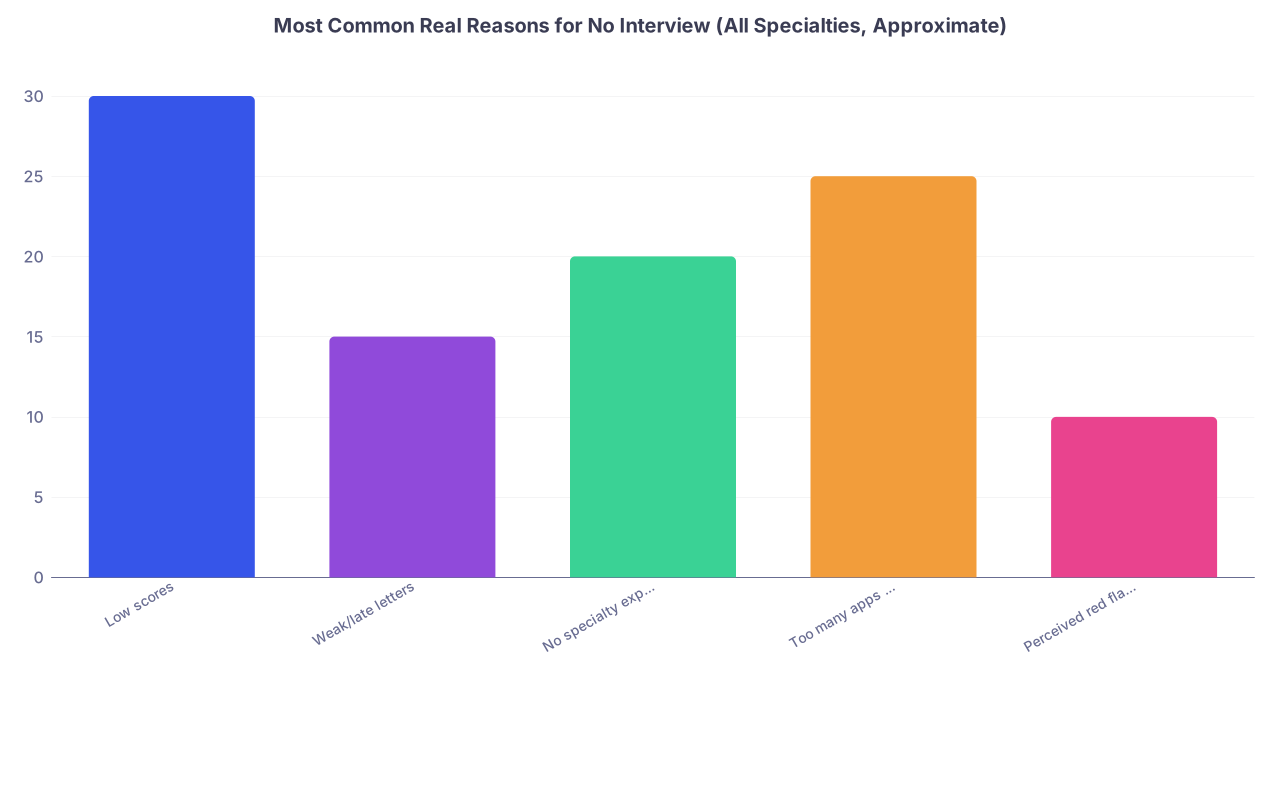
- PDs write 4–5 sentence replies outlining big issues: low Step 2, no US clinical experience, weak LORs.
- APDs hop on a 10–15 minute zoom or phone call in the off-season to talk strategy.
- Coordinators forward emails to the PD who then replies with “Happy to chat after Match.”
Who’s most likely to get real feedback?
- Reapplicants who clearly signal they’re planning to apply again.
- Applicants who are polite, concise, and not emotionally loaded in their email.
- Applicants with a realistic connection: home institution, away rotation, regional ties.
If your email clearly reads: “I want to learn and improve, not argue,” you have a shot.
2. It can help you calibrate your next application strategy
Sometimes you don’t need a detailed critique. You just need a pattern.
If a couple of programs say things like:
- “We prioritized applicants with U.S. LORs in our specialty.”
- “Your Step 2 score was below our initial screen cutoff.”
- “Research productivity was a major focus this season.”
…that’s gold for planning your gap year or reapplication.
You can change:
- Whether you prioritize a research year, prelim year, or more USCE.
- How broadly and where you apply next time.
- How you tailor your personal statement and experiences.
A single line of honest feedback from someone who actually saw your file can be worth far more than 20 anonymous Reddit opinions.
3. You can build a future connection if you’re reapplying
Done well, a polite feedback email can put your name in a neutral or mildly positive light for the next cycle, especially if:
- You’re an IMG planning to gain more US experience.
- You’re SOAPing now but reapplying next year.
- You’re switching specialties or changing your strategy.
If you show up in their inbox again next year with a significantly stronger application—and you previously came across as mature and coachable—that can help. Not massively, but enough to matter at some programs.
| Category | Value |
|---|---|
| No Response | 60 |
| Polite Generic Reply | 25 |
| Specific Feedback Given | 12 |
| Interview Offer or Future Encouragement | 3 |
Cons (and why it often feels terrible and useless)
Now the part most people learn the hard way.
1. You probably won’t get a response
Program email inboxes during application and interview season are chaos.
Reality:
- Program coordinators are buried in scheduling, cancellations, system glitches, and 100+ “LOI” and “update” emails.
- PDs and APDs are clinically busy and reading applications at night. Your “why didn’t I get an interview?” email sits at the bottom.
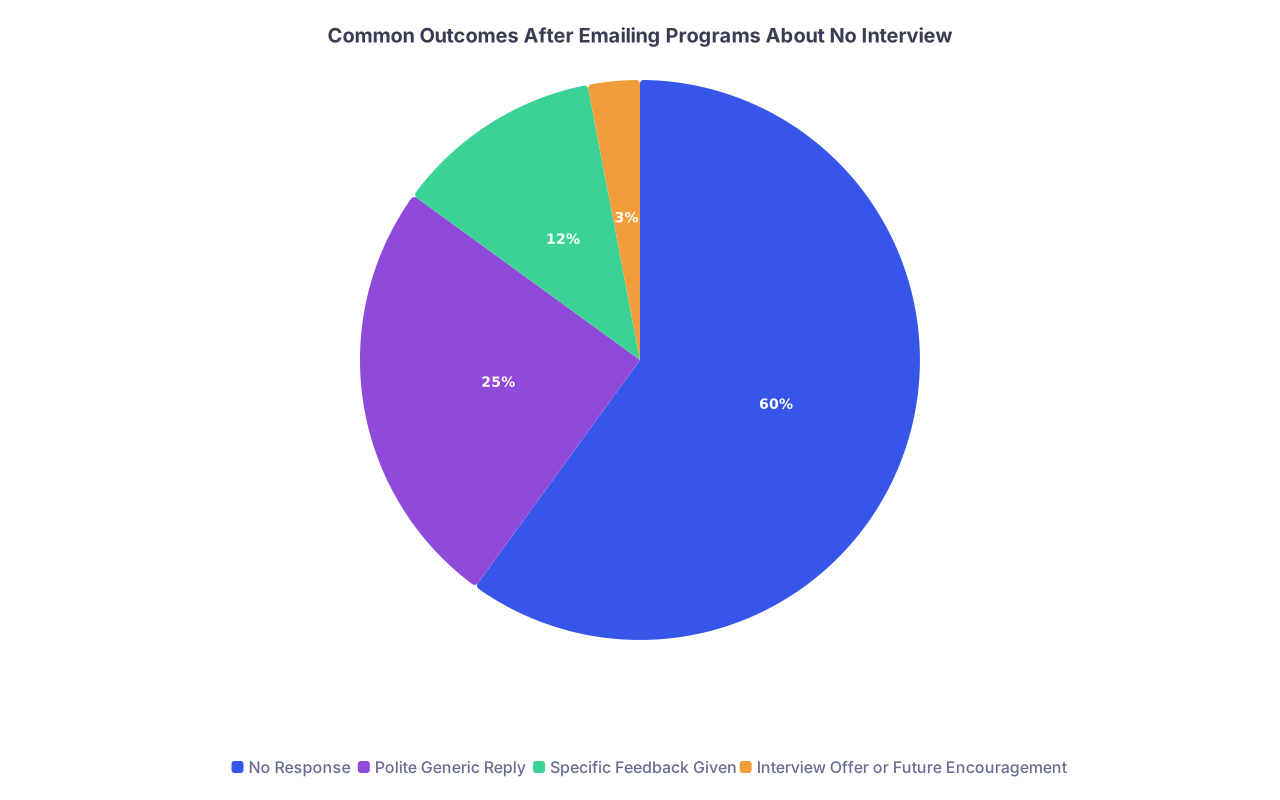
Outcomes I’ve seen over and over:
- No response. Ever.
- A one-line generic: “Thank you for your interest. We received many qualified applications and were unable to interview all strong candidates. We wish you the best.”
- A delayed response months later after the cycle is dead.
You might pour emotional energy into crafting the email and get absolutely nothing back. That’s rough when you’re already stressed and doubting yourself.
2. You risk coming across as entitled or argumentative
This is the big risk, and most applicants underestimate it.
If your message even slightly reads like:
- “I had XYZ scores/experiences, so I’m confused why I didn’t get an interview.”
- “I rotated there, so I thought I’d at least get an interview.”
- “I’m ranked top of my class, and I’m surprised…”
That can be read as: “Explain yourself. You owe me a reason.”
Nobody in that office is going to write back: “Your LORs were bad” or “You came off poorly on your rotation” or “We heard concerning feedback.” They’ll just remember your name in a negative way. Especially dangerous if you might apply there again or end up in the same region.
Programs don’t like drama. They like low-maintenance residents.
3. It usually will NOT flip a “no interview” into an invite
This is the part people don’t want to hear.
Once interview slots are gone, they’re gone. A few realities:
- Interview lists are usually finalized by committee. One person is rarely going to re-open that process because of your email.
- If they did want you, they would have reached out earlier or moved you up from “hold” already.
- If they put you on a “hold” list, a generic “why no interview?” email won’t move you. A targeted, update + continued interest email is far better (different topic).
So if your main hope is: “Maybe emailing will trigger them to look again and realize I’m great”—you’re setting yourself up for disappointment.

| Step | Description |
|---|---|
| Step 1 | No Interview from Program |
| Step 2 | Do NOT email |
| Step 3 | Usually dont email |
| Step 4 | Email optional, low yield |
| Step 5 | Send brief, polite feedback request |
| Step 6 | What is your goal? |
| Step 7 | Timing? |
| Step 8 | Are you likely to reapply to this program or region? |
When emailing makes sense (and when it doesn’t)
Let’s separate this into practical scenarios.
Good times to email
After Match / late in the cycle
- Best window: March–May, when the Match is done and the panic is over.
- Your ask: advice for next cycle, not “why did you reject me yesterday.”
You’re clearly reapplying
- Especially if:
- You’ll do a prelim year and reapply for categorical.
- You’re an IMG taking a year for USCE/research.
- You can position the email as: “I’m committed to improving and would value your perspective.”
- Especially if:
You had a real connection
- You did an away/sub-I there.
- You’re from their med school or strong regional tie.
- You had prior email communication with the PD/APD about career interests.
Those are the situations where the cost-benefit starts to tilt in your favor.
Bad times to email
During peak interview invite season (Sept–Dec)
That inbox is exploding. You just become noise or, worse, the annoying email they complain about.Right after getting a “no interview” or post-rejection
Emotions are high—on your side, for sure. It’s very easy to sound defensive, even if you think you’re being “professional.”If you’re not reapplying or don’t care about that program long term
Why burn energy (and possibly a bridge) if you’re never going near them again?

How to email programs for feedback (if you decide to do it)
If you decide the potential upside is worth it, do it properly. Here’s a template that doesn’t make you sound entitled or needy.
Key rules
- Keep it under 150–200 words.
- Don’t argue your merits or list your stats. They already didn’t pick you.
- Make it about learning and growth, not about their decision.
Sample email template
Subject: Former Applicant Seeking Brief Feedback (Future Application Planning)
Body:
Dear Dr. [Last Name],
I applied to your [specialty] residency program in the [20XX–20XX] cycle but did not receive an interview. I’m planning to reapply next cycle and am working hard to strengthen my application.
If feasible, I’d be very grateful for any brief feedback on major areas I should focus on improving (for example, exam scores, clinical experience, letters, research, or personal statement). Even a single sentence or general guidance would be extremely helpful.
I understand you receive many requests and may not be able to respond. Thank you for your time and for the work you do training future physicians.
Sincerely,
[Full Name], [Degree]
[Current position: MS4 at X / PGY1 prelim at Y / IMG with USCE at Z]
AAMC ID: [optional]
That’s it. No attachments. No CV. No “for reference, here are my scores.” If they want more detail, they’ll ask.
How many programs should you email?
Don’t carpet-bomb 50+ programs. That’s a waste and looks desperate.
Instead:
- 5–10 programs where:
- You’d seriously apply again.
- You have some plausible connection (region, rotation, school, genuine interest).
- Expect maybe 1–3 real replies if you’re lucky.
| Situation | Email? |
|---|---|
| Sept–Dec, trying to get interview this year | No |
| Post-Match, planning to reapply | Yes, selectively |
| You did a sub-I/away there | Usually yes |
| No real connection, not reapplying | Not worth it |
| You feel angry or insulted | Do NOT email |
Better alternatives than “why no interview?” emails
If your real goal is to improve your chances next time, a few things usually give you far more ROI than emailing programs.
1. Get your application reviewed by someone who knows the game
Not your friend. Not Reddit. Someone who:
- Sits on a residency selection committee
- Is a PD/APD or faculty reviewer
- Or a dean/advisor who’s repeatedly placed people into your target specialty
Have them look at:
- Step/COMLEX trends
- Red flags (leaves, failures, professionalism notes)
- LOR quality and sources
- Personal statement tone and focus
- Overall strategy: number and mix of programs
One serious, honest review beats 20 random opinions.
2. Strengthen the obvious weak spots
From what I’ve seen, reapplicants usually improve most by doing one or more of these:
- USCE/sub-I in the specialty, with strong letters
- Research year with tangible output (poster, paper, at least something real)
- Better Step 2 / Level 2 if scores are borderline
- Cleaner, more mature personal statement and experiences that show progression
You don’t need 30 PDs to tell you your 215 Step 2 and no USCE is a problem for derm or ortho. You already know. Act on it.
| Category | Value |
|---|---|
| Low scores | 30 |
| Weak/late letters | 15 |
| No specialty exposure | 20 |
| Too many apps vs spots | 25 |
| Perceived red flags | 10 |
3. Focus on programs that actually match applicants like you
Look at:
- Their resident roster (IMG vs AMG, DO representation, average grad year).
- Your school’s match list. Do they historically take people from your background?
- Filters: Some programs quietly filter by year of graduation, exam attempts, or visa status.
Email isn’t going to overcome a quiet hard filter. Adjust your list instead.
Quick decision framework
Ask yourself these three questions:
Is my goal to get an interview this year?
- If yes → Don’t email asking “why no interview?” That’s the wrong lever.
Am I realistically reapplying, and do I care about this program/region long term?
- If no → Don’t bother. Low ROI.
Can I wait until after Match season when emotions and inboxes are calmer?
- If yes → That’s your window for a brief, humility-forward feedback request.
If all three line up—then send a short, respectful email and expect very little. Be pleasantly surprised if you get something useful.
FAQ (exactly 5 questions)
1. Can emailing a program after no interview ever get me an interview this same cycle?
Very rarely. It’s not zero, but it’s close. By the time you notice you didn’t get an invite, most interview slots are already assigned, and the list went through a committee. Programs aren’t going to reopen their process because of one email. If you want to express interest this cycle, focus on update/interest letters before they’ve finished sending invites, not “why no interview?” after you’ve been passed over.
2. Is it okay for my dean or advisor to email the program on my behalf instead?
Sometimes, but it’s still low-yield if the goal is an interview this cycle. A strong, well-connected dean or chair vouching for you before invites go out can help. A “why no interview?” message from your school after you’ve been skipped usually doesn’t move the needle. Use your dean/advisor to improve your list and application, not to chase individual programs post hoc.
3. Should I email programs that rejected me via ERAS with a formal rejection message?
No, not during the season. Once you get a formal rejection, their file is closed on you this cycle. Replying to that or emailing right after looks emotional and won’t change anything. If you’re going to reach out for feedback, wait until after Match and reframe it as future-planning, not second-guessing their decision.
4. If I rotated there and didn’t get an interview, should I ask why?
This one hurts, but you still need to be careful. Away rotators who don’t get interviews often suspect there was negative feedback. Emailing with “why didn’t I get an interview after rotating with you?” is almost guaranteed to get you a generic line or silence. If you’re going to reach out, do it months later, very humbly, framing it as: “I’m trying to understand how I can grow as a future resident and colleague,” not “defend your decision.”
5. What if I feel strongly that my application is much stronger than where I matched or didn’t match?
That’s common—and sometimes true. But the Match isn’t purely merit-based; it’s about fit, timing, geography, filters, and luck. Vent to friends, mentors, or a therapist, not to programs. Emailing in a way that hints “you made a mistake” will only hurt you, especially if you ever cross paths again. Take that energy and channel it into building a killer next application, a strong prelim year, or excelling where you did match.
Open your email drafts folder right now. If you’ve got a half-written “why didn’t I get an interview?” message sitting there, delete it or rewrite it using the post-Match, future-focused template above—and then schedule-send it for after Match season, not tonight.