
What do you actually risk — and what might you save — if you pull your application from the Match after interviews?
Let me be blunt: withdrawing from the Match is sometimes the smartest move you can make. It’s also sometimes the single worst decision you could make for your career. The trick is knowing which situation you’re in.
This isn’t about “being brave” or “trusting the process.” It’s about math, risk, and timing.
We’ll go through specific scenarios where withdrawing might make sense, when it’s usually a terrible idea, and how to think about the trade-offs in a way that’s actually grounded in reality, not vibes or panic.
First: What “Withdrawing from the Match” Actually Means
People mix up terms all the time, so let’s clear this up.
There are three different decisions that often get lumped together:
- Not submitting a rank list
- Certifying a very short / “safe only” rank list
- Formally withdrawing from the Match in NRMP (or your specialty match) before rank list deadline
“Withdrawing from the Match” in the strict sense usually means #3: you actively withdraw in the system so you will not be matched at all that cycle.
That’s different from:
- Ranking 1–2 “safe” programs only (still in the game)
- Intentionally going short on your list to avoid low-fit programs (risky, but still participating)
So as we talk through this, keep in mind: you’re not choosing between “perfect outcome vs catastrophe”; you’re choosing between actual imperfect options.
The Only Situations Where Withdrawing Might Be Worth It
There are a few scenarios where I’ve seen withdrawing be defensible — even smart.
1. You Know You Can’t Start Residency This Year
Not “might,” not “probably.” You know.
Examples:
- Major health issue that will clearly prevent you from working 60–80 hr weeks in July
- Visa situation that definitely won’t be resolved in time
- Significant family crisis (e.g., primary caregiver responsibilities that can’t be delegated and will last months)
In these cases, forcing a match and then trying to delay or resign is often worse:
- You risk burning bridges with programs
- You may be reported to NRMP for a Match violation if you back out improperly
- You might start residency in terrible physical/mental shape and crash out anyway
If you’re in this category:
- Talk to your dean’s office or graduate medical education (GME) early
- Get real legal/immigration input if it’s a visa issue
- If it’s clear you can’t start PGY-1 on time, withdrawing and planning a clean, well-explained reapplication is usually better than matching and imploding
2. You Matched a Major Life Decision After You Applied
This is the “my life changed mid-cycle” group.
Examples:
- Spouse/partner accepts an immovable job in a location where you have zero interviews
- Sudden custody situation where you need to stay in a specific city
- You’re locked to a military commitment or other contract that conflicts with starting residency now
If staying in the Match means:
- Almost guaranteed relocation away from your required location, and
- You have no realistic way to transfer or change PGY-1 location afterward
…then withdrawing and reapplying targeted to your new reality can make sense.
The key test:
Would matching anywhere this year put you in an impossible situation that you’d likely back out of?
If yes, withdrawing is painful but rational. If no, you’re probably rationalizing.
3. You Didn’t Actually Complete Graduation Requirements
People underestimate this.
If your school has made it clear you may not graduate on time — failed a required clerkship, major professionalism issue under review, unremediated exam failures — then your “best case” might be to avoid a match violation.
Programs need you to be eligible to start PGY-1. If there’s a real chance you won’t be:
- Matching and then failing to graduate creates administrative chaos
- You may risk burning your name with multiple programs in a small specialty
- Sometimes your school will recommend or require that you withdraw
In that situation, it’s not about “worth it.” It’s about not compounding one problem with another.
Scenarios Where Withdrawing Is Almost Always a Bad Idea
Now the more common category: people who want to withdraw because they’re scared, embarrassed, or perfectionistic.
Here’s where I’m going to be a bit harsh: most of these are bad reasons to withdraw.
1. “My Interviews Were Only at ‘Low-Tier’ or Community Programs”
This is the classic MS4 panic.
You thought you were a top-25 applicant. You end up with interviews mostly at community programs or lower-ranked academic centers. Now you’re thinking:
“I’d rather take a year, do research, and match somewhere ‘better.’”
In most cases, that’s fantasy.
Here’s what usually happens:
- You gamble on withdrawing
- You spend the year in a research or prelim year that doesn’t fundamentally change your competitiveness
- You reapply to the same or slightly better set of programs
- Meanwhile, you lost a year of attending salary on the back end
On top of that, most residency training — especially in core specialties like IM, FM, peds, psych — is far more about your effort and mentors than the “tier” of the program.
Unless you’re absolutely dead set on ultra-competitive fellowships that truly care about pedigree, withdrawing purely for prestige reasons is a poor trade.
2. “I Only Have a Few Interviews, I’m Afraid of Not Matching”
This one is emotional, but the math is brutal and clear.
If you have at least a few interviews (say 5+ in non-competitive fields, more in competitive ones), your odds of matching somewhere are usually far from zero. In many specialties they’re still decent.
Pulling out because you’re embarrassed by the idea of SOAP is not a smart financial or career move.
You’re comparing:
- Option A: Risk of not matching → SOAP → maybe a prelim or off-path PGY-1 → still in the system
- Option B: Certain non-match → No SOAP → automatic 1+ year delay → explaining to every future program why you sat out
Is SOAP fun? No.
Is a prelim surgery year ideal for a future outpatient internist? Not really.
Is it usually still better than burning a whole cycle on purpose? Yes.
| Category | Value |
|---|---|
| Stay in Match | 75 |
| Withdraw | 0 |
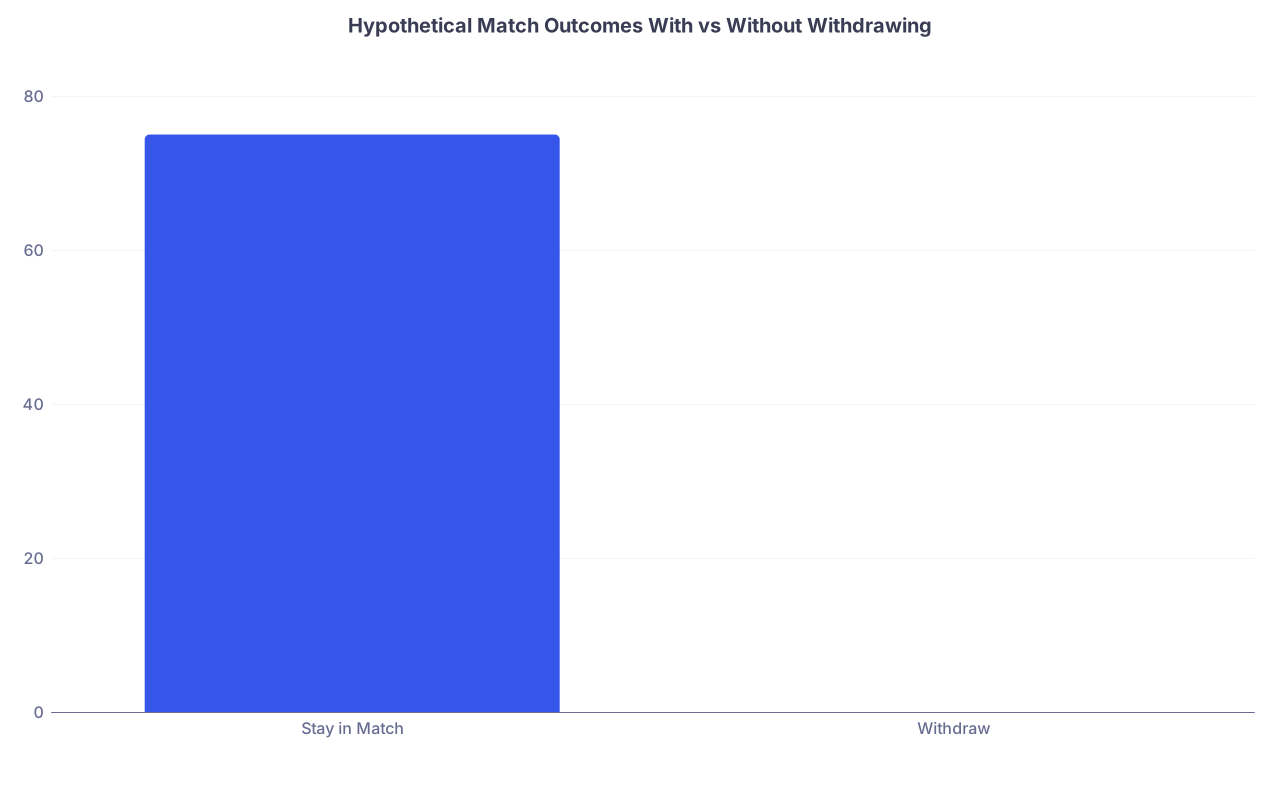
Interpret that bar as: if you stay in, you at least have some probability (here, pretend 75%) of landing something (categorical or SOAP). If you withdraw, your probability of a PGY-1 this year is exactly 0%.
3. “I Didn’t Get My Dream Specialty, I’ll Reapply Next Year”
Example: You applied to dermatology, got 1–2 interviews, panic, and think: “I’ll just withdraw completely, do a research year, and come back stronger.”
Better option almost every time:
Rank your derm interviews and rank a parallel backup (IM, prelim, TY, etc.). If you don’t match derm, at least you’re in the system doing a PGY-1 that keeps doors open.
Withdrawing entirely gives you:
- A weaker narrative (“I sat out voluntarily”) vs
- A stronger narrative (“I pursued derm from a position of clinical growth and got outstanding letters from my PGY-1”)
There are rare, ultra-competitive edge cases (plastic surgery, neurosurgery) where the strategy is more nuanced, but for 95% of people in 95% situations, withdrawing instead of at least securing a PGY-1 is a mistake.
How to Actually Decide: A Simple Framework
Here’s how I’d walk you through this if we were sitting in a dean’s office with a whiteboard.
Step 1: Clarify Your Realistic Outcomes This Year
Make three columns:
- Best realistic outcome this year
- Most likely outcome this year
- Worst realistic outcome this year
For “stay in the Match” vs “withdraw,” fill them in honestly.
Example: borderline internal medicine applicant with 7 interviews.
Stay in the Match:
- Best: Match categorical IM at a solid community program
- Likely: Match categorical low-to-mid tier
- Worst: Don’t match → SOAP into prelim IM or TY
Withdraw:
- Best: Land strong research/clinical year and improve your app
- Likely: Get some gap year position, reapply with modest improvement
- Worst: No good gap role, reapply with weaker narrative and same issues
Now ask: Are you actually improving your worst-case scenario by withdrawing? Usually you’re not. You’re just swapping one set of discomforts for another, and burning time.
Step 2: Look at Money and Time Like an Adult
People rarely run the arithmetic.
Take a standard non-surgical specialty. Being an attending even one year earlier is easily $200–$400k of income gained.
So for you to voluntarily give up a whole year, your reapplication outcome has to be dramatically better to compensate. Not “slightly better program.” Dramatically better job prospects, fellowship odds, or long-term positioning.
Most of the time, the expected value doesn’t come close.
| Scenario | Financial Impact | Career Impact |
|---|---|---|
| Match now | +1 year attending salary | Earlier independence, earlier promotions |
| Withdraw, reapply, same tier | -1 year attending salary | Same trajectory, delayed |
| Withdraw, reapply, slightly better tier | -1 year salary | Small brand bump, often not worth it |
| Withdraw, reapply, truly elite upgrade | -1 year salary | May matter for ultra-competitive fellowships |
If you’re not playing in that last category, be honest with yourself.
Step 3: Check Your “Dealbreaker” List
Make a very short list — 3–5 items max — of things that would make you absolutely miserable or unable to continue:
- Being in a specific geographic region (for major family reasons)
- A specialty you truly cannot tolerate
- Call schedule or lifestyle that would worsen a known serious health issue
Now ask:
- Are the programs likely to rank me actually crossing these lines?
- Or am I just worried I won’t love the idea of them?
Training is hard everywhere. “Not perfect vibe” is not a valid reason to withdraw from the entire Match.
Practical Alternatives to Withdrawing Entirely
If your gut’s telling you “this might be a mistake, but I hate my options,” there are several middle paths.
1. Short But Honest Rank List
You don’t have to rank every program. If there are truly toxic-feeling places, don’t rank them. But don’t pretend that “no match” is usually better than “imperfect but functional match.”
2. Aggressive SOAP Strategy
If you’re borderline and know it, prep for SOAP like it’s its own cycle:
- Updated CV and personal statement ready
- Reconfirm with mentors they can support you that week
- Research which programs typically have SOAP spots in your specialty or a reasonable backup
I’ve seen people land surprisingly good positions through SOAP when they took it seriously instead of treating it as some shameful consolation prize.

| Step | Description |
|---|---|
| Step 1 | Interviews Complete |
| Step 2 | Strongly consider withdrawing |
| Step 3 | Plan SOAP and refine rank list |
| Step 4 | Submit full rank list |
| Step 5 | Plan structured reapplication year |
| Step 6 | Any catastrophic barrier to starting PGY-1? |
| Step 7 | Worried about match quality or odds? |
3. Dual Strategy: Match Now, Upgrade Later
People forget this option exists.
- Match IM at a decent community program
- Crush residency, get great letters, do strong research
- Move for fellowship or job to the city or institution you thought you needed either way
Your final job location and prestige matter way more than the patch on your PGY-1 white coat.
Special Case: Ethical or Safety Concerns
One exception where I’m more sympathetic to withdrawing late: serious concerns about the programs that are most likely to rank you.
Examples:
- You observed repeated egregious patient safety problems, brushed off by leadership
- Multiple residents quietly told you about abuse, discrimination, or massive chronic under-staffing
- You’re in a vulnerable group and repeatedly got overtly discriminatory vibes
If your likely match options involve places you genuinely think are unsafe or ethically unacceptable, you have three options:
- Don’t rank those specific programs, but still stay in the Match
- Rank a backup specialty/location that felt safe
- If every realistic option feels bad enough, then yes, withdrawing and planning a cleaner path may be better
But be honest: “Not prestigious” is not the same as “unsafe.”

How to Talk About Withdrawing If You Do It
If you ultimately decide withdrawing is the least bad option, don’t wing the narrative later.
Programs are going to ask: “Why didn’t you participate in the Match last year?”
Bad answers:
- “I didn’t like my options.”
- “I didn’t get enough interviews.”
- “I wanted a better program.”
Good answers (if true and documented):
- “I had a serious but time-limited personal/health situation that made starting residency in July unrealistic. I took a year, resolved it, and worked in X role to stay clinically and academically active.”
- “There was late uncertainty about my graduation eligibility, and my school and I agreed withdrawing was safer than risking a mismatch between my status and program expectations. I remediated fully and have since done X.”
You need:
- A clear, concise timeline
- Evidence you used the year productively (clinical work, research, degrees, meaningful caregiving, etc.)
- Validation from your dean’s letter or LORs that your explanation is accurate

Quick Reality Checks Before You Hit Withdraw
Ask yourself these, out loud, preferably with someone honest (advisor, mentor, not your panicked classmate):
- Am I withdrawing to avoid short-term discomfort, or because there’s a genuine, structural barrier to starting residency?
- Does withdrawing actually improve my worst-case scenario, or just postpone it?
- Is there a reasonable way to secure some PGY-1 spot (categorical, prelim, TY, SOAP) that keeps doors open, instead of blowing up the whole cycle?
- In 10 years, will I care more about:
- The exact name of my residency program, or
- Starting my attending life a full year earlier?
- If I saw another student in my exact situation, would I advise them to withdraw — or am I being softer on myself than I would be on them?
If you’re honest with these, the answer becomes clearer than you think.

FAQ: Withdrawing From the Match
1. If I withdraw from the Match, can I still participate in SOAP?
No. If you formally withdraw from the Match (NRMP Main Match), you’re not eligible for SOAP. SOAP is for applicants who are in the Match but go unmatched when results release. Withdrawing means you’re out for the entire cycle.
2. Does withdrawing from the Match show up as a red flag on future applications?
Programs don’t get a “red stamp” that says you withdrew, but they do see gaps. They’ll ask what you did that year and why you didn’t start residency. With a clear, legitimate reason and a productive year, it can be fine. With a vague “I just didn’t like my options” story, it absolutely can hurt you.
3. Is it better to rank only a few programs I like or withdraw altogether?
In almost all cases, it’s better to rank the programs you can live with and stay in the Match than to withdraw. You’re still eligible for SOAP if you go unmatched. Withdrawing takes away every chance at a PGY-1 this year. The exception is if starting any residency this year is truly impossible for personal, legal, or health reasons.
4. What if I suspect I won’t graduate on time — should I still stay in the Match?
If there’s a real risk you won’t meet graduation requirements before residency start, you need to talk to your dean and potentially the NRMP. Sometimes schools will advise (or insist) that you withdraw rather than create a situation where you match but can’t start. That’s one of the rare times withdrawing can be the responsible choice.
5. Can withdrawing ever help me match into a more competitive specialty later?
Only in pretty specific circumstances: if you use that year to substantially change your profile (major research output, new degree, significantly improved exams) and you have a clean, compelling reason for sitting out. Even then, it’s a gamble. For most people, doing a solid PGY-1 and reapplying from inside the system is a stronger position.
6. What’s the deadline to withdraw, and can I change my mind after?
Each Match (NRMP, SF Match, etc.) has a specific withdrawal deadline, usually around or before the rank list certification deadline. Once you formally withdraw and the deadline passes, you can’t just “rejoin” that same cycle. You’re out until the next Match. Always check the current year’s Match calendar and confirm with your dean’s office.
7. If I stay in and match somewhere I hate, can I just resign and reapply next year?
You can, but it’s not clean. Early resignation can trigger NRMP policy issues and definitely raises questions for future programs. It’s much easier to explain, “I ranked programs realistically and trained there,” than “I matched and bailed.” If you truly think you’d rather resign than complete training at a place, you probably shouldn’t rank that program at all.
Key takeaways: Withdrawing from the Match is only “worth it” in narrow situations where you truly can’t or shouldn’t start residency that year. For most applicants, staying in the Match — even with imperfect options and SOAP as a backup — is a far better strategic and financial move than voluntarily burning a full year.