What do you actually do when program directors raise an eyebrow the second they see your school’s name—and half of them have to Google it?
If you are from a new, provisionally accredited, or internationally unaccredited medical school, you are playing this game on “hard mode.” Not impossible. But harder. The usual “just apply broadly and write a good personal statement” advice does not cut it for you.
I’m going to walk through what I’d tell a student from a brand‑new MD school or an offshore school with a shaky match history who sits in my office in October of MS3 and says: “I want IM, but I’m scared no one will take me seriously.”
Step 1: Get Very Honest About Your Starting Point
You cannot fix what you will not admit. Start with a brutally clear snapshot of your situation.
Ask yourself:
- Is my school LCME-accredited, provisionally accredited, candidate status, or not on the list at all?
- Am I considered a U.S. MD, U.S. DO, US-IMG, or non-US IMG for ERAS purposes?
- Has anyone from my school matched yet? If yes, where and into what specialties?
Then, compare yourself to typical expectations for your target specialty.
| Specialty Tier | Example Specialties | Typical Reality for New/Unaccredited Schools |
|---|---|---|
| Very Competitive | Derm, Ortho, Plastics | Essentially closed unless you are exceptional and well-connected |
| Competitive | EM, Anesthesia, Radiology | Possible but uphill; need strong scores + backing |
| Moderate | IM, Peds, Psych, Neuro | Most realistic starting targets |
| Less Competitive | FM, Path, IM-Prelim | Often primary entry point for many IMGs |
If your school is new or not fully accredited, your margin for error is tiny. Low scores, failed attempts, weak clinicals—these hurt you more than they hurt applicants from established schools.
So you:
- Probably should not aim at the most competitive specialties first pass.
- Probably do need higher scores and stronger clinical letters than your U.S. MD peers to be seen as “equivalent.”
If that stings, good. It should. Better to feel that now while you can still adjust the plan.
Step 2: Anchor Yourself With Hard Numbers (Scores & Exams)
Like it or not, for unknown schools, programs lean heavily on standardized metrics. They do not know your curriculum. They do know what a 250+ on Step 2 means.
If you still have exams ahead:
- Treat Step 2 / Level 2 as non-negotiable. For many IMGs and new-school folks, Step 2 is now the main objective metric.
- Aim high. “Passing” or “average” is not enough if your school name is a question mark.
Rough ballpark (not rigid cutoffs, but patterns I actually see):
- For IM, Peds, Psych from a new or offshore school: I want to see at least mid-220s+ Step 2 if possible. Higher helps.
- For EM, Anesthesia, Radiology: 230s–240s+ pretty much minimum to be competitive from a newer/unknown school.
- For FM or Path: you can get interviews with lower scores, but every point helps, especially if your school is unproven.
If Step 2 is already done and it is mediocre:
- Shift your specialty target if needed. Better to reset expectations than to stay in denial.
- Go all-in on strengths you can still build: clinical performance, letters, research, networking.
If you have a failure on record:
- You’re not dead in the water, but you need a story, growth, and some clear wins afterwards (strong Step 2, good clerkships, perhaps a transitional year).
Do not waste time on magical thinking here. Programs use numbers as a filter. Your job is to either meet those bars or build a compensatory story that is so strong someone is willing to bend.
Step 3: Understand How Programs View New or Unaccredited Schools
Let me translate what people won’t say out loud.
When a PD or coordinator sees a school they do not recognize, common thoughts:
- “Is this a legit program or a diploma mill?”
- “Will this person function on day one?”
- “Have I ever had a positive experience with someone from this school?”
- “Will the GME office question this diploma?”
If your school is:
- New U.S. MD/DO with provisional accreditation: suspicion is mostly “lack of track record.” You’re still in better shape than offshore, but you’ll face skepticism.
- Caribbean/offshore with mixed reputation: people have stories—some good, many bad. You’re fighting against other people’s negative experiences.
- Non-accredited or very fringe: you may run into pure eligibility barriers. Some hospitals will not allow you to be credentialed.
So your tasks become:
- Reassure them you’re competent and safe.
- Plug yourself into known, trusted institutions (rotations, research, mentors).
- Provide external validation: scores, letters from name-brand places, research with known faculty.
Step 4: Clinical Rotations – Where You Rotate Matters More Than You Think
If your core and electives are all at small community hospitals with no residency programs, you’re making this much harder.
Your goal: get U.S. clinical experience in hospitals that already train residents and, ideally, that sponsor visas if you need one.
Prioritize:
- Rotations at hospitals with ACGME-accredited residencies in your target specialty.
- Sites where you can realistically impress someone who actually has a say in resident selection.
- At least one “brand name” rotation if you can swing it—doesn’t have to be Harvard; a solid regional academic center is enough.
On each away or elective:
- Act like an intern. Be early, reliable, humble, and hungry to work.
- Volunteer for notes, follow-ups, family talks. The mundane stuff is where residents/attendings test reliability.
- Make it very easy for someone to say, “If this student were my intern, I’d be comfortable.”
Because that’s the line that ends up in LORs: “This student performed at the level of a strong intern.” That one sentence can offset a lot of skepticism about your school.
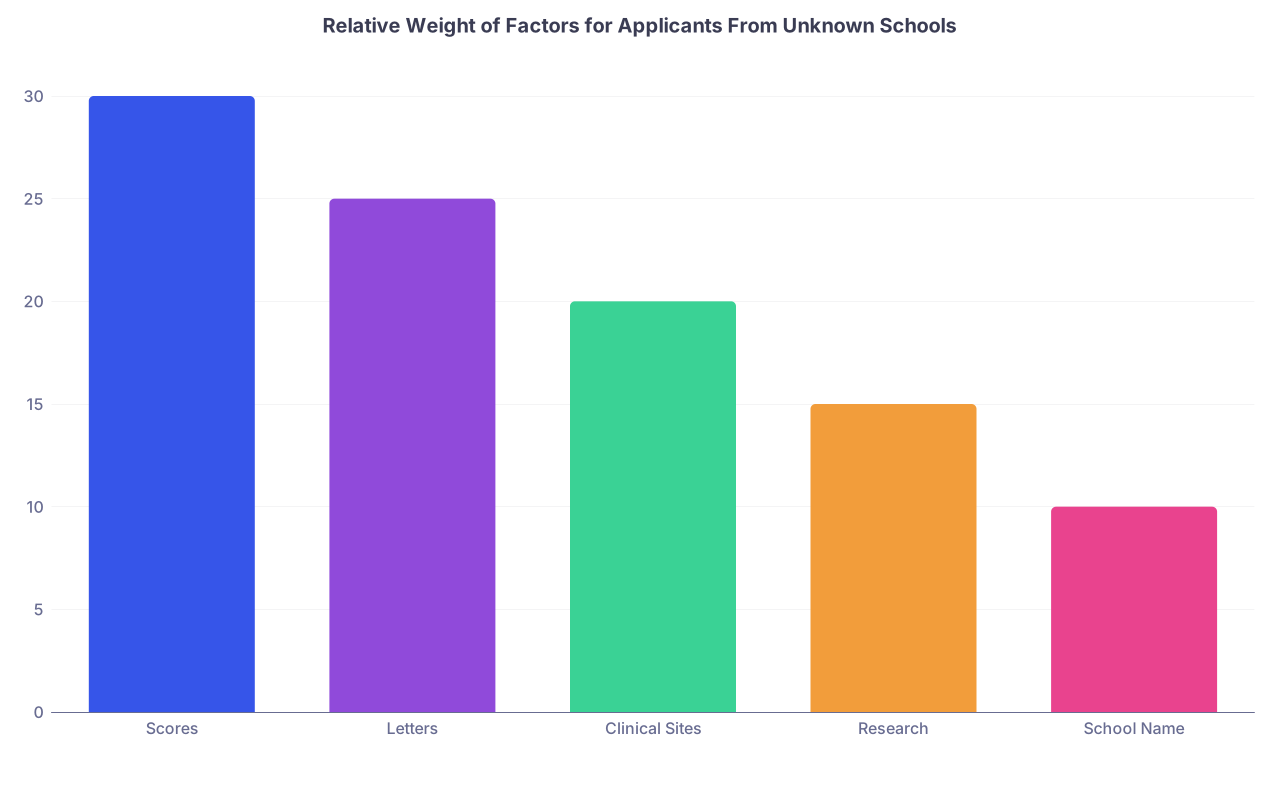
| Category | Value |
|---|---|
| Scores | 30 |
| Letters | 25 |
| Clinical Sites | 20 |
| Research | 15 |
| School Name | 10 |
Step 5: Letters of Recommendation – You Need Heavy Hitters
Programs do not put equal trust in all letters. A glowing letter from “Dr. Smith, Community Hospital with No Residency” is worth less than a solid letter from “Associate Program Director, University Internal Medicine.”
Your priority:
- Minimum: 2 letters in your target specialty from faculty at residency-training hospitals.
- At least one letter from someone with a recognizable title: PD, APD, clerkship director, chair, or well-known academic.
How to earn those:
- Early in the rotation, identify letter-writers: attendings who actually watch you work.
- Say it directly: “Dr. X, I’m applying to internal medicine and I’m from a newer school. Strong letters are critical for me. If—by the end of this rotation—you feel you can write me a strong letter, I’d be very grateful. If not, I totally understand.”
- Then perform. Daily. No off days.
Red flag: lukewarm or generic letters. If someone hesitates, thank them and do not use that letter. A “meh” letter hurts more than no letter.
Step 6: Research and CV Building – Strategic, Not Random
You do not need a PhD. But you do need evidence that you can function in academic medicine and work within U.S. systems.
Good moves:
- Short-term projects with US-based faculty in your desired specialty. Case reports, chart reviews, QI projects.
- Anything that ties you to a specific program or institution: “I worked on a QI project with Dr. Y at X Hospital’s IM department.”
Less useful:
- 10 low-quality posters from conferences nobody has heard of, supervised solely by people from your unaccredited school.
- Random unrelated research (e.g., lab work from undergrad in plant biology) as your only “academic” experience, unless it’s at a big-name institution and you can get a great letter out of it.
Be picky. One or two solid, U.S.-based, specialty-relevant activities >> a laundry list of weak fluff.
Step 7: Targeting Programs Intelligently (Not Just “Apply to 200+”)
Spray-and-pray is expensive and stupid. You need smart targeting.
Look for:
- Programs with history of taking IMGs or grads from new schools.
- Community-based programs, especially those that:
- Are not in major coastal cities.
- Have a significant service load.
- Are in the Midwest, South, or smaller cities where applicants tend to overlook them.
Avoid wasting energy on:
- Ultra-competitive university programs that explicitly say they “prefer” U.S. MDs and basically never take IMGs.
- Programs that state they only accept graduates from LCME-accredited schools if you don’t meet that.
Use your school’s GME office—if it exists—and any alumni database. If your school is brand new and has no match history, then you lean on:
- Attending/resident contacts from your rotations.
- LinkedIn searches: “[Specialty] resident [Hospital]” plus your country of medical education or similar schools.
If you are visa-needing, double-filter for:
- Programs that explicitly sponsor J-1 and/or H-1B.
- Historical track record of actually matching visa-needing residents, not just claiming they “consider” them.

| Step | Description |
|---|---|
| Step 1 | List All Programs in Specialty |
| Step 2 | Remove from List |
| Step 3 | Low Priority / Skip |
| Step 4 | High Priority Target |
| Step 5 | Accept IMGs / New Schools? |
| Step 6 | Scores Near Their Averages? |
| Step 7 | Visa Friendly if Needed? |
Step 8: Networking Without Being Awkward or Desperate
For you, networking is not optional. It is damage control for your school’s reputation.
Ways to do this without being weird:
- During rotations, explicitly express interest: “I’d really like to end up in a program like this. Are there residents or faculty you’d recommend I talk to?”
- Ask residents: “Would it be okay if I emailed you when I’m working on my application list? I’m trying to be realistic about where to apply.”
- Use program open houses and virtual Q&As. Yes, they’re dull. Show up anyway. Ask one thoughtful question, then email a brief thanks with your CV attached only if it feels natural.
Do not:
- Cold-email 50 PDs with your life story and score report attached.
- DM residents on Instagram asking them to “put in a good word.”
Aim for a small, high-quality network: a few attendings, a couple of residents, maybe a PD/APD who know your face and name when your application hits their stack.
Step 9: Owning Your Story in Personal Statements and Interviews
You cannot pretend your school is Harvard. Do not try. It comes across as insecure.
Instead:
- Acknowledge, briefly, that your path is atypical.
- Focus on what you did with the opportunities you had, not on defending your school.
Example framing:
- “I chose [School] understanding it was a newer program. That came with uncertainty, but it also forced me to be deliberate about seeking strong clinical training and external validation. That’s why I pursued rotations at [Hospitals X and Y], where I worked under [Dr. Z] and confirmed my desire to train in internal medicine in a high-volume setting.”
In interviews, if asked directly:
“Why your school? It’s pretty new / I’ve never heard of it.”
Do not get defensive. Something like:
- “You’re absolutely right—it’s a newer school and does not have the reputation of a long-established institution yet. For me, that meant I had to build my own track record. That’s part of why I prioritized rotations at [residency site] and focused on [specific clinical achievements]. I’m confident in my training because of the hands-on responsibility I had and the strong mentorship I sought out.”
Short, direct, and then pivot to your strengths.
Step 10: Backup Plans and Multi-Year Strategy
Hard truth: even with good stats and planning, coming from a new or unaccredited school means your first application cycle might not work out. You need contingency planning now, not after you get zero interviews.
Reasonable backup paths:
- Prelim / Transitional year: Match into a prelim IM or surgery year, work your tail off, earn U.S. experience and letters, and reapply to your desired field or switch to categorical IM/FM.
- Research year in the U.S.: At a serious academic center, in your specialty or close to it. This works best if there’s a clear intention from your mentor to advocate for you later.
- Switch to a less competitive specialty: Especially if your main goal is to practice clinically in the U.S., not to do something ultra-specific.
Bad backup “plans”:
- Apply blindly in 3 different specialties with 20% effort in each. Programs can smell that.
- Reapply year after year with the same weak application and no new experiences or scores.
You want each year to show upward motion. New letters. New experiences. Clear trajectory.
A Quick Reality Table: Where You Stand and What to Fix
| Profile | Biggest Risk | Top Priority This Year |
|---|---|---|
| New U.S. MD, good scores, few connections | No track record for school | Strong letters from known institutions |
| Offshore IMG, average scores | Program skepticism about training | U.S. rotations at teaching hospitals + high-yield letters |
| Non-accredited/in-limbo school, visa-needing | Eligibility + visa barriers | Target visa-friendly IMG-heavy programs + backup pathways |

Final Reality Check: What You Control vs What You Do Not
You do not control:
- Your school’s current reputation.
- Biased assumptions some PDs have about certain regions or schools.
- Hospital-level credentialing rules that might exclude your degree.
You do control:
- How strong your clinical performance and letters are.
- Whether you secure high-yield U.S. clinical experiences.
- How honestly you pick your specialty and program list.
- How clearly and confidently you tell your story.
People from brand-new schools and lower-reputation offshore programs match every single year. Not all of them. But enough to prove it is possible.
Your job is to stop pretending you are playing the same game as a Hopkins MS4 and start playing your game correctly.