It is late September. ERAS is open, your personal statement is finally not terrible, and you are about to certify your application. Then you hit the “Professionalism/Conduct” and USMLE/COMLEX sections. The words jump out:
“Have you ever been the subject of an investigation or disciplinary action for irregular behavior on a licensing or qualifying exam?”
Your stomach drops. Because the answer is yes.
This is the moment almost nobody prepares you for. You are not dealing with a low Step score or a failed shelf. You are dealing with a formal “testing irregularity” that lives in permanent bureaucratic memory: NBME, NBOME, FSMB, and eventually state medical boards. And now it has to live in ERAS, too.
Let me break down, specifically, what you are up against and how to handle it in a way that gives you a fighting chance.
1. What “Testing Irregularity” Actually Means (And Why PDs Care So Much)
People toss around “irregular behavior” like it is a generic professionalism ding. It is not.
In the USMLE/COMLEX world, “irregular behavior” usually means one of these:
- Suspected or confirmed cheating (looking at another’s screen, using notes, signaling, collaborating).
- Impersonation or identity issues (someone else testing under your name, or vice versa).
- Unauthorized test content use (sharing questions, using recalled item banks, “braindumps”).
- Security violations (phone out during a break in a restricted area, accessing locker improperly, taking photos).
- Misrepresentation or fraud in registration (fake documentation, false eligibility pathways).
I have seen students nailed for:
- Having notes in a locker and opening it mid-break in an area cameras could see but staff had not cleared.
- Taking a picture of the testing station “for the vibe” and triggering a full-scale security investigation.
- Being in a WhatsApp group that exchanged remembered questions and later got reported.
- Having another person “help” with the Step 2 CK scheduling portal and creating identity confusion that escalated fast.
To you, it might have felt like a misunderstanding. To boards and residency programs, it signals two things they care about more than anything:
- Trustworthiness under pressure.
- Risk to institutional reputation and licensure.
Program directors are not only choosing trainees. They are choosing people whose names will sit under their letterhead when they apply for a state license. A testing irregularity immediately raises the question:
Will this person create trouble with boards, lawsuits, or accreditation?
That is why this is a top-tier red flag, sometimes more radioactive than a failure.
2. What ERAS Actually Asks – And What You Must Disclose
You do not get to “interpret away” these questions. ERAS and the Match take misrepresentation very seriously. Programs can and do pull contracts if they later discover you lied.
You will see questions in some or all of these areas:
- Professionalism / Conduct / Disciplinary history
- USMLE / COMLEX irregularities
- Institutional actions (from medical school or other degree programs)
- Criminal / legal issues
On the testing side, the relevant pieces are:
ERAS questions like:
“Have you ever been the subject of any investigation or disciplinary action by an examination board or licensing authority (e.g., USMLE, NBME, COMLEX, NBOME, FSMB)?”The exam transcript itself:
USMLE Step transcripts and COMLEX transcripts include an annotation if there has been a finding of irregular behavior or certain security investigations.Deans’ letters (MSPE):
Some schools mention exam-related issues in the professionalism/academic history sections.
You must align all three:
- If the NBME/NBOME found irregular behavior → “Yes” in ERAS, with an explanation.
- If there was an investigation but no finding and no annotation → you are on trickier ground; often still safer to disclose if it was formal and documented.
- If your school disciplined you for behavior related to testing (even if the board did not) → that belongs under institutional action and, depending on details, possibly still under exam board disclosure.
If there is any written record in your file (dean’s office, promotions committee, exam board, FSMB) that could reasonably be considered “investigation or disciplinary action,” err on the side of disclosing.
Hiding it is how people lose matches, licenses, or board eligibility later.
3. First Step: Get the Exact Paper Trail
Before you write a single word in ERAS, you need to know exactly what exists about you.
Get documents, not vibes.
Request your USMLE or COMLEX score report / transcript directly as a PDF. Look for:
- “Irregular Behavior” annotations
- Any explanatory text or footnotes
- Cancellations or nullified scores
Ask your dean’s office (Student Affairs or equivalent), in writing:
- “Is there any record of disciplinary or professionalism concerns related to examinations or testing in my file?”
- “How, if at all, will these be described in my MSPE?”
If you had direct correspondence with NBME/NBOME/FSMB, pull:
- Letters of inquiry
- Final decision letters
- Any settlement or resolution statements
If lawyers were involved, review any settlement language or agreements. Make sure you do not accidentally violate a confidentiality clause; if in doubt, talk to that lawyer again.
You want to know:
- Exactly what the investigating body concluded
- Exactly what words they used (e.g., “confirmed irregular behavior,” “policy violation,” “no finding,” “warning issued”)
- Whether this appears anywhere that programs can see without you telling them
Once you know the official story, your ERAS explanation must track it closely. If your narrative contradicts written documents, you look evasive or dishonest.
4. How To Frame Your Written Explanation in ERAS
This is the meat. You usually get a text box or are expected to explain in your “Additional Information” or sometimes specialty-specific section.
Your explanation needs to do four things, in this order:
- State what happened.
- Own your role (without self-immolation).
- Show insight and remediation.
- Close firmly, then move on.
Let me give you a structure I actually recommend to students:
A. One-sentence headline
What happened, when, and what body was involved. No drama, no adjectives.
Example:
“In 2022, I was found to have engaged in testing irregularity by the NBME during my USMLE Step 1 examination.”
If the investigation did not result in a formal finding:
“In 2021, I was investigated by the NBME for alleged testing irregularity during Step 1; the investigation concluded without a finding of irregular behavior and my score was released.”
You are anchoring the explanation in time and authority.
B. Concise factual description (3–6 sentences)
You are aiming for clear, concrete, and non-defensive. Focus on behavior, not your feelings.
Bad version:
“There was a misunderstanding at the testing center where the staff thought I might have cheated, but I absolutely did not and it was all very unfair.”
Better version:
“During a scheduled break, I accessed my locker and reviewed a handwritten formula sheet that I had brought to the center. This was a violation of test security policy, even though I did not bring the sheet back to the workstation. The testing center reported this to the NBME as potential irregular behavior. After review, the NBME concluded that my conduct constituted irregular behavior and annotated my USMLE transcript accordingly.”
Key rules here:
- Do not argue the verdict line-by-line.
- Do not relitigate the case. Programs are not appeals courts.
- Do not put all blame on others, even if you feel wronged. You can mention context, but you must own something.
C. Insight and responsibility (3–5 sentences)
This is the pivot from “Here is the mess” to “Here is who I am now.”
You want to explicitly name:
- The ethical/professional principle you violated or put at risk.
- What you misunderstood at the time, and what you understand now.
- That you accept the consequences.
Example:
“At the time, I naively viewed my actions as harmless because I did not bring any notes to the testing terminal. I have since come to understand that preserving the integrity of standardized examinations is a core professional obligation, and that attempting to gain any advantage during an exam, even on break, is inconsistent with that obligation. I accept the NBME’s decision and the annotation on my record as a consequence of my actions.”
That is the kind of language that makes program directors lean back and think, “OK. This person gets it.”
D. Remediation and evidence of changed behavior (3–6 sentences)
Talk about what you did after, not just what you felt. Programs care about behavior in the years that followed:
- Did your school impose conditions (professionalism course, reflection papers, faculty mentorship)?
- Did you meet with professionalism or ethics committees, and what came out of that?
- Since then, have there been any further concerns? (Ideally: “No.”)
Example:
“Following the NBME decision, my medical school required me to meet with the professionalism committee and complete a structured reflection and remediation plan focused on test conduct and professional ethics. I have since taken Step 2 CK and all subsequent standardized exams without any concerns or incidents. My clerkship directors and advisors are aware of this history and have consistently observed reliable, ethical behavior in patient care and academic settings.”
If your school did not impose anything, you can still describe concrete steps you took:
“I proactively met with my associate dean for student affairs to review the case and my responsibilities going forward. I completed an online course on academic integrity recommended by the dean and sought mentorship around handling high-stakes environments without cutting corners.”
E. Firm closing
One or two sentences, then stop. No begging for forgiveness.
“I understand that this history may raise concerns. My subsequent conduct and evaluations reflect my commitment to upholding the standards of the profession, and I welcome the opportunity to address this further during interviews.”
That is it. Anything more sounds like over-selling.
5. Where (Else) To Address It: Personal Statement, Additional Info, Or Not At All?
You do not need to make your entire application about this event. That is another mistake I see.
Here is a sensible division:
ERAS conduct / exam irregularity section:
Factual, neutral explanation as above. This is mandatory.MSPE (Dean’s Letter):
Out of your control, but you should know what is in it and make sure your own description does not contradict it.Personal Statement:
Usually not the place to re-litigate details. But in some cases, a short, carefully written paragraph can work IF:- The irregularity genuinely reshaped how you approach medicine, professionalism, or patient advocacy; and
- You can talk about it from a place of growth, not self-justification.
If you do mention it, do not put it in the opening. Somewhere middle or late, as part of “challenges I have faced.”
“Additional Information” / “Anything Else You’d Like Us To Know” sections:
Good place for 1–2 sentences that point PDs to your explanation and frame it:“As noted in my USMLE transcript, I have a prior testing irregularity finding. I have provided a detailed explanation in the ERAS professionalism section and am happy to discuss my subsequent growth in this area during interviews.”
Keep the center of gravity of your application on your strengths. You must disclose, you must explain, but you are not defined solely by this.
6. Program Strategy: Where You Still Have a Shot, Where You Probably Do Not
Let me be blunt: some programs will not touch any applicant with a testing irregularity. At all. It is an automatic screen-out in their internal filters because they do not want to spend a single minute justifying their choice to GME committees, hospital legal, or the board.
But “some” does not mean “all.”
Here is how this tends to break down in the real world (yes, there are exceptions).
| Program Type | Likely Response |
|---|---|
| Top 10 academic, ultra-competitive specialty | Almost always automatic screen-out |
| Mid-tier academic, core specialties (IM, FM, Peds, Psych) | Case-by-case, more open if rest of app strong |
| Community programs with strong GME infrastructure | Often willing to consider with clear remediation |
| Small or newer programs | Highly variable; some cautious, some flexible |
| IMG-heavy programs | Sometimes more flexible, but still cautious with exam integrity issues |
And yes, specialty matters:
- Dermatology, plastics, ENT, ortho, neurosurgery: essentially zero tolerance.
- EM, anesthesia, radiology: tough, but some mid-tier/community programs may consider if rest is excellent.
- IM, FM, Peds, Psych, Path: more range; irregularity is still serious but not always disqualifying, especially if older and you have a clean record since.
You will probably need:
- A wider application spread than your classmates.
- More community and lower- to mid-tier academic programs in the mix.
- Realistic counseling from someone who has sat on a selection committee.
This is where a smart advisor (not your most optimistic friend) is priceless.
7. Letters, Dean’s Office, And What To Tell Whom
You are not required to disclose every painful detail to every person who writes you a letter.
You are required, if you are smart, to ensure that key institutional people are aligned with you:
Dean / Student Affairs
They should:- Know exactly what happened.
- Help you understand what is in your MSPE.
- Approve or at least be aware of the wording you plan to use in ERAS.
Sometimes they will also reach out quietly to program directors they know to contextualize things. You want them on your side.
Letter Writers
Who needs to know?- If someone is in a position to be asked about your professionalism (clerkship directors, PD at your home program), it is better they hear it from you briefly and early than from your MSPE.
- If this issue never touched their rotation and will not be in their letter anyway, you can choose not to burden them with it.
When you do disclose, give a short, mature script:
“I want you to be aware that I have an NBME testing irregularity annotation from Step 1 related to a security violation during break. It is explained in my ERAS application, and my dean and I have worked on remediation. There have been no concerns since. I do not expect you to comment on it directly, but I wanted to be transparent.”
Home Program PD (if applying to that specialty)
I strongly recommend a one-on-one, early, with your home program director if you are applying in their field. They might:- Tell you honestly how this will play at their program.
- Help you calibrate your specialty choice.
- Advise on phrasing and back-channel advocacy.
Do not surprise your own institution with something that will appear prominently in your transcript.
8. How To Talk About This In Interviews Without Digging The Hole Deeper
If you get interviews, expect this question in some version:
“I see there was a notation of testing irregularity on your transcript. Can you tell me about that?”
The wrong approaches:
- Going on a 7-minute monologue.
- Attacking the testing center, NBME, or your school.
- Saying “it is all in my ERAS; I do not really want to discuss it.”
Use a simple framework:
- Brief summary of the event (1–2 sentences).
- Clear acceptance of responsibility (1–2 sentences).
- One concrete learning point.
- One concrete example of changed behavior / clean record since.
- Stop talking.
Example, spoken:
“During my Step 1 exam, I accessed a handwritten formula sheet in my locker during a scheduled break, which was a violation of NBME test security policy. The NBME reviewed the incident, determined that it constituted irregular behavior, and annotated my transcript. At the time I failed to appreciate that even behavior on break can undermine exam integrity, and I take full responsibility for that lapse in judgment. Since then, I have taken Step 2 and all in-training exams with strict adherence to the rules and have had no further concerns about my professionalism or test conduct. The experience has made me much more deliberate about following policies and understanding the reasons behind them.”
If they want more, they will ask follow-up questions.
If someone keeps pressing in a way that feels hostile or inappropriate, you still stay calm and factual. That interaction is telling you something about that program, too.
9. Timing, Application Strategy, And Backup Plans
Testing irregularities are not single-issue problems. They intersect with:
- Step/COMLEX scores
- Fails or repeats
- Leaves of absence
- IMG vs AMG status
- Specialty choice
The harsher the combination, the more you need to:
- Consider less competitive specialties seriously.
- Start networking earlier (away rotations, emails to PDs, faculty advocates).
- Apply extremely broadly.
You also need to think beyond “Match this year or bust.”
I have seen people with irregularity findings:
- Take a research year and build a strong, clean, supervised track record with a respected PI who then vouched for them.
- Start in a preliminary year (IM/surgery prelim) and prove themselves, then slide into a categorical spot later.
- Pivot specialties when doors in one field simply would not open.
No, this is not fair. Yes, the system over-weights one bad event compared to years of good behavior. But you are not helped by pretending you are in the same risk category as the average applicant.
You are making a case for rehabilitated trust, not just competence.
10. Quick Decision Flow: Do I Need To Disclose This As A “Testing Irregularity”?
Use this as a rough mental algorithm.

| Step | Description |
|---|---|
| Step 1 | Was there any contact from NBME/NBOME/FSMB about your exam conduct? |
| Step 2 | No formal board issue |
| Step 3 | Check only school conduct questions |
| Step 4 | Was there a formal investigation or written notice? |
| Step 5 | Consider discussing with dean; usually no irregularity disclosure |
| Step 6 | Was there a final decision or annotation? |
| Step 7 | Disclose as testing irregularity in ERAS |
| Step 8 | Discuss with dean; strong argument for disclosing investigation if documented |
If you are anywhere from “formal investigation” onward, involve your dean and probably disclose in ERAS.
Silence is what burns people later.
11. Emotional Reality: Not Letting This Eat You Alive
One thing I see often: by the time someone with a testing irregularity comes to talk to me, they are carrying:
- Shame
- Anger
- Fear that their entire career is over
You need to separate three things in your head:
- What happened.
- How you responded and grew after.
- How the system will perceive it.
You control #2 completely. You influence #3 by how well you handle #2 and how clean the rest of your record is.
But obsessing about the unfairness of #3 will drain the energy you need to fix everything else: your Step 2 score, your letters, your rotations, your interview performance.
I am not telling you to “move on.” I am telling you to operationalize this:
- Get the documents.
- Craft the explanation.
- Get it reviewed by someone experienced.
- Put it into ERAS.
- Prepare a spoken 60–90 second version.
- Then spend the rest of your time becoming the strongest applicant you can be.
That is how people with real red flags still match. Not by pretending the red flag does not exist, and not by turning their entire identity into that flag.
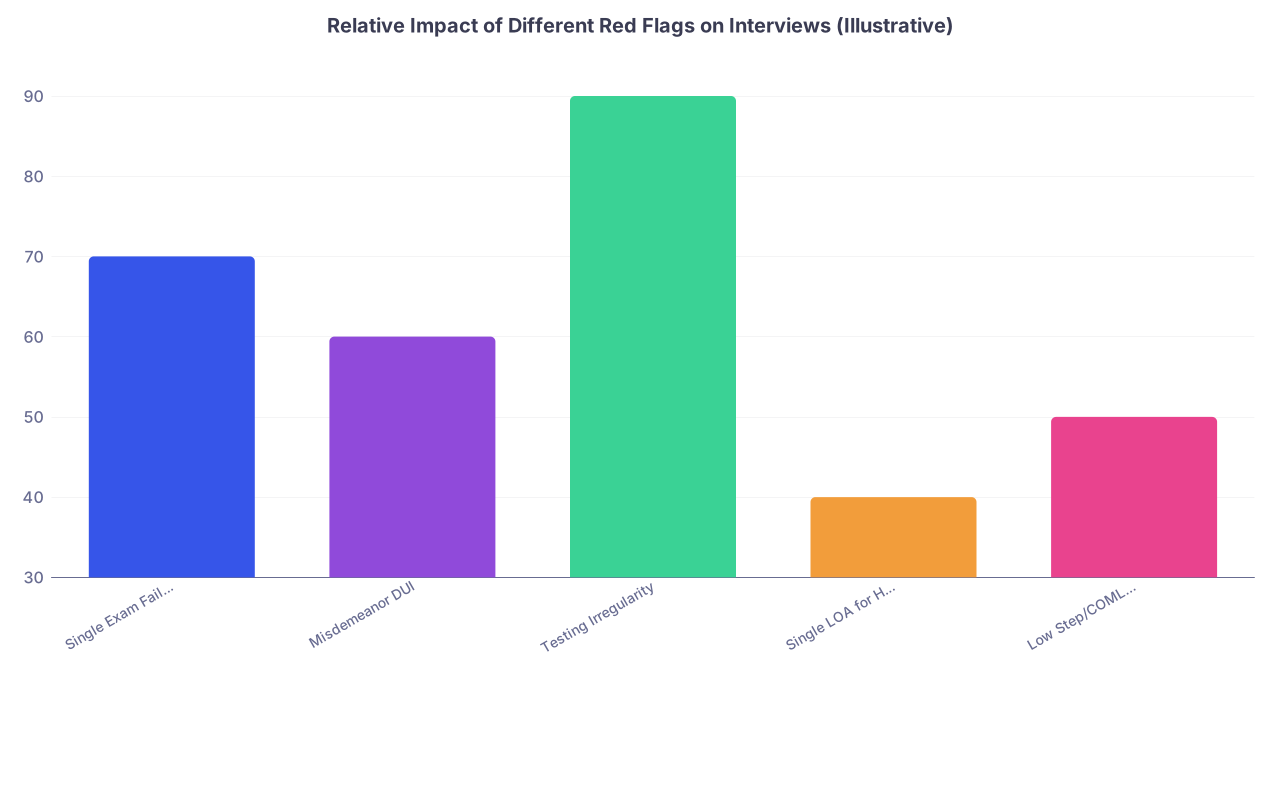
| Category | Value |
|---|---|
| Single Exam Failure | 70 |
| Misdemeanor DUI | 60 |
| Testing Irregularity | 90 |
| Single LOA for Health | 40 |
| Low Step/COMLEX | 50 |
(Higher value = more likely to significantly reduce interview offers, illustrative scale 0–100.)
Testing irregularity sits at the nastier end of the spectrum. That does not mean “game over.” It means “handle this with surgical precision.”
12. Concrete To-Do List Before You Certify ERAS
You are busy. Let me make this practical.
Pull your official USMLE/COMLEX transcript and read every line.
Meet with your dean or student affairs dean. Bring:
- All letters from NBME/NBOME/FSMB.
- A draft 200–300 word explanation you propose to use in ERAS.
Ask directly:
- How will this appear in my MSPE?
- Do you recommend any changes to my explanation language?
Decide with your advisor:
- Do we mention this at all in the personal statement? (Often no.)
- Which programs and specialties are realistic given this plus my numbers?
Identify 1–2 trusted faculty mentors familiar with residency selection to review your explanation and your specialty list.
Craft and memorize a tight 60–90 second spoken response for interviews.
Once all that is locked, enter the explanation in ERAS, certify, and redirect your focus to everything that improves the rest of your application.

With those steps, you are not erasing what happened. You are doing something better: showing that you can handle a serious professional setback in a mature, transparent, and reliable way.
That is exactly what people want in a resident.
You are in a hard spot, but not an impossible one. You handle this cleanly, you put the rest of your file in the best possible shape, and then you let programs decide. Many will pass. The ones that do not will be the places that are actually willing to look at you as a whole person, not just a line on a transcript.
With this foundation in place, you are ready for the next step: building a rank list and managing interview conversations without letting this single issue dominate your entire season. But that is a story for another day.
FAQ (Exactly 5 Questions)
1. Will a USMLE/COMLEX testing irregularity automatically disqualify me from matching?
No, not automatically. It will exclude you from some programs and probably from the most competitive specialties and top-tier institutions. However, many mid-tier academic and community programs will consider you if the rest of your application is strong, the event is older, you have a clean record since, and your explanation shows maturity and insight.
2. Should I apply to a backup specialty because of my irregularity?
If you are aiming for a highly competitive specialty (derm, ortho, ENT, plastics, neurosurgery), then yes, I would seriously consider a backup in a less competitive field unless your overall record is otherwise exceptional and you have strong insider mentorship telling you it is still realistic. For core specialties like IM, FM, Peds, and Psych, a testing irregularity is damaging but not necessarily career-ending; a backup may not be required but a broader application strategy is smart.
3. Can I avoid disclosing the irregularity if it was “only an investigation”?
If there was any formal investigation with written correspondence or documentation, especially involving NBME/NBOME/FSMB, you are on dangerous ground if you do not disclose. At minimum, you should review this with your dean and possibly legal counsel. If the investigation was extremely minor (clerical clarification, no formal case opened), disclosure is less clear-cut. But if there is an annotation on your transcript or a formal letter of finding, you must disclose it.
4. How long does a testing irregularity stay on my record?
For USMLE, irregular behavior findings are generally permanent annotations on your transcript and are subject to reporting to state medical boards and residency programs. COMLEX is similar. These do not “expire” in the way that a low Step score might fade from importance as you progress in training. However, the further in the past the event is, and the more years of clean, documented performance you accumulate, the less weight many decision-makers will place on it.
5. Will programs ever ask for details beyond what is in ERAS and my transcript?
Yes. Some programs will ask about it directly in interviews. Occasionally, program directors may contact your dean for more background. Rarely, especially when you apply for state licensure later, boards may request additional documentation or explanations. This is why your written ERAS explanation, your dean’s description, and your interview narrative need to be consistent, factual, and aligned. Any discrepancy raises more concerns than the original irregularity itself.