
The residency match does not fall apart because of your grades or your Step scores. It falls apart because the state medical board does not clear you in time to start.
I have watched excellent applicants lose positions—not for misconduct, not for a bad LOR—but because their state license or training permit was delayed beyond the program’s start date. That hurts more than any failed exam, because it was preventable with the right level of paranoia and planning.
Let me break this down specifically: state board or licensing delays are one of the most under‑recognized “red flags” in residency applications. Not because you did something wrong, but because programs hate uncertainty. Any whiff that you might not be cleared to start on July 1, and suddenly you become “risky” on a rank list.
This article is about how to keep that from happening—and what to do if the delay is already in play.
1. How Licensing Delays Become a “Red Flag” in Residency
Programs do not care about licensure as an abstract bureaucratic exercise. They care because without a training license (or full license, depending on the state), you are:
- Not allowed to touch patients
- Not covered by malpractice
- A payroll and FTE headache for the GME office
So any licensing uncertainty becomes a risk calculation. And residency programs are risk‑averse.
Where the red flag actually shows up
The “red flag” is not usually a big red stamp on ERAS. It manifests in more subtle ways:
Your application includes hints that licensing could be complicated:
- Multiple state changes with prior licensure
- Past disciplinary actions, board complaints, or investigations
- Prior criminal charges, even dismissed or expunged
- History of impairment, substance use treatment, or mental health hospitalization
- Multiple attempts or irregularities on Step/COMLEX exam records
Program coordinators see your answers on pre‑employment or credentialing forms:
- “Have you ever been investigated by any licensing board?”
- “Have you ever been convicted, pled nolo contendere, or had charges deferred?”
- “Have you ever been dismissed, suspended, or non‑renewed from a training program?”
If you answer “Yes” to any of these—even with a benign explanation—that immediately flips you from “standard processing” to “board review likely needed.”
Past delays in other jurisdictions: If your file shows that another state took a long time or flagged you previously (e.g., you applied for a student permit or extern license that dragged), a cautious coordinator may quietly warn the PD: “This one might not clear fast.”
So the red flag is “potential licensure difficulty,” not “actual denial.” Programs know they are on a tight timeline. If you need five layers of board review, they worry you will not be ready on time.
2. The Real Timeline: Residency vs State Board Clocks
You cannot manage this if you do not understand the competing clocks. They are not aligned, and the board does not care about your Match Day.
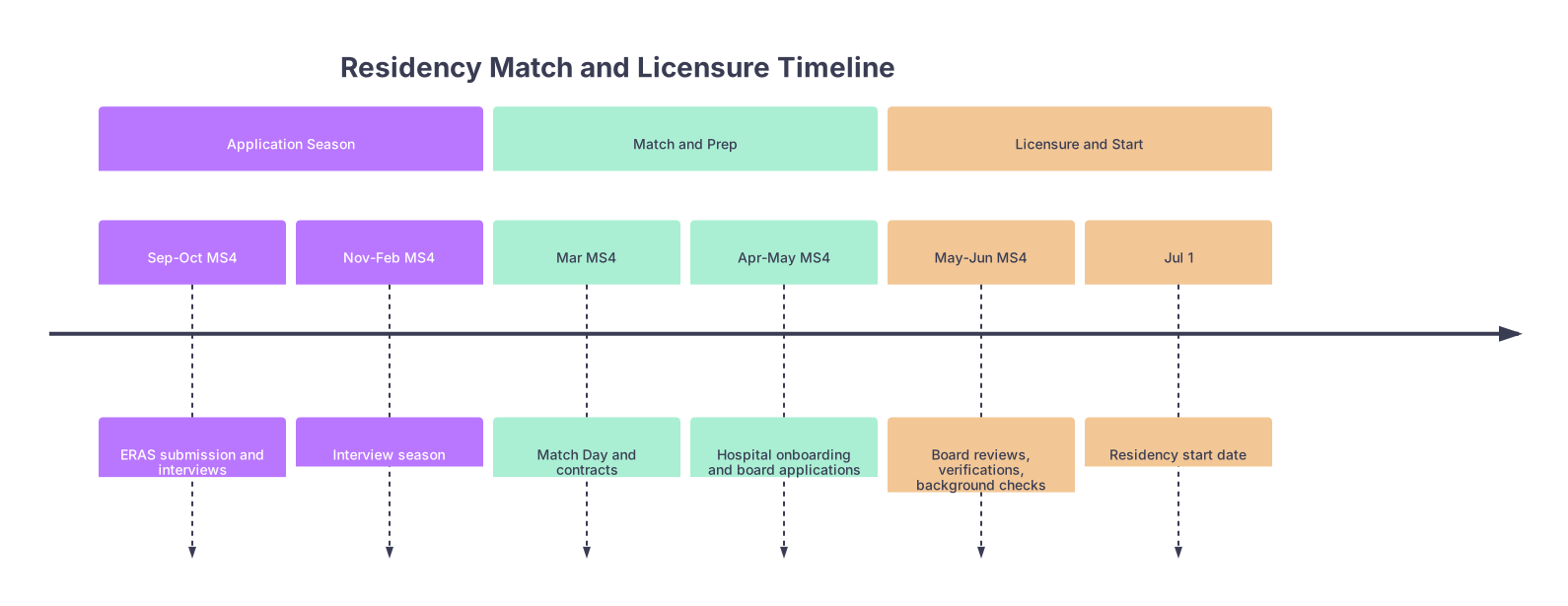
| Period | Event |
|---|---|
| Application Season - Sep-Oct MS4 | ERAS submission and interviews |
| Application Season - Nov-Feb MS4 | Interview season |
| Match and Prep - Mar MS4 | Match Day and contracts |
| Match and Prep - Apr-May MS4 | Hospital onboarding and board applications |
| Licensure and Start - May-Jun MS4 | Board reviews, verifications, background checks |
| Licensure and Start - Jul 1 | Residency start date |
Why this mismatch matters
Residency programs commit to you in March. Most state boards seriously start dealing with your application in late spring. And if your file is even slightly complex, you can end up in a board meeting after your start date.
Typical pattern I have seen:
- March 15: You match a categorical IM spot in a state you have never lived in.
- April 1–15: Program sends credentials packet. Someone casually says, “Get your training license in ASAP.”
- May 1: You finally have time after finals to assemble documents.
- Late May: Your application is “received but incomplete” due to one missing form from your med school or a slow background check.
- June 20: Your file goes to “review,” but you missed the cutoff for the June board meeting. Next meeting? Late July.
Now your PD gets an email from GME: “Cannot start clinical duties until license issued.”
That is how people sit unpaid in orientation limbo, or worse, get released from their contract.
3. Common Triggers for State Board or Licensing Delays
Let me be blunt: the board does not move fast on anything that might make them look bad later. If there is any hint of risk, they slow down and dig.
Here are the most common triggers that turn a routine application into a “this needs board review” case.
1. Criminal history or legal issues
This includes:
- DUIs or DWIs (including old ones from college)
- Assault, disorderly conduct, domestic disputes, even if dismissed
- Misdemeanors involving dishonesty or controlled substances
- Felony charges, regardless of final outcome
People fool themselves: “It was expunged; it’s like it never happened.” Wrong. Many boards require disclosure even for expunged or sealed cases. Fingerprint‑based background checks will surface more than you think.
The delay pattern: Board requests certified court records, police reports, and sometimes personal statements or proof of rehabilitation. None of that happens quickly.
2. Academic or professionalism actions in medical school
Anything beyond a simple failed exam can attract attention:
- Formal professionalism letters or suspensions
- Required leaves of absence, especially “medical” or “personal”
- Non‑promotion, dismissal, or extension of program
- Honor code violations (cheating, plagiarism, falsification)
Programs often know about these from your MSPE. Boards get a more formal version, and sometimes they ask for clarification from your dean. That back‑and‑forth takes weeks.
3. Irregularities on USMLE/COMLEX
Boards look closely at:
- Multiple exam failures (especially Step 2 or Step 3)
- NBME “irregular behavior” findings
- Score cancellations or investigations into identity, cheating, or unusual test conditions
You will not sneak this past them. FSMB reports are very explicit. Once this is flagged, your license application is guaranteed to be manually reviewed.
4. Prior licensure or training problems
Red flags here:
- Prior training contract not renewed or early separation
- Probation in another program or state
- Prior license subject to conditions, monitoring, or discipline
- Gaps in training or unexplained time out of medicine
Boards do not like uncertainty in clinical continuity. If they suspect you left a program under a cloud, they stall until they get a very clear, detailed statement from someone in authority.
5. Health, impairment, and substance use disclosures
This is where things get messy ethically and legally. Many boards still ask intrusive questions about:
- Past or current mental health treatment
- Substance use disorder history
- Physical conditions that could affect practice
In more progressive states, they focus on current impairment, not diagnosis. In others, any mention of “treatment” triggers monitoring requirements or additional documentation from treating physicians. That documentation rarely arrives in less than several weeks.
You must answer truthfully, but you also must be strategic and very precise.
4. How Programs Actually Think About Licensing Risk
Programs sit in a weird spot. They want to support you. They also cannot afford to keep an empty slot for six months.
Behind closed doors, here is how they categorize applicants in the context of licensing risk:
| Risk Level | Typical Features | Program Response |
|---|---|---|
| Low | Clean background, no issues | Standard processing, no extra concern |
| Moderate | Minor legal/professional issues | Ask for clarification, may rank slightly lower |
| High | DUIs, prior discipline, health monitoring | Deep discussion, possible conditional ranking |
| Extreme | Pending investigations, major felonies | Often not ranked, or ranked very cautiously |
Programs worry about three specific scenarios:
- You cannot start on time (no license by July 1).
- You start, then the board later imposes restrictions that cripple your role (no prescribing, no nights, mandatory monitoring the program is not equipped to handle).
- They are blindsided late—learning about your issues from the board, not from you.
If they suspect any of these, they may:
- Call you before ranking to ask “clarification” questions.
- Ask their GME office or legal counsel whether your history is compatible with the hospital’s policies.
- Quietly push you down the list, even if they like you, because “we just do not know if they are going to clear.”
This is why your job is not to pretend there is no issue. Your job is to convince them you understand the licensing risk better than they do and that you already have a plan in motion.
5. Pre‑Match Strategy: If You Know You Have Licensing Risk
If you are early enough in the game (MS3/MS4 before ERAS, or even early in interview season), you should not sit back and hope the board is kind.
You need to act like the most anxious program coordinator in the room.
Step 1: Identify your specific risk profile
Be brutally honest with yourself. Ask:
- Do I have any criminal history—no matter how minor or old?
- Did I ever have a formal academic or professionalism action?
- Did I take a leave from medical school for health or personal reasons?
- Have I ever been investigated by any exam body, school, or licensing entity?
- Have I ever been in treatment for substance use where someone else had a duty to report?
If “yes” to any, you are not doomed. You are just in the group that cannot afford a casual approach.
Step 2: Research state boards where you are applying
Not all states behave the same. Some are relatively streamlined for training licenses. Others are infamous black holes. You want to know which is which before you rank.
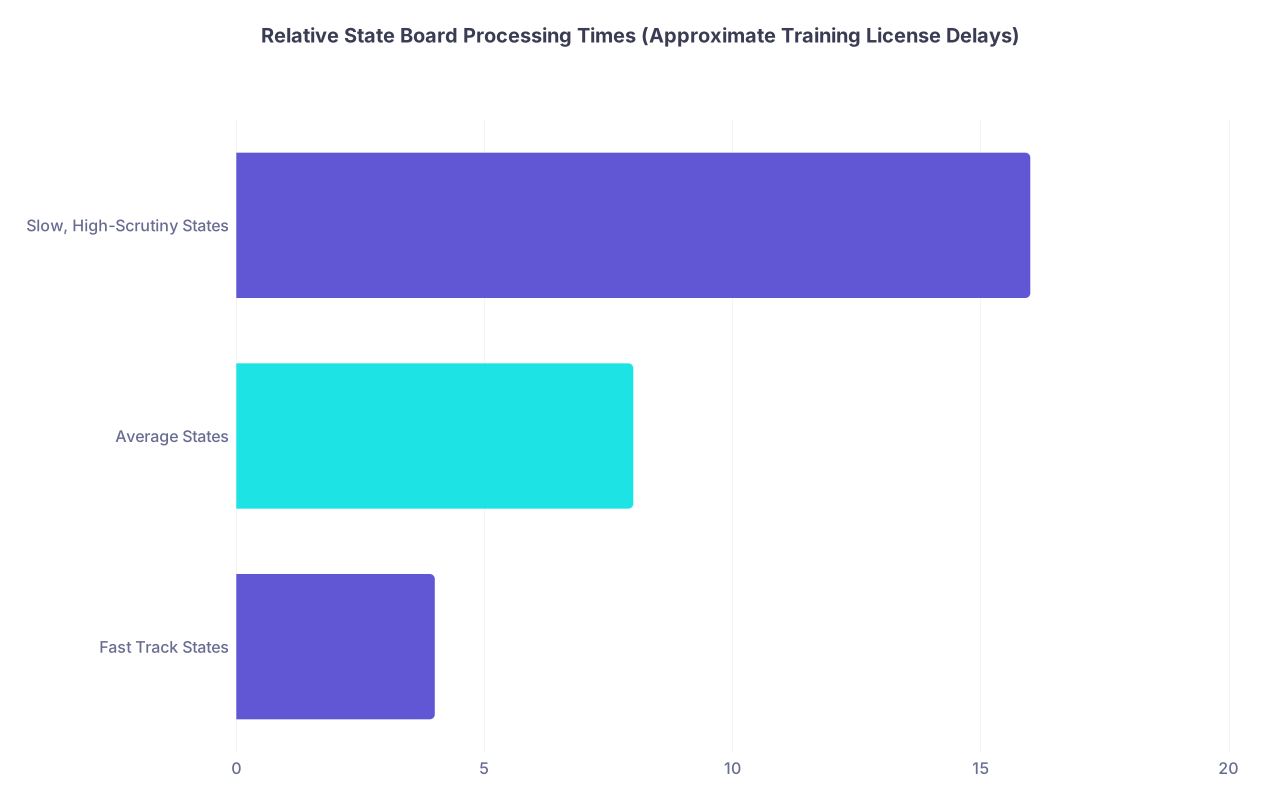
| Category | Value |
|---|---|
| Fast Track States | 4 |
| Average States | 8 |
| Slow, High-Scrutiny States | 16 |
This is not exact, and it changes, but as a rough example:
- Fast track (few weeks for clean files): states like Minnesota, Ohio, Virginia
- Average (6–10 weeks): large states with volume but decent infrastructure
- Slow/high‑scrutiny (can be months for complex files): California, Texas, Florida, New York, some southern boards
Look at:
- Board websites: training permit requirements, FAQ, processing times
- Forum discussions from residents in that state (filter out the noise, look for consistent patterns)
- Your school’s GME/dean’s office—ask, “Where have our students had board delays, and why?”
If you have major risk factors, ranking a bunch of programs in historically slow, high‑scrutiny states without planning is reckless.
Step 3: Tighten your narrative before anyone asks
You do not need to dump your whole life story into your personal statement. But you do need a clean, consistent, non‑defensive narrative for any licensing red flag.
For example:
DUI 5 years ago:
- One sentence in ERAS (“I faced legal consequences for a DUI in 2019 and completed all mandated treatment and monitoring.”)
- Concise, forward‑looking explanation if asked in interviews.
- Documentation already organized: court records, completion certificates.
Medical leave for depression:
- Frame as a bounded, treated episode with successful return to full function.
- Make it absolutely clear there is ongoing professional support if needed, but no current impairment.
The worst thing you can do is give five different versions of the same event in different settings. Boards and programs hate inconsistency.
6. Post‑Match: Immediate Actions to Prevent Licensing Delays
Match Day is not the end of your application stress. For applicants with potential board issues, it is the start of the sprint.
Here is the sequence I recommend in the first 1–2 weeks after you match.
1. Get the board requirements in writing and dissect them
Do not rely only on your program’s generic welcome packet. Go to the state board website yourself and:
- Download the exact training license or limited permit application.
- List every required document: transcripts, MSPE, exam scores, background checks, verifications from other boards (if applicable), reference forms, personal statements.
- Identify anything that will require another institution’s help: med school dean’s letter (separate from MSPE), prior program verifications, foreign medical grad documents, ECFMG.
Then map rough timing. Some schools need 2–4 weeks just to process a form. You are not their only graduate.
2. Alert the program early if you have known risk factors
This sounds counterintuitive, but hiding never helps.
Send a concise, professional email to the program coordinator (and CC APD/PD only if appropriate) along the lines of:
- Acknowledge you have an issue that often triggers board review.
- Confirm you have fully disclosed it on all official documents.
- Outline what you are already doing to expedite processing (collecting records, preparing written explanation).
- Ask if the institution has a standard approach or legal office that helps with complex board applications.
Programs are much more likely to advocate for you if they see you are proactive and organized, not panicked and reactive.
3. Front‑load the “slow” components
Typical slow pieces:
- Fingerprint‑based background checks (especially if out‑of‑state or out‑of‑country)
- Court records for old cases
- Official verifications from foreign med schools or prior training sites
- Any letter from a treating psychiatrist/addiction specialist, if needed
Do these first. Do not waste two weeks filling out the easy pages while ignoring the hard piece that will actually hold you up.
7. If You Are Already Facing a Board Delay
Now the hard part. You are in May or June, your license application is in, and you get the dreaded news: “Your file has been pulled for board review,” or “Your file will go to the July meeting.”
You need a damage control plan.
Step 1: Understand the specific reason for the delay
Push for clarity. Ask the board staff (politely, in writing if possible):
- Is my file considered complete?
- Has it been assigned to a specific analyst or investigator?
- Is the delay purely due to meeting schedule timing, or is additional information required?
If they say your file is incomplete, that is fixable. If they say it is complete but must go to the board, timing becomes the primary problem.
Step 2: Loop in your program leadership immediately
Do not wait until late June to tell your PD there is an issue. They need time to strategize.
Provide:
- A clear summary (1 page) of what the board is reviewing and where the process stands.
- Copies of any board communications you have received.
- A timeline showing: date of application submission, date marked complete, any requests for extra information.
Coordinators and DIOs sometimes have informal contacts at boards and can at least ask, “Will this be on the June agenda?” They cannot force a decision, but they can advocate when there is an obvious administrative lag.
Step 3: Prepare for temporary non‑clinical status
If it is June and your license will clearly not be ready by July 1, your program may:
- Allow you to start orientation and non‑clinical activities only.
- Delay your official start date (with pay or without pay, depending on GME policy).
- In worst‑case scenarios, withdraw the contract if they believe the delay could extend many months.
You do not have full control here. But you can:
- Ask explicitly: “If my license is approved by [specific date], can I still start this year?”
- Clarify whether they will reserve your position if the board outcome is favorable.
- Document all communication in writing.
If they must delay your start, get clear in writing whether you will be in the next year’s class automatically or considered a re‑applicant.
8. Documentation: How to Present Your “Red Flag” to a Board
Boards are not impressed by emotional essays. They want:
- Precise facts
- Evidence of insight and responsibility
- Concrete changes and ongoing safeguards
Here is the structure I recommend for any written statement you must submit.
A. Factual summary (1–2 paragraphs)
- What happened, where, and when
- Legal or institutional outcome
- Objective description without blame‑shifting
Example for DUI:
“In March 2019, I was arrested in [city, state] and charged with driving under the influence with a measured BAC of 0.11. I pled guilty to a misdemeanor DUI in June 2019. The court imposed a fine, license suspension, required DUI education classes, and one year of probation, which I completed successfully in July 2020. There have been no further legal incidents.”
B. Reflection and insight
- What you learned
- How you understand the violation of professional standards
- Connection to patient safety and trust
Avoid cliches like “I learned a lot about responsibility.” Be specific.
C. Concrete remediation and current status
- Treatment attended, if any
- Monitoring or follow‑up, if applicable
- Concrete behaviors and support systems you have in place now
- Proof that there is no current impairment
Boards are not looking for perfection. They are looking for someone who is unlikely to blindside them with new problems.
9. International Medical Graduates: Extra Licensing Traps
If you are an IMG, you have all the same risks as US grads, plus several extra ways for delays to surface.
Common traps:
- Delayed or inconsistent documentation from your med school (different names, lost records, incomplete transcripts).
- Date discrepancies across ECFMG, school letters, CV, and ERAS.
- Old internship or partial residency abroad that needs verification.
- Visa status questions that interact with licensure (e.g., if state requires SSN before granting a license).
For IMGs, I recommend:
- Triple‑checking that every date and name is consistent across all documents.
- Getting your medical school to identify a single contact person for all board‑related verifications.
- Starting the licensure dossier assembly the same week you submit your rank list—not after you match.
You do not have the luxury of waiting. Time zone differences and bureaucratic schools can add weeks to simple paperwork.
10. What If the Board Denies or Heavily Conditions Your License?
Worst‑case scenario. The board either:
- Denies your training license outright, or
- Grants a license with conditions your program cannot accommodate (e.g., strict practice monitors, no overnight work, regular testing).
At that point, you have two fronts:
Legal/regulatory:
- Some states allow appeals or reconsideration.
- This is where you get a lawyer who actually practices before that board, not your cousin who does real estate.
- You may be able to negotiate conditions.
Career/program:
- Honest discussion with your PD about feasibility.
- Ask if a deferral is possible while conditions are clarified.
- If the program must release you, get their support for future applications (letters explaining that your performance was not the problem, licensure was).
It is brutal, but not terminal to your career. I have seen residents bounce back in another state with more modern board policies, or after a period of clearly documented recovery and stability.
11. Turning a Potential Red Flag Into a Contained Risk
Licensing and state board delays become a true “red flag” in residency applications when they blindside everyone and threaten start dates. Programs hate surprises.
You reduce that risk when:
- You identify your risk factors early and realistically.
- You choose states and programs with an eye toward board behavior, not just prestige.
- You communicate proactively with your matched program.
- You treat the licensure process like its own high‑stakes exam, not miscellaneous paperwork.
One last perspective: programs are used to seeing perfect, polished stories. What stands out—in a good way—is the applicant who has faced something hard, owns it completely, and has already done the unglamorous work of making sure it will not derail their ability to practice.
That is the resident coordinators fight for in GME meetings when the board is slow and the start date is looming.
With this mindset and structure in place, you are not just surviving the licensure gauntlet—you are learning how to manage institutional risk, advocate for yourself, and think like an attending. The next step after this? Making sure those same skills carry you through privileging, credentialing, and hospital politics when you finish residency. But that is a problem for your future self—and another conversation entirely.