
The most dangerous residency applications are not the ones with one big red flag. They are the ones with ten tiny ones that add up to “No.”
You know this application. Decent scores but not stellar. A couple of awkward gaps. Generic personal statement. Mediocre letters. Activities list that reads like a resume, not a story. Nothing catastrophic anywhere, but no part strong enough to carry the rest.
Programs do not reject you for “one weak bullet point.” They reject you for pattern recognition: inconsistency, sloppiness, lack of direction. The good news: that pattern can be fixed. Systematically.
Here is a five-point checklist I use with applicants whose files feel “off” but not doomed. You do not need a total rewrite. You need a structured cleanup.
1. Fix the Narrative: Force a Coherent Through-Line
Most “multiple small issues” applications suffer from one core disease: they read like a random collection of facts, not a coherent story.
Faculty will not say this out loud, but I have heard it a hundred times in committee:
“This applicant is fine, but I do not really get who they are.”
You must answer one question across your entire file:
Who are you as a future resident, and why does that make sense given your path so far?
Step 1: Pick a Clear, Boringly Simple Identity
Not a life manifesto. A residency-facing identity. For example:
- “Future internist who likes complex, multi-problem patients and longitudinal care.”
- “Surgery applicant who is calm under pressure and likes procedures plus teaching.”
- “Psychiatry applicant with a track record of working with underserved, high-need populations.”
If I ask you in one sentence: “What kind of resident are you trying to be?”
You should have a crisp answer. If you do not, fix that before touching anything else.
Step 2: Audit Every Component Against This Identity
Pull up your whole application:
- Personal statement
- Experiences section
- CV
- Letters (what you know about them)
- MSPE / Dean’s letter
- Secondary essays (if applicable)
- Program-specific questions
Now, do a ruthless pass:
- Highlight anything that supports your chosen identity.
- Put a question mark next to anything that is unrelated or contradictory.
- Circle anything that accidentally sends the wrong message (e.g., all research but you claim you want a pure clinical career).
Your goal is not to fabricate a new you. It is to align what is already true into a coherent picture.
Examples of problems I see constantly:
Applicant says they want primary care IM, but:
- All activities: lab research and bench work
- Zero outpatient continuity experiences emphasized
- Personal statement talks more about pipetting than patients
→ The message: confused or not actually committed.
Applicant says they love teaching, but:
- No examples of actual teaching
- No mention of peer tutoring, mentoring, or curricular work
→ The message: buzzword, not substance.
Step 3: Rewrite for Signal, Not Volume
You likely cannot change your scores or your transcript. You can absolutely change:
- Which experiences you emphasize
- How you describe them
- The order they appear
- What you omit or downplay
Do this:
Pick 2–3 core themes that fit your identity, such as:
- Ownership and follow-through
- Working with underserved groups
- Teaching and mentoring
- Calm in high-acuity situations
In your personal statement and experiences, make sure each major section showcases one of those themes with a specific example.
Cut or shrink content that:
- Does not fit any theme
- Introduces new, unrelated directions (e.g., long discussion of orthopedics research in an EM application with no EM context)
You are creating an “of course” reaction in the reader:
- “Of course they are applying to this specialty. Of course they will fit our program.”
Until your file does that, every small flaw weighs more heavily.
2. Patch Academic and Testing Blemishes (Without Over-Explaining)
A lot of applicants have a transcript or score report that is “mostly fine” with a few landmines:
- One or two low preclinical course grades
- Fail or marginal performance on a shelf
- Step 1 fail with subsequent pass
- Step 2 score that is noticeably lower than your peers
- Downward trend late in clinical years
None of these alone is fatal for many fields. What kills you is pretending program directors will not notice. They will. Their eyes go there first.
Step 1: Build a Clean, Honest Timeline
Write out a very simple timeline for yourself:
- Dates of preclinical and clinical years
- Course / clerkship / exam issues with:
- Course/exam name
- Grade or outcome
- Any relevant life event (if real and significant: health, family, visa, etc.)
- What changed afterward
This is for your eyes and for structured explanation later, not for self-flagellation.
Step 2: Decide Which Issues Need Explicit Addressing
Not every B+ or “High Pass” needs a story. Use this grid:
| Issue Type | Needs Explanation? |
|---|---|
| Single B or HP in strong record | No |
| Pattern of lower grades early | Short, brief context |
| Shelf fail / clerkship fail | Yes, concise explanation |
| Step fail (1 or 2) | Yes, must address |
| Long unexplained gap | Yes, must address |
If something appears in:
- MSPE “Concerns” section
- Transcript as a failure, remediation, or withdrawal
- Score report as “Fail” before “Pass”
Then you either explain it, or the committee invents their own explanation. Their version will not be flattering.
Step 3: Use the Right Place and Tone for the Explanation
You have a few possible locations:
- Designated “Academic difficulties” or “Gap” field (ERAS sometimes)
- Personal statement (briefly, not the whole essay)
- MSPE addendum (if your dean’s office allows)
- LOR writer explanation (especially for clerkship failures)
General rules:
- 2–4 sentences maximum for most issues
- Own it. No passive voice, no blame dumping.
- End with demonstrated improvement, not self-pity.
Example for a failed shelf and remediated clerkship:
During my third-year surgery clerkship, I initially failed the shelf exam. I underestimated the volume of material and relied too heavily on passive review instead of active questions. I remediated the shelf with a significantly higher score and adopted a question-based approach that I have maintained throughout fourth year, resulting in Honors in my subsequent IM and EM rotations.
Bad version:
Unforeseen circumstances led to a disappointing outcome on my surgery shelf, which does not reflect my true abilities. Once these resolved, my performance improved.
You feel the difference. Programs do too.
Step 4: Make the “Fix” Visible in Your Record
If you say you learned and improved, the record should show something to support that:
- Later shelves that are solid
- Strong Step 2 after Step 1 struggles
- Improved clinical comments as the year progresses
- Extra coursework or board prep that demonstrates effort
If you do not have obvious objective improvement, highlight qualitative:
- Comments about preparation, reliability, growth over rotation
- Specific faculty line in a letter: “I know about his prior academic difficulties and fully support his readiness for residency.”
Do not just claim growth. Point to it.
3. Clean Up Your Letters and Relationships (The Silent Killers)
Most applicants with “lots of little issues” also have one big blind spot: weak or generic letters of recommendation.
You may think your letters are “fine.” I have read hundreds of “fine” letters. I remember none of them.
Programs do not need you to have four superstar letters. But they absolutely notice:
- Letters that are non-specific
- Letters from people who barely know you
- Letters that faintly damn with “adequate,” “satisfactory,” “met expectations”
Step 1: Map Your Current Letter Set
List your letters like this:
- Dr. X – Specialty / role – Knows me from _____ – Strength: 1–10 (your estimate)
- Dr. Y – …
- Dr. Z – …
Be brutally honest with yourself. If you barely interacted with them, do not magically assume a “9/10” letter.
Red flags in your letter mix:
- No letter from your chosen specialty (where it is expected)
- Only one letter from core clinical faculty
- Two or more letters from people who never directly supervised you clinically
- More than one letter that is clearly a template (if you have seen them)
Step 2: Identify Where a Weak Letter is Dragging You Down
Patterns I have seen:
- The big-name researcher who writes a generic, two-paragraph “I support their application” letter. Impresses nobody.
- The preclinical faculty letter that says nothing about how you actually function with patients.
- The “Department Chair” form letter that is obviously a fill-in-the-name template.
If you have time before ERAS submission or before you assign letters to programs, you can:
Replace a weak letter with a stronger, more specific one from:
- A sub-I attending who loved your work
- A mentor who has seen you longitudinally in clinic or research
- A program director from an away rotation
Change how you assign letters by specialty:
- Use your best two clinical letters for all programs.
- Add a specialty-specific letter for that specialty only.
- Drop the weakest letter entirely rather than “using all four” just because you can.
Step 3: Rescue Late or Uncertain Letters
If a potentially strong letter writer:
- Is late
- Has not submitted
- Is historically vague/brief
You intervene. Politely but clearly.
Your email should:
- Provide an updated CV and personal statement.
- Remind them of specific cases or projects you worked on together.
- Explicitly mention qualities you hope they can address (work ethic, clinical reasoning, etc.).
You are not writing the letter for them. You are loading their memory so they can write something concrete.
Example structure (shortened):
Dear Dr. Smith,
I hope you are well. Thank you again for agreeing to support my internal medicine residency application. As ERAS submission approaches, I wanted to share my updated CV and personal statement for context.I particularly valued working with you on the inpatient cardiology service in March, especially managing the complex heart failure patient we rounded on daily together. If you feel comfortable, it would be very helpful if you could comment on my clinical reasoning, reliability with follow-up tasks, and my interactions with nursing staff, as these are areas IM programs focus on closely.
Thank you again for your time and support.
Short, direct, focused.
4. Repair the “Soft” Red Flags: Professionalism, Gaps, and Vibes
This is the part most applicants underestimate. Programs reject a lot of technically qualified people because something just feels off.
What do I mean by “soft” red flags?
- Unexplained time gaps
- Odd or unprofessional email handles
- Sloppy application (typos, inconsistent dates)
- Strange or negative social media footprint
- Vague answers about leaves of absence, transfers, or school changes
- Overly negative or blaming tone when describing past experiences
Step 1: Hunt Down Every Inconsistency
Open your ERAS, CV, MSPE, and any supplemental documents side by side.
Look for:
- Mismatched start/end dates for the same activity
- Different responsibilities described for the same research job
- City/hospital names spelled differently
- Activities that appear in one place but not another
Each small mismatch alone is harmless. But when faculty see five or six of them, they start thinking:
- Disorganized
- Careless
- Maybe shading the truth
Fix these. One by one. This is tedious and absolutely necessary.
Step 2: Fix Gaps and Odd Transitions Before Programs Ask
If you have:
3 months with no listed activity
- School transfer
- Leave of absence
- Switch in career path (e.g., PhD dropout to MD, or another health profession to med)
You have two options:
- Explain it briefly in the application (ideal if it might raise concern).
- Be ready with a crisp, rehearsed explanation for interviews (if it is minor).
A decent written explanation follows this structure:
- 1 line: What happened (fact, not drama)
- 1–2 lines: Why (only as much detail as needed)
- 1–2 lines: What you did constructively and how you are now
Example:
From January to April 2023, I took a medical leave of absence to address a newly diagnosed health condition. During this time, I focused on treatment and recovery under the guidance of my physicians. Since returning, I have completed all remaining clinical rotations on schedule and without limitation, and I am fully cleared for the demands of residency.
Programs read that and mentally move on. That is what you want.
Step 3: Professionalize Every Touchpoint
Quick checklist:
- Email: Use something like firstname.lastname@…, not drcoolguy@…
- Voicemail: Short, clear, professional recording. No music. No jokes.
- ERAS photo: Neutral background, business attire, no selfies.
- Social media:
- Lock anything questionable.
- Remove obviously unprofessional public posts.
It sounds basic, but I have seen offers vetoed because someone’s public feed was a disaster.
Step 4: Audit Tone: Are You Blaming or Owning?
Programs are allergic to:
- “The attendings did not like me.”
- “The school was disorganized.”
- “The test was unfair.”
Even if some of that is true, your written persona must be:
- Accountable
- Solutions-focused
- Not bitter
Before final submission, read through:
- Personal statement
- Explanations for difficulties
- Any optional essays
Ask yourself: “Do I sound like someone who blames the system or someone who learns and adapts?” If it is the former, rewrite.
5. Rebuild the Activities Section So It Pulls Real Weight
Most medical students waste their experiences section. They list tasks. They do not show growth, impact, or continuity. That is how “a lot of little issues” stay exposed.
Your activities list is one of the best places to quietly fix multiple weak spots:
- Lack of leadership
- Lack of service
- Poor continuity
- No teaching
- No initiative
You can do this without inventing anything new.
Step 1: Prioritize and Group Intelligently
First, sort your experiences:
Tier 1 (top 3–5): Activities that are:
- Longitudinal
- Closely related to your specialty or core themes
- Show responsibility or leadership
Tier 2: Solid but shorter or less central items.
Tier 3: Short, minor, or purely box-checking roles.
Then:
- Put Tier 1 at the top of your experiences list.
- Combine similar Tier 3 items where allowed (e.g., multiple one-day fair-volunteering stints into a single “community health outreach events” entry with dates and frequency).
You are not hiding things. You are stopping clutter from diluting your message.
Step 2: Rewrite Descriptions with a Simple Formula
For each significant activity, use a three-part frame:
- Scope: What this thing actually is (1 line)
- Role: What you actually did (2–3 bullets or sentences)
- Impact or growth: What changed because of you or for you (1–2 lines)
Bad example (actual style I see all the time):
Volunteer
- Helped patients.
- Took vitals.
- Shadowed doctors.
Fixed example:
Student volunteer, Community Free Clinic
- Conducted intake interviews and obtained vitals for 10–15 uninsured patients per evening under RN supervision.
- Coordinated follow-up appointments and prescription assistance with social workers and pharmacy.
- Through 2 years of weekly shifts, became comfortable managing language barriers and social complexity, which now informs my interest in continuity primary care.
Same hours. Different signal.
Step 3: Use Activities to Quietly Answer Concerns
You can subtly counter red flags by what you highlight:
Concern: “Is this person actually interested in our specialty?”
- Emphasize: sub-I in specialty, specialty clinic, related research, specialty interest group leadership.
Concern: “Weak preclinical academics – are they practically capable?”
- Emphasize: comments about clinical performance, responsibilities you handled independently, situations requiring judgment.
Concern: “Gap or leave – is this person resilient and stable now?”
- Emphasize: longitudinal commitments maintained after the gap, leadership roles in later years, consistent clinical performance.
You do not write: “Look how resilient I am.” You show continuity and increased responsibility.
Putting It All Together: From “Messy” to “Coherent with Blemishes”
Let me give you a concrete before-and-after pattern I have seen:
Before
- Personal statement: Vague “I like helping people, I like science” story.
- Experiences: Unsorted laundry list, lots of one-liners.
- Academic record: One failed shelf, one remediation, no explanation anywhere.
- Letters: Two generic, one good, one non-clinical.
- Soft spots: Unexplained 4-month gap, minor inconsistencies in dates, casual email.
This person matches only in the most forgiving programs, if at all.
After working the five-point checklist:
- Narrative: Clear IM-focused identity: outpatient continuity + complex patients.
- PS: One central patient story plus 2–3 tied experiences that highlight longitudinal commitment and clinical growth.
- Experiences:
- Top entries: Free clinic, IM sub-I, IM interest group leadership.
- Consolidated minor volunteer work.
- Descriptions emphasize responsibility, judgment, and follow-through.
- Academic issues:
- Brief, clean explanation for failed shelf and remediation.
- Point to subsequent stronger clinical rotations.
- Letters:
- Dropped weak preclinical letter.
- Added strong sub-I attending letter.
- Used three best clinical letters for all IM programs.
- Soft fixes:
- Gap briefly explained as family caregiving, with onward continuity.
- Dates and titles cleaned.
- Professional email, tightened social media.
Same human being. Same fundamental record. But the committee’s reaction shifts from:
- “Eh, messy, not sure”
to:
- “Some early bumps, but clear direction, improvement, and a coherent fit for IM.”
That is the real win. You are not deleting your flaws. You are convincing the reader they are manageable chapters in a larger, solid story.
A Quick Visual: Where Your Fixes Actually Hit
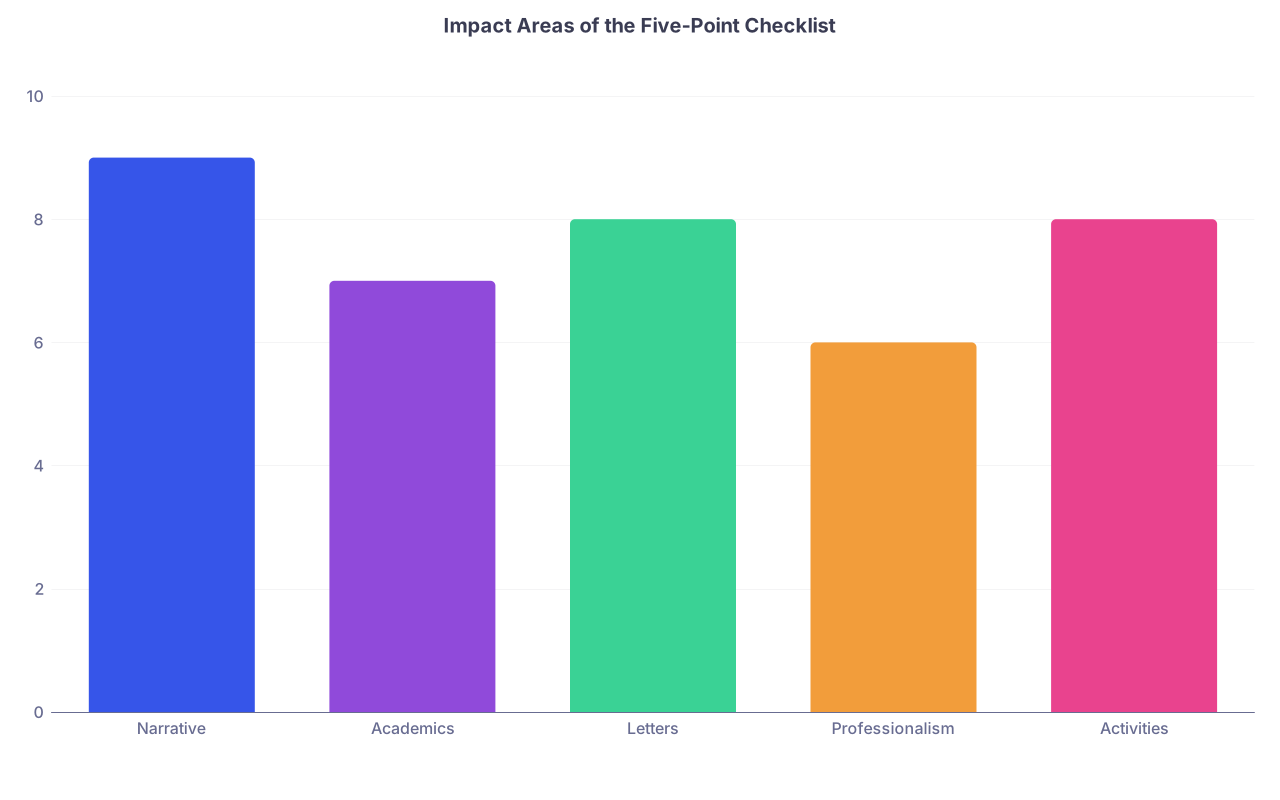
| Category | Value |
|---|---|
| Narrative | 9 |
| Academics | 7 |
| Letters | 8 |
| Professionalism | 6 |
| Activities | 8 |
The five points do not work in isolation. They cross-support each other. Fixing your narrative (Point 1) makes your academic explanation (Point 2) more believable. Better activities (Point 5) make letters (Point 3) stronger, because writers have more to talk about.
Implementation Plan: What To Do This Week vs. Later
Use a simple phased approach so you do not drown in revision.
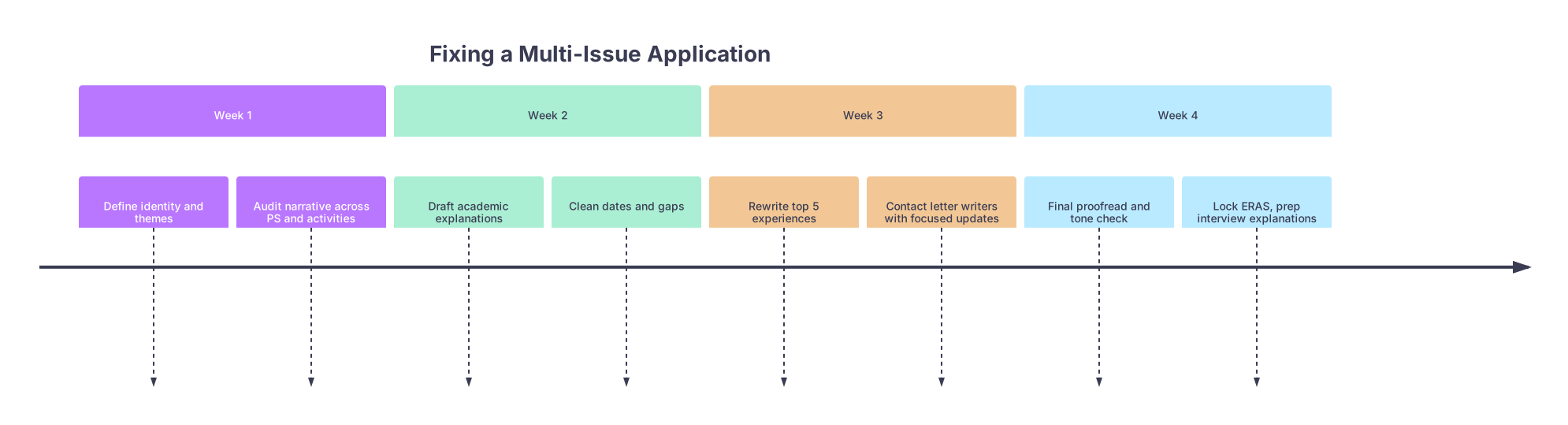
And to keep yourself honest, track which levers you have pulled:

Final Checklist: Five Points You Must Be Able to Say “Yes” To
Before you submit or before you re-apply, you should be able to honestly check all of these:
Narrative
- I can say my residency identity in one sentence.
- My PS and experiences clearly support that identity.
Academics
- Every major academic blemish has a concise, owning explanation somewhere.
- There is visible evidence of stability or improvement afterward.
Letters
- I have at least two strong, specific clinical letters.
- I am not sending any letter I suspect is generic or weak if I can avoid it.
Professionalism & Gaps
- All significant gaps or leaves are either briefly explained or ready to explain in interviews.
- My application materials and contact details appear professional and consistent.
Activities
- My top 3–5 experiences show responsibility, impact, and continuity.
- I have minimized clutter and vague, one-line descriptions.
If you cannot say “yes” to one of those, that is exactly where to work next.

Open your ERAS (or your last application) right now and do one thing: write your one-sentence residency identity at the top of a blank page. Then compare every section of your current file to that sentence. Anywhere it does not match, put a red mark. Those red marks are your immediate to-do list for the week.