
How to Frame a Mid-Career Medical School Transfer on Your Application
It is December. You are on your medicine clerkship, pre-rounding on a patient with decompensated cirrhosis, and your senior casually asks, “Remind me, you started at [Other Med School], right? How’d you end up here again?”
You feel that familiar micro-second of dread. Because you know that same question is coming from program directors, too. But this time it will be on paper, without the benefit of your tone, your face, your context. Just: mid-career. Transferred schools. Non-traditional path. Red flag… or not?
You are not trying to hide anything. You just do not want your application reduced to: “older student with baggage who could not hack it in one place.” That is the line you are walking. And you need to get it right.
Let me break this down specifically.
You have two issues to manage:
- You are mid‑career / non-traditional.
- You transferred medical schools.
Each one alone can be neutral or even positive. Together, handled poorly, they can look like instability, remediation, professionalism problems, or “someone else’s problem” that is about to become the program’s problem.
Handled well, they tell a coherent story: maturity, intentionality, and resilience, not drama.
How Program Directors Actually Read These Red Flags
Before we touch the “how,” you need to be brutally clear on the “what they see.”
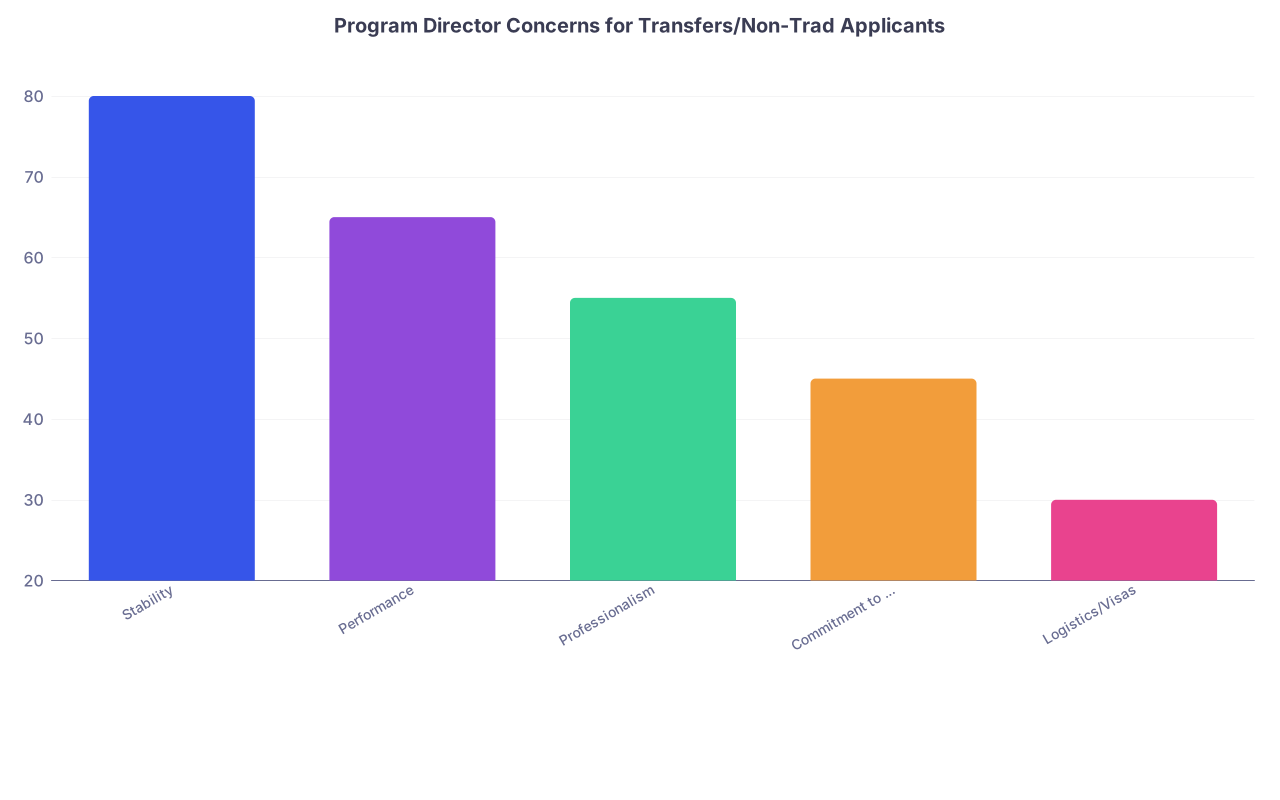
| Category | Value |
|---|---|
| Stability | 80 |
| Performance | 65 |
| Professionalism | 55 |
| Commitment to Specialty | 45 |
| Logistics/Visas | 30 |
These are the questions floating in a PD’s head when they see: mid-career + transfer.
Did they leave under pressure?
Academic trouble, professionalism issues, conflicts, or “asked to leave” scenarios. This is the big one. Nobody wants to inherit a problem that another school quietly solved by “supporting a transition.”Are they going to bolt again?
Residency is a 3–7 year investment. PDs hate attrition. If you already changed medical schools, they will wonder: will this person leave my program or change specialties when it gets hard?Is their performance trajectory solid?
Did their grades improve, stabilize, or fall off after transfer? Any unexplained leaves, extended time, or gaps will be dissected.Is there an underlying health, family, or visa issue that will disrupt training?
This is less about stigma, more about reliability and coverage. Can they be scheduled like everyone else?Is this someone who blames systems, other people, or “culture fit”?
Read enough personal statements and you develop an allergy to “toxic environment,” “unsupportive faculty,” “politics,” or “they didn’t appreciate me.” Massive red flag.
Your job is not to spin. Your job is to answer those concerns so clearly and calmly that they stop being concerns.
First: Decide If You Should Explain It, and Where
You do not have to scream “I TRANSFERRED” from the first paragraph. The application itself will show it.
Here is the layout:
| Application Element | What They Learn |
|---|---|
| Education section | Two med schools, dates, transfer timing |
| MSPE (Dean’s letter) | Official reason(s), performance narrative |
| Transcripts | Grades before and after transfer |
| Personal statement | Your framing and story (if you choose) |
| Program signals/PS | Whether your story matches your stated goals |
So you have three strategic decisions:
Do you address the transfer in the main personal statement?
- Yes, if there is any risk it looks like academic or professionalism trouble, or if the reason is central to your story (major life change, geographic relocation for family, etc.).
- Maybe not, if the transfer was early (M1 only), purely geographic, and your MSPE already explains it simply and favorably.
Do you use the “additional information” / “education interruption” boxes?
- Yes, if transfer linked to a leave of absence, health issue, or disruption in training dates. Those are precisely what those boxes are for.
Do you script a concise spoken explanation for interviews?
- Absolutely yes. If you have a mid-career transfer and you walk into interviews without a crisp 30–45 second version, you are unprepared.
Here is the principle:
If it can be misinterpreted as a hidden problem, explain it. Clearly, briefly, without excuses.
Building the Core Narrative: From Risk to Asset
You need one unifying arc that connects:
- Why you started medical school where you did
- Why you transferred
- Why you are applying to this specialty and this set of programs now, mid-career
The worst move is to treat these as three separate mini-stories. That reads as fragmented and impulsive. You want one continuous, coherent trajectory.
Step 1: Start with your pre-med career and decision timing
Mid-career means PDs want to know: were you running toward medicine or running away from something else?
Good framing:
- “I spent 10 years as an ICU nurse, where I saw…”
- “I worked as a software engineer in health tech, but after leading projects alongside clinicians, I recognized…”
- “I was an attorney in disability law, increasingly focused on clinical care challenges for my clients…”
Bad framing:
- “I tried multiple careers and none of them felt right, so I decided to try medicine.”
- “I was unhappy and unfulfilled, so I decided to pursue my passion.”
You want to show pattern recognition and increasing commitment, not a restless personality.
Step 2: State the transfer reason in one clean sentence
If you cannot state it in one clear, non-defensive sentence, you have not thought it through enough.
Examples that usually work:
- “I transferred after my pre-clinical years to relocate closer to my spouse and children, who were anchored by work and school obligations in [city].”
- “After my first year in a 6-year international program, I transferred to [US/Canadian] medical school to complete LCME-accredited training and better align with my goal of U.S. residency.”
- “I transferred from [School A] to [School B] when my father’s health declined, to be within driving distance and assist with his care.”
Note what is missing:
No blame. No “toxic culture.” No “politics.” No “the administration.” Even if all of that was true, writing it in your application makes you look like a walking HR issue.
If the real reason includes serious conflict or disciplinary issues, you must be honest where required (MSPE, disclosures). But you do not put the drama in your personal statement. You put growth and outcomes.
Step 3: Show that performance stabilized or improved
After a transfer, PDs look straight at the post-transfer record. That is your proof-of-concept environment.
You want a narrative like:
- “Following my transfer to [School B], my academic performance strengthened. I earned honors in internal medicine and surgery and took on a longitudinal role in the student-run clinic…”
Versus:
- “Although I experienced challenges at my first institution…” (and then you never provide evidence that you actually did better somewhere else)
If you had remediation or a failed course/step before transfer, your story must emphasize:
- What changed (study methods, support, health, treatment of ADHD, etc.).
- How that translated into concrete improvement (no more failures, higher clinical evaluations, strong Step 2, reliable performance on wards).
The test is simple: if I cover your “explanation paragraph,” does the rest of your application already show the improvement you claim?
If not, you have a performance problem, not just a narrative problem.
Where to Put What: Personal Statement vs MSPE vs Extra Boxes
Let us get tactical.
The MSPE (Dean’s letter)
You do not control the MSPE, but you need to know what is in it. Go read your draft or request a meeting if you have not seen it.
Look for:
- How the transfer is described (one line? a paragraph? neutral vs defensive?)
- Whether any adverse actions or leaves are mentioned
- Any language that hints at “professionalism concerns,” “communication challenges,” or “required additional support”
If the MSPE already gives a neutral, factual reason for transfer (e.g., “Student transferred to be closer to family in [city]”), you can be briefer in your own writing.
If the MSPE is vague or stiff (“Student transitioned to another institution for personal reasons”), you may need to clarify in your personal statement or supplemental info so programs do not assume the worst.
Personal statement: how much space do you give it?
You have ~750–850 words. Do not burn 400 on your transfer story. That screams “this is the most interesting thing about me.” It is not.
Reasonable allocation:
- 1–2 sentences on your prior career and decision to pursue medicine
- 1–2 sentences on the transfer itself (reason + result)
- The rest on your clinical experiences, why this specialty, and what you bring now
Example of balanced integration:
“After a decade as a respiratory therapist working in high-acuity ICUs, I entered medical school with a clear goal: to deepen my role in caring for critically ill patients. I began training at [School A], where I completed the pre-clinical curriculum before transferring to [School B] to relocate to [city] with my spouse and young children. In my new setting, I found mentors in pulmonary and critical care who helped me translate my prior bedside experience into the physician role…”
See what this does: acknowledges transfer, gives a logical reason, then immediately moves forward to clinical growth and specialty.
ERAS “Education interruption” / “Additional comments” fields
Use these for:
- Gaps in education during or around the transfer
- Health issues, caregiving leaves, or logistical disruptions that changed your timeline
Keep them dry, factual, and short. This is not the place for emotional backstory.
Example:
“During my transition from [School A] to [School B], my training was briefly interrupted from 07/2021–10/2021 while transfer logistics and credit evaluations were completed. There were no disciplinary or academic actions associated with this interval. I used the time to complete online modules in clinical reasoning and shadow in a local clinic.”
That single sentence “There were no disciplinary or academic actions associated with this interval” does a lot of work. Use it if it is true.
Handling Common High-Risk Scenarios
Let’s hit the specific messes I actually see.
Scenario 1: International-to-U.S. transfer during preclinical years
You did 1–3 years abroad (Caribbean, Eastern Europe, etc.) then transferred to a U.S. MD or DO program.
PDs will think:
- Could not make it work abroad?
- Why did the U.S. school take them in the middle?
- How strong is the didactic foundation?
You want to highlight:
- Intentional move toward LCME/COCA-accredited training for U.S. residency goals
- Strong performance after the transfer
- Any standardized metrics backing up your foundation (NBME subject exams, Step scores, etc.)
Bad: a long explanation of how bad the overseas school was. Good: one sentence about alignment with long-term goals and three sentences about how you proved yourself in the new system.
Scenario 2: Transfer linked to family illness or caregiving
This is common in mid-career students with parents or partners who become ill.
The trap: over-sharing. You do not need graphic clinical detail about your father’s chemo complications or your spouse’s psychiatric hospitalization.
You need:
- Clear reason: “to be physically available as a caregiver”
- Clear boundary: you remained a full-time student
- Clear outcome: your performance remained solid, and the situation is now stable or well-managed
PDs worry: will this still be an active issue during residency?
So include some version of:
- “My father’s condition has since stabilized, and my siblings and I now share responsibilities in a sustainable way.”
or - “We have established long-term caregiving support that will allow me to fully commit to residency training.”
You are not promising zero emergencies ever. You are showing there is a plan beyond “I will figure it out later.”
Scenario 3: Transfer after academic struggles
This is the hardest to rehab, but not impossible.
If you had failing grades or needed remediation before transfer, your structure is:
- Own it. Do not dance around the word “failed.”
- Explain what went wrong in concrete terms (study approach, undiagnosed ADHD, untreated depression).
- Explain what you did differently next (coaching, therapy, medication, structured schedules, NBME-based question practice).
- Show sustained improvement across multiple semesters/clerkships, not just one test.
Something like:
“In my first year, I failed the renal block and required remediation. My approach mirrored how I had studied part-time while working in my prior career—late-night, last-minute, and largely passive. The intensity and pace of the medical curriculum exposed the limits of that strategy. I sought support from our learning specialist, was evaluated and treated for previously undiagnosed ADHD, and shifted to a structured, active learning approach. Since then, I have passed every course and clerkship on the first attempt and scored above the national mean on NBME subject exams in internal medicine and surgery.”
If the transfer came after such a failure, you can add:
“I transferred to [School B] to be closer to family support while implementing these changes.”
You cannot erase the red flag. You can show that it is no longer waving.
Integrating “Mid-Career” So It Helps You, Not Hurts You
A lot of non-traditional students either underplay or overplay their prior careers.
Overplaying looks like: 60% of the statement about your old career, 30% about how your skills “transfer,” and 10% about actual clinical experiences. That tells PDs you are still more attached to your old identity than your new role.
Underplaying looks like: barely mentioning 10–15 years of your life, which just feels odd and evasive.
You want to extract 2–3 usable traits from your prior career and then show where they reappeared in med school.
Examples:
- From engineering: systems thinking → applied to QI projects on the wards.
- From nursing/respiratory therapy/paramedic: communication with families, calm in crises → examples from code situations as a student.
- From business/management: team leadership, project execution → leading a student-run clinic or research team.
Then tie it to being an attractive resident, not just an interesting person.
PDs do not need your life philosophy. They need to know: can you show up, carry a pager, function in a team, and not melt down at 3 a.m.?
So your subtext should be:
- “I have done hard things before.”
- “I know what it is like to be the reliable person in the room.”
- “I am not romanticizing residency. I know what work looks like.”
Put that in concrete scenarios, not adjectives.
Letters, MSPE Language, and Back-Channel Risk
You can write a perfect narrative and still get kneecapped by one passive-aggressive line in the MSPE or a lukewarm letter.
So, you want alignment:
Ask at least one letter writer who knows the transfer context but can speak to your current performance and reliability.
They do not need to talk about the transfer directly; they need to be emphatically positive about the present you.If your prior school had concerns that might follow you, talk to your dean or advisor explicitly:
- “What will be in my MSPE regarding my transfer and any prior issues?”
- “How are these typically interpreted by programs?”
- “Is there any additional context I should provide in ERAS?”
Avoid letters that sound backhanded:
- “Despite their non-traditional background…”
- “Although they transferred and had some initial difficulty adjusting…”
Those are subtle bombs.
If you sense a faculty member is ambivalent, do not use them. You are allowed to protect yourself.
How to Answer the Transfer Question in Interviews
You will get this question. Often casually. Sometimes as a test.
You need a 30–45 second answer that:
- States the reason plainly
- Includes a phrase that signals there were no disciplinary issues if that is true
- Quickly pivots to what you gained
Template:
“I started medical school at [School A], completed my pre-clinical years there, and then transferred to [School B] to relocate to [city], where my spouse and our two kids are based. It was purely a geographic and family decision; there were no academic or disciplinary issues involved. The move actually ended up being very positive—at [School B] I connected with mentors in [specialty], joined a longitudinal clinic, and that is where my interest in [X aspect of the field] really solidified.”
If there were academic struggles:
“I began at [School A], where I struggled initially with the pace of the curriculum and failed one block. That was a wake-up call. With support from our learning services and treatment for newly diagnosed ADHD, my performance improved, and I passed subsequent courses. I transferred to [School B] to be closer to family support, and since then I have passed all courses and rotations on the first attempt, with strong clinical evaluations and a Step 2 score of [XXX]. The experience made me much more intentional and structured in how I approach work, which has served me well on the wards.”
Say it once. Calmly. Then stop. Do not start rambling, over-defending, or dragging in old grievances. The more relaxed you are, the more it reads as settled history.
Matching Your Story to Specialty Choice
A mid-career transfer story plays differently in psychiatry vs neurosurgery. Some specialties are more forgiving about non-linear paths; some are hyper-focused on performance and continuity.
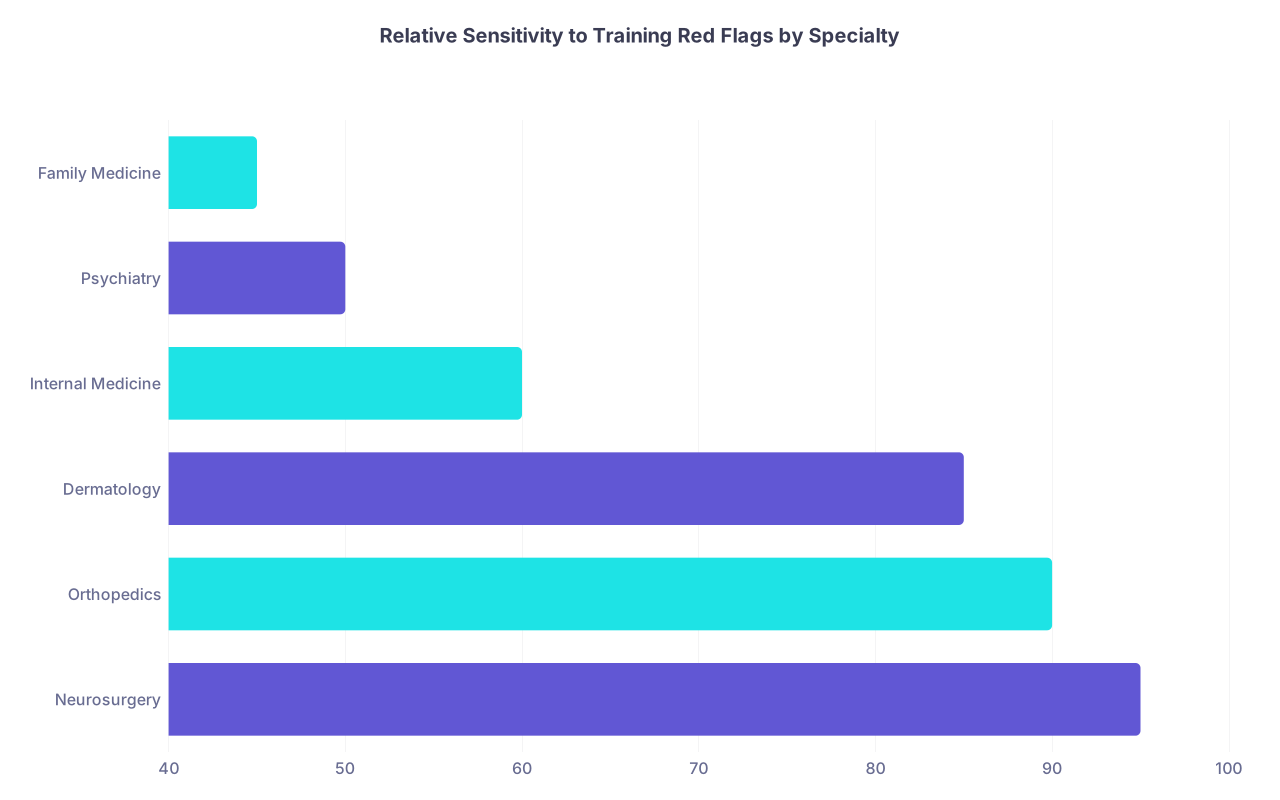
| Category | Value |
|---|---|
| Neurosurgery | 95 |
| Orthopedics | 90 |
| Dermatology | 85 |
| Internal Medicine | 60 |
| Psychiatry | 50 |
| Family Medicine | 45 |
High-intensity, small-field specialties (neurosurgery, ortho, ENT, derm) often have less patience for any perceived instability or remediation. That does not mean you cannot match there, but the bar is higher:
- Your post-transfer record must be nearly spotless.
- Your letters must be very strong.
- Your explanation must be razor-clean.
Broader-access specialties (IM, FM, psych, peds) can be more open, especially if your mid-career background obviously enriches the field (e.g., prior psych nursing going into psychiatry, long-term primary care PA going into FM).
Either way, your narrative should show why you are now fully aligned with this specialty and not still exploring.
Visualizing the Story You Are Telling
Here is the mental “timeline” you are trying to convey—cleanly, without chaos:
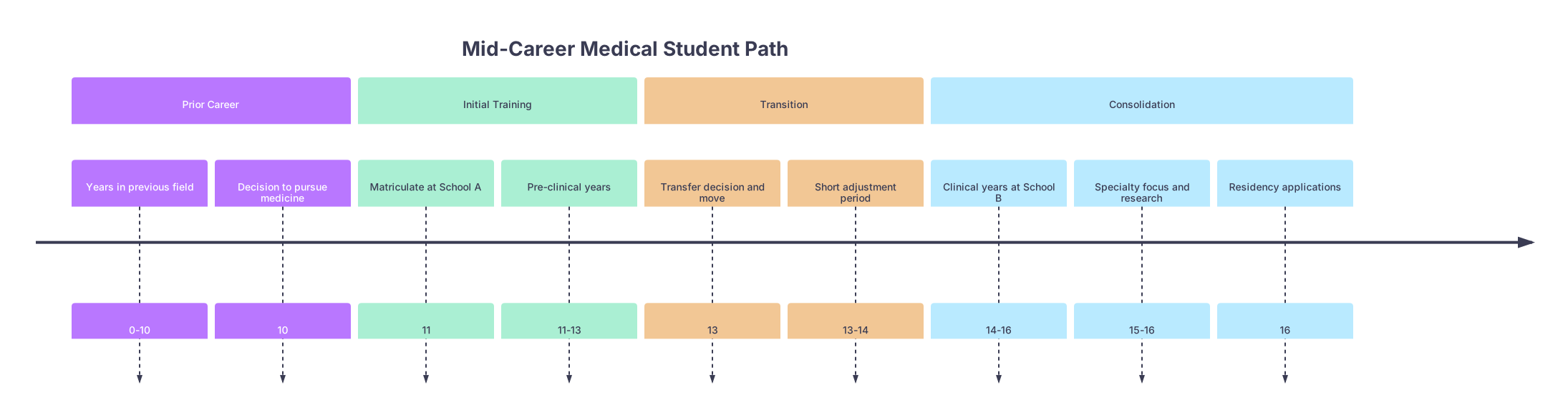
| Period | Event |
|---|---|
| Prior Career - Years in previous field | 0-10 |
| Prior Career - Decision to pursue medicine | 10 |
| Initial Training - Matriculate at School A | 11 |
| Initial Training - Pre-clinical years | 11-13 |
| Transition - Transfer decision and move | 13 |
| Transition - Short adjustment period | 13-14 |
| Consolidation - Clinical years at School B | 14-16 |
| Consolidation - Specialty focus and research | 15-16 |
| Consolidation - Residency applications | 16 |
No zigzagging back and forth. No repeated resets. One clear turn, then straight.
Final Refinements: What To Cut, What To Emphasize
Cut:
- Long grievances about the prior institution
- Detailed family medical sagas
- Overly dramatic language about “finally finding my true calling” at age 40
- Vague phrases like “personal reasons” without at least one concrete anchor (geography, caregiving, accreditation)
Emphasize:
- Stability after the transfer: consistent performance, same specialty interest
- Concrete skills from prior career applied in clinical settings
- Maturity: insight about your own learning style, limitations, and how you improved
- A forward-looking tone: what you want to contribute in residency, not what happened to you in the past

A Quick Reality Check: When the Story Is Not Fixable on Paper Alone
Some situations cannot be cleaned with framing alone:
- Multiple failed courses after the transfer
- Repeated professionalism citations across two schools
- Inconsistent specialty interest, repeatedly changing targets every few months
- No clear reason for transfer and no performance improvement
If that is you, narrative polish is not the first step. You need:
- Explicit, honest advising from your dean’s office about competitiveness
- Possibly a broader specialty list, including prelim/transitional options
- A longer runway: research years, extra clinical experiences, or smaller programs where people know you personally
Sometimes the most honest, mature move is to adjust your target, not your story.
Key Takeaways
- A mid-career transfer is not automatically fatal, but if you do not explain it clearly and calmly, programs will assume the worst. One sentence reason, one sentence “no disciplinary issues” (if true), then move on to your growth and current performance.
- Your post-transfer record must validate your story. Improvement, stability, and aligned specialty interest matter more than whatever went wrong or changed earlier.
- Use your prior career and the transfer to show maturity and resilience, not instability. Concrete examples of reliability, self-awareness, and strong clinical work are what turn a potential red flag into “this is actually an adult I trust on my team.”