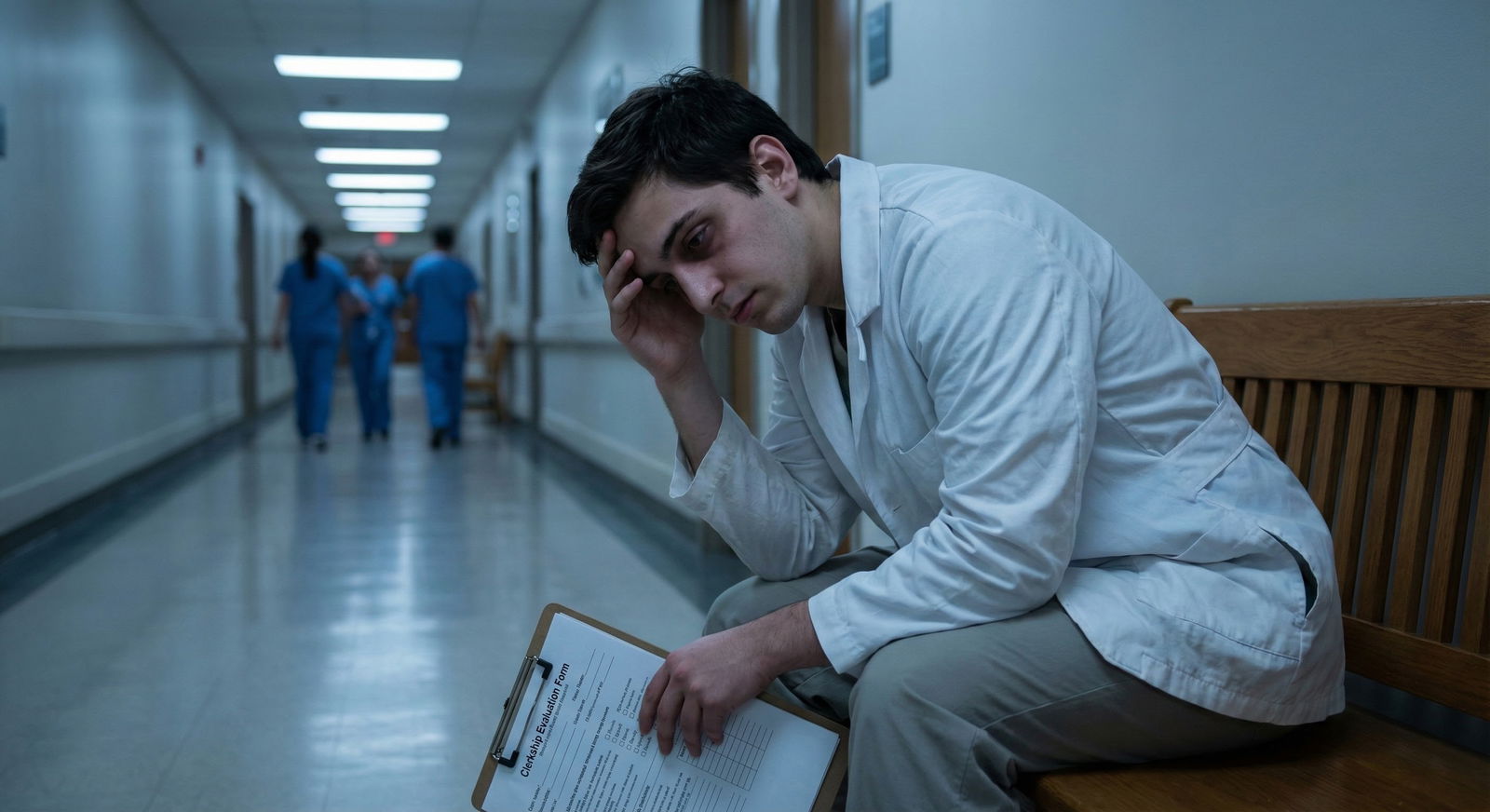
Failing a clerkship does not automatically make programs think you’re toxic.
But I know that’s not what your brain is telling you right now.
Your brain is probably going:
“I failed a clerkship → attendings think I’m a disaster → my MSPE will destroy me → PDs will assume I’m unsafe, lazy, and impossible to work with → no one will rank me → I won’t match → my career is over.”
I know that loop. It’s miserable. Let’s rip it apart piece by piece and be brutally honest about what this actually means for residency.
What programs really see when they see a failed clerkship
Here’s the part that feels unfair: a single word on a transcript—“Fail,” “Unsatisfactory,” “Repeat”—suddenly feels bigger than four years of work.
Programs don’t see “perfect context.” They see:
- Your transcript
- Your MSPE narrative
- Your letters
- Your personal statement
- Your Step/COMLEX scores
- Your interviews
A failed clerkship is a red flag, yes. But red flags aren’t “automatic death.” They’re “this needs an explanation.”
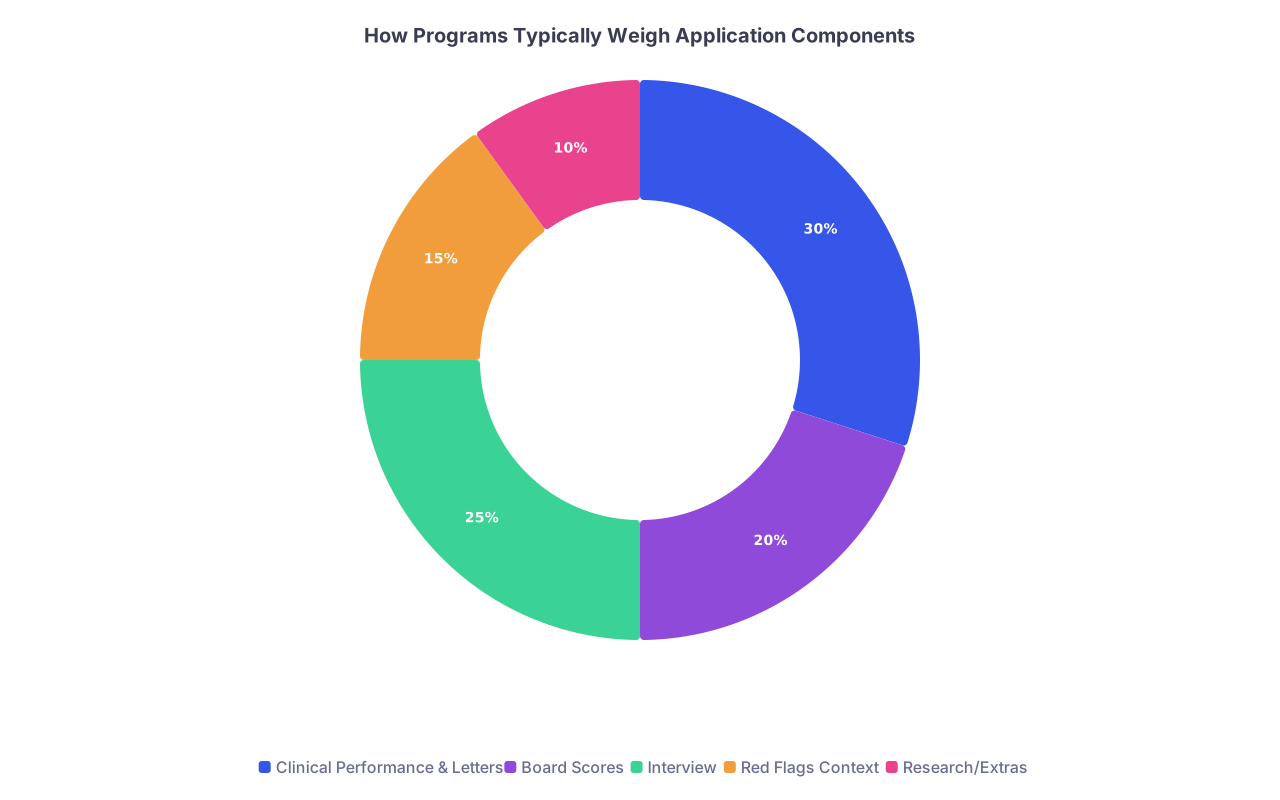
| Category | Value |
|---|---|
| Clinical Performance & Letters | 30 |
| Board Scores | 20 |
| Interview | 25 |
| Red Flags Context | 15 |
| Research/Extras | 10 |
The real question programs are asking isn’t “Is this person awful to work with?” It’s more like:
- Was this a one-off or a pattern?
- Was this about professionalism / behavior, or about knowledge / performance?
- What did the applicant do after this happened?
- Do other people (letters, MSPE, dean) vouch that this is not who they are?
If your brain is jumping straight to “They’ll assume I’m difficult,” that usually comes from one specific fear: that the fail is coded as a personality or professionalism problem instead of a skills, knowledge, or situational problem.
That distinction matters. A lot.
The nightmare scenarios your brain is inventing (and what’s actually true)
Let’s drag the worst fears into the light.
Fear #1: “They’ll think I’m a nightmare to work with.”
Programs don’t default to “this person is horrible.” They default to “what happened here?”
What actually shapes whether they see you as “difficult”:
- The narrative in the MSPE
- The language in clerkship comments
- Your letters of recommendation
- How you talk about it in your application and interview
If your fail came with:
- “Concerns about professionalism,”
- “Struggled with communication with staff,”
- “Difficulty incorporating feedback,”
…then yes, programs will flag that more heavily. Not because you’re doomed. But because those behaviors affect patient safety and team function.
If instead it was:
- Shelf score below cutoff
- Missed requirements (notes, logs, deadlines)
- Personal crisis that tanked your performance
That’s still serious, but it doesn’t automatically scream “unworkable.”
The key: your job is to control the narrative as much as you honestly can.
Fear #2: “One fail means they’ll see me as unsafe.”
Here’s the uncomfortable line: programs care more about patterns than single events.
One failed clerkship with:
- A clean repeat, passed on second try
- Solid performance in other rotations
- Strong letters saying you’re reliable
→ They’re curious, maybe cautious. But not automatically done with you.
Multiple issues like:
- More than one failed rotation
- Professionalism “concerns” in multiple settings
- Vague, defensive explanations
→ That’s when they start thinking about risk.
So if you’re sitting here with ONE failed clerkship and a bunch of passes/honors otherwise, your brain is probably catastrophizing way harder than most PDs actually would.
Fear #3: “My MSPE is going to betray me and make me look awful.”
The MSPE can feel like a trap because you don’t fully control it. Some schools are… blunt. Some are vague to the point of useless.
Here’s how most PDs read it:
- They skim for red flag phrases: “unprofessional,” “repeated clerkship,” “remediation,” “concerns.”
- They look for whether the tone is: “We were really worried” versus “This happened, they fixed it, we’re okay with them.”
- They cross-check against letters and your personal statement.
If your dean’s office is supportive, they’ll often phrase things like:
“Required to repeat clerkship due to difficulty meeting expectations in X; successfully remediated with improved performance noted in Y.”
That reads very differently from:
“Multiple professionalism concerns, including conflicts with staff and failure to complete patient care responsibilities.”
Same fail. Totally different signal.
If you haven’t already, you need to talk to someone in student affairs and literally ask:
“How is this clerkship failure going to be described in my MSPE, and is there any context you can include about my improvement?”
Yes, it’s terrifying to ask. Do it anyway.
What actually makes “difficult to work with” a real concern
Programs start seriously worrying about “difficult to work with” when they see:
- Documented professionalism lapses: lateness, missing shifts, disrespect, making others uncomfortable.
- Comments like “resistant to feedback,” “argued with staff,” “struggles to function on a team.”
- Patterns of blaming others or refusing to accept responsibility.
- Multiple red flags: failed clerkship + poor narrative + weak letters.
Failing because you bombed a shelf, weren’t efficient, or were overwhelmed doesn’t automatically land you in this category.
Let me be harsh for a second:
If your failure was related to behavior or professionalism, the problem isn’t that programs will see it.
The problem is whether you actually changed.
If you:
- Reflected honestly
- Got specific feedback
- Made concrete changes
- And can point to later rotations where staff saw improvement
…then this becomes a story of growth, not permanent condemnation.
If you’re still certain “it was all their fault and they were out to get me,” then yeah, that will leak into interviews and that’s when PDs think, “This might be a problem.”
Can one failed clerkship sink my chances? The painful but honest answer.
It can hurt you. It will close some doors. But it doesn’t have to close all of them.
Think in terms of specialties and program types.
| Program Type | Impact of Single Failed Clerkship |
|---|---|
| Highly competitive specialty (Derm, Ortho, Plastics) | Significant red flag, often screening out unless strong explanation & connections |
| Mid-competitive university programs | Case-by-case; strong overall app and honest narrative can offset |
| Community programs (IM, FM, Peds, Psych) | Usually more flexible, especially with convincing growth story |
| Home institution program | Often knows the full context; sometimes more forgiving |
| Completely new region with no connections | More reliant on paper app; red flag carries more weight |
If you failed:
- Surgery but want FM → more survivable.
- IM but want Derm → you already know the answer.
You may not have the same luxury of “shooting your shot everywhere.” You might need to be more strategic:
- More community programs
- More geographic spread
- More realistic choices given your record
That’s not your career ending. That’s your path changing.
How to talk about a failed clerkship without making it worse
You can’t hide it. You shouldn’t overexplain it. You need a tight, honest, non-defensive explanation that hits three things:
- What happened (briefly, no drama).
- What you learned.
- How you changed, with proof.
Think structure, not script. Something like:
“On my [clerkship], I struggled with [specific issue: time management, clinical reasoning under pressure, personal crisis]. This led to [clear consequence: not meeting expectations / failing the shelf / needing to repeat the rotation].”
“I met with [clerkship director / dean] and got specific feedback on [2–3 concrete things]. I realized I needed to [specific changes].”
“Since then, I’ve [evidence: passed repeat with strong feedback, honored later rotation, have letter from attending highlighting improvement]. I’m grateful it forced me to confront this early, instead of as an intern when the stakes are higher.”
That’s it. No ranting about unfairness. No 10-minute monologue in an interview. No vague “I just had a lot going on.”
If there was a legitimate personal/medical crisis, you can say just enough to give context without oversharing:
- “I was dealing with a significant family/health issue at the time. I worked with student affairs and addressed it. I’m now stable and have performed consistently since.”
Residency programs don’t need your entire therapy session. They just need to know you’re not walking into internship as an unpredictable risk.
The quiet power of strong letters after a failure
Letters can absolutely rescue the narrative.
One fail with:
- A repeat clerkship where the attending writes, “They took feedback seriously and made dramatic improvement. I’d be happy to work with them as a resident.”
- Later rotations (especially in your chosen specialty) where people describe you as “hardworking, receptive to feedback, great team member.”
…tells a very different story from:
- Generic, lukewarm letters.
- No one willing to stick their neck out for you.
If you failed, you almost need at least one letter that subtly or explicitly counters the “difficult to work with” fear.
You can ask directly (terrifying, I know):
“Given my prior difficulty on [clerkship], I’m trying to show programs that I’ve grown and that I work well on teams. Do you feel you can comment on that in a letter?”
If they hesitate? Don’t chase that letter. That hesitation is an answer.
What you should be doing right now if you failed a clerkship
Let’s get out of the spin and into actual steps.

| Step | Description |
|---|---|
| Step 1 | Failed Clerkship |
| Step 2 | Meet with Student Affairs |
| Step 3 | Clarify MSPE Language |
| Step 4 | Plan Future Rotations Strategically |
| Step 5 | Secure Strong Letters Emphasizing Growth |
| Step 6 | Draft Brief, Honest Explanation |
| Step 7 | Discuss Specialty & Program List Realistically |
You should, today or this week:
Meet with student affairs / your dean
Ask:- How exactly will this be written in my MSPE?
- Can you include mention of my improvement/remediation outcome?
- Given my record, what specialties and program types are realistic?
Look hard at your clerkship evaluations
Ask yourself:- Is there a theme? (organization, communication, knowledge gaps, attitude?)
- Where have I already improved? Where do I still need help?
Identify potential letter writers who’ve seen the “post-fail” version of you
Aim for:- People who saw you handle feedback well
- Attendings who supervised you closely
- Ideally someone who knows about your setback and saw you recover
Draft your 3–4 sentence explanation (for personal statement / interviews)
Not to submit yet. Just to get it on paper. Then revise until it’s boringly honest, not emotionally explosive.Adjust your specialty and program list based on reality, not wishful thinking
This one hurts. But it’s better than mass rejection and scrambling.
You are not the only one
There are residents right now who:
- Failed a surgery clerkship and matched IM.
- Failed IM and matched FM.
- Had professionalism flags and, after serious work, convinced programs to take a chance on them.
I have literally heard PDs say in meetings:
- “They had a rough clerkship year but really pulled it together.”
- “The fail worries me a bit, but their letters and interview were solid.”
- “I’m okay with one red flag if everything else lines up.”
And yeah, I’ve also heard:
- “Two failed clerkships and weird comments in the MSPE. I don’t want to deal with that.”
- “They were very defensive about their evaluation. I’m not comfortable ranking them.”
You can’t undo the failure. But you can decide which bucket you end up in.
FAQ: Failing a Clerkship & Being Seen as “Difficult”
1. Should I bring up the failed clerkship in my personal statement?
Sometimes. If it’s your only major red flag, a short, clear paragraph showing insight and growth can help. If your PS is already overloaded or you’ve addressed it in a secondary/other section, you can save the deeper explanation for interviews. Just don’t pretend it never happened—programs will see it in your MSPE.
2. What if my fail was 100% due to a terrible attending or unfair situation?
You can mention context briefly (“There were significant conflicts on the team”), but if you sound like you’re blaming or attacking, it backfires. Programs don’t know your attending. They know you. Focus on what you learned, how you adapted, and what’s different now. You can acknowledge difficulty without turning it into a rant.
3. Is failing a clerkship worse than a low Step score?
They’re different kinds of problems. A low Step is a test performance issue. A failed clerkship might signal problems with clinical work or professionalism. Many PDs are more spooked by behavior/clinical concerns than by a bad test day. That’s why your job is to show clearly that this was a performance/learning curve issue you’ve outgrown—not an ongoing attitude or reliability problem.
4. Should I avoid mentioning the fail unless directly asked in interviews?
Don’t open every interview with “Hi, I failed a clerkship,” but be prepared. If they don’t bring it up at all, that’s unusual but possible. If they do, you want a calm, rehearsed, honest explanation. No rambling. No oversharing. If there’s a natural place to mention how you grew from a setback (like a “tell me about a challenge” question), that can be a smart way to proactively frame it.
5. How many programs should I apply to if I have a failed clerkship?
More than the “average applicant” in your specialty. For core fields (IM, FM, Peds, Psych), that might mean 40–60+ instead of 20–30. For more competitive fields, you may need a parallel backup plan (like applying to IM or prelim years as well). The exact number depends on your other metrics—talk to your dean with your full profile in front of them.
Open a blank document right now and write the 3–4 sentence explanation you’d give a PD about your failed clerkship—no excuses, no self-destruction, just honest facts and growth. Then read it out loud and ask yourself: “Does this sound like someone I’d trust as a future intern?” If not, revise until the answer is yes.