
It’s 1:12 a.m. You’re staring at your school’s email that says something like “Committee on Student Promotions Decision: Academic Probation.” You’ve already read it 18 times, but your brain keeps looping on one phrase: “may be reported to residency programs.”
And now your mind won’t shut up.
“I’m screwed.”
“No competitive specialty will touch me.”
“Why would anyone rank me when they have people with clean records?”
“Should I just give up on [derm/ortho/neurosurgery/ENT/whatever you love] now?”
Let’s just name it: academic probation feels like a scarlet letter. Especially if you’re eyeing a competitive field. You know programs are risk‑averse. You know they have a stack of applicants with 260s and honor cords and leadership titles that sound fake.
You? You have a formal blot on your record.
So here’s the real question you’re terrified to ask out loud:
Can you still match into a competitive field after academic probation?
Yes. Not easily. Not by accident. And not everywhere.
But yes.
Let me walk through this like I’m sitting next to you in an empty study room, because the worst part right now is you probably feel alone and radioactive.
First: What “Academic Probation” Actually Signals to Programs
Programs don’t all think the same way, but they’re reading that line in your MSPE with a few default assumptions loaded.
In their heads, academic probation = one or more of:
- You struggled to meet basic academic standards
- You might not pass Step/Level exams
- You might not be reliable under pressure
- You could be a “project” instead of plug‑and‑play
Cold? Yes. But that’s honestly how most PDs and selection committees frame it at first glance.
What they don’t know (until you explain it) is:
- Was it one failed course or multiple?
- Step failure? Shelf failures?
- Life blew up? Mental health crisis? Family tragedy?
- Did you bounce back or barely limp through?
Competitive fields—derm, ortho, plastics, ENT, neurosurgery, urology, radiation oncology, certain IM fellowships pipelines—are already swimming in people with spotless records. So your red flag stands out even more.
But here’s the catch: committees also love a good redemption arc. What they can’t stand is chaos that never gets resolved. They don’t need perfection as much as they need evidence that the problem is identified, fixed, and unlikely to reappear.
So probation doesn’t automatically end your shot at a competitive field. It just means the burden of proof is now on you. You must prove:
- The problem is clearly understood
- It won’t happen again
- You’re actually stronger because you faced it
The Awful But Honest Question: “Is My Dream Specialty Still Realistic?”
I know this is the part that keeps you spiraling at 3 a.m.
Let me be blunt and then fair.
Academic probation does not hit all specialties equally.
| Specialty Level | Impact of Probation | Realistic? With Strong Recovery |
|---|---|---|
| Ultra-competitive (derm, plastics, ortho, ENT, NSGY) | Major red flag | Possible but limited programs |
| Competitive (gas, rad onc, EM, urology) | Significant concern | Yes at many mid‑range programs |
| Moderately competitive (IM at strong academic centers, OB/GYN, anesthesia community) | Noticeable but workable | Yes with clear upward trend |
| Less competitive fields (FM, psych, peds, path) | Manageable | Often yes across many programs |
This is not absolute. I’ve seen:
- Someone with probation from failing pre‑clinical courses match neurosurgery at a mid‑tier program because they crushed Step 2 and had serious research.
- A student on probation for a Step 1 failure match ortho after a 260+ Step 2 and two full gap years of research and glowing letters.
- And I’ve seen people with probation not match into relatively less competitive fields because the probation was part of a larger pattern: late exams, professionalism issues, multiple failures, vague explanations.
So here’s the boring, painful, necessary task:
You have to honestly put yourself in one of three buckets:
- Probation for limited, contained academic issues with strong evidence of rebound (high Step 2, solid clerkship evals, no other flags).
- Probation for bigger or repeated academic problems, but you’ve taken major corrective actions and have a clear narrative.
- Probation plus other red flags (Step failures, repeated remediation, professionalism issues, leaves of absence, scary MSPE language).
Bucket 1? Competitive field is still in play, but you’ll have to be strategic and realistic about tiers and geography.
Bucket 2? You might still aim for a competitive area, but you need a Plan B specialty you’d actually be okay training in.
Bucket 3? Going all‑in on an ultra‑competitive field is usually self‑sabotage. You can want it, but match data will not be kind.
Read that again: this is about being strategic, not giving up.
What Programs Actually Want to See After Probation
They’re not looking for a perfect sob story. They’re looking for control and trajectory.
Here’s what moves the needle:
1. A clean, sustained rebound
You want your record after probation to look like someone slammed a switch:
- No more course failures
- Passing shelves (ideally above average)
- Solid or improving clinical evaluations
- Strong Step 2 or Level 2 (this really matters)
Program directors are pattern‑seekers. If your graph looks like:
Bad semester → probation → then a long clean runway of solid performance, that’s defensible.
If it looks like:
Bad semester → probation → okay-ish → more minor issues → leaves of absence → late exams—
They see a risk.
2. Step 2 / Level 2 COMLEX: your redemption exam
Probation + mediocre board scores = tough road for competitive fields. Period.
Probation + strong Step 2 score? Now your story shifts from “struggler” to “late bloomer who figured it out.”
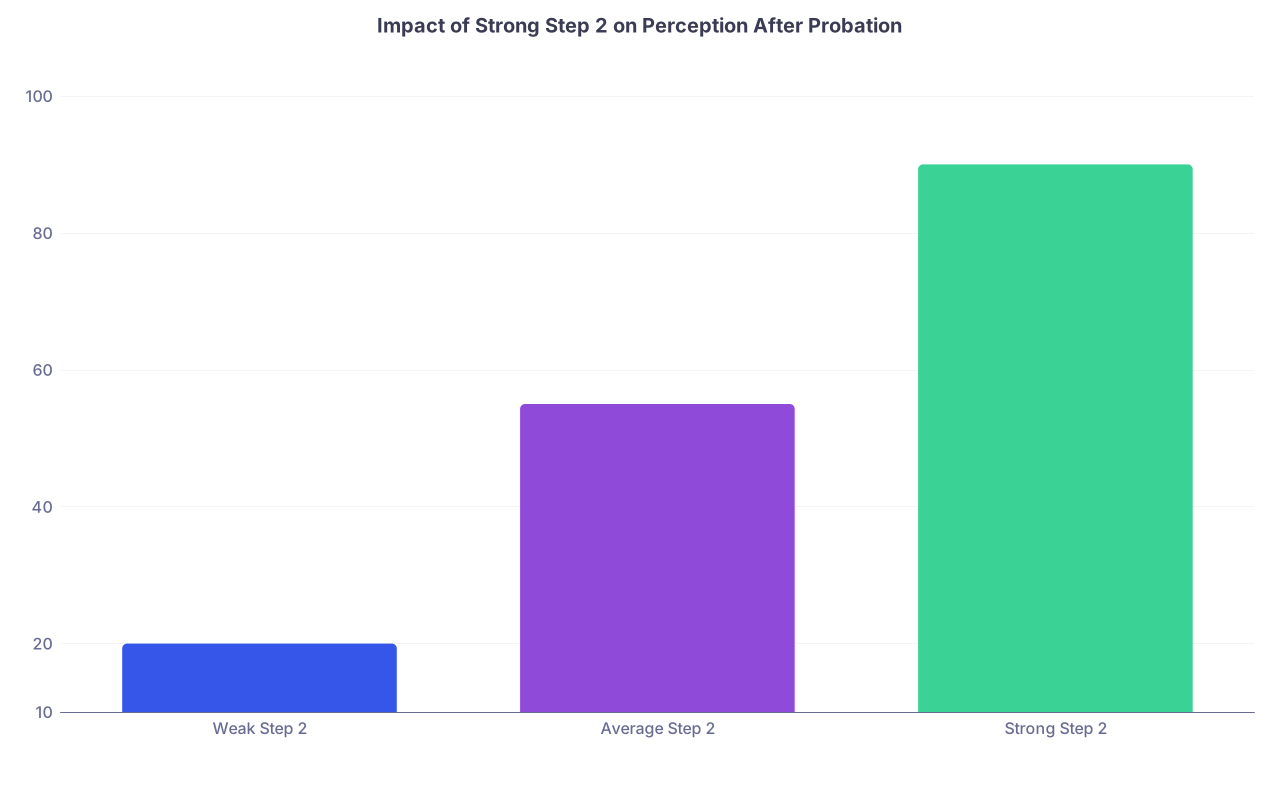
| Category | Value |
|---|---|
| Weak Step 2 | 20 |
| Average Step 2 | 55 |
| Strong Step 2 | 90 |
Think of those numbers as “how comfortable a typical PD feels” (out of 100) taking a chance on you. Not scientific, but it tracks with how conversations in selection meetings actually sound.
If you’re still pre‑Step 2, your absolute top priority is to destroy that exam.
3. Departmental advocates in your chosen field
For competitive fields, you need people inside the specialty who are willing to say, “Yes, they had a stumble. I’d still take them.”
That means:
- Doing rotations with the department
- Working closely with attendings who actually know your work
- Being the dependable, early, prepared, not‑on‑your‑phone student
- Getting specific letters that address your growth, not generic fluff
The gold standard is something like:
“X had academic probation early in medical school after failing [course], which they’ve been open and reflective about. Since then, I’ve supervised them over 8 weeks on our service. They consistently performed at or above the level of our average Sub‑I, handled high‑stress situations maturely, and took ownership when things went wrong. I have no concern this prior issue will repeat in residency.”
That kind of letter neutralizes a lot of fear.
4. A narrative that’s honest but not messy
You can’t hide probation. Programs see it in the MSPE. Trying to dance around it just makes it worse.
You need a tight, clear explanation that hits:
- What happened
- Why it happened (without 10 layers of drama)
- What you did to fix it
- Evidence the fix worked
- Why it matters for residency
Something like:
“During second year, I was placed on academic probation after failing [course/block]. I struggled with [specific issue—time management, test‑taking, untreated ADHD, family crisis], and I didn’t recognize how far behind I’d fallen until it was too late. After this, I met regularly with [academic advisor/learning specialist], changed my study methods, and addressed [mental health/diagnosed issue] with professional support. Since then, I’ve passed all subsequent courses and clerkships on the first attempt, improved my standardized test performance, and demonstrated reliability in clinical settings. This experience forced me to build systems that I now rely on daily, especially in busy rotations like [X].”
Short. Concrete. Borders drawn.
Strategy Shift: How You Apply Has to Be Different Now
You don’t get to be “just another applicant” anymore. You’ve got a file that will trigger extra scrutiny. So you have to out‑work the average applicant on strategy, not just effort.
Apply early. Like, actually early.
No “I’ll submit in mid‑October once I polish my personal statement for the 14th time.”
You’ve lost the luxury of timing sloppiness. Competitive fields? Your best odds are when your file is one of the first they review, before interview slots are tight and they start nitpicking.
Over‑apply (within reason)
Yes, it’s expensive. Yes, it sucks.
But if you’ve got probation and you’re targeting a competitive specialty, applying to only 30 programs “because my scores are solid” is playing chicken with the Match.
For truly competitive specialties after a red flag, it’s normal to see 70–100+ applications. Plus a real backup plan (another specialty you apply to at the same time, not as a day‑before‑rank‑list panic move).
Lean hard on away rotations (if your field uses them)
For things like ortho, ENT, neurosurgery, derm, EM—away rotations are currency. They let programs see you as a person instead of a PDF with “Academic Probation” stamped in it.
Away rotations are where:
- You make someone willing to pick up the phone for you
- You can make your narrative real: they see your work ethic, not just your explanation
- You prove you’re not a risky mess, you just had one bad chapter
Be that student who shows up early, knows their patients cold, reads, and is normal to be around at 2 a.m.
The Part No One Wants to Talk About: When To Pivot
Sometimes the anxiety isn’t lying. Sometimes the dream specialty really isn’t the best play right now.
Here’s where I’ve seen people get hurt: they cling to the most competitive specialty on earth with a messy record and then act shocked on Match Day when they go unmatched.
You need to separate two questions:
- “What specialty would I love in a perfect, clean-record world?”
- “Given the actual file I have, where can I realistically build a good, stable, meaningful career?”
Those are not always the same answer. That doesn’t mean you’ve “failed life.”
I’ve seen:
- A student with probation and two shelf failures not match ENT, pivot into IM, crush residency, and then do a competitive fellowship that gave them some of what they wanted from ENT anyway.
- Someone with a Step failure + probation give up on ortho, go into PM&R, and later land a sports and spine practice that scratched the same itch.
- And yes, people who stubbornly aimed at derm with a red-flagged transcript and ended up scrambling into a prelim year with no categorical spot, burned out and furious.
Sometimes the bravest move is not doubling down on the hardest possible road.
A Quick Reality Check vs. Catastrophic Thinking
Your brain right now is probably saying absolutely wild things:
“I’ll never match anywhere.”
“No one will ever trust me as a doctor.”
“Program directors sit around laughing at people like me.”
No.
Here’s a more accurate, uncomfortable but not-doomsday version:
- Some programs will auto-screen your file out solely because of probation. You’ll never hear from them.
- Some will be cautious but open, if the rest of your app screams growth and reliability.
- A few will actively appreciate your resilience, especially if they’ve had residents who crumbled the first time they failed anything.
You’re not applying as a blank slate anymore. You’re applying as the person who was hit early, faltered, and then chose to rebuild anyway.
There are PDs and faculty who respect that more than the “perfect” CV.
Mini Timeline: What To Do From Probation to Match
Just to anchor your brain a bit, here’s a rough sequence.
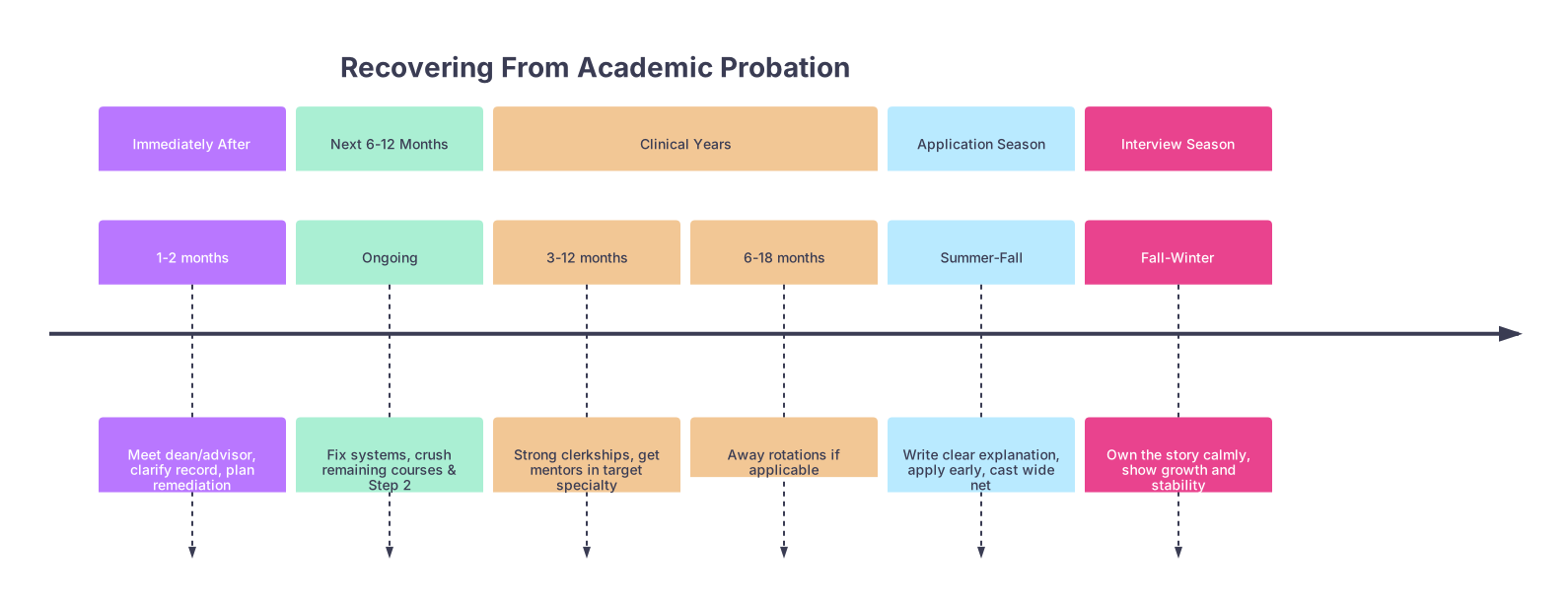
| Period | Event |
|---|---|
| Immediately After - 1-2 months | Meet dean/advisor, clarify record, plan remediation |
| Next 6-12 Months - Ongoing | Fix systems, crush remaining courses & Step 2 |
| Clinical Years - 3-12 months | Strong clerkships, get mentors in target specialty |
| Clinical Years - 6-18 months | Away rotations if applicable |
| Application Season - Summer-Fall | Write clear explanation, apply early, cast wide net |
| Interview Season - Fall-Winter | Own the story calmly, show growth and stability |
How to Talk About Probation in Interviews Without Crumbling
This is the part that makes people want to throw up.
You know they’re going to ask:
“So tell me about this academic probation noted in your MSPE.”
You cannot:
- Ramble for 7 minutes
- Start crying (it happens; if it might for you, practice a ton)
- Blame everyone else
- Say “I just wasn’t motivated then” (massive red flag)
- Get defensive or weirdly vague
You’re aiming for ~60–90 seconds, max. Calm. Steady. Rehearsed but not robotic.
Blueprint:
- Briefly state what happened.
- Briefly explain the key underlying cause.
- Describe concrete actions you took.
- Point to evidence that the problem is fixed.
- Tie it to how you’ll function as a resident.
Example:
“During my second year, I was placed on academic probation after failing our [systems/path block]. I’d been trying to manage a family crisis at home and didn’t adjust my study approach or ask for help until I was too far behind. After that, I met regularly with our learning specialist, changed how I structure my study time, and got support for my anxiety which I’d been ignoring. Since then, I’ve passed all courses and clerkships on the first try, improved my standardized exam scores, and my clinical evaluations highlight my reliability. It was a low point, but it forced me to build the habits and support network I now use to stay organized and steady, especially during busy rotations like ICU and surgery.”
Then stop. Let them ask follow‑ups if they want.
FAQ (Exactly 4 Questions)
1. Is academic probation automatically disqualifying for ultra‑competitive specialties like derm or ortho?
Not automatically, but it makes an already brutal process even harsher. If your probation was early, contained, and followed by a sustained, very strong upward trajectory (excellent Step 2, honors in clinical rotations, research, and strong letters from the specialty), you can still match—just not broadly. You’ll need to be extremely strategic, apply widely, likely have a backup specialty, and accept that some top programs will screen you out no matter what.
2. Should I mention academic probation in my personal statement?
If it’s clearly mentioned in your MSPE (it usually is), pretending it doesn’t exist makes you look evasive. A short, direct paragraph in your personal statement that acknowledges it, explains the core issue, and focuses on growth can help you control the narrative. Don’t turn your whole personal statement into a probation essay. A focused, 3–5 sentence acknowledgment is usually enough, with more detail reserved for interviews and secondary questions that specifically ask about any academic issues.
3. How do I know if my school’s description of my probation will tank my application?
Ask to see your MSPE wording early. Sit down with your dean or advisor and read exactly what’s written. If the language sounds vague, harsh, or like a character judgment instead of a factual description, advocate—politely but firmly—for clarifying edits. Deans don’t always realize how certain phrases land with program directors. You can’t erase history, but you can push for wording that’s accurate, specific, and not needlessly alarming.
4. What if my probation was for non‑academic issues, like professionalism or behavior?
That’s often harder to overcome than pure academic probation. Programs can accept someone who struggled with content or test‑taking more easily than someone flagged for unprofessional conduct, dishonesty, or boundary issues. It doesn’t mean you’re doomed, but your explanation and subsequent behavior need to be rock solid. You’ll want strong letters specifically vouching for your professionalism, reliability, and integrity, and you may need to recalibrate your specialty choice more than someone whose probation was purely academic.
Years from now, you won’t remember the exact wording of the probation email or how nauseous you felt reading it. You’ll remember whether you used this as a breaking point or a turning point.