
Your withdrawals will not magically disappear. You either control the story, or they control you.
If your transcript looks like a battlefield of W’s, dropped courses, or leaves of absence, you’re not imagining it: programs will notice. Some will shrug. Some will care a lot. A few will toss your application aside because they think “unreliable” and move on.
You cannot fix that. But you can do two things:
- Stop making it worse.
- Present it so a reasonable PD thinks, “Okay, that makes sense, and I can trust this person now.”
Let’s walk through how.
1. What Program Directors Actually Think When They See W’s
I’ve heard this in conference rooms, behind closed doors, while scrolling ERAS on a projector.
Common reactions:
- “What happened here?”
- “Is this someone who bails when it’s hard?”
- “Is there a health or professionalism issue?”
- “Have they grown out of this, or is this still ongoing?”
They are not counting every W like it’s a felony. They’re looking for patterns.
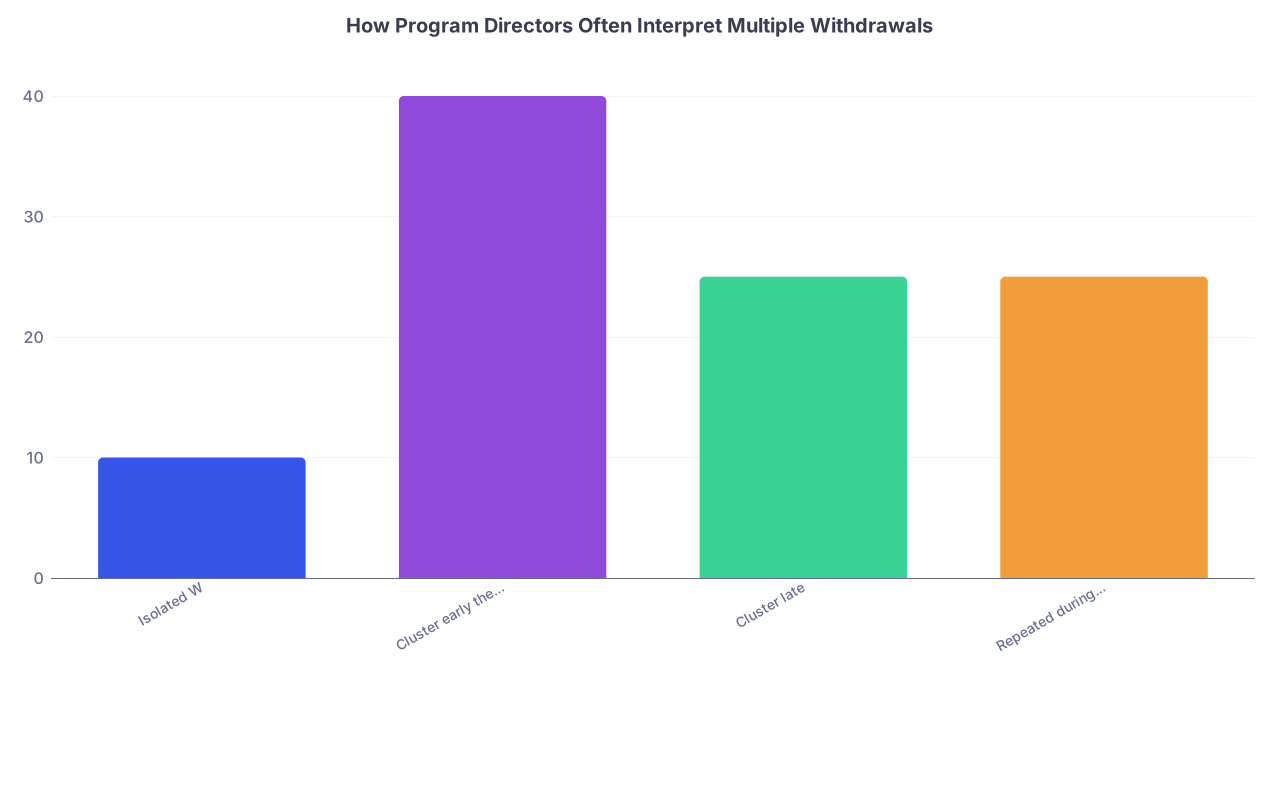
| Category | Value |
|---|---|
| Isolated W | 10 |
| Cluster early then clean | 40 |
| Cluster late | 25 |
| Repeated during clerkships | 25 |
Roughly how I’ve seen discussions break down:
- One isolated W, early pre-clinical: usually ignored.
- A heavy cluster in M1–M2, then clean M3–M4: concern → “maybe they grew.”
- Multiple W’s late (M3/M4) or during core rotations: red flag for reliability, resilience, or health.
- Ongoing pattern every year: big concern for consistency, risk during residency.
They worry about:
- Will you show up for 28-hour calls?
- Will you crumble on busy services?
- Are you going to take “sick” days every week?
- Will they need to scramble for coverage because you withdrew from life mid-year?
Your job is to answer those questions head-on, not pretend the W’s are invisible.
2. First Step: Diagnose Your Own Pattern Honestly
Before you write a single sentence, actually map out what happened. Not the story in your head. The timeline.
Do this on paper or in a doc, month-by-month or block-by-block.

| Step | Description |
|---|---|
| Step 1 | Print/Review Transcript |
| Step 2 | Mark Each Withdrawal |
| Step 3 | Note Reason Beside Each W |
| Step 4 | Growth Story |
| Step 5 | Stability & Recovery Proof |
| Step 6 | Unified Cause & Resolution |
| Step 7 | Pattern? |
Ask yourself:
- Are they mostly in one bad semester/year?
- Did they cluster around a life event? (parent’s illness, your own illness, divorce, visa problems)
- Do they disappear after a certain point? Or continue sporadically?
- Do they correlate with certain course types? (heavy-science, clinical, call-heavy rotations)
Write a blunt one-line summary for your pattern. Examples:
- “I had 4 withdrawals during M1 related to untreated depression; after treatment, there were no further W’s.”
- “I withdrew from 2 clerkships and 1 elective in M3/M4 due to escalating caregiving demands at home; once we arranged external care, my performance stabilized.”
- “I repeatedly withdrew from heavy-load semesters because I overcommitted and panicked; after structured planning and mentorship, I completed my last 2 years without withdrawing.”
If your summary sounds like an excuse, you’re not ready. Rework it until it sounds like ownership plus change.
3. The Line Between Explanation and Excuse
Programs are fine with context. They are allergic to deflection.
This is the difference:
Excuse-style
“Due to the difficulty of the coursework and several unfair exams, I had no choice but to withdraw from multiple classes.”
Explanation-with-accountability
“During my first year, I struggled with untreated anxiety and poor time management. I responded with multiple course withdrawals instead of seeking help earlier. Since engaging with counseling, adjusting my course load proactively, and using structured study schedules, I’ve completed all subsequent coursework and rotations without withdrawing.”
You want:
- Short context (what happened)
- Direct ownership (what you did wrong or could’ve done earlier)
- Concrete change (what you did to fix it)
- Verifiable stability (what’s been clean since then)
Avoid:
- Blaming professors, administration, or “toxic culture” as the main villain
- Over-sharing trauma details no one needs to know
- Making it sound like it could easily fall apart again next month
4. Where To Explain: PS, Experience Sections, or Dedicated Statement?
You have a few tools. Use them strategically, not all at once.

A. Personal Statement (Primary Location for Most)
If your withdrawals are a major pattern, the personal statement is usually where you take control of the narrative.
But do not turn your entire PS into a withdrawal story. You get maybe 1 paragraph—sometimes just 3–6 sentences.
Template you can adapt:
In my first year of medical school, I withdrew from several courses while struggling with [brief issue: e.g., untreated depression/family crisis/poor coping strategies]. At that time, I responded to stress by stepping away instead of seeking help and adjusting my approach. Over the following [time frame], I worked with [counselor/dean/mentor] to [treatment/skills]. Since then, I’ve completed [X years/clerkships/electives] without withdrawals, including [short concrete examples of demanding rotations], and have consistently [shown up/kept up/earned solid evaluations]. That period reshaped how I handle stress and ask for support, and I now bring those habits into every team I join.
Short, owned, forward-looking.
B. ERAS “Education Experiences” / “Interruption” Section
If there was an official leave of absence or a formal interruption, use the specific ERAS section where schools expect that explanation. That’s exactly what it’s for.
Be more clinical and less narrative here:
Medical school enrollment was interrupted from 08/2020–01/2021 due to a mental health condition. I received treatment and returned to full-time enrollment in 02/2021. Since returning, I have completed all coursework and clerkships without further interruption.
No drama. No paragraphs of backstory. Just facts + stability.
C. Disability / Health / Very Sensitive Issues
If your withdrawals are tied to:
- Serious mental illness
- Disability
- Pregnancy complications
- Legal issues
- Trauma
You do not need to give graphic or deeply personal detail. Programs need:
- A high-level diagnosis or category if you’re comfortable (“mental health condition,” “chronic illness,” “family emergency”)
- Reassurance about current stability and management
- Evidence you can handle residency demands
If something is particularly sensitive (e.g., assault, suicidal hospitalization), consider:
- Briefly referencing it in PS or interruption section
- Offering, “I’m happy to provide further detail confidentially if needed,” and being prepared to discuss with a trusted faculty/PD if asked—not in an interview room with 6 faculty members.
5. Building the “Here’s Why You Can Trust Me Now” Case
Your explanation is worthless if it’s not backed by evidence.
You need to show, not just say, that the version of you who withdrew repeatedly is not the version sitting in front of them now.
Look at your record after the last W:
| Evidence Type | What Programs Look For |
|---|---|
| Clean transcript | No W’s after a certain date/phase |
| Strong clerkship evals | Phrases like “reliable,” “hardworking,” “handles stress well” |
| Increased responsibility | Chief roles, leadership in clinics, coordinator roles |
| Consistent work hours | Completed full schedules on demanding services |
You want to be able to say something like:
- “Since that time, I have completed 3 years without a single withdrawal, including demanding rotations such as [ICU, surgery, night float].”
- “My recent clerkship evaluations consistently mention reliability and resilience, which are areas I previously struggled with.”
- “I now meet regularly with [mentor/advisor] and maintain [X] hours per week for self-care, which has kept me stable during intensive rotations.”
If your post-W record is still shaky, then:
- You need to be even more specific about current supports (therapy schedule, disability accommodations, structured oversight).
- You should strongly consider a less competitive specialty or preliminary year to prove yourself reliably before aiming higher.
Brutal but true: if the “evidence of stability” section is empty, your words won’t save you.
6. How to Talk About Withdrawals in Interviews Without Sounding Defensive
You will get some version of:
“I see there were several withdrawals/interruptions in your training. Can you tell me about that?”
Here’s the structure you use. Think 60–90 seconds, not a TED talk.
- Briefly name the issue.
- State what you did wrong or what wasn’t working.
- Explain what changed and how.
- End with concrete proof and a forward-looking statement.
Example 1 – Mental Health:
During my first year, I had multiple withdrawals related to untreated depression. At the time, I tried to push through alone and then pulled out of courses when I became overwhelmed instead of asking for help. I eventually sought care, started therapy, and worked with the student affairs office to gradually increase my course load while using structured study schedules. Since then, I’ve completed all of my clinical rotations and the last two years of coursework without withdrawals, including ICU and surgery months. That experience forced me to build sustainable habits I now rely on, and I’m comfortable asking for support early if I feel myself slipping.
Example 2 – Family Caregiving:
My withdrawals clustered during my third year while I was the primary caregiver for a critically ill parent. I underestimated the impact of that role and tried to manage full-time clinical responsibilities and home care without enough backup. This led to withdrawing from two rotations. Eventually, I recognized that I needed more support, worked with my siblings to establish outside caregiving help, and coordinated with the school to reschedule rotations at a more sustainable pace. Since those changes, I’ve completed all remaining rotations and electives as scheduled. It taught me to be honest about my bandwidth and to plan proactively rather than reach a breaking point.
Example 3 – Poor Habits / Time Management:
Early on, I reacted to poor performance by withdrawing from courses rather than seeking help or adjusting my approach. That’s on me. I had to confront that pattern after a series of W’s. With guidance from our learning specialist, I shifted to using structured weekly planning, setting earlier deadlines, and meeting with faculty before problems became unmanageable. The result is that I haven’t withdrawn from a course or rotation in the last two years and I’ve handled call-heavy rotations without needing schedule changes. It completely changed how I respond to stress and feedback.
Notice the vibe: clear, calm, no begging, no blaming.
7. Getting Letters That Indirectly Reassure PDs About Your Past
You don’t need a letter that says, “This student has a ton of withdrawals but they’re fine now.” That would be a disaster.
You want letters that naturally counter the fears your transcript raises.
If your red flag is “bails when stressed,” your letters should scream:
- “Reliable”
- “Shows up early”
- “Stayed late”
- “Handled a heavy census without complaint”
- “Excellent follow-through”
If your red flag is “mental/physical health stability,” your letters should show:
- You functioned fully on demanding services
- You didn’t miss shifts
- You can work nights, weekends, call
Before asking for a letter, have a brief, adult conversation:
“I’m applying in [specialty]. Earlier in medical school, I had several withdrawals while I was struggling with [very brief context]. Since then, I’ve been stable and have completed my rotations without interruption. If you feel you can honestly comment on my reliability and performance on your service, I would be grateful for a strong letter.”
If they hesitate, find someone else. A lukewarm or coded letter hurts more than no letter from that person.
8. If You’re Still Early: Preventing More Damage Right Now
If you’re reading this during M1–M2 and you already have a few W’s: stop the bleeding first.
Some blunt advice:
- Do not keep stacking withdrawals thinking “I’ll explain it later.” At some point it becomes un-explainable.
- If you’re struggling with health or mental health, take one organized leave with a clear plan, not 7 scattered W’s over 3 years.
- Use formal support: student affairs, counseling, disability services, financial aid. Quiet suffering plus serial withdrawals is the worst combo.
If you’re about to withdraw again, ask yourself:
- Is this unavoidable (hospitalization, serious acute crisis)?
- Or is this me panicking because I’m behind?
If it’s panic/behind:
- Talk to course directors about remediation or incomplete instead of W.
- Ask if there is a structured study plan, tutoring, or extension option.
- Use this one as a test: can you struggle and still finish? Residency demands that.
9. When To Consider Specialty Strategy Adjustments
Multiple withdrawals won’t usually kill your chances everywhere, but they absolutely hit harder in ultra-competitive fields.
If your application has:
- Many W’s
- A leave of absence
- Plus: average scores and average letters
Then trying to match Derm, ENT, Ortho, or Plastics is asking for heartbreak.
You may need to:
- Pivot to a less competitive specialty where PDs are more open to “non-linear” paths (FM, IM, Psych, Peds in many places).
- Consider a transitional or prelim year to prove reliability and then reapply if you want up.
This is not “settling.” This is understanding risk. If your red flags are real, your safest anchor is a specialty and a program that value persistence and growth more than flawless transcripts.
FAQ (Exactly 3 Questions)
1. Should I mention my withdrawals even if the program doesn’t ask?
If you have only one or two isolated W’s early on, you do not need to highlight them. If you have a clear pattern (multiple W’s, LOA, or gaps), yes—address them briefly in your personal statement or the interruption section. Silence reads as avoidance. A concise, mature explanation reads as self-awareness.
2. How detailed should I be about mental health or personal crises?
Give enough detail to make the pattern understandable, but stop well before emotional oversharing. “Untreated depression,” “a serious family health crisis,” or “a chronic health condition” is usually enough. Then focus 80% on what you did to stabilize and what your track record looks like since, rather than lingering on the painful parts.
3. Can multiple withdrawals completely prevent me from matching?
Not by themselves. Applicants with messy transcripts match every year. The key is: a) no ongoing chaos—your recent record must look stable, b) a clear, owned explanation, and c) letters and performance that contradict the fear that you’re unreliable. You might need to recalibrate specialty choice or program tier, but you are not automatically shut out of residency.
Key Takeaways:
- Own the pattern, don’t minimize it, and describe how you’ve changed.
- Back your explanation with actual evidence of stability and reliability.
- Use every part of your application—PS, interruption section, interviews, letters—to consistently tell the same clear, grown-up story.