
The worst thing you can do with early academic trouble is pretend it’s a footnote. It’s not. It’s the spine of your residency application story for the next three years—if you handle it right.
You’re not “a student who had some issues first year.” You’re building a clear, chronological narrative: “I had a problem. I fixed it. Here is three years of proof.”
Here’s how that looks, step by step, over three full years.
Big Picture: Your Three-Year Recovery Arc
At this point you should stop thinking in semesters and start thinking in arcs.
You have three phases:
- Year 1 – Stabilize and Diagnose
- Stop the bleeding. No new failures. No new flags.
- Document what went wrong and what changed.
- Year 2 – Prove Reliability on the Big Stages
- Crush clinicals.
- Turn board performance from red flag to at least neutral.
- Year 3 – Package the Turnaround
- Make your application scream “upward trend.”
- Control the narrative in every component: MSPE, LORs, PS, interviews.
We’ll go month‑by‑month for the first year, then zoom out slightly for Years 2 and 3 while still keeping a “by this point you should…” structure.
Year 1: Stabilize and Diagnose (Right After the Trouble)
Assume you’ve just had:
- A failed course
- A repeated preclinical block
- A failed shelf
- Or ugly early grades (bottom quartile, multiple low passes)
This is your triage year.
Months 0–1: Immediate Aftermath
At this point you should be doing damage control, not denial.
Get the official facts
- Meet with:
- Academic affairs
- Your assigned advisor or learning specialist
- Course director(s) for the failed/low performance
- Clarify:
- Exactly what will appear on your transcript and MSPE
- Whether the school labels it “remediation,” “failure,” “repeat,” or “incomplete”
- If your class year changes
- Meet with:
Write a one-page “post-mortem” for yourself
- What specifically failed? (content knowledge, test-taking, language barriers, health issues, burnout, life crisis)
- What were the early warning signs that you ignored?
- What support did you not use that was actually available?
The language here later becomes your personal statement and interviewer script.
- Lock in a remediation plan
- Do not “wing it” on a retake.
- Concretely:
- Book weekly or biweekly meetings with a learning specialist.
- Pick a question bank and schedule use (e.g., 40 questions/day, 5 days/week).
- Set a hard weekly review time with someone (advisor, tutor, trusted upperclassman).
Months 2–4: Build Systems, Not Wishes
By this point you should:
- Know your exact weaknesses.
- Have calendar blocks protecting study time.
Redesign your study system
- Common early mistakes I see:
- Passive rereading. No.
- Too many resources. Pick fewer and commit.
- Move to:
- Active recall (Anki, practice questions).
- Weekly synthesis: 1–2 hours to summarize key concepts in your own words.
- Example weekly template:
- Mon–Thu: 30–40 new cards + 40 questions/day.
- Fri: Review wrong questions, refine notes.
- Sat: Mini self-test (timed 20–30 questions).
- Sun: OFF or very light review.
- Common early mistakes I see:
Start documenting improvement
- Keep a simple log:
- Practice questions/week
- Average score
- Study hours
- This is not just for you; it gives you concrete proof of change to show advisors and letter writers.
- Keep a simple log:
Address real-life obstacles
- If mental health is a factor, you should:
- Have a therapist or counselor on board.
- Have a documented treatment plan if appropriate.
- If work/financial strain is crushing you:
- Meet with financial aid or student affairs now, not during Step prep.
- If language or test-taking is an issue:
- Consider formal evaluation for testing accommodations early, not 6 weeks before boards.
- If mental health is a factor, you should:
Months 5–8: Demonstrate Consistency
At this point you should not have any new academic surprises. Your goal is boring reliability.
Retaken course / repeated block
- Target:
- Solid Pass or better; High Pass if your school uses it.
- No last-minute scrambles.
- Before each exam:
- Do 2–3 full-length practice sets under timed conditions.
- Review errors the same day.
- Target:
Get at least one faculty ally
- Someone who:
- Knows you struggled.
- Has seen real change in your work.
- How:
- Show up to office hours.
- Ask for feedback, then actually apply it.
- Circle back 4–6 weeks later and say, “Here’s what I changed and how my last exam went.”
- Someone who:
Later that person can write: “The student had early academic difficulty but has made a dramatic and sustained improvement.” Gold.
- Start thinking specialty directionally, not definitively
- If your early trouble is likely to limit ultra-competitive fields (derm, ortho, plastics):
- You do not need to decide now.
- But you should quietly research:
- Typical Step score ranges
- How much early failures hurt in that field
- If your early trouble is likely to limit ultra-competitive fields (derm, ortho, plastics):
| Specialty | Sensitivity to Early Failures | Comment |
|---|---|---|
| Dermatology | Very High | One fail often fatal |
| Orthopedic Surg | Very High | Needs clean, strong record |
| Internal Med | Moderate | Upward trend can compensate |
| Family Medicine | Low–Moderate | Narrative + improvement matters |
| Psychiatry | Moderate | Fit and narrative are key |
Months 9–12: Entering “Upward Trend” Territory
By now you should have:
- No new Fs or remediations in the last 6–9 months.
- At least one strong recent performance to point to.
Plan timing of major exams (Step/Level 1)
- With a rocky start, rushing Step/Level 1 is the fastest way to add a second red flag.
- Decide:
- Are you aiming for a standard timing with extra prep?
- Or slightly delayed with school support?
- I’d rather see:
- One early course failure and a solid Step 1/Level 1.
- Than: early course failure + barely passing or failing board exam.
Ask for brutally honest feedback
- Sit with your advisor and ask:
- “If I continue on my current trajectory, which specialties are realistic?”
- “What would you need to see over the next 18 months to confidently recommend me?”
- Sit with your advisor and ask:
Write down their wording. You’ll echo it back later in essays and interviews.
- Start light board prep
- By the end of this first year post-trouble:
- You should have:
- One primary board resource (e.g., UWorld, AMBOSS).
- A plan to start slow and ramp up in Year 2.
- You should have:
- By the end of this first year post-trouble:
Year 2: Prove Reliability on the Big Stages
Year 2 is when you move from “I’m not failing anymore” to “I’m actually good at this.”
Usually this is your core clinical year + Step/Level 2 window.
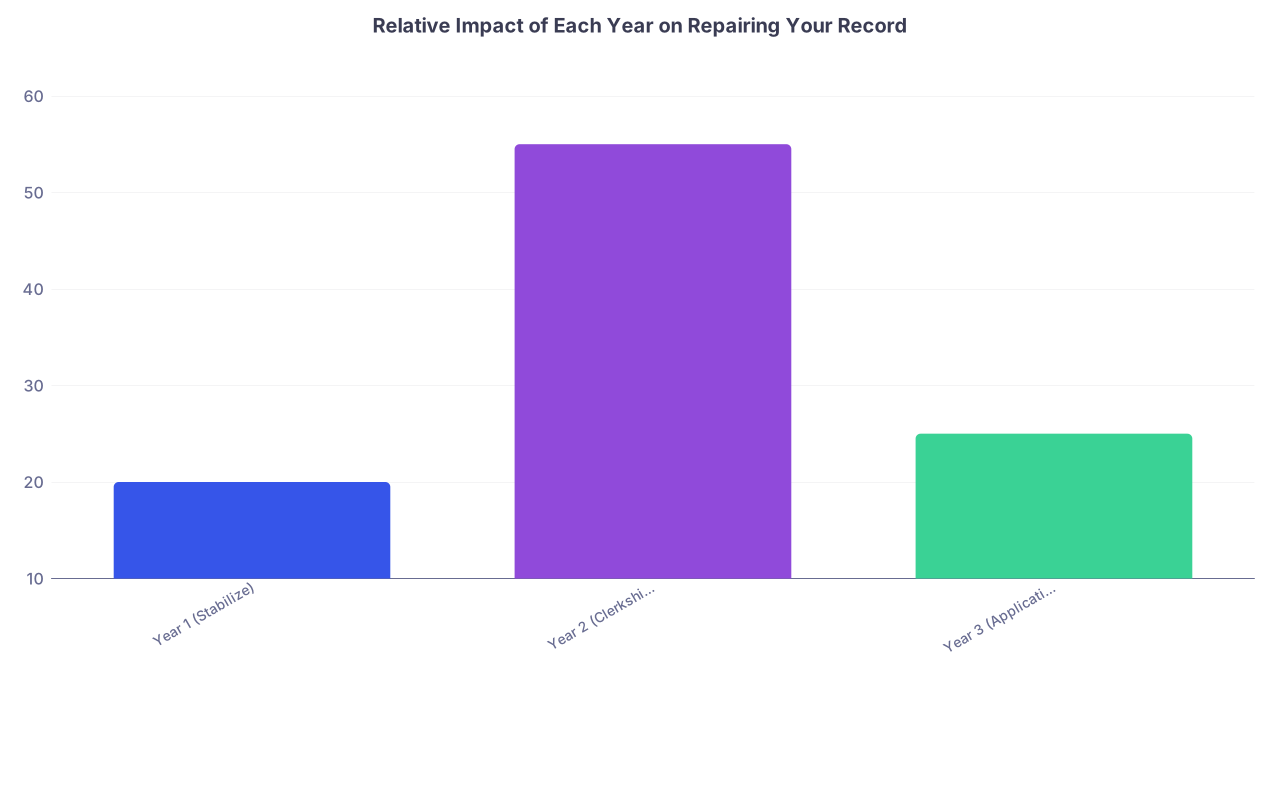
| Category | Value |
|---|---|
| Year 1 (Stabilize) | 20 |
| Year 2 (Clerkships + Step2) | 55 |
| Year 3 (Application Packaging) | 25 |
Months 13–15: Starting Clinicals (or Advanced Preclinical)
At this point you should be entering clerkships or late preclinical with a clean recent record.
Reset your identity with every new team
- Do not introduce yourself as “I had some trouble early on.”
- You’re “the student who is prepared, on time, and teaches themselves overnight.”
- On Day 1 of a clerkship:
- Know basic guidelines (e.g., JNC for HTN, ADA basics for DM in IM).
- Have 1–2 good pocket references ready.
Figure out one thing you’ll be known for
- Example:
- In IM: rock-solid progress notes.
- In Surgery: always first in, last out, and you know every patient’s post-op day and drains.
- In Psych: you know every med’s side effect and dose.
- This becomes easily writable material for your clinical evals.
- Example:
Months 16–20: Early Clerkships — Where You Really Prove It
By mid-year 2, you should be stacking wins.
Aim for strong clinical narratives, not perfection
- You don’t need all Honors.
- You do need:
- No new failures.
- No professionalism flags.
- Several rotations where attendings say “I’d work with this person again.”
- Ask midway through each rotation:
- “What do I need to do to be at the level of an Honors student by the end?”
- Then follow up your behavior the same week.
Tackle Shelf Exams intelligently
- Early trouble often = test-taking issues.
- For each shelf:
- Start question bank 3–4 weeks before.
- Minimum 30–40 questions/day.
- Track your percentages; ask for help if you’re under 55–60% a week before.
- If you barely pass or fail a shelf:
- Immediately:
- Meet with clerkship director + learning specialist.
- Adjust strategy before repeating that mistake on the next shelf.
- Immediately:
Quietly test specialty fit
- On each rotation, ask yourself:
- “If my early trouble closed doors, could I be happy here long term?”
- Notice:
- Which attendings seem unfazed by your early record once they see you work.
- Which specialties give you extra side-eye over it (they exist; believe their reactions).
- On each rotation, ask yourself:
Months 21–24: Step/Level 2 and Strengthening Your Case
This is a critical pivot window.
Plan Step/Level 2 CK/CE timing
- With early academic trouble, Step 2 becomes your redemption shot.
- At this point you should:
- Have completed enough core clerkships to know your weak spots.
- Have at least 6–8 weeks you can carve out for focused prep if you need it.
- Strategy:
- If Step 1/Level 1 is pass/fail and you passed but barely:
- Step 2 must be clearly above bare minimum.
- If you failed Step 1 and then passed on retake:
- Step 2 should be taken only when your practice exams are safely above passing by 15–20 points (or COMLEX equivalent cushion).
- If Step 1/Level 1 is pass/fail and you passed but barely:
Use practice scores as hard data
- Before scheduling test day:
- Have at least 2–3 NBME/COMSAE scores that are:
- Stable or rising.
- Not borderline.
- Have at least 2–3 NBME/COMSAE scores that are:
- If your performance is shaky:
- Delay within reason, in coordination with your school.
- Better a later, solid Step 2 than another red flag.
- Before scheduling test day:
Secure key letters of recommendation
- By end of Year 2, you should have:
- 1–2 attendings ready to speak to your growth.
- Ideally one who literally watched you go from shaky to solid.
- Have explicit conversations:
- “I had early academic trouble, but you’ve seen my performance now. Would you be comfortable writing a strong letter that reflects that improvement?”
- By end of Year 2, you should have:
You are not just asking “for a letter.” You’re curating your narrative.
Year 3: Package the Turnaround for Residency Applications
Year 3 is MS4 + application year. Your job now: make the entire file tell a single, coherent story.
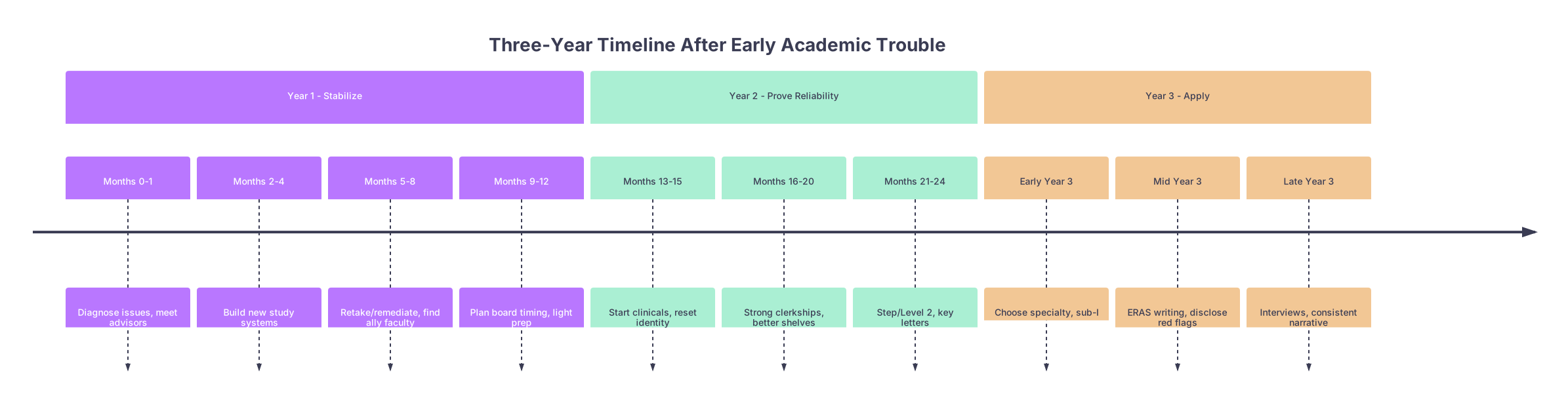
| Period | Event |
|---|---|
| Year 1 - Stabilize - Months 0-1 | Diagnose issues, meet advisors |
| Year 1 - Stabilize - Months 2-4 | Build new study systems |
| Year 1 - Stabilize - Months 5-8 | Retake/remediate, find ally faculty |
| Year 1 - Stabilize - Months 9-12 | Plan board timing, light prep |
| Year 2 - Prove Reliability - Months 13-15 | Start clinicals, reset identity |
| Year 2 - Prove Reliability - Months 16-20 | Strong clerkships, better shelves |
| Year 2 - Prove Reliability - Months 21-24 | Step/Level 2, key letters |
| Year 3 - Apply - Early Year 3 | Choose specialty, sub-I |
| Year 3 - Apply - Mid Year 3 | ERAS writing, disclose red flags |
| Year 3 - Apply - Late Year 3 | Interviews, consistent narrative |
Early Year 3 (Months 25–28): Sub-I and Final Specialty Decision
At this point you should have:
- Step 2 score in hand or scheduled with realistic confidence.
- A short list of 1–2 specialties you’re serious about.
Do a Sub-I where you need to prove yourself
- Internal medicine, surgery, or your chosen field.
- Goal:
- Show you function like an intern.
- Get a letter that says exactly that.
- On Day 1 of your Sub-I:
- Volunteer for responsibility early.
- Ask your senior, “What does a great sub-I look like to you?”
Reality-check your specialty choice
- Sit down with:
- Specialty advisor.
- Dean or MSPE writer.
- Ask very direct questions:
- “Given my early fail + my now-solid Step 2 and clinicals, where do I stand in this specialty?”
- “Am I applying uphill but realistic, or am I wasting a year?”
- Sit down with:
You’re not looking for flattery. You’re optimizing risk.
Mid Year 3 (Months 29–32): ERAS Application Build
This is where you explicitly frame your academic trouble. Do not bury it.
Personal Statement
- If your academic trouble was significant (failures, repeat year, board fail), you should:
- Address it briefly and clearly.
- Structure:
- One short paragraph:
- What happened. (Concrete, not dramatic.)
- What you changed. (Systems, support, behavior.)
- Evidence it worked. (Board score improvement, clinical performance, feedback.)
- One short paragraph:
- Example skeleton:
- “In my first year, I failed X due to Y. After this, I did Z. Since implementing these changes, I have [no further failures / strong clinical evaluations / Step 2 score of ___].”
- If your academic trouble was significant (failures, repeat year, board fail), you should:
-
- Meet with the MSPE writer early.
- At this point you should:
- Provide them with a concise timeline of:
- When the trouble occurred.
- What remediation occurred.
- How your performance changed.
- Provide them with a concise timeline of:
- Ask:
- “How will this be represented in the MSPE?”
- “Is there language you can use to highlight my improvement trend?”
Application Strategy: Number and Type of Programs
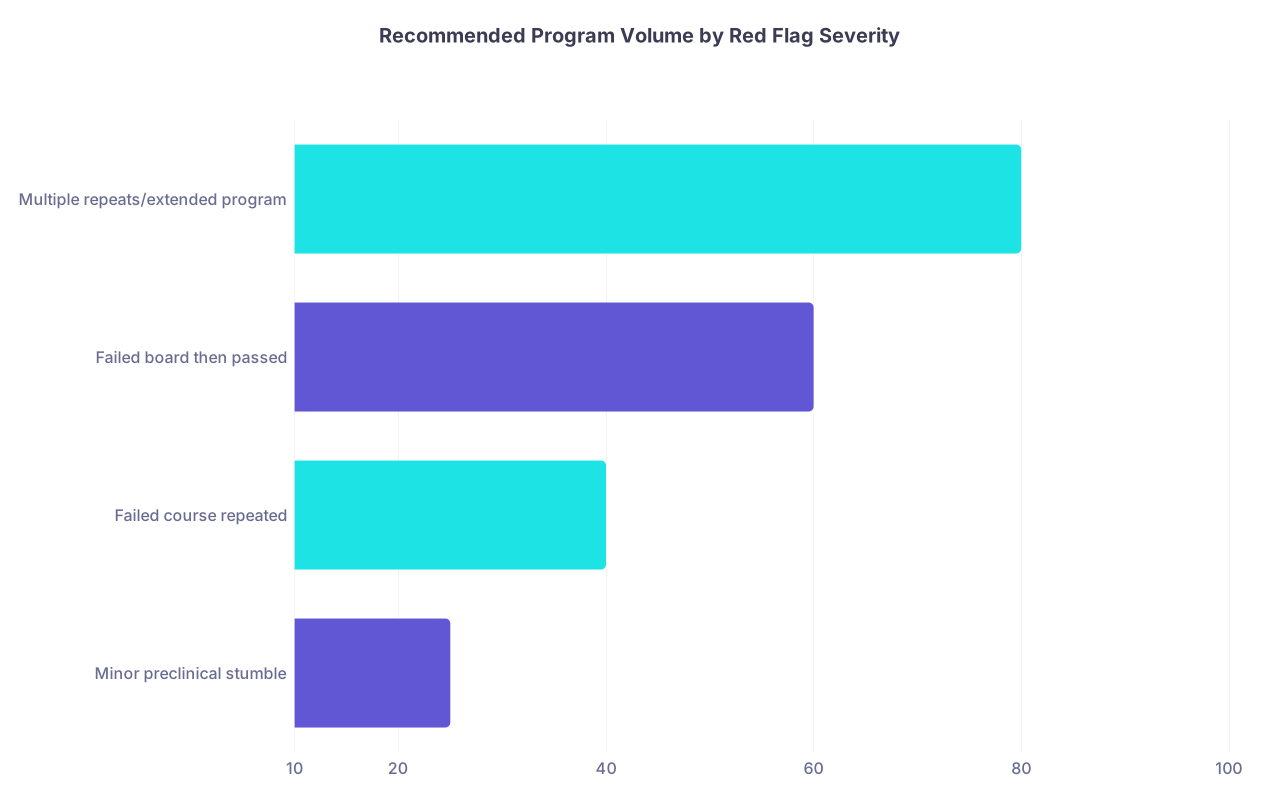
| Category | Value |
|---|---|
| Minor preclinical stumble | 25 |
| Failed course repeated | 40 |
| Failed board then passed | 60 |
| Multiple repeats/extended program | 80 |
- With early academic trouble, you should:
- Apply to more programs than your “clean-record” classmates.
- Very rough ranges (for moderately competitive fields):
- Minor early trouble, strong recovery: ~25–40 programs.
- Board fail or repeated year, good recovery: 50–80+ programs.
- Include:
- A core of mid-tier academic/community programs.
- A solid set of safer options in less competitive locations.
Late Year 3 (Months 33–36): Interviews and Rank List
At this point you should be in full “consistent narrative” mode.
Interview prep: Your red-flag script
Have a 60–90 second answer ready for:
- “Can you tell me about [this failure/year off/board issue]?”
Framework:
- Acknowledge the problem without excuses.
- Brief root cause.
- Specific corrective actions.
- Evidence of sustained improvement.
- One sentence linking it to how you’ll function as a resident.
Example skeleton:
- “In my first year, I failed X because I relied on [bad strategy]. After that, I did [concrete changes]. Since then, I’ve [no further failures, strong clerkship comments, Step 2 score]. I’m actually grateful it forced me to build the system I use now to stay ahead on the wards.”
During interviews
- You do not:
- Repeatedly apologize.
- Bring up your red flag if they don’t.
- You do:
- Answer directly when asked.
- Pivot quickly to your strengths and recent performance.
- Pay attention:
- Some programs will clearly signal: “We value your journey.”
- Others will clearly not. Believe them and rank accordingly.
- You do not:
Rank list strategy
- By the time you rank, you should:
- Favor programs where:
- Residents seemed honest about performance issues.
- Faculty acknowledged your improvement positively.
- Be realistic:
- Anchor your list with enough programs that have historically matched applicants with similar backgrounds.
- Favor programs where:
- By the time you rank, you should:
Visualizing How Your Story Changes Over Time
One way to keep your head straight is to think about how programs read your file across the three years.

| Time Point | Likely Impression | Your Job |
|---|---|---|
| End of Year 1 | Risky, but maybe fixable | Stop new issues, show stability |
| End of Year 2 | Improving, potentially trustworthy | Strong clinicals + Step 2 |
| During Apps (Y3) | Either “recovered” or “still risky” | Package clear, consistent story |
What You Should Have Accomplished by Each Milestone
To wrap this into a checklist:

By End of Year 1 (Post-Trouble)
You should:
- Have no additional failures or professionalism issues.
- Know exactly how your trouble appears on your record.
- Have at least one faculty member who has seen your improvement.
- Be using a stable, proven study and test-taking system.
By End of Year 2 You should:
- Have solid clinical evaluations on core clerkships.
- Have Step/Level 2 planned or completed with a non-borderline performance.
- Have 2–3 potential strong letter writers who can speak to your growth.
- Have a short list of specialties that realistically fit your profile.
By Application Season (Year 3) You should:
- Have a concise, honest explanation of your red flag(s).
- Have a personal statement and MSPE that frame your story as “problem solved, system in place.”
- Apply broadly and strategically, favoring programs likely to consider your full trajectory.
- Deliver a consistent, confident narrative in interviews.
The core of this three-year plan boils down to three things:
- Stop adding new red flags.
- Build a long, boringly consistent record of competence after the initial trouble.
- Tell that story clearly, on your terms, in every part of your residency application.