Understanding the Family Medicine Residency Interview Landscape as a Caribbean IMG
As a Caribbean medical school graduate targeting a family medicine residency in the United States, your pre-interview preparation needs to be deliberate, structured, and tailored to your profile as an IMG. While family medicine is often perceived as more “IMG-friendly” than some other specialties, the process is still competitive—especially for desirable locations and programs.
You’re navigating several layers simultaneously:
- Being an IMG from a Caribbean medical school, where program directors may have variable familiarity with your institution.
- Competing in a specialty that strongly values communication, continuity of care, and cultural competence.
- Needing to demonstrate that you can transition smoothly into the U.S. healthcare system, even if most of your training was abroad.
- Making sure your story and skills stand out in the context of the Caribbean medical school residency narrative, where program directors may hold both positive and skeptical preconceptions.
This article focuses specifically on pre-interview preparation for Caribbean IMGs applying to family medicine residency—what to do from the moment you receive an interview invitation up until interview day. It will cover strategy, logistics, content preparation, and mindset so that you are ready not just to “answer questions,” but to persuade programs that you are exactly the kind of resident they want.
Step 1: Strategic Preparation Before Interview Season Starts
Clarify Your Overall Message and Personal Brand
Before you answer a single question, you must know the core story you are trying to communicate:
- Why family medicine?
- Why the U.S. system?
- Why now?
- Why you specifically, as a Caribbean IMG?
Think of this as your personal brand—a concise, coherent narrative that threads through your application, your interview answers, and even your emails. For family medicine, this often includes:
- Commitment to longitudinal, relationship-based care
- Interest in whole-person, community, or primary care
- Comfort with bread-and-butter medicine and coordination of care
- Alignment with health equity and care for underserved populations
As a Caribbean IMG, layer in:
- Evidence that your Caribbean medical school education prepared you well clinically
- A clear explanation of any non-traditional pathways (e.g., SGU residency match story, US clinical rotations, observerships)
- Demonstrated resilience, adaptability, and cultural humility
Write a short branding statement (2–3 sentences) that captures this. You won’t read it word-for-word in interviews, but it will guide your answers.
Example:
“I’m a Caribbean-trained medical graduate with extensive U.S. primary care exposure who is passionate about long-term patient relationships and community-based care. My experiences caring for diverse, underserved populations in both the Caribbean and U.S. outpatient clinics have reinforced my commitment to family medicine as the specialty where I can most meaningfully impact health over a lifetime.”
Research the Specialty: What Family Medicine Programs Are Looking For
Family medicine programs tend to value:
- Strong communication skills and empathy
- Teamwork and collaboration with nurses, social workers, and other professionals
- Comfort with outpatient medicine, chronic disease management, and preventive care
- Adaptability to different practice settings (rural, urban, suburban)
- Interest in behavioral health, social determinants of health, and health systems navigation
Before interviews start, review:
- The AAFP website (American Academy of Family Physicians) and its resources on family medicine training.
- Any program signals: FQHC partnerships, community clinics, or specific populations (immigrant, rural, urban underserved).
- Your own experiences that demonstrate these qualities: clerkships, volunteer work, community projects, QI initiatives.
Make a simple table: Program priorities vs. Your Matching Experiences. Use this when preparing answers.
Step 2: Program-Specific Research and Application Alignment

Deep-Dive Research on Each Program
Once you have interview invites, do targeted research for each program. This is central to effective residency interview preparation and will distinguish you from applicants giving generic answers.
For each program, know:
- Location: urban vs rural, cost of living, patient demographics, local health challenges.
- Mission statement and values: especially if they emphasize underserved care, social justice, or primary care innovation.
- Curriculum structure: unopposed vs. opposed, community vs. academic, inpatient vs. outpatient emphasis.
- Unique features:
- Global health tracks
- Obstetrics-heavy family medicine
- Addiction medicine, geriatrics, sports medicine exposure
- Community engagement projects or FQHC partnerships
Use:
- Program website (read beyond the first page: curriculum, resident bios, program director’s message).
- Social media (especially Instagram/Twitter/LinkedIn, where residents may post about their experiences).
- Alumni success, including SGU residency match or other Caribbean medical school residency placements if available.
Create a Program Prep Document
For each program, create a one-page “cheat sheet” with:
- Program name, city, and key features
- Why this program is a good fit for you
- What you bring that aligns with their mission (particularly as a Caribbean IMG and future family physician)
- 3–5 tailored talking points you might use in answers
- 3–5 specific questions you will ask them
This helps avoid generic answers and supports authenticity.
Example tailored fit (for an underserved, urban program):
“Your partnership with the city’s FQHCs and focus on immigrant populations align directly with my experience caring for low-income, uninsured patients during my outpatient rotations in Brooklyn. As a Caribbean IMG who has worked across cultures, I’m particularly interested in building language-concordant care and addressing barriers like insurance status and transportation.”
Step 3: Core Content Preparation – Answers You Must Have Ready
A major part of how to prepare for interviews is rehearsing structured answers to predictable questions. The key is to sound prepared but not robotic.
1. Your “Tell Me About Yourself” Story
This is almost guaranteed and sets the tone for the interview.
Structure:
- Brief background (where you’re from, medical school, high-yield details).
- Key experiences or themes that led to family medicine.
- Current goals and what you’re seeking in a residency.
For a Caribbean IMG, weave in:
- Clear, confident reference to your Caribbean medical school (e.g., SGU, Ross, AUC, Saba) without being defensive.
- Key U.S. clinical experiences that show readiness.
- A concise connection to family medicine.
2. “Why Family Medicine?”
Use 2–3 specific experiences that support your interest. Highlight:
- Continuity of care: following a patient or family over multiple visits.
- Enjoyment of variety: newborns to geriatrics, chronic disease to preventive care.
- Systems thinking: coordination of care, social determinants of health.
Mention how your Caribbean and U.S. experiences reinforced this.
Example angle:
“In my Caribbean rotations, I saw how a single physician could be the anchor for entire families. During my U.S. outpatient rotations, I realized I loved managing multiple chronic conditions while building long-term relationships. Family medicine allows me to integrate that broad clinical scope with continuity and community impact.”
3. “Why This Program?” / “Why This Location?”
Avoid generic: “You have strong training, diverse patients, and good teaching.”
Instead, use:
- 2–3 specific elements from your program research.
- Personal and professional reasons (e.g., community ties, interest in their patient population, specific curricular strengths).
4. “Why Did You Choose a Caribbean Medical School?”
This is particularly important for Caribbean medical school residency applicants.
Be:
- Honest, concise, and positive.
- Avoid sounding apologetic or overly defensive.
- Emphasize maturity and growth from this path.
Example structure:
- Brief reason (e.g., timing, opportunities, personal situation, competitiveness).
- Focus on what you gained: clinical variety, resilience, cultural competence.
- Link to proof of readiness for U.S. residency: strong USMLE scores, U.S. clinical rotations, letters of recommendation.
5. Strengths and Weaknesses
For strengths, select traits that matter in family medicine:
- Communication
- Empathy and patience
- Teamwork
- Responsibility and reliability
- Adaptability to different systems and cultures
Use specific stories to demonstrate them.
For weaknesses, choose something real but manageable and improved:
- E.g., initial over-detailing notes, being overly self-critical, needing to set better boundaries with time.
- Always describe what you did to improve and where you are now.
6. Behavioral Questions (Use the STAR Method)
You will likely be asked behavioral interview questions, such as:
- “Tell me about a time you had a conflict with a team member.”
- “Describe a time you made a mistake in patient care.”
- “Tell me about a challenging patient encounter and how you handled it.”
Use STAR (Situation, Task, Action, Result):
- Situation: Set context.
- Task: What your role or responsibility was.
- Action: What you did.
- Result: What changed, and what you learned.
Prepare 6–8 multi-purpose stories that can be adapted to different questions. Include:
- A time you communicated well with a difficult patient.
- A challenging family discussion or breaking bad news.
- An error or near-miss and your accountability.
- A teamwork or leadership experience.
- A time you navigated limited resources (often powerful as a Caribbean IMG).
Step 4: Practice, Mock Interviews, and Communication Skills

Use Mock Interviews Strategically
Residency interview preparation is far more effective when you practice out loud. Silent preparation is not enough.
Options:
- School-based mock interviews (if available through your Caribbean medical school or alumni networks).
- Mentor or attending-led mock interviews in the U.S.
- Practicing with peers, ideally other Caribbean IMGs applying to family medicine or similar fields.
- Recording yourself on video to assess body language, tone, and clarity.
Focus on:
- Consistent eye contact (or camera focus for virtual).
- Clear, moderately paced speech.
- Logical structure to answers.
- Avoiding filler words (“uh,” “like,” “you know”) as much as possible.
Train for Common “Interview Questions Residency Programs Ask”
Make a list of frequent interview questions residency committees use, including:
- Why family medicine?
- Why our program?
- Tell me about a time you failed.
- Tell me about a time you worked with a difficult teammate.
- Where do you see yourself in 5–10 years?
- How do you handle stress and long hours?
- What are you most proud of?
- How will you contribute to diversity in our program?
Prepare bullet point frameworks, not scripts. Example:
Handling stress:
- Acknowledge that stress is inevitable in residency.
- Provide specific tools you use (exercise, family support, time management, reflection, debriefing).
- A brief example showing you used these strategies during a demanding rotation or exam period.
Communication Nuances for Caribbean IMGs
Many Caribbean IMGs have strong interpersonal skills, but there can be cultural or accent differences to navigate.
Practical tips:
- Record and playback your responses to check:
- Clarity and speed.
- Whether you’re understandable via audio-only.
- Ask a U.S.-trained mentor or colleague to give feedback on:
- Any phrases or idioms that may not translate clearly.
- Whether your tone seems too formal or too casual.
Being yourself is crucial—but being intelligible and culturally attuned is part of professional communication.
Step 5: Logistics, Technology, and Presentation
Virtual vs. In-Person: What Caribbean IMGs Must Prepare
Most interviews now are virtual, though some programs may offer optional in-person second looks.
For Virtual Interviews:
Technology Setup
- Reliable internet (test speed and stability).
- Laptop or desktop (avoid only using a phone).
- Functional webcam and microphone (test through Zoom/Webex/Teams).
- Updated software and backups (browser versions, meeting apps).
Environment
- Quiet, well-lit space with a neutral background.
- Camera at eye level; not looking down or up.
- No clutter or distractions behind you.
Dress Code
- Business formal: typically a suit jacket or professional blouse/shirt.
- Conservative colors; avoid busy patterns.
- Ensure your attire is fully appropriate even if only upper body is seen.
Backup Plans
- A phone hotspot ready if Wi-Fi fails.
- Program contact emails or numbers accessible if you need to reconnect.
- Printed or easily accessible interview schedule and links.
For In-Person Interviews (if any):
- Plan travel early; factor in time zone changes.
- Arrive the day before if possible; sleep and hydration matter.
- Bring:
- Extra copies of your CV and personal statement.
- A small notebook and pen.
- Professional folder or portfolio (no large backpacks unless necessary).
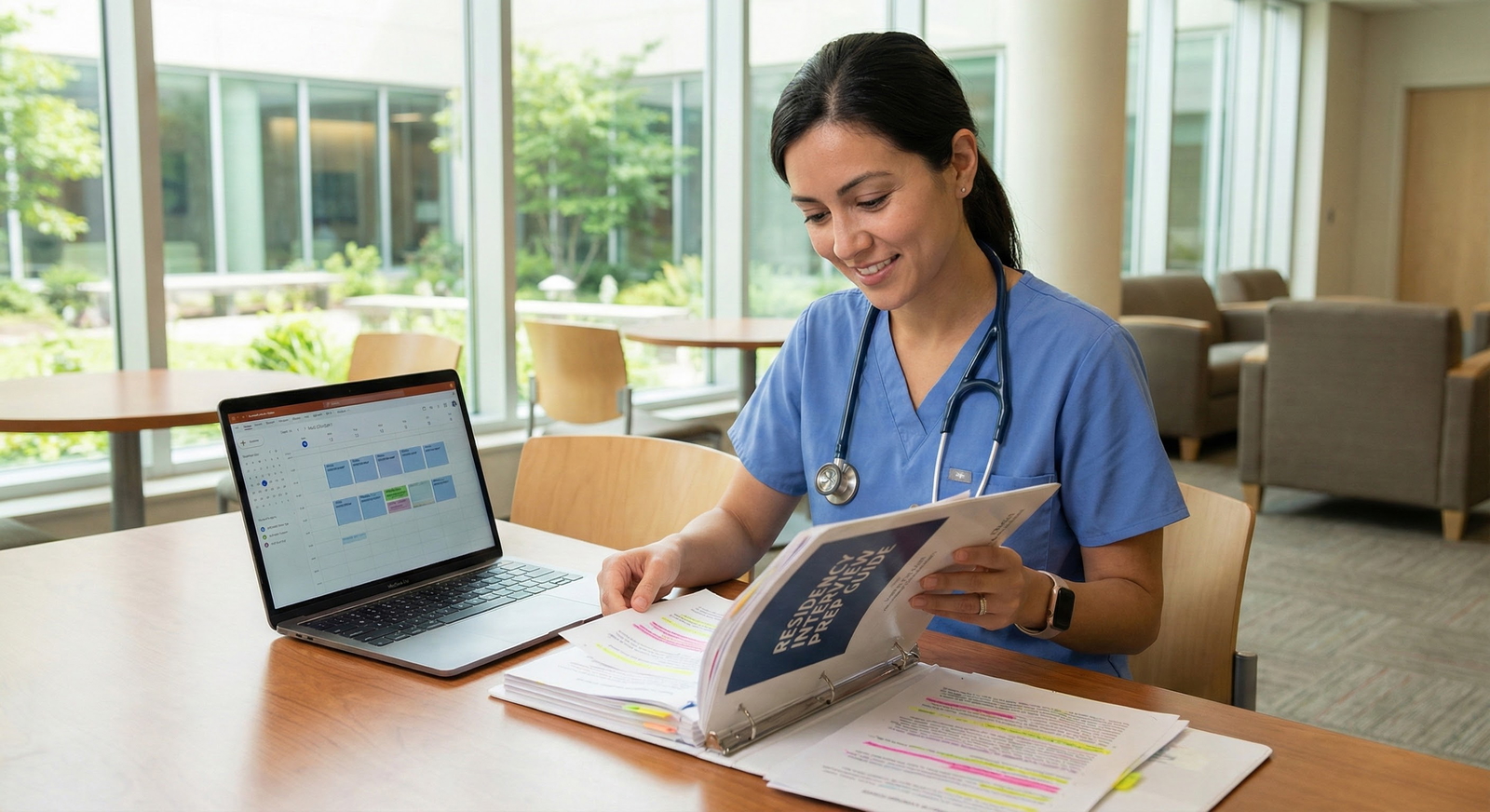
Organizing Your Interview Calendar
As a Caribbean IMG, you might have multiple interviews across time zones.
Use:
- A dedicated calendar (digital or paper) with:
- Date, time, time zone, platform (Zoom/Webex).
- Program name and interviewers (if provided).
- A checklist 48 hours in advance:
- Confirm time zone.
- Re-read the program’s website and your prep sheet.
- Prepare questions you’ll ask them.
This reduces day-of stress and prevents missing or scrambling for details.
Step 6: Mindset, Confidence, and Managing IMG-Specific Concerns
Addressing the “IMG Question” Internally
Even if not explicitly asked, many Caribbean IMGs worry: “Will they hold my school against me?”
Your pre-interview work is to reframe:
- You are not “less than”; you are a candidate with a different training pathway.
- You bring:
- Experience adapting to new systems and cultures.
- Often strong clinical exposure to underserved communities.
- Resilience developed from pursuing a non-linear route.
Go into interviews prepared to own your story without apology:
- Calmly acknowledge you chose a Caribbean medical school for specific reasons.
- Highlight how you’ve demonstrated competence:
- USMLE scores
- Strong letters from U.S. faculty
- Extensive U.S. clinical exposure
- Show clear insight into how this path makes you uniquely valuable in family medicine, where cross-cultural competence and flexibility are assets.
Building Confidence Through Evidence
Confidence comes more from preparation and proof than from self-talk alone.
Before interview season:
- List your substantial accomplishments:
- Clinical rotations where you excelled.
- Research, QI, or community projects you led or contributed to.
- Feedback from attendings that confirmed your strengths.
- Milestones like successful SGU residency match examples from alumni, to remind you that this is achievable.
Use this list to counter self-doubt. You’re not an imposter; you’re prepared and building on a proven path that many Caribbean IMGs have followed successfully.
Balancing Multiple Offers and the FM Match Strategy
As family medicine is relatively IMG-friendly, you may receive multiple interviews but still worry about the FM match outcome.
Pre-interview preparation includes:
- Understanding your personal priorities (geography, academic vs community, OB exposure, program size).
- Being honest with yourself about where you could realistically thrive.
- Knowing that ranking programs in the order of your true preference is the best match strategy.
During interviews, focus on fit rather than trying to game the system. Programs want residents who genuinely want to be there.
Step 7: Preparing Questions for Programs
Never end an interview without asking thoughtful questions. This shows maturity, genuine interest, and preparation.
For each program, prepare:
Curriculum and Training Questions
- “How is continuity clinic structured across the three years?”
- “What opportunities exist for residents to work with underserved or immigrant communities?”
Culture and Support
- “How would you describe the culture among residents and faculty?”
- “How does the program support resident wellness and prevent burnout?”
IMG-Specific or Caribbean Graduate Concerns (asked tactfully)
- “How has the program supported international graduates transitioning into the U.S. system?”
- “Are there mentorship opportunities for IMGs or residents from non-traditional pathways?”
Future Career Preparation
- “How well do graduates feel prepared for outpatient practice or fellowship?”
- “What proportion of graduates enter community vs academic careers?”
Avoid questions easily answered by a simple website glance (e.g., “Do you have a night float system?” if it’s already specified clearly online). Instead, probe for experience-based insights.
Step 8: Post-Preparation Checklist (1–2 Days Before Each Interview)
Run through this checklist prior to each interview:
- Re-read your personal statement and ERAS application—be ready to explain any part of it.
- Review your USMLE scores and timeline—be prepared to discuss without defensiveness.
- Know your clinical experiences and key patient stories well.
- Go through your program-specific prep sheet.
- Practice “Tell me about yourself,” “Why family medicine?” and “Why this program?” out loud once.
- Test your technology and interview space (for virtual).
- Prepare professional attire and grooming details.
- Print or open your question list for the program.
- Plan meals and rest so you’re not hungry or exhausted during the interview.
This structured approach shifts you from anxious to intentional—and that alone changes how you appear to interviewers.
FAQs: Pre-Interview Preparation for Caribbean IMG in Family Medicine
1. As a Caribbean IMG, should I bring up my medical school proactively in the interview?
You don’t need to lead with it, but you should be ready for questions about your training pathway. When it comes up, answer confidently and briefly:
- State why you chose the Caribbean route.
- Emphasize the strengths of your training—clinical exposure, diversity, adaptability.
- Connect it to your preparedness for U.S. family medicine residency, supported by U.S. letters, rotations, and exam performance.
Avoid being defensive. Treat it as one part of your journey, not the central defining factor.
2. How many mock interviews should I do before the real ones?
Quality matters more than quantity, but as a guide:
- At least 2–3 formal mock interviews (with mentors, advisors, or experienced peers).
- Additional short practice sessions focusing on specific questions (e.g., “Tell me about yourself,” behavioral questions).
- Record at least one full-length practice interview to assess body language, clarity, and pacing.
Refine based on feedback; stop short of over-rehearsing to the point that you sound scripted.
3. Are family medicine programs more forgiving of IMG status compared to other specialties?
Family medicine is generally more open to IMGs than many other specialties, particularly in community-based or underserved-focused programs. However, this does not mean standards are low. Programs still look for:
- Solid USMLE performance.
- Strong clinical evaluations and U.S. letters of recommendation.
- Clear, authentic commitment to family medicine.
- Good communication skills and professionalism.
Caribbean IMGs match into family medicine successfully every year, including through pathways like the SGU residency match, but they do so with strong preparation and well-aligned applications.
4. What are the most important “interview questions residency” programs use that I should prioritize in my preparation?
For family medicine and IMGs, prioritize:
- “Tell me about yourself.”
- “Why family medicine?”
- “Why our program?”
- “Why did you choose a Caribbean medical school?”
- “Tell me about a time you made a mistake and what you learned.”
- “Tell me about a difficult patient encounter.”
- “How do you handle stress and long hours?”
- “What are your long-term career goals in family medicine?”
If you can answer these clearly, confidently, and with specific examples, you will be well-positioned for the rest of the interview.
By approaching your family medicine residency interviews with a structured, IMG-specific preparation plan, you move from uncertainty to control. As a Caribbean IMG, you bring valuable perspectives and experiences that are deeply aligned with the values of family medicine. Thoughtful pre-interview preparation ensures that programs can clearly see that potential—and feel confident ranking you highly in the FM match.