Understanding the Clinical Informatics Interview Landscape
Clinical informatics sits at the intersection of medicine, data, and technology. That means your pre-interview preparation must cover more than standard residency interview preparation—it must also demonstrate that you can think like a clinician, a system designer, and a change leader.
Before diving into detailed tactics on how to prepare for interviews, it helps to understand what programs are actually evaluating:
Core dimensions most programs assess
- Clinical foundation
- Solid residency training and clinical reasoning
- Understanding of patient safety, quality, and workflow
- Technical literacy (not hardcore programming)
- Comfort with electronic health records (EHRs)
- Basic concepts in data analytics, interoperability, decision support
- Systems thinking
- Ability to see beyond the single patient to populations and processes
- Recognition of unintended consequences of health IT
- Change management & communication
- How you work with clinicians, IT, administration, and patients
- Skills in stakeholder engagement, training, and governance
- Professional narrative
- Why clinical informatics? Why now in your career?
- How this fellowship aligns with your long-term goals in health IT training and leadership
Understanding these dimensions will shape your pre-interview preparation strategy and help you anticipate the interview questions residency program faculty are likely to ask specifically for clinical informatics fellowship applicants.
Step 1: Clarify Your Clinical Informatics Story
Before you rehearse answers or study technical topics, you need a clear, coherent story about who you are as a future informatician. Every other part of your residency interview preparation will be stronger if your story is solid.
Craft your “informatics origin story”
Reflect on what specifically led you to clinical informatics:
- A frustrating EHR workflow that harmed efficiency or safety?
- A quality improvement (QI) project involving dashboards or order sets?
- Building a small tool (macro, template, spreadsheet, app) that made a big difference?
- Research using EHR data or clinical databases?
- Telehealth implementation during COVID-19?
Write out a short paragraph answering:
- “When did I first become aware of informatics as a field?”
- “What concrete experience made me say: ‘I want to fix this at scale’?”
- “What have I actually done since then to pursue this interest?”
Turn this into a concise, 60–90 second response you could comfortably use when asked:
- “Tell me about your interest in clinical informatics.”
- “How did you become interested in health IT training and this fellowship?”
Align your goals with what fellowships actually offer
Clinical informatics fellowships differ in emphasis, but most combine:
- Project-based EHR optimization and implementation
- Data analytics and quality improvement
- Clinical decision support design and governance
- Exposure to regulatory, safety, and compliance issues
- Collaboration with IT, data science, and operations teams
- Formal coursework (often through a master’s or certificate) in informatics
Be ready to clearly state:
Short-term goals (fellowship + 3–5 years)
Example: “I want to lead clinical decision support and order set optimization at an academic medical center, focusing on sepsis and perioperative safety.”Long-term goals (5–10+ years)
Example: “Ultimately I’d like to serve as a CMIO or lead a health system’s population health analytics efforts, bridging clinical practice, data science, and operational leadership.”
Programs want to see that your goals:
- Are realistic
- Align with their available resources and strengths
- Show you understand what a clinical informatics career actually looks like
Example: Putting your story together
“I first became interested in clinical informatics during my intern year when our hospital switched EHR vendors. I saw how poor workflow design led to medication errors, duplicated notes, and clinician burnout. I joined a resident advisory group working with our CMIO to redesign order sets, and our revisions reduced average admission time by 15 minutes per patient while improving adherence to DVT prophylaxis.
Since then, I’ve completed online coursework in health informatics, participated in a data-driven QI project on readmissions, and served as a superuser for our ED documentation redesign. I’m pursuing a clinical informatics fellowship because I want the structured health IT training, mentorship, and protected time to develop into someone who can lead system-level improvements that enhance safety and usability.”
This narrative directly addresses motivation, experience, and alignment with the fellowship’s goals.

Step 2: Master the Content: Clinical + Informatics
You don’t need to be a programmer or data scientist, but you do need to speak the language of informatics fluently enough to hold your own in an interview. Think of this as targeted, high-yield health IT training for the interview setting.
Brush up on core clinical informatics concepts
Expect some interview questions residency faculty might ask such as:
- “What is clinical informatics in your own words?”
- “Can you give an example of how CDS (clinical decision support) can improve care?”
- “How would you think about alert fatigue?”
- “What challenges have you seen with EHR implementation?”
Review these topics:
EHR & workflow basics
- Components: CPOE, documentation, results review, messaging, scheduling
- Common pain points: documentation burden, copy-paste, order set overload
- Basic workflow design principles: minimize clicks, align with cognitive flow
Clinical Decision Support (CDS)
- Types: alerts, order sets, documentation templates, care pathways, calculators
- Pros/cons of interruptive vs non-interruptive alerts
- Concept of sensitivity vs specificity in alerts and how it relates to alert fatigue
Data, quality, and safety
- Structured vs unstructured data
- How EHR data supports quality metrics, dashboards, and QI projects
- Examples of safety events related to poor health IT design
Interoperability
- Very basic understanding of data exchange (e.g., FHIR as a framework, even if high-level)
- Why interoperability matters for patient transitions and population health
Human factors & usability
- Concept of cognitive load
- Importance of user-centered design
- Trade-offs when introducing new technology into clinical workflows
You don’t need to sound like a textbook; you just need to show you’re thinking critically about these domains.
Connect concepts to your real experiences
For every concept above, prepare one concrete example from your own training:
- A CDS alert that didn’t work well (and how you’d improve it)
- A QI project that relied on EHR data
- A workflow bottleneck you noticed (e.g., discharge summary, med reconciliation)
- A telehealth or remote monitoring experience and its challenges
Programs are less interested in theoretical knowledge and more interested in your ability to:
- Notice system problems
- Analyze root causes
- Propose realistic, user-centered solutions
Understand common clinical informatics fellowship roles
You won’t be expected to know every detail of how a CMIO or CDS committee works, but it helps to understand:
- CMIO/Associate CMIO – strategic leadership, governance, clinician-IT bridge
- Informatics fellow – project work, evaluation, analytics, change management
- Analysts/builders – actual configuration and build within the EHR
- Data analysts/BI – dashboards, reports, and metrics
Being able to intelligently discuss how fellows typically work with these roles demonstrates maturity and readiness for a health IT training environment.
Step 3: Research Programs Strategically
Not all clinical informatics fellowships are the same. Advanced residency interview preparation in this field means deeply understanding each program’s context so your conversations are targeted and specific.
Go beyond the website
Use a structured system when researching each program:
Clinical environment
- Academic center vs community vs health system
- Adult, pediatric, or mixed populations
- Significant telehealth, rural health, or safety-net missions?
IT infrastructure
- EHR platform(s) used (Epic, Cerner, others)
- Any public information on major initiatives:
- Epic go-live or optimization
- Patient portal expansion
- Population health, ACO, or value-based care projects
- AI/ML pilots
Program focus
- More operations- and implementation-oriented vs research-oriented
- Strong ties to:
- Data science or AI
- Public health informatics
- Imaging or pathology informatics
- Education and training
Faculty interests
- Skim faculty bios and publications
- Note themes: CDS, usability, safety, telehealth, data science, global health, etc.
- Identify 1–2 faculty whose work overlaps with your interests
Non-informatics context
- Health system challenges in the region (e.g., rural access, aging population)
- Institutional strengths (cancer center, transplant, pediatrics, etc.)
- Strategic initiatives that likely involve informatics
Turn research into targeted questions
Residency interview preparation isn’t just about answers; it’s also about asking excellent questions. For each program, prepare 5–7 program-specific questions that show you’ve done your homework, such as:
- “I saw that your system recently rolled out an enterprise patient portal strategy. How have fellows been involved in optimizing patient messaging and reducing inbox burden?”
- “Several faculty publish on CDS governance. What role do fellows play in prioritizing and testing new CDS interventions?”
- “I noticed your institution has a strong population health focus. Are fellows able to work with your analytics team on risk stratification or care gap projects?”
Aim for questions that:
- Could not be answered by simply reading the website
- Invite the interviewer to talk about real work and real challenges
- Show genuine curiosity and alignment with your goals

Step 4: Rehearse High-Yield Interview Questions (with an Informatics Lens)
Many interview questions residency applicants face are generic (e.g., “Tell me about yourself”), but in clinical informatics you should expect those same questions to be subtly tilted toward systems and technology.
Below are categories of questions and how to prepare for them.
1. Classic questions, tailored for informatics
“Tell me about yourself.”
Structure this as:
- Brief clinical background (residency, interests)
- Key experiences that led to informatics
- Current informatics activities
- Future goals and why this fellowship fits
“Why clinical informatics?”
Anchor your answer in:
- A specific experience or problem
- The need for system-level solutions
- Your desire to combine clinical work with health IT training and leadership
“Why our program?”
Use your earlier research:
- Call out 1–2 specific projects, faculty, or structural features
- Link them to your goals and prior experiences
- Show that you see yourself in their environment, not just at “any” program
2. Behavioral questions: Show how you handle complexity and change
Clinical informatics is change management. Expect behavioral questions that test your ability to work with resistance, ambiguity, and multidisciplinary teams. Use the STAR method (Situation, Task, Action, Result) for answers.
Common prompts:
- “Tell me about a time you led a change or improvement project.”
- “Describe a time you had to influence someone without formal authority.”
- “Tell me about a difficult stakeholder or colleague and how you managed that relationship.”
- “Describe a time technology created an unexpected problem in patient care and what you did.”
Prepare 6–8 stories you can adapt:
- QI project involving the EHR or data
- Conflict about workflow or documentation
- IT or EHR outage or failure scenario
- Teaching/educating peers about a new system or process
- Multidisciplinary committee or working group
- Mistake or near-miss and what you learned
Emphasize:
- Systems thinking (“We realized the issue wasn’t just user error but a design problem.”)
- Stakeholder engagement (“We included nurses and front-desk staff from the start.”)
- Measurable outcomes when possible
3. Scenario-based informatics questions
Some programs use case scenarios to see how you think. You’re not expected to know their system in detail; they’re evaluating your process.
Sample scenarios and approaches:
Scenario 1: Alert fatigue
“Clinicians are complaining about too many medication alerts. How would you approach this problem?”
Talk about:
- Understanding current alert burden (data, frequencies, overrides)
- Stratifying by clinical relevance and risk
- Engaging a multidisciplinary group (pharmacy, frontline clinicians, informatics, safety)
- Balancing safety vs workflow
- Piloting changes and measuring impact
Scenario 2: New documentation requirement
“The hospital wants to add several mandatory documentation fields to support billing and quality metrics. Clinicians are upset. How do you proceed?”
Discuss:
- Clarifying the why behind the requirement
- Exploring alternatives (auto-population, smart phrases, decision support)
- Involving clinicians in design
- Testing in a small pilot group
- Measuring time burden and data quality
Scenario 3: Using data for QI
“You want to reduce 30-day readmissions for heart failure using EHR data. How might you start?”
Outline:
- Defining the population and outcome
- Identifying available data elements (meds, labs, visits)
- Partnering with analytics/BI
- Building and validating risk identification logic
- Designing interventions (alerts, order sets, outreach)
- Iterative evaluation
Practice talking through 3–4 such scenarios out loud. Focus on your reasoning, not technical jargon.
4. Addressing your clinical and technical background
Programs understand most applicants are not engineers or computer scientists. Be honest but proactive:
If you have strong technical background (e.g., CS degree, significant coding), emphasize:
- How you translate between technical and clinical stakeholders
- Your respect for analysts/developers and their constraints
- Examples where you’ve balanced elegant technical solutions with practical usability
If your technical background is limited, emphasize:
- Comfort learning new tools and systems
- Specific steps you’re already taking (courses, self-study, small projects)
- Your value as a clinician who deeply understands workflow and end-users
Be ready for:
- “What technical or analytical skills are you hoping to develop during fellowship?”
- “How do you see your clinical background contributing to informatics projects?”
Step 5: Plan the Logistics and Professional Presentation
Pre-interview preparation is not only cognitive—it’s also logistical and interpersonal. Small details can strongly influence how you’re perceived.
Organize your interview materials
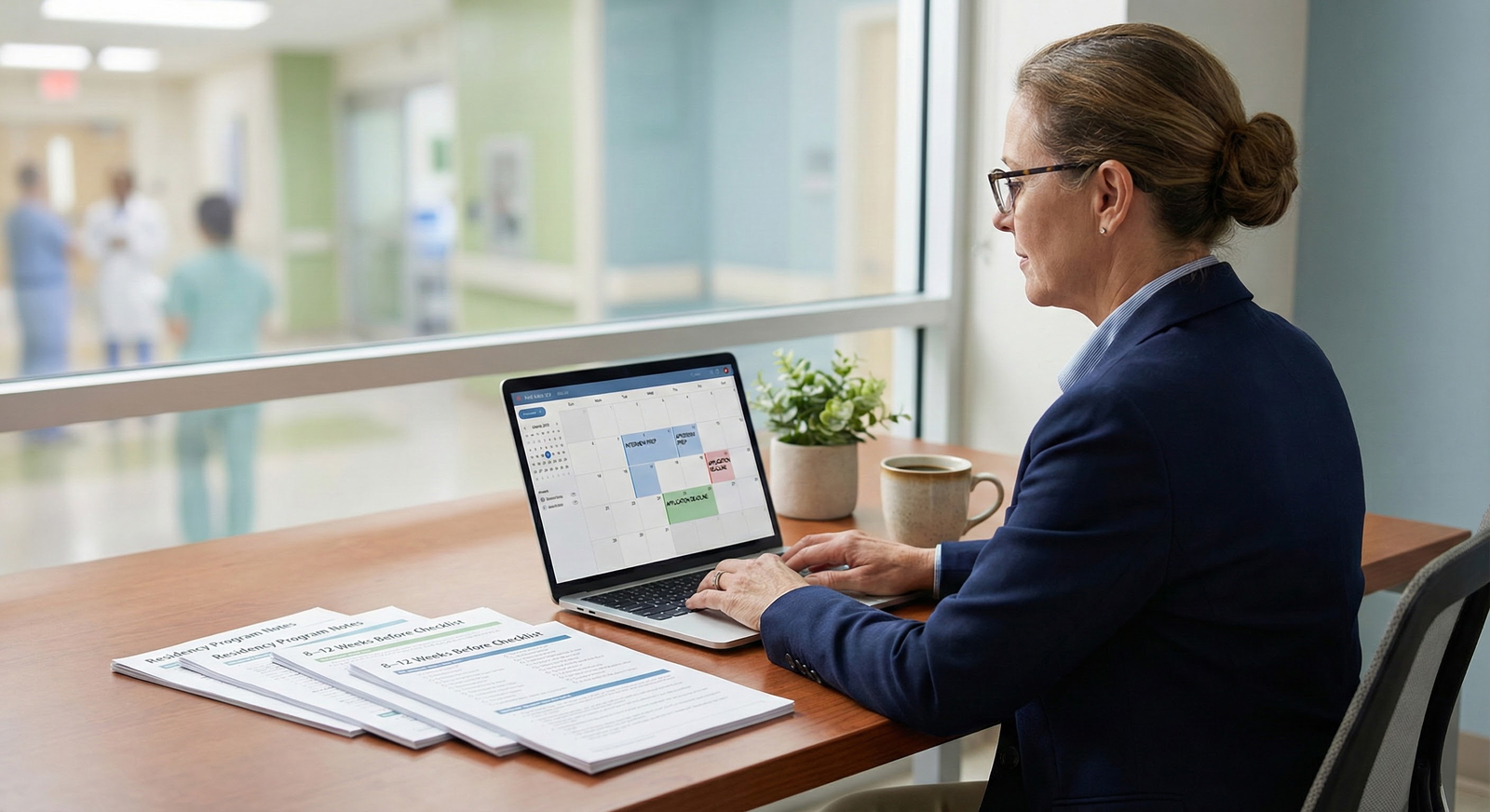
Create a digital or physical folder for each program with:
- Program overview notes
- Faculty names, roles, and key interests
- Your tailored “Why this program?” points
- Program-specific questions you plan to ask
- Your own CV and personal statement (re-read before each interview)
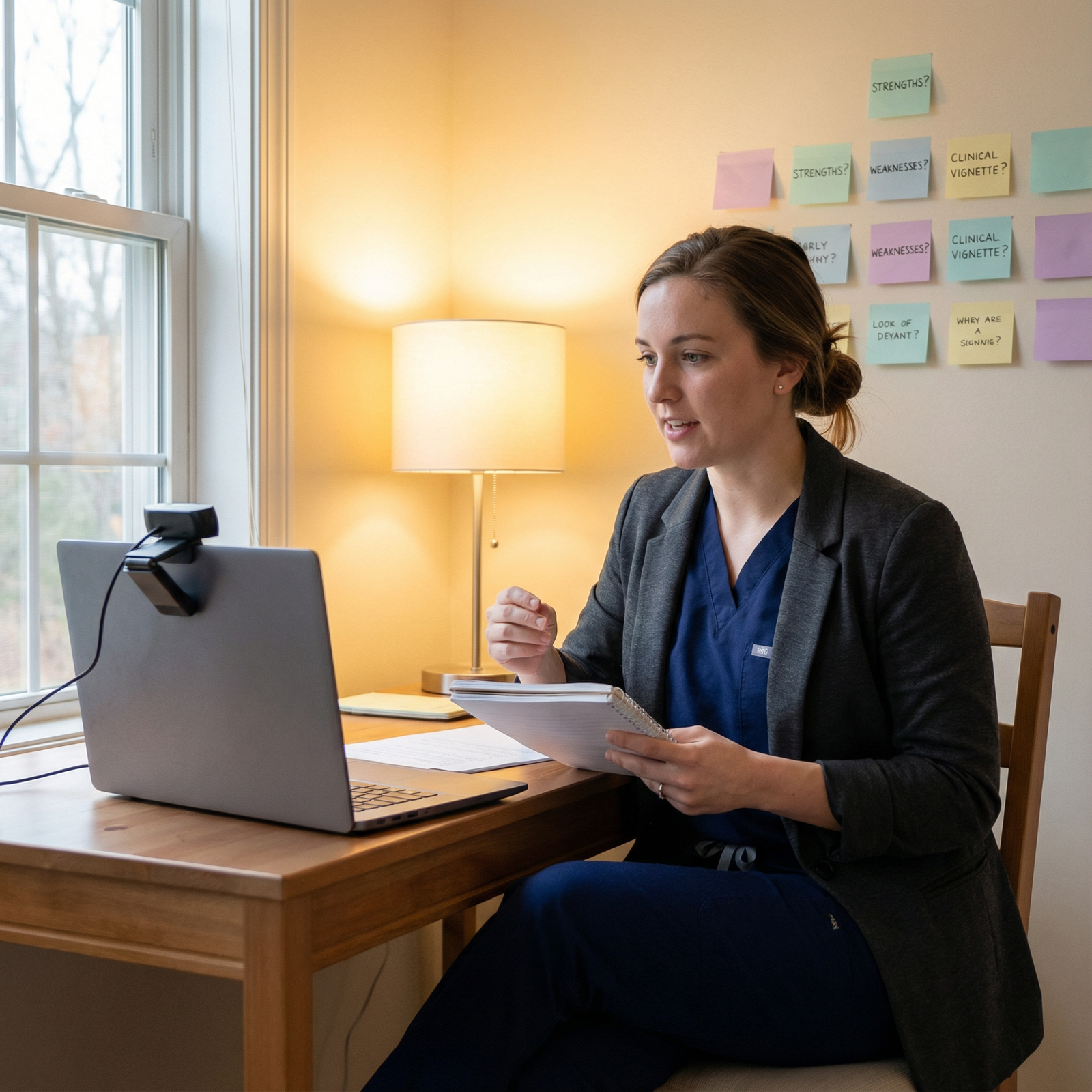
For virtual interviews:
- Test your camera, microphone, and platform (Zoom, Teams, etc.)
- Choose a quiet, professional background with adequate lighting
- Keep a notepad with your key points; avoid obviously reading from a script
For in-person interviews:
- Plan travel and timing carefully; aim to arrive early
- Bring:
- Printed copy of your CV
- Small notebook and pen
- List of questions for faculty and fellows
Polish your professional communication
Body language
- Maintain eye contact (look at the camera for virtual)
- Sit upright, attentive
- Nod and verbally confirm understanding (“That makes sense; in my experience…”)
Answer cadence
- Aim for 1–2 minute answers for most questions
- Stop periodically (“I can give a brief example if that would be helpful.”)
- Avoid long, meandering monologues—clarity is more impressive than density
Handling difficult questions
- If you need a moment, say: “That’s a thoughtful question—let me take a second to think about it.”
- For knowledge you don’t have: “I’m not sure of the exact technical details, but here’s how I would approach finding out and who I’d involve.”
Prepare to discuss your application materials
Review your own file:
- Personal statement: know what you wrote, and ensure your spoken narrative is consistent
- CV: be ready to discuss any:
- Gaps
- Project outcomes
- Research details (you should be able to explain methods and impact at a high level)
Anticipate questions such as:
- “Tell me more about this QI project—what was your specific role?”
- “What did you learn from this rotation/research experience that’s relevant to informatics?”
Being confidently familiar with your own record reinforces professionalism and self-awareness.
Step 6: Pre-Interview Reflection and Mindset
Finally, give equal attention to your mental preparation. Pre-interview anxiety is common, especially in a competitive field like clinical informatics fellowship positions.
Clarify what you’re evaluating, too
You’re not just trying to “earn” a spot; you’re also assessing fit. Before interview day, write down:
- Your top 5 priorities in a fellowship:
- Clinical load vs project time
- Research vs operations focus
- Mentorship style and structure
- EHR platform and type of projects
- Geographic/family considerations
During interviews, actively look for data points:
- Are fellows enthusiastic or burned out?
- Do faculty describe genuine responsibility for fellows, or mostly shadowing?
- Are informatics projects embedded in meaningful institutional priorities?
This perspective shifts you from a purely performance mindset to a collaborative, exploratory mindset—usually resulting in better conversations.
Practice concise self-reflection
Many programs ask:
- “What are your strengths as an informatician?”
- “What do you see as your areas for growth?”
Prepare 2–3 thoughtful strengths tied to specific examples:
- Systems-level thinking
- Ability to translate between clinician and IT perspectives
- Skill in education/communication
- Curiosity and comfort with ambiguity
And 2–3 growth areas, framed constructively:
- Limited formal statistics background → currently taking courses
- Early-stage project management skills → seeking structured training
- Need more experience with large-scale implementation → specific interest in fellowship to gain this
Programs value applicants who are honest, self-aware, and proactive in addressing growth needs.
FAQs: Pre-Interview Preparation for Clinical Informatics Fellowship
1. How is clinical informatics fellowship interview preparation different from other residency interview preparation?
You still need all the basics—professionalism, clear communication, and good behavioral stories—but clinical informatics interviews add a layer of systems thinking and technology. Expect more scenario-based questions about EHRs, decision support, data, and change management. You’ll also need a more detailed understanding of each institution’s IT environment and informatics activities, so your program-specific questions can go beyond the generic.
2. Do I need to know how to code to do well in interviews?
No. Many successful applicants have little or no formal programming experience. You should, however, be comfortable discussing basic data concepts, workflows, and how technology affects care. If you do have programming or data science experience, be prepared to explain how it practically supports informatics work and how you collaborate with non-technical stakeholders. Either way, articulate what specific technical or analytical skills you hope to build through structured health IT training in fellowship.
3. What are some high-yield topics to review right before the interview?
In the 24–48 hours before interviews, skim:
- Your own CV, personal statement, and key projects
- Basic informatics concepts: CDS, EHR workflows, alert fatigue, usability, interoperability
- Recent institutional news or projects related to IT, quality, or population health
- Your list of tailored “Why this program?” points and program-specific questions
This targeted review is far more useful than broad, unfocused studying.
4. How can I practice answering interview questions for residency and fellowship-level informatics roles effectively?
Use a combination of solo and interactive practice:
- Record yourself answering common prompts (“Tell me about yourself,” “Why clinical informatics?”) to refine clarity and timing.
- Conduct at least 1–2 mock interviews with a mentor, co-resident, or faculty member, focusing on informatics scenarios.
- After each practice, ask for feedback on content, structure, and jargon level—your goal is to sound clear, thoughtful, and accessible to both clinicians and IT leaders.
- Maintain a running list of strong stories and examples you can adapt to different interview questions residency faculty might ask.
With structured preparation across your story, content knowledge, program research, and communication skills, you’ll enter your clinical informatics fellowship interviews ready to have sophisticated, authentic conversations about how you can contribute to the future of health IT.