Understanding the Unique Challenge: DO Graduate Applying EM-IM
Applying to combined Emergency Medicine-Internal Medicine (EM-IM) residency as a DO graduate is both exciting and strategically demanding. You’re targeting a small, highly competitive niche: physicians trained to manage the most complex, undifferentiated, and critically ill patients across both the ED and inpatient settings.
Before you even walk into your first interview, you need to understand three things:
- Your identity as a DO graduate
- The unique nature of EM-IM combined training
- The expectations programs have for dual-trained residents
These three themes should anchor your entire pre-interview strategy.
The DO Advantage—and How to Frame It
Programs aren’t just “willing to consider” DO applicants—many actively value them, particularly in EM and IM. As a DO graduate, you bring:
- A whole-person, biopsychosocial perspective
- Comfort with ambiguity and undifferentiated complaints
- OMM/OMT training (whether you plan to use it regularly or not)
- Often, significant clinical exposure and early patient contact
In your residency interview preparation, you should be ready to:
- Explain how osteopathic principles shape your approach to emergency and inpatient care (e.g., functional status, psychosocial context, preventative mindset).
- Address your use of OMT honestly: interest, limitations, realistic future integration in EM-IM.
- Briefly normalize any nontraditional elements (e.g., COMLEX vs USMLE, school name recognition) by focusing on performance, growth, and clinical readiness.
What Makes EM-IM Combined Different
EM-IM combined programs are small and highly intentional. They’re looking for residents who can:
- Thrive in high-acuity, high-volume ED environments
- Manage complex chronic disease and multisystem pathology on the wards and ICU
- Maintain stamina for 5 years of dual training
- Think systematically while acting rapidly
In pre-interview preparation, you should be very clear on:
- Why EM alone is not enough for you
- Why IM alone is not enough for you
- Why a 5-year EM-IM combined makes more sense than doing EM then a fellowship, or IM with critical care, or other pathways
This distinction will be a core part of your answers in interview questions residency programs will ask.
Building Your Application Story Before Interview Season
Before focusing on how to prepare for interviews day-of, step back and clarify your overall narrative. Strong interview performance begins with knowing yourself and your story in detail.
Clarify Your “Why EM-IM as a DO?” Narrative
You need a 60–90 second, coherent explanation that touches on:
- Why medicine (very brief)
- Why DO (what drew you to osteopathic training)
- Why EM (e.g., acute resuscitation, procedures, undifferentiated complaints, fast decisions)
- Why IM (e.g., complexity, longitudinal reasoning, systems thinking, continuity, ICU)
- Why combined EM-IM
- A unifying thread (e.g., complex, high-acuity patients across settings; bridging ED and inpatient care gaps)
- Specific career goals that require dual training (e.g., ED-based observation unit, hospitalist with ED leadership role, critical care, systems redesign, global health, academic leadership).
You should be able to deliver this narrative naturally, without sounding scripted.
Example structure:
“I chose osteopathic medicine because I value whole-person care and functional outcomes, which became more important as I saw how social and structural factors impact ED utilization. During my EM rotation, I loved resuscitating critically ill patients and managing undifferentiated complaints, but I found myself wanting to follow them upstairs and understand their long-term management. Internal medicine gave me the depth in pathophysiology and longitudinal reasoning that complements the acute decision-making of EM.
EM-IM combined training fits how I think about complex, high-risk patients: I want to manage them across the ED, ICU, and ward, and contribute to better transitions of care and systems-level change. As a DO, my focus on whole-person function and prevention also informs how I think about avoidable admissions and recurrent ED visits. Long-term, I see myself in an academic role that bridges ED leadership and inpatient systems improvement.”
Map Your Experiences to EM-IM Competencies
List your major experiences and align each with what EM-IM programs value:
- EM rotations: Fast-paced, resuscitations, procedures, ED flow, teamwork
- IM rotations (wards, ICU, CCU): Diagnostic reasoning, chronic disease, multi-morbidity, systems-based practice
- Sub-internships / audition rotations: Concrete examples of responsibility, ownership, and feedback
- Research / QI: Clinical reasoning, data use, systems improvement, population health
- Leadership / volunteer work: Resilience, communication, conflict management, teaching
For each experience, prepare 1–2 stories using a structured format (STAR or CAR):
- Situation – What was going on?
- Task – What was your role / responsibility?
- Action – What did you do?
- Result / Reflection – What happened and what did you learn?
You’ll use these to answer many of the most common interview questions residency programs ask, such as:
- “Tell me about a challenging clinical case.”
- “Describe a time you made a mistake.”
- “Tell me about a conflict with a team member.”
- “Describe a stressful situation and how you handled it.”
Residency Interview Preparation: Core Content for EM-IM DO Applicants
Once your story is clear, the next step in how to prepare for interviews is mastering the content and themes most likely to come up in EM-IM conversations.
Know the Landscape: EM-IM as a Career Path
Before interviews, you should be able to discuss:
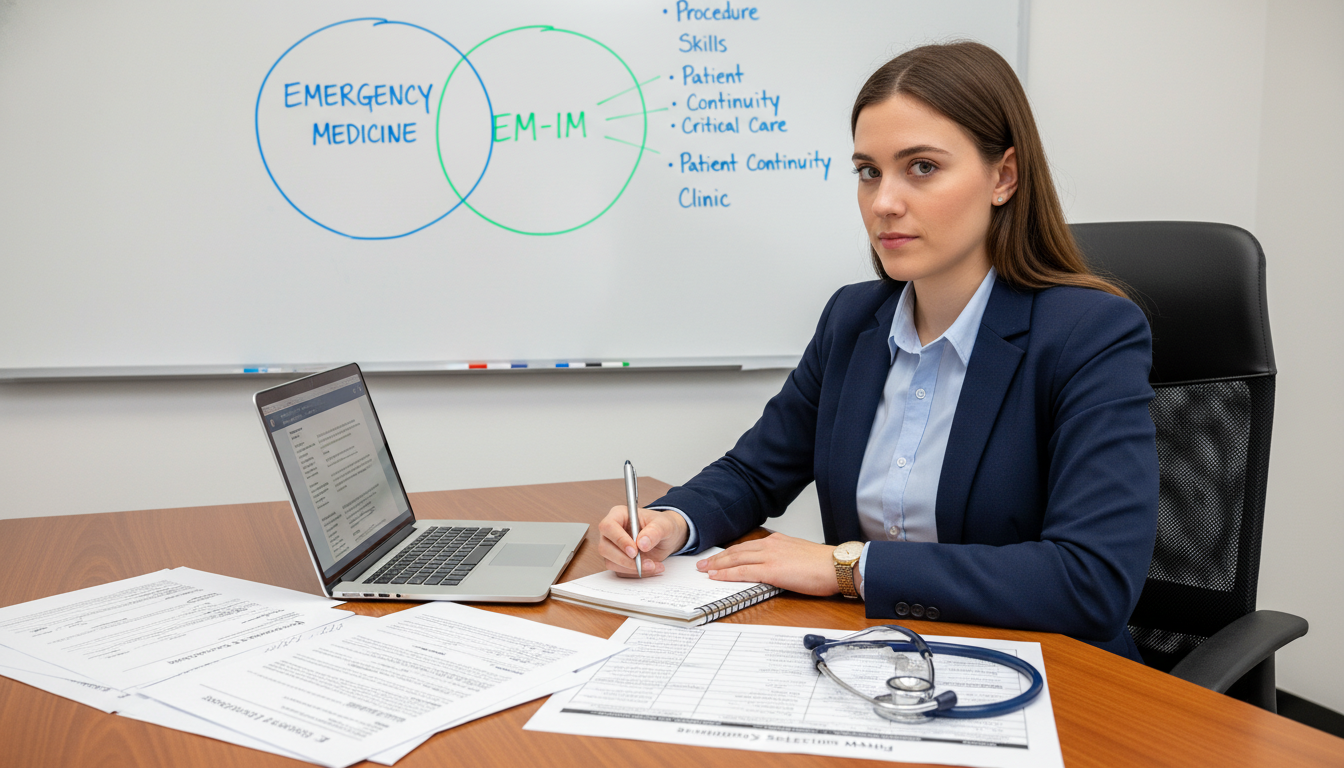
What EM-IM combined training entails
- 5-year program
- Dual board eligibility (EM and IM)
- Typical training structure (alternating or integrated EM/IM blocks; ICU and ED time; longitudinal clinics)
Common post-residency pathways:
- Academic EM or IM with dual roles
- Critical care fellowship
- ED-based observation or clinical decision units
- Hospital administration, quality and safety, ED–inpatient transitions
- Global health or resource-limited settings
- Hospitalist roles with ED coverage or cross-department leadership
You don’t need a rigid career plan, but you must present plausible, EM-IM–relevant directions, not generic “I’m keeping my options open.”
Prepare Specific EM-IM Talking Points
Programs want reassurance that you understand what you’re signing up for. Be prepared to address:
Why 5 years is worth it
- Depth of training
- Flexibility of career options
- Ability to influence both ED and inpatient systems
How you handle heavy schedules and transitions
- Rotating between EM and IM cultures
- Managing different documentation demands, workflows, and teams
- Protecting personal wellness
Your comfort with ambiguity and complexity
- Acute undifferentiated patients in EM
- Complex, multi-morbid chronic disease in IM
How being a DO specifically benefits EM-IM
- Holistic assessment: functional status, psychosocial context
- Communication style and attention to patient experience
- Ability to connect ED care with prevention and long-term management
Common EM-IM Interview Questions to Expect
When doing your residency interview preparation, practice answers to questions like:
- “Why EM-IM, and not EM only or IM only?”
- “What unique strengths would you bring to a dual program as a DO graduate?”
- “How do you envision balancing the cultures and demands of EM and IM?”
- “Tell me about a time you managed a critically ill patient from the ED to the ICU or wards.”
- “Describe a situation where you had to coordinate care across multiple services.”
- “What do you anticipate will be the hardest part of combined training for you?”
Have 2–3 strong clinical stories that show:
- Acute resuscitation (EM)
- Complex diagnostic reasoning or chronic disease management (IM)
- Systems-level awareness, transitions of care, or interdepartmental communication (EM-IM overlap)
Strategic Preparation: Programs, Materials, and Logistics
Pre-interview preparation isn’t just about answers—it’s also about information and organization.
Research Each EM-IM Program Deeply
Because the EM-IM world is small, programs will expect you to arrive informed. For each program:
Review:
- Program’s website (especially curriculum, EM/IM rotation schedule, ICU exposure)
- Resident biographies (backgrounds, DO vs MD mix, interests)
- Recent publications or QI projects from EM or IM departments
- Hospital type (county, academic, community affiliate), patient population, trauma level
Identify:
- What specifically attracts you to this program (and not just geography)
- How the program’s structure fits your learning preferences
- Unique opportunities you might pursue (global health, ultrasound, QI, simulation, critical care)
Write down 3–4 tailored reasons for each program, and 3–5 thoughtful questions to ask interviewers about:
- Integration of EM and IM training
- Mentorship and career guidance for EM-IM residents
- Graduates’ career paths (fellowships, jobs, academic roles)
- Wellness and support for dual residents
- Role of DOs in their program (if not obvious from their roster)
This level of preparation communicates maturity and genuine interest.
Organize Your Documents and Data
Before your first interview:
Review your ERAS application, personal statement, CV, and letters so you remember:
- Specific dates, roles, and projects you listed
- Numbers/statistics you mentioned (e.g., research data, number of patients/encounters)
- Themes you emphasized (EM-IM, systems, leadership, underserved care)
Prepare a program tracking system, such as a spreadsheet with:
- Interview date and format (in-person vs virtual)
- Names and roles of interviewers (if available)
- Your pros/cons and post-interview impressions
- EM, IM, and EM-IM specific strengths
- Culture notes (support, teaching style, DO-friendliness)
This will be invaluable later when you’re building your rank list, especially if you’re also considering categorical EM or IM programs as part of your osteopathic residency match strategy.

Performance Skills: Practicing for Interview Day
Content and organization are essential, but your delivery will shape how programs perceive your fit.
Mastering Behavioral and Situational Questions
Most interview questions residency committees ask now are behavioral:
- “Tell me about a time you failed.”
- “Describe a situation when you had to advocate for a patient.”
- “Tell me about a conflict within a team and how you handled it.”
Use a structured response model (e.g., STAR: Situation, Task, Action, Result) and keep your answers:
- Concrete – One clear story per question
- Specific – What you did, not just the team
- Reflective – What you learned and how you changed
When choosing stories, prioritize:
- ED–inpatient interface issues (e.g., boarding, admission disagreements, handoffs)
- Ethical dilemmas (e.g., capacity, goals of care) managed across settings
- Systems problems you recognized and addressed (e.g., delayed consults, poor discharge planning)
These show your natural alignment with EM-IM thinking.
Addressing Common DO-Specific Topics
As a DO graduate in an allopathic-dominant environment, you may be asked:
- “Why did you choose a DO school?”
- “How do you see osteopathic principles informing your practice?”
- “Will you use OMT in your career? How?”
Prepare answers that are:
- Confident but not defensive
- Focused on added value, not comparison
- Honest about OMT use:
- If you intend to use it only rarely in EM-IM, that’s fine—focus on how DO training shapes your diagnostic reasoning, hands-on exam skills, and patient communication.
If you took COMLEX only, or had a USMLE/COMLEX imbalance, be ready with a brief, non-apologetic framing that highlights your clinical performance, growth over time, and fit for EM-IM.
Practicing Out Loud
Silent preparation is not enough. To truly know how to prepare for interviews:
Schedule 2–3 mock interviews:
- With faculty in EM and IM
- With your school’s career office
- With mentors who understand the DO graduate residency landscape
Record yourself answering:
- “Tell me about yourself.”
- “Why EM-IM?”
- “What are your weaknesses?”
- “Tell me about a mistake you made.”
Watch the recording and assess:
- Filler words (“um,” “like,” “you know”)
- Eye contact (or camera contact for virtual)
- Speaking speed and clarity
- Length of answers (aim for 1–2 minutes for most answers)
Refine until your answers feel conversational, concise, and confident.
Fine-Tuning Virtual vs In-Person Skills
For virtual interviews:
Test:
- Camera angle (eye level)
- Microphone quality
- Internet stability
- Lighting (face clearly illuminated, no harsh backlight)
Environment:
- Neutral background (plain wall or professional-looking shelves)
- No background noise or distractions
- Professional attire, head to toe (it affects how you feel, even if unseen)
For in-person interviews:
- Plan:
- Travel and lodging early
- Route and timing to the hospital
- Professional, comfortable shoes (you may walk a lot)
- Bring:
- Printed copy of your CV and personal statement
- Small notebook and pen
- List of key questions for the program
Wellness, Mindset, and Professionalism: The Invisible Preparation
Residency interviews are not just assessments of your CV; they’re extended evaluations of your professionalism, insight, and interpersonal skills.
Managing Anxiety and Imposter Thoughts
Especially as a DO graduate entering a competitive EM-IM combined field, it’s common to worry:
- “Do they really want DOs?”
- “Am I competitive enough?”
- “What if they ask something I can’t answer?”
Counter this by:
- Reviewing your accomplishments and positive feedback from EM and IM attendings.
- Remembering that an interview offer means you’re already viewed as capable and potentially a good fit.
- Practicing a brief pre-interview grounding routine:
- Deep breaths for 30–60 seconds
- Remind yourself of 2–3 strengths (e.g., “I’m calm in crises,” “I connect quickly with patients,” “I’m persistent and thorough”)
Signaling Professionalism Consistently
From scheduling emails to post-interview thank-yous, you’re being evaluated on:
- Timeliness (responding to emails and interview invitations promptly)
- Attention to detail (correct names, program titles, spelling)
- Respectfulness (for coordinators, residents, faculty, and other applicants)
Before interview season, create:
- A professional email signature (name, DO, medical school, phone, ERAS ID).
- A template for thank-you emails, customized for each interviewer and program.
Preparing Thoughtful Questions
When they ask, “What questions do you have for us?” use it strategically. Avoid questions you could easily answer from the website. Instead, ask about:
EM-IM integration:
- “How do you facilitate identity formation for EM-IM residents across both departments?”
- “Are there EM-IM–specific conferences, mentorship structures, or retreats?”
DO inclusion and culture:
- “How have DO graduates done in your program, and are there any DO-specific supports?”
- “How do you support residents preparing for dual boards, especially those with a COMLEX background?”
Career development:
- “How do you support EM-IM residents interested in critical care, administration, or academic careers?”
- “Can you share examples of recent EM-IM graduate paths?”
Questions like these demonstrate maturity, insight, and genuine interest in building a sustainable, meaningful EM-IM career.
FAQs: Pre-Interview Preparation for DO Graduates in EM-IM
1. As a DO graduate, do I need USMLE scores to match an EM-IM combined residency?
Many EM-IM programs are familiar with COMLEX and will consider DO-only testing pathways, but some may still prefer or require USMLE scores. Before interviews, review each program’s stated testing preferences and be ready to discuss your performance and your clinical strengths. Emphasize rotation evaluations, letters from EM and IM attendings, and your fit for EM-IM training rather than focusing solely on test numbers.
2. How is interview preparation for EM-IM different from categorical EM or IM interviews?
You’ll still need strong general residency interview preparation, but EM-IM interviews require an additional layer:
- A coherent, detailed explanation of why combined training
- Examples that show you understand and appreciate both acute EM and longitudinal IM care
- Awareness of 5-year training implications and dual-board career options
Categorical EM or IM programs may touch on these, but EM-IM interviews will explore them in depth.
3. What are some red flags in EM-IM interviews for DO applicants?
Potential red flags include:
- Vague or generic answers like “I like variety” without a deeper EM-IM rationale
- Lack of awareness of what 5-year combined training entails
- Speaking negatively about EM or IM when justifying the combined path
- Defensiveness about being a DO, rather than confident, value-focused framing
Aim to present yourself as someone who has thoughtfully chosen EM-IM and understands both the challenges and rewards.
4. How can I stand out positively as a DO graduate in the osteopathic residency match for EM-IM?
You can distinguish yourself by:
- Demonstrating clear, well-articulated alignment between osteopathic principles and EM-IM practice
- Bringing strong, specific stories from both ED and inpatient settings that show clinical maturity and systems awareness
- Showing familiarity with each program’s structure, culture, and graduates’ paths
- Exhibiting humility, resilience, and readiness for a demanding, dual-identity training path
Above all, success as a DO graduate in the osteopathic residency match for EM-IM comes down to preparation, clarity of purpose, and the ability to communicate who you are—and why this path is the right one for you and for the patients you hope to serve.