
Understanding Your Goals as a DO Applicant in Orthopedic Surgery
As a DO graduate entering the orthopedic surgery residency match, the questions you ask programs can significantly shape both how you are perceived and how well you evaluate each program. The osteopathic residency match has evolved since the merger into a single accreditation system, but DO applicants still face unique considerations—particularly in a competitive field like orthopedic surgery.
This guide focuses on questions to ask programs—residents, faculty, and especially what to ask program directors—so you can:
- Demonstrate insight and maturity as an orthopedic surgery applicant
- Assess how DO‑friendly and supportive a program truly is
- Clarify training quality, operative experience, and fellowship potential
- Decide where to rank programs after the interview
- Avoid common pitfalls (e.g., asking questions that are easily found on the website)
You can think about questions in three buckets:
- Due diligence questions – To understand core training quality and expectations
- Fit and support questions – To gauge culture, DO inclusion, and wellness
- Career and outcomes questions – To assess your trajectory as a future orthopedic surgeon
Throughout, you’ll see questions framed with context—when to ask, why they matter, and what to listen for in the response.
Strategy: How to Approach Asking Questions on Interview Day
Before listing specific interview questions for them, it helps to have a strategy. Asking good questions is not about filling silence—it’s a crucial part of evaluating whether a program is right for you as a DO graduate in orthopedic surgery.
1. Build a Question Bank in Advance
Create a question bank divided by audience:
- Program Director / Associate PD / Chair
- Faculty interviewers
- Current residents (juniors and seniors)
- Program Coordinator / Administrative staff
Within each group, have 3–5 core questions you definitely want to ask, and several “optional” questions to use if time allows.
2. Avoid “Website Questions”
Do not ask about information that is clearly posted online or in the program brochure, such as:
- Number of residents per year
- Basic call schedule rotation durations
- Generic mission statement
If you want to explore these topics, build on the posted information:
“I saw on your site that interns rotate through trauma and night float early in the year. Can you share how that shapes early operative exposure and autonomy?”
This shows you did your homework and are looking deeper.
3. Tailor Questions as a DO Graduate
As a DO graduate residency applicant in orthopedic surgery, you should intentionally explore:
- Historical and current support for DOs
- Board preparation for both ABOS and AOBOS (if applicable)
- Any differences in mentorship or opportunities—ideally, there are none, but you want to hear this explicitly
- Whether DOs match well from this program into competitive fellowships
Asking about these topics helps you assess how smoothly a DO graduate fits into that specific program.
4. Use Open-Ended, Non-Defensive Phrasing
Avoid questions that sound accusatory or defensive:
- Bad: “Do DOs get treated differently here?”
- Better: “How have DO residents historically done in your program in terms of evaluations, leadership positions, and fellowship placement?”
This invites meaningful, honest answers while keeping the tone professional.
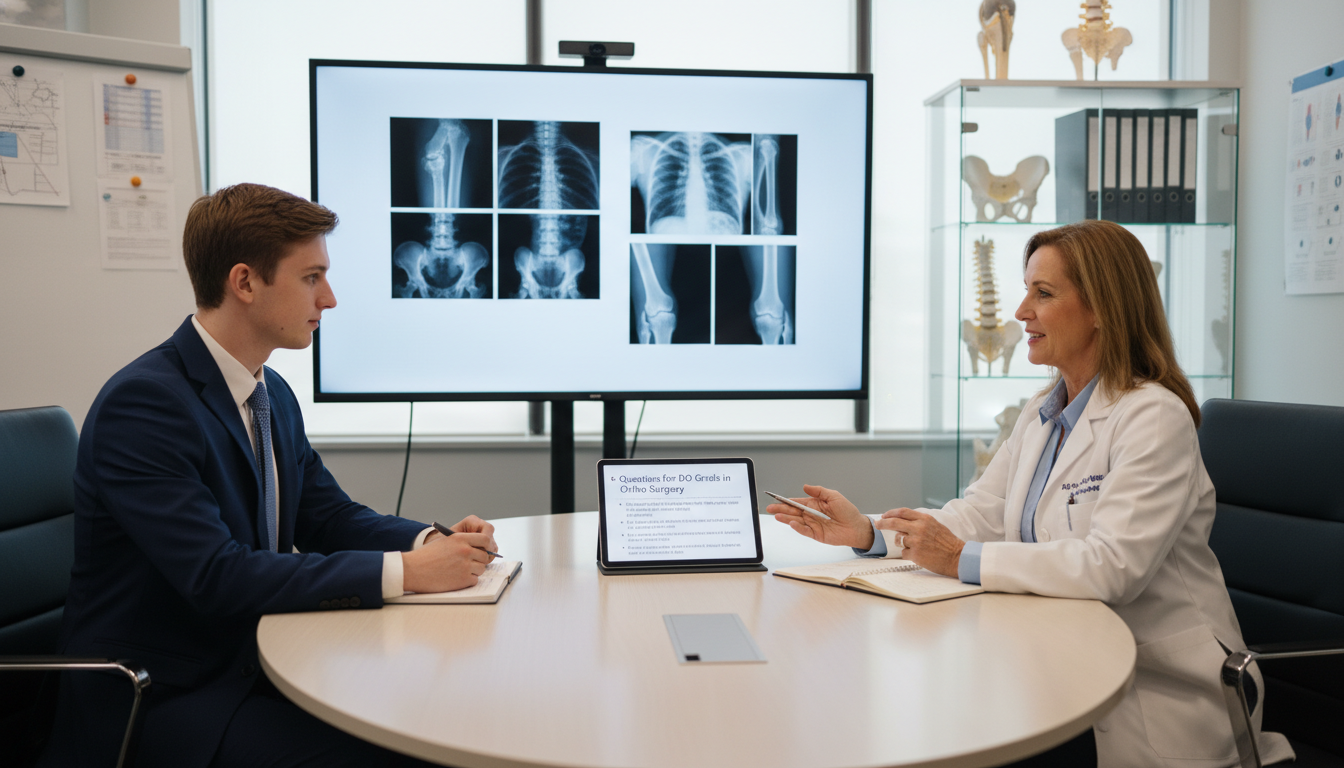
Key Questions to Ask the Program Director (and Leadership)
When you consider what to ask a program director, focus on questions that probe training philosophy, DO inclusion, and long-term outcomes.
You will typically have limited time (often 10–20 minutes), so prioritize 4–6 high-yield questions.
A. Program Philosophy, Expectations, and Training Model
“How would you describe the overall training philosophy of your orthopedic surgery residency?”
- Why it matters: Reveals whether the program is service-heavy vs. education-focused, early vs. late autonomy, and how they see the role of residents.
“In what ways has the program changed in the last 5 years, and how do you see it evolving over the next 5?”
- Why it matters: Shows responsiveness to feedback and adaptability. A stagnant program may not be keeping pace with modern ortho training.
“What characteristics do you see in the residents who thrive here?”
- Why it matters: Helps you assess your fit—work style, personality, academic interest—and whether your strengths align with what the program values.
B. DO-Friendliness and Support
For a DO graduate residency candidate in orthopedic surgery, these are critical:
“How have DO graduates historically integrated into your program, and where have they gone after graduation?”
- Listen for:
- Specific examples of DO residents and their careers
- Absence of hesitation or discomfort
- Evidence of equal opportunity
- Listen for:
“Are there any differences in expectations, opportunities, or support for DO and MD residents here?”
- Ideal answer: An immediate, confident “No—everything is identical,” backed with examples of DO residents in leadership roles, research, or top fellowship placements.
“How do you support residents in preparing for their board examinations (ABOS, and where relevant, AOBOS)?”
- Why it matters: You want a structured board-prep strategy, especially in a competitive field with high expectations for board performance.
C. Operative Experience and Autonomy
Orthopedic surgery training quality lives and dies on case volume and graduated autonomy.
“How do you balance early operative exposure with ensuring patient safety and appropriate supervision?”
- Listen for:
- Objective case logs
- Structured progression of responsibility
- Faculty culture of teaching in the OR, not just using residents as retractors
- Listen for:
“What are the strengths of your operative experience, and what areas are you actively working to improve?”
- Red flags: A director who claims “We’re strong in everything” without specifics. You want evidence they track case data and respond to gaps.
“How do you ensure that all residents meet or exceed ACGME case minimums across subspecialties?”
- Why it matters: This indicates systematic tracking, not blind hope.
D. Fellowships and Career Outcomes
As DO graduates increasingly pursue competitive fellowships, your ortho match strategy must include long-term outcomes.
“Can you share recent fellowship match outcomes, particularly for residents interested in highly competitive subspecialties such as sports, spine, hand, and trauma?”
- Listen for:
- Specific fellowship programs and institutions
- Success of DO graduates in those matches
- Clear, tracked data vs. vague statements
- Listen for:
“How do you support residents who are unsure early on about pursuing fellowship versus general orthopedics?”
- Why it matters: Good programs help you explore options intellectually and clinically, not pressure a single path.
“What kind of mentorship structure do you have for residents applying to fellowships?”
- Look for:
- Formal mentorship programs
- Faculty with national connections
- Help with research, letters, and networking
- Look for:
E. Culture, Feedback, and Wellness
“How do you handle residents who are struggling—whether clinically, academically, or personally?”
- Why it matters: This reveals whether they remediate thoughtfully or simply “weed out” struggling learners.
“What does resident wellness look like here in practical terms, not just policies?”
- Listen for:
- Protected time
- Reasonable duty hours and call coverage
- Supportive attitudes, not dismissive comments about toughness
- Listen for:
“What sort of feedback mechanisms are in place for residents to provide anonymous feedback about the program or specific rotations?”
- Good signs: Regular, structured anonymous surveys with evidence of changes made based on that feedback.
Essential Questions to Ask Current Residents
Residents give you the clearest picture of reality. You can ask more direct, practical questions here—especially during pre-interview dinners or resident-only sessions.
A. Day-to-Day Life, Call, and Workload
“Can you walk me through a typical day on your busiest rotation?”
- What this reveals: Start time, end time, scut vs. education, operative vs. clinic balance, round length.
“How often does the actual work hour experience match what’s described in the schedule?”
- Red flag: Residents consistently going far beyond 80 hours, or wincing when asked about it.
“How is call structured for junior versus senior residents, and how manageable is it in reality?”
- Look for:
- Night float vs. 24-hour calls
- In-house vs. home call
- Backup systems and attendings’ responsiveness
- Look for:
“When you leave the hospital, are you usually able to disconnect, or are you frequently called back or texted?”
B. Operative Experience and Autonomy—Resident View
“How early in training did you first start doing meaningful parts of cases (beyond just retracting)?”
- Listen for: Specific PGY level and examples.
“Do you feel your operative experience is equitable among residents, or do a few people get the majority of the cases?”
- Red flags: Case hoarding, favoritism, or fellows displacing resident experience.
“Are there any rotations where you feel the educational yield is low, and how does the program handle that feedback?”
C. DO Culture, Inclusion, and Support
As a DO graduate residency applicant in orthopedic surgery, this section is critical.
“As a DO (or with DO colleagues in the program), have you observed any difference in how DO and MD residents are treated by faculty or staff?”
- If you’re speaking with a DO resident, ask directly:
“How has your experience been here as a DO, from internship through senior years?”
- If you’re speaking with a DO resident, ask directly:
“Have DO residents had any barriers in securing research, OR time, or leadership positions compared to MD colleagues?”
- Good sign: DOs in chief roles, leadership, or strong fellowship positions.
“For DO residents taking both COMLEX and USMLE (if applicable), has the program been supportive and knowledgeable about both pathways?”
D. Education, Didactics, and Board Preparation
“Are didactics protected time, or do you frequently get pulled away to cover cases or floor work?”
- You want: Regularly protected education time where residents actually attend.
“How effective are the board review sessions, and how early do they start focusing on OITE and ABOS performance?”
“What resources does the program provide for board prep—question banks, review courses, funding for courses?”
E. Culture, Morale, and Red Flags
“What made you choose this program originally, and has it lived up to your expectations?”
“If you had to apply to residency again, would you choose this program?”
- Pay attention to: Tone, hesitation, and authenticity of the answer.
“Have there been any residents who left the program in recent years? If so, do you feel it was handled fairly?”
- Why it matters: High attrition or conflict with little transparency can be a concern.
“What are some things you would change about the program if you could?”
- Every program has flaws; you’re assessing which flaws and how they affect you.
F. Life Outside the Hospital
“What is it realistically like to live here on a resident salary—housing, commute, family life?”
“Do residents get to maintain hobbies or outside interests? Can you give examples?”
“How supportive is the program of major life events—marriage, children, illness, etc.?”

Questions for Faculty Interviewers and Subspecialty Surgeons
Faculty can give you a subspecialty perspective and insight into mentorship, research, and expectations.
A. Subspecialty Exposure and Mentorship
“How robust is resident exposure to your subspecialty (e.g., spine, sports, hand), and what does a typical resident experience look like on your service?”
“If a resident becomes particularly interested in your field, what additional opportunities exist—research, extra cases, electives?”
“How would you describe your style of teaching in the OR?”
- Listen for: Stepwise autonomy, pre-op planning with residents, post-op debriefs.
B. Research and Academic Development
“What are realistic research opportunities for residents, especially those who may not have a strong research background from medical school?”
“Are there structured research expectations by PGY level, and how are residents supported in meeting them?”
“Do DO residents participate in and lead research projects at similar rates as MD residents?”
- Good sign: Named DO residents on publications, podium presentations, or grants.
C. Evaluation and Professional Development
“How are residents evaluated on your service, and how do you deliver feedback?”
“What distinguishes your strongest residents in the OR and clinic—what behaviors or habits stand out?”
“How do you support residents who may be struggling in a particular domain, whether technical, cognitive, or professional?”
Questions for Program Coordinators and Administrative Staff
Program coordinators know the operational side of your osteopathic residency match experience better than almost anyone and can be a great resource for DO graduates.
Administrative and Logistical Questions
“How does the program support residents with licensing exams, credentialing, and paperwork—especially for DO applicants managing both COMLEX and USMLE or different licensure pathways?”
“What is the process for requesting vacation, parental leave, or time off for major life events?”
“How does the program help new residents transition to the area—housing, onboarding, EMR training?”
“What are some common struggles incoming interns have, and how can I best prepare to hit the ground running if I match here?”
These might seem less glamorous than questions about the OR, but they strongly influence day-to-day satisfaction.
Tailoring Questions to Your Priorities as a DO Orthopedic Applicant
Not every question will be equally important to you. Use these steps to personalize your list.
Step 1: Identify Your Top 3 Priorities
Common examples for DO orthopedic surgery applicants include:
- Early and high-quality operative experience
- Demonstrated support and success for DO residents
- Strong fellowship placement in a specific subspecialty (e.g., sports, spine, trauma)
- Geographic location or family considerations
- Culture of wellness and resident support
For each priority, write 2–3 targeted questions that will clarify whether the program aligns with that priority.
Step 2: Prepare a “Short List” for Each Interview
On the day of the interview, you may have multiple mini-interviews. For each:
- Select 1–2 high-yield questions you specifically want that person to answer
- Keep additional backup questions in case the conversation naturally ends early
- Be ready to pivot if your question has already been addressed
Step 3: Take Notes Immediately After
Right after each interview day, write down:
- Which questions you asked
- The key parts of each answer
- Your impressions of tone, honesty, and enthusiasm
This will be invaluable later when making your rank list, especially if you interview at many programs.
Common Pitfalls to Avoid When Asking Questions
As you refine your list of interview questions for them, keep these pitfalls in mind:
Asking only about lifestyle early in the conversation
- While work-life balance matters, you don’t want to appear uninterested in training quality. Balance your questions.
Sounding confrontational or entitled
- Turn critical topics into open-ended, curious questions (e.g., “How does the program handle…” rather than “Why do you…”).
Overly long or multi-part questions
- Keep questions tight and clear; interview time is limited.
Not adjusting based on what’s already been covered
- If the PD already gave a detailed answer about fellowships to the group, don’t ask the same thing again; instead, go deeper or shift topics.
Failing to ask anything
- When a PD or faculty member asks, “Do you have any questions for me?” you should always have at least one thoughtful question.
FAQ: Questions to Ask Programs as a DO Graduate in Orthopedic Surgery
1. As a DO graduate, should I specifically ask programs if they are “DO-friendly”?
Rather than using the phrase “DO-friendly,” ask concrete, outcome-based questions:
- “How have DO graduates done in your program in terms of leadership roles and fellowship placement?”
- “Are there any differences in expectations or opportunities between DO and MD residents?”
Their comfort level and the specificity of examples will tell you more than a generic label.
2. What are the best questions to ask to assess fellowship potential from a program?
Strong fellowship potential is clear when you ask:
- “Can you share recent fellowship match outcomes by subspecialty?”
- “How do you support residents applying to competitive fellowships?”
- “Are there particular fellowships or institutions where your residents frequently match?”
Look for a track record of graduates entering your areas of interest and formal mentorship systems.
3. How many questions should I ask each interviewer?
Typically:
- Program Director: 3–5 thoughtful questions
- Faculty: 2–4 questions
- Residents: As many as the conversation allows, often 5–10 across a group
- Coordinator: 2–3 logistical questions
Quality is more important than quantity. Keep questions concise and be mindful of time.
4. Is it okay to ask about weaknesses or problems in the program?
Yes—but phrase these respectfully and constructively:
- “What areas is the program actively trying to improve?”
- “Have there been any recent changes based on resident feedback, and how have they impacted training?”
You’re assessing responsiveness and transparency, not trying to “catch” them.
By coming to your orthopedic surgery residency interviews with a thoughtful, prioritized list of questions to ask residency programs, you’ll present yourself as a mature, engaged candidate—and, just as importantly, you’ll gather the information you need to make a confident rank list as a DO graduate in the orthopedic surgery match.