
Why Your Questions Matter as a DO Applying to Pediatrics
As a DO graduate entering the pediatrics residency match, the questions you ask programs are almost as important as the answers you give. Thoughtful, targeted questions:
- Help you evaluate whether a program truly supports osteopathic training
- Reveal how well you will be prepared for independent pediatric practice or fellowship
- Demonstrate maturity, insight, and genuine interest
- Allow you to compare programs beyond location and prestige
For DO applicants, especially in pediatrics, you’re not just looking for a spot in the peds match—you’re looking for a place that understands your osteopathic background and will help you thrive. That means asking questions that get beyond generic “What is your call schedule?” and into “How will I be trained, mentored, and supported here as a DO pediatrician?”
This guide focuses on what to ask program directors, faculty, and residents during pediatrics residency interviews and virtual open houses. Use it to build your personal list of interview questions for them—questions that reveal culture, training quality, and DO-friendliness.
Strategy First: How to Choose the Right Questions
Before we dive into question lists, you should have a clear strategy:
Clarify your priorities as a DO pediatrician-in-training
- Do you want strong osteopathic recognition and OMM opportunities?
- Are you aiming for a pediatric subspecialty fellowship?
- Is location or family support a key factor?
- Do you value community-oriented pediatrics, academic research, or both?
Target different audiences with different questions
- Program Director (PD) and leadership → Big-picture structure, outcomes, culture
- Faculty → Teaching philosophy, feedback, academic support
- Residents → Real-life experience, workload, wellness, hidden challenges
- Coordinators → Logistics, scheduling, housing, support systems
Avoid questions you can easily answer yourself
- If it’s on the website or in the program brochure, don’t waste precious time asking it. Instead, ask clarifying or deeper questions:
- Instead of: “How many residents are in your program?”
Ask: “With your class size of 12, how do you foster individual mentorship and feedback?”
- Instead of: “How many residents are in your program?”
- If it’s on the website or in the program brochure, don’t waste precious time asking it. Instead, ask clarifying or deeper questions:
Use DO-specific, pediatrics-specific angles
- You’re not “just another applicant.” You are a DO graduate targeting a pediatrics residency track. Let your questions reflect that:
- Ask about osteopathic mentorship, how DOs perform on boards, and historical match success of DOs into fellowships.
- You’re not “just another applicant.” You are a DO graduate targeting a pediatrics residency track. Let your questions reflect that:
Plan for multiple settings
- Interview day
- Virtual info sessions
- Second looks / follow-up emails
Create a simple one-page “question bank” and mark:
- MUST ASK in interview
- Nice to ask if time
- Can email later

Core Questions to Ask the Program Director (PD) and Leadership
These are high-yield questions to ask residency leadership that reveal training quality, DO culture, and program vision. Tailor the phrasing to your style, but keep the intent.
1. Questions About DO-Friendliness and Osteopathic Identity
For a DO graduate, this is essential in the osteopathic residency match (now fully integrated through NRMP). You want a program that sees your background as an asset, not a deficit.
Ask:
“How have DO graduates historically performed in your pediatrics residency in terms of evaluations, board pass rates, and fellowship placement?”
- Follow-up: “Are there DO alumni I might connect with to learn about their experience here?”
“What specific supports do you offer for residents coming from an osteopathic background?”
- Look for: Board prep resources, mentorship, remediation pathways that include DOs.
“Are there faculty members with DO training, and are any in leadership or educational roles?”
- Programs with DO faculty often better understand your training and strengths.
“Is there a place for osteopathic manipulative medicine (OMM) within your inpatient or outpatient pediatric services?”
- This may include consults, integrated pain management, or special clinics.
Red flags:
- PD seems unfamiliar with DO training or dismissive of osteopathic principles
- DOs rarely match here or don’t advance to leadership roles
- No DO faculty, no recognition of your background
2. Questions About Clinical Training and Patient Mix
You want to graduate confident managing everything from NICU preemies to complex adolescents.
Ask:
“Can you describe the typical patient mix and acuity at your main training sites?”
- Ask specifically: NICU level (II/III/IV), PICU structure, ED volume, community vs tertiary.
“How is continuity clinic structured, and how much ownership do residents have over their own panel?”
- Look for: Longitudinal relationships, progressive responsibility, diverse pathology.
“How do you ensure residents get sufficient exposure to bread-and-butter pediatrics as well as complex subspecialty care?”
“What changes have you made recently to the curriculum or rotations based on resident feedback?”
- This reveals responsiveness and growth mindset in the program.
3. Questions About Board Preparation and Academic Support
As a DO, you may take COMLEX (Level 3) and/or USMLE Step 3, and you’ll also need to pass pediatric boards. Ask about both.
Ask:
“What has your pediatrics board pass rate been over the last 3–5 years, and how do you support residents who may struggle?”
“What structured board preparation resources do you provide—question banks, protected board review time, mock exams?”
“How do you support residents who are preparing for both COMLEX Level 3 and USMLE Step 3?”
- This is a DO-specific question that signals you’re serious about exams and licensure.
“Is there protected time for academic half-day or didactics, and how is that time protected in practice?”
4. Questions About Fellowship and Career Outcomes
Many pediatric DOs pursue subspecialties: NICU, PICU, heme/onc, peds EM, etc. If that interests you, ask targeted peds match questions:
Ask:
“Where have your graduates matched recently—for both general pediatrics jobs and fellowships?”
“How competitive have your DO graduates been in the pediatrics residency match and fellowship match compared to MD graduates?”
“Are there built-in opportunities for research, QI, or scholarly work that support fellowship aspirations?”
“How early are residents connected with mentors if they express interest in a particular subspecialty?”
If you’re more primary care–focused, adapt:
- “What proportion of your graduates enter primary care pediatrics, and where do they typically practice?”
- “How do you prepare residents for community-based practice, including outpatient efficiency, billing, and working with diverse systems?”
5. Culture, Wellness, and Program Direction
This is where “fit” becomes clear.
Ask:
“How would you describe the culture of your residency program in a sentence or two?”
- Listen for authenticity, not slogans.
“What are you most proud of about this program, and what aspects are you actively working to improve?”
“How does leadership respond to resident feedback, especially when changes may be challenging institutionally?”
“Can you share an example of a time a resident struggled—academically or personally—and how the program supported them?”
These are powerful questions to ask residency leadership that show you’re thinking long-term and realistically.
High-Value Questions for Residents: The Real Story Behind the Brochure
Residents will give you the clearest sense of what your day-to-day life could look like as a DO pediatric resident. You’ll typically meet:
- Current interns (PGY-1)
- Senior residents (PGY-2/3)
- Chief residents
Your interview questions for them should focus on lived experience, not stats.
1. Questions About Workload, Schedule, and Support
Ask:
“Can you walk me through a typical day on wards as an intern and as a senior resident?”
- Compare: How autonomous are interns? How much support?
“What does cross-coverage and night float look like, and how manageable is the workload overnight?”
“Do you generally feel you have enough time to learn, not just get the work done?”
“How is time off actually protected in practice—vacation, post-call days, sick days?”
“When things get overwhelming, who has your back—other residents, attendings, program leadership?”
Look for patterns: If multiple residents independently describe similar challenges or praise, that’s informative.
2. Questions About Culture, Inclusion, and DO Experience
You specifically want to know how DOs have done in this environment.
Ask:
“As a DO applicant, I’m curious—how have DO residents felt supported here, and have they had similar opportunities as MD colleagues?”
- If there are current DOs: “What has your experience been like as a DO in this program?”
“How would you describe the resident community—collaborative, competitive, family-like?”
“Are there formal or informal mentorship systems, especially for underrepresented backgrounds or nontraditional paths?”
“Do you feel comfortable approaching faculty and leadership with concerns or new ideas?”
If you sense hesitation or guarded answers, that’s data.
3. Questions About Education and Feedback
Ask:
“What does meaningful teaching look like here—on rounds, in clinic, from fellows and attendings?”
“Do you receive regular, specific feedback, or is it more sporadic and generic?”
“Do you feel the curriculum prepares you for the pediatrics boards and independent practice?”
“Are there any gaps in your training that you’ve had to actively fill yourself?”
These tell you whether the program is intentional about education or just expects you to figure it out.
4. Questions About Life Outside the Hospital
Burnout is high in training; wellness is more than a buzzword.
Ask:
“What do you realistically have time for outside of residency—family, hobbies, exercise?”
“Do people live close to the hospital, and how is the cost of living for residents?”
“What are things you wish you had known about this city/area before starting residency?”
“Have you ever seriously considered leaving the program, and if so, what made you stay?”
- Only ask if the vibe feels safe and open.
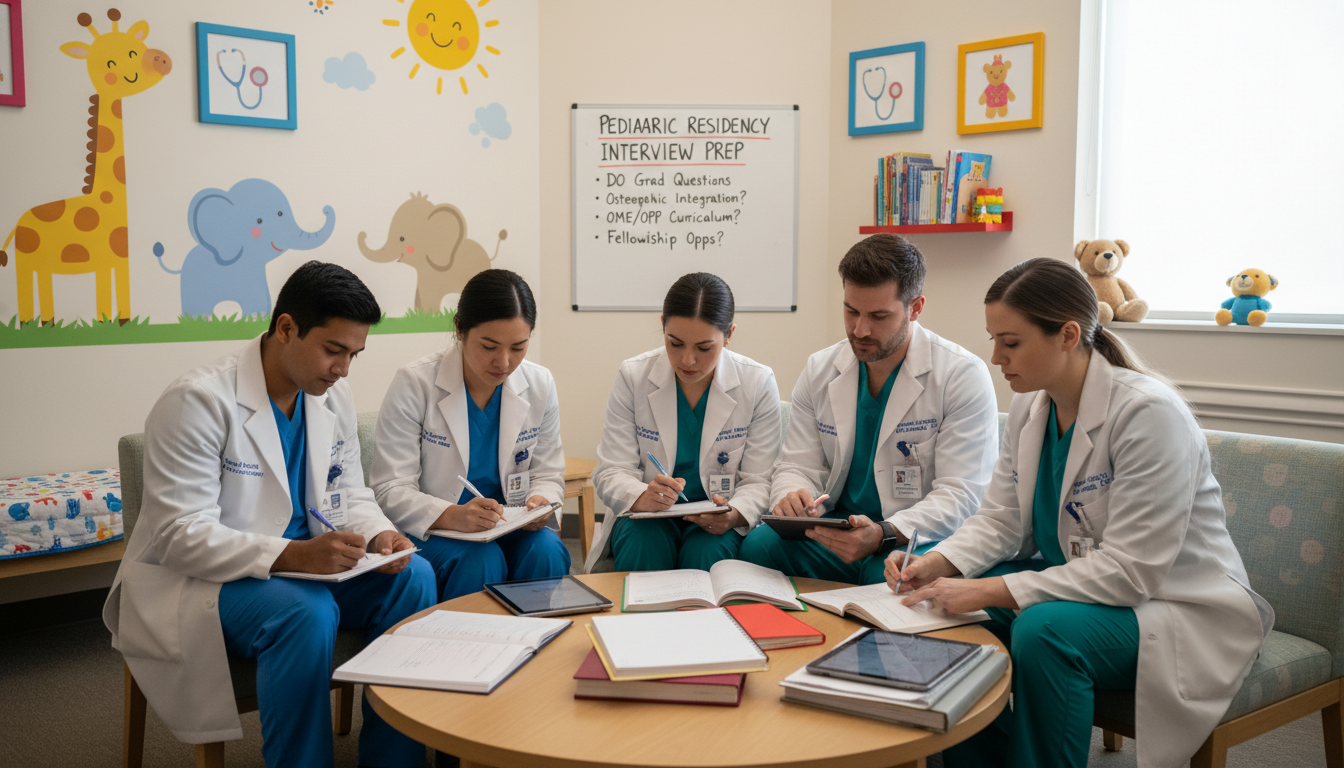
Targeted Questions by Topic: Build Your Personalized List
Below is a categorized bank of interview questions for them—mix and match to build a tailored list that fits your goals as a DO entering pediatrics.
A. Curriculum, Rotations, and Autonomy
- “How do you ensure graded responsibility from intern year to senior year?”
- “What is the balance between inpatient, outpatient, NICU, PICU, ED, and electives?”
- “How early in training do residents get primary responsibility for patient care decisions?”
- “How flexible is the elective time, and can residents design away rotations or niche experiences?”
- “Are there opportunities to work in community or rural pediatric settings?”
B. Subspecialty and Fellowship Preparation
- “Which pediatric subspecialties are most represented in your faculty?”
- “How early do interested residents get involved with subspecialty divisions (e.g., NICU, heme/onc, peds cardiology)?”
- “How does the program support residents applying for competitive fellowships?”
- “Do DO residents have any unique challenges or support needs when applying for fellowships, and how do you address them?”
C. Research, Quality Improvement, and Scholarship
- “Is research required, optional, or strongly encouraged in this program?”
- “What kind of scholarly projects have recent residents completed?”
- “Are there structured QI curricula and opportunities to lead QI initiatives?”
- “Do residents have protected time or mentorship for research, and how is that arranged?”
For DOs who may not have a heavy research background, ask:
- “How do you support residents who may be new to research but want to build that skill set for future fellowship applications?”
D. Osteopathic Training and Philosophy Integration
Even in non-traditionally osteopathic settings, your DO lens is an asset.
- “How does the program view the strengths DO residents bring—communication, holistic care, OMM?”
- “Are there opportunities to teach or share osteopathic approaches with co-residents or medical students?”
- “Have DO residents here maintained OMM skills or integrated them into pediatric care in any way?”
- “Is there institutional support to build an OMM consult service or educational session if there isn’t one already?”
E. Wellness, Diversity, and Professional Development
- “What structured wellness resources are available for residents, beyond just an EAP brochure?”
- “How does the program handle situations of mistreatment or unprofessional behavior toward residents?”
- “What initiatives exist around diversity, equity, and inclusion, especially in pediatrics and family-centered care?”
- “Are there leadership or teaching-development tracks for residents who want to become chief residents or educators?”
F. Logistics and Practicalities (Good for Coordinators/Chiefs)
- “How are schedules created, and how far in advance do you know your rotation and call schedules?”
- “How does moonlighting work here, if allowed, and at what level of training?”
- “What is the process if a resident needs time off for board exams, major life events, or unexpected crises?”
- “Is there dedicated orientation or boot camp for interns, particularly those coming from osteopathic schools that may have different clinical exposure patterns?”
How to Ask Smart Follow-Up Questions
The most revealing conversation often comes from follow-up questions. When you get an answer, consider asking:
- “Can you give an example of that?”
- “How has that changed over the last few years?”
- “How do residents feel about that change?”
- “What are you hoping this will look like in 2–3 years?”
For instance, when a PD says:
“We really value DO graduates in our pediatrics residency.”
Follow with:
- “What specific changes or policies reflect that value?”
- “How have DO residents shaped the culture or educational structure here?”
These targeted follow-ups turn vague statements into concrete insight.
DO-Specific Considerations: Making the Most of the Osteopathic Residency Match
Even though the single accreditation system has merged most ACGME and AOA pathways, reality on the ground still varies. As a DO:
Be upfront (confidently) about your background
- It’s perfectly appropriate to say:
- “As a DO graduate, I’m particularly interested in how your program has supported osteopathic residents in the past…”
- It’s perfectly appropriate to say:
Ask directly about COMLEX vs USMLE
- “Do your DO residents typically take USMLE Step 3, or has COMLEX Level 3 been sufficient for most state licensure and employment opportunities?”
- “Have you noticed any differences in how DO versus MD residents fare in job or fellowship placement, and how do you address that?”
Inquire about alumni networks
- “Do you maintain contact with DO alumni from your pediatrics residency, and what are they doing now?”
- “Are there DO faculty or alumni I could reach out to after the interview day to learn more about their paths?”
Frame your DO training as a strength
- Use questions that highlight your perspective:
- “How does your program incorporate family-centered, holistic care in pediatrics, and how might DO graduates contribute to that mission?”
- Use questions that highlight your perspective:
Putting It All Together: A Sample Question Plan for Interview Day
Here’s how you might structure your questions across a typical pediatrics residency interview day as a DO graduate.
With the Program Director
- “How have DO graduates historically done in your program in terms of evaluations, exams, and fellowship or job placement?”
- “What are you most proud of about your pediatrics residency, and what specific areas are you actively working to improve?”
- “How do you support residents preparing for both COMLEX Level 3 and USMLE Step 3, and eventually the pediatrics boards?”
- “How would you describe the culture of your residents and faculty?”
With Faculty/Subspecialists
- “How do you balance service needs with resident education on your rotation?”
- “What opportunities exist for residents to get involved in your subspecialty early if they’re interested?”
- “How do you typically give feedback to residents, and how early do you intervene if someone is struggling?”
With Current Residents
- “What made you rank this program highly, and has it lived up to your expectations?”
- “As a DO (if applicable), how has your experience been here compared to what you expected?”
- “What are the hardest parts of training here, and what keeps you going?”
- “If you had to choose again, would you come back to this program?”
With the Coordinator/Chief Residents
- “How flexible can the program be for major life events—pregnancy, illness, family emergencies?”
- “What does communication look like between residents and leadership when schedules or policies need to change?”
- “Are there specific resources for out-of-state or out-of-region residents adjusting to this area?”
Use this structure as a template, but always adapt your list to each specific program and what you genuinely want to know.
FAQ: Questions to Ask Programs as a DO Graduate in Pediatrics
1. What are the most important questions to ask a pediatrics program director as a DO graduate?
Prioritize questions about:
- Historical performance of DO residents (evaluations, boards, fellowships)
- Support for COMLEX and/or USMLE, plus pediatrics board prep
- Culture and responsiveness to feedback
- Patient population, autonomy, and educational philosophy
Those reveal whether you’ll be seen as a valued trainee and well prepared for independent practice or fellowship.
2. How many DO-specific questions should I ask during a pediatrics interview?
You don’t need a long list of explicitly DO-focused questions; 2–3 well-placed questions are enough. Integrate your DO identity into broader questions, such as:
- “How have DO graduates contributed to your program?”
- “What support do DO residents receive for board exams and fellowship applications?”
Balance these with general pediatrics training and culture questions.
3. Is it okay to ask tough questions about workload, burnout, or red flags?
Yes, as long as you’re respectful and professional. Ask residents:
- “What are the most challenging aspects of training here?”
- “How does the program respond when residents are overwhelmed or burned out?”
You’re not trying to interrogate them, but to understand whether you’ll be supported as a whole person, not just a workforce.
4. Should I repeat the same questions at every pediatrics program?
Have a core set you ask consistently (DO support, board prep, culture, patient mix) so you can compare programs. Then add program-specific questions based on their strengths (e.g., strong NICU, rural outreach, research focus). Customizing your questions shows genuine interest and preparation.
Use these frameworks to craft your own list of questions to ask programs as a DO graduate in pediatrics. The goal is not just to impress programs, but to clearly determine where you will be trained, mentored, and trusted to grow into the pediatrician you want to become.