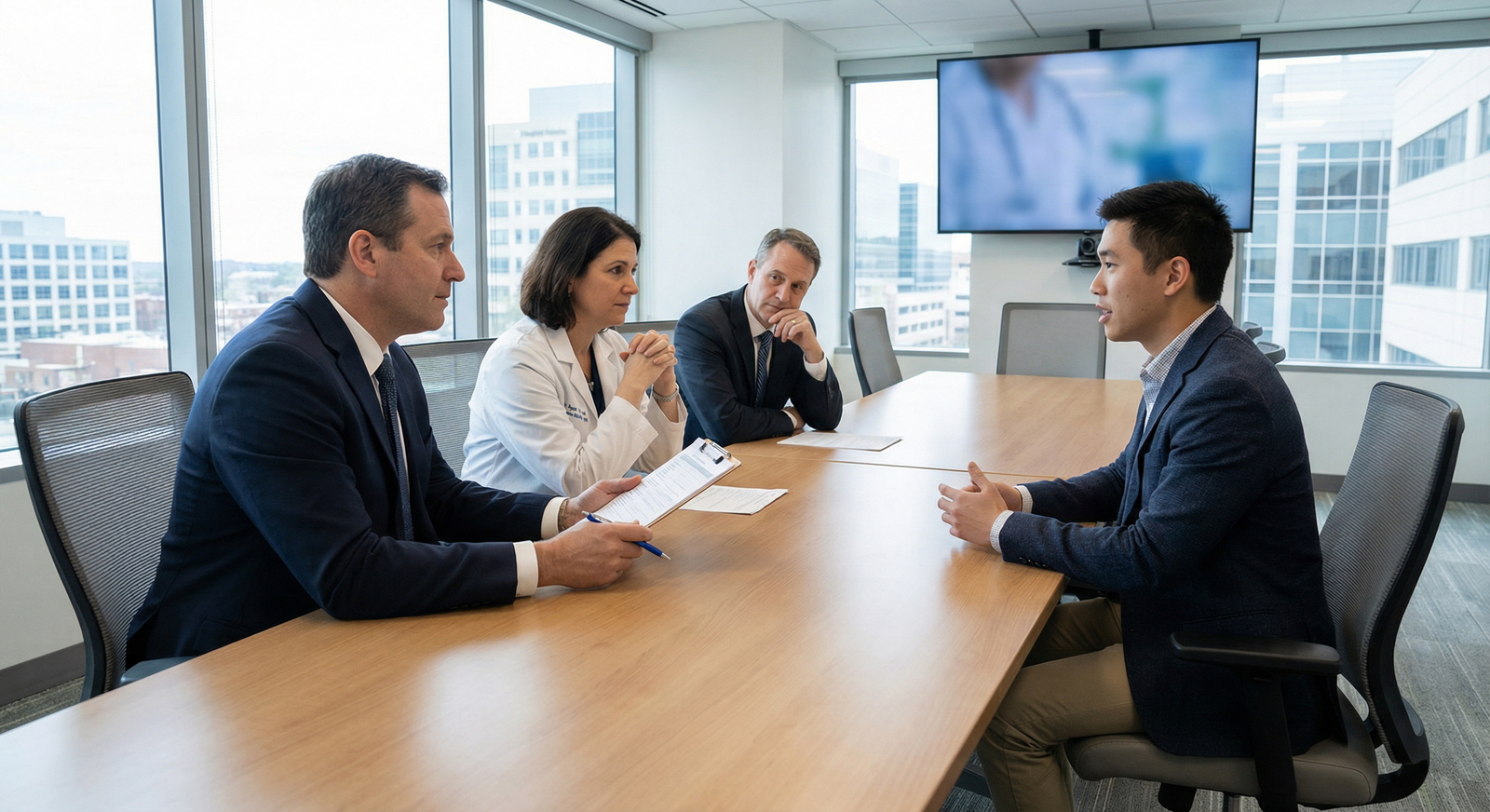
Understanding the Unique Nature of EM-IM Combined Interviews
Emergency Medicine–Internal Medicine (EM IM combined) residency programs attract applicants who are comfortable with complexity, uncertainty, and high-acuity care—both in the ED and on the wards. Pre-interview preparation for these programs must therefore be more deliberate and nuanced than for categorical programs.
You’re not only preparing for residency interview preparation in general; you’re preparing to show that you understand:
- What makes emergency medicine internal medicine combined training distinct
- Why you specifically want a dual pathway rather than EM alone or IM alone
- How your skills and personality fit two fast-paced but very different clinical cultures
- How you’ll use this dual training in your career (critical care, ED observation, hospital leadership, global health, etc.)
This guide walks step-by-step through how to prepare for interviews in EM-IM combined programs—from early research through mock interviews, logistics, and mental preparation—so you can go into interview day confident, organized, and ready to tell your story.
Step 1: Understand the EM-IM Pathway and Clarify Your “Why”
Before you rehearse any answer or polish your suit, you need clarity about your motivations. EM-IM programs will press you on this.
1.1 Know the Structure and Outcomes of EM-IM Training
Most EM-IM combined programs are 5 years, integrating:
- Emergency medicine rotations: ED shifts, trauma, ultrasound, toxicology, EMS
- Internal medicine rotations: inpatient wards, ICU, subspecialty consults, continuity clinic
- Hybrid or integrated experiences: ED observation units, medical EDs, ED-based acute care for complex medical patients
Graduates may:
- Practice both EM and IM clinically
- Complete a fellowship (e.g., Critical Care, Ultrasound, Toxicology, Palliative Care, Hospital Medicine)
- Take on academic or administrative roles bridging inpatient and ED settings
Being able to articulate that you understand these paths—and where you may fit—is a core part of pre-interview preparation.
1.2 Develop a Clear, Honest “Why EM-IM?” Narrative
You will almost certainly be asked some version of:
- “Why EM-IM combined instead of emergency medicine alone?”
- “Why not just internal medicine?”
- “What drew you to a dual-training pathway?”
Before interview season:
Reflect on your clinical experiences
- Times you enjoyed undiagnosed, high-acuity presentations in the ED
- Cases where you wanted to follow a patient beyond initial stabilization into ICU or ward care
- Longitudinal relationships in continuity clinic or inpatient medicine that appealed to you
Identify patterns
- Do you enjoy initial resuscitation and complex medical decision-making over time?
- Do you like systems thinking, flow, and disposition planning across the ED–inpatient interface?
Draft a concise narrative (2–3 sentences) that connects:
- Your experiences
- Your strengths
- Your future goals
Example:
During my EM rotation I loved stabilizing complex, undifferentiated patients, but I found myself wanting to see how our decisions played out on the wards and in the ICU. On IM, I enjoyed longitudinal management and complex diagnostic puzzles, but I missed the team dynamics and rapid decisions of the ED. EM-IM combined training feels like the natural way to build a career focused on bridging acute care and inpatient medicine, especially for critically ill and medically complex patients.
Write this out, read it aloud, revise it until it sounds natural.
1.3 Anticipate Skepticism and Prepare Thoughtful Responses
Some faculty will test your commitment by asking:
- “What if you could only match in EM or only in IM?”
- “Aren’t you worried about burnout with dual training?”
- “How will you maintain competence in both specialties?”
These are not trick questions—they’re opportunities. Before the interview, outline 2–3 talking points for each:
Example talking points:
On burnout:
- You understand the intensity of a 5-year program
- You’ve developed sustainable habits for wellness, time management, and support
- You see dual training as a better long-term fit than forcing yourself into a single specialty that doesn’t fully match your interests
On competence in both fields:
- You know EM-IM graduates have well-defined pathways (e.g., EM + ICU, ED observation, hospital medicine leadership)
- You value maintaining a broad skill set and working at the ED–inpatient interface where dual training is an asset
Writing these down as part of your residency interview preparation will make your answers sound confident rather than defensive.

Step 2: Program Research and Strategic Preparation
Generic interview answers stand out poorly in EM-IM combined interviews. Programs are small, niche, and tightly knit—faculty can immediately tell who has done their homework.
2.1 Create a Structured Research Template
For each EM-IM program, build a 1-page summary (digital or printed) with:
- Program basics
- Number of EM-IM residents per year
- Total residents in EM and IM separately
- Associated hospitals and ED volumes
- Curriculum details
- Unique rotations (ED-ICU, observation, ultrasound, toxicology, research)
- Schedule structure (block vs longitudinal)
- How EM and IM time are interleaved across 5 years
- Fellowship and career outcomes
- Common fellowships EM-IM grads pursue (e.g., Critical Care, Ultrasound, Administration)
- Practice patterns of recent grads (split practice, academic vs community)
- Program culture
- Mission statements emphasizing underserved care, academics, QI, or global health
- Evidence of strong mentorship or scholarly expectations
- EM-IM specific information
- EM-IM program leadership and their career paths
- Any published information about the role of EM-IM residents (e.g., leadership in observation units, ICU, ED flow pathways)
Distilling this ahead of time positions you to ask sharper questions and tailor your responses.
2.2 Prepare Program-Specific Questions
Near the end of most interviews, you’ll be asked: “What questions do you have for us?”
Arrive with 2–4 thoughtful questions tailored to each program that reflect:
- Your understanding of EM-IM combined training
- Your interest in what they specifically offer
Examples related to EM-IM:
- “How do EM-IM residents typically integrate into both EM and IM leadership structures—for example in committees or quality improvement projects that span the ED and inpatient units?”
- “What are the most common career paths your EM-IM graduates pursue, and how does the program support residents in deciding where to focus?”
- “How have EM-IM residents contributed to improving transitions of care between the ED and the wards or ICU here?”
- “Can you describe the support system for EM-IM residents, given they intersect with two departments and cultures?”
Avoid questions that can be answered by a 30-second website visit, such as basic call schedule structure or whether there is a simulation center—unless you are asking for deeper detail.
2.3 Know Your Interviewers
If your interview schedule is released ahead of time:
- Look up faculty backgrounds
- EM vs IM training
- Subspecialty focus (toxicology, ultrasound, ICU, hospital medicine, administration, global health)
- Research interests and recent publications
Use this to:
- Tailor questions (e.g., about critical care pathways, ultrasound education, or ED operations)
- Connect your interests to theirs (“I saw you’ve done work in ED-based observation units; I’m very interested in how EM-IM training fits into that model.”)
If the schedule isn’t released before the day, you can still familiarize yourself with:
- Program leadership bios
- Recent EM-IM-specific initiatives or publications at the institution
Step 3: Mastering Core Residency Interview Questions (EM-IM Focus)
Standard interview questions residency applicants get will all appear in EM-IM interviews, but the content of your answers should reflect a dual perspective.
3.1 Behavioral and Classic Questions to Prepare
You should have clear, practiced (but not robotic) answers ready for:
- “Tell me about yourself.”
- “Why EM-IM combined?”
- “Why this program?”
- “Tell me about a difficult patient encounter.”
- “Tell me about a time you had a conflict on the team.”
- “What are your strengths and weaknesses?”
- “Describe a clinical case that influenced your specialty choice.”
- “How do you handle stress or high-acuity situations?”
- “Where do you see yourself in 5–10 years?”
- “What would you do if you don’t match in EM-IM?”
3.2 Tailoring Your Answers for a Combined Pathway
“Tell me about yourself.”
Include elements that illustrate compatibility with both EM and IM:
- Comfort with high acuity and rapid decision-making
- Appreciation for longitudinal care and complex medical thinking
- Examples of leadership, communication, and systems thinking
Case example:
I grew up in a rural area with limited acute care resources, which first drew me to medicine. On my clerkships, I was consistently drawn to the ED because I enjoy working in high-acuity, undifferentiated situations with a tight-knit team. At the same time, I found myself wanting to stay involved in patients’ longer-term trajectories on the wards and in the ICU. That tension is what led me to EM-IM. I’ve pursued experiences—like working on an ED–ICU handoff quality project—that sit at that interface and confirmed how much I enjoy bridging those two worlds.
“What are your strengths?”
Select strengths that apply to both specialties:
- Ability to stay calm and organized when juggling multiple tasks
- Efficient information gathering and prioritization
- Collaborative communication across interdisciplinary teams
- Curiosity and analytic thinking over time for complex cases
“What are your weaknesses?”
Use an honest but growth-oriented example—ideally something you’ve worked on that’s relevant to EM-IM:
Earlier in medical school I sometimes took on too much responsibility independently before looping in my team, especially during busy ED shifts. I received feedback on that and have since focused on improving real-time communication and escalation—now I intentionally check in more often with my senior or attending when the situation is evolving quickly. It’s made me a better team player and safer clinician, particularly in high-acuity settings.
3.3 EM-IM Specific Questions to Anticipate
You should be prepared for questions that test your understanding of emergency medicine internal medicine combined training:
- “What does a typical week you’d enjoy look like as an EM-IM attending?”
- “How do you see yourself balancing EM and IM over the course of your career?”
- “What unique challenges do you anticipate in EM-IM training?”
- “How do you think EM-IM residents benefit the hospital system?”
Outline short bullet responses in advance, for example:
- Benefits to the system:
- Improved transitions of care ED→wards/ICU
- Insight into admission criteria and disposition decisions
- Leadership potential in observation units, step-down units, and ED–inpatient flow
- Ability to lead quality and safety projects spanning ED and inpatient medicine
Having these rehearsed but flexible will make you sound both prepared and thoughtful.
Step 4: Deliberate Practice – Mock Interviews, Stories, and Feedback
Preparation isn’t only about what you know; it’s about how you communicate under pressure.
4.1 Build a Personal Story Bank
Before interview season, list 8–10 specific stories from:
- Clerkships (especially EM, IM, ICU)
- Sub-internships or acting internships
- Research or QI projects
- Leadership, teaching, or volunteer roles
- Non-medical experiences that show resilience or teamwork
Categorize them by themes:
- Teamwork and communication
- Handling conflict
- Managing high-acuity or stressful situations
- Coping with uncertainty or diagnostic complexity
- Learning from mistakes or feedback
- Leading in a challenging environment
This “story bank” allows you to adapt to many behavioral questions quickly.
Example EM-IM relevant stories:
- A time in the ED when you collaborated with ICU and medicine teams to decide on disposition
- A complex patient who deteriorated on the floor and required rapid escalation and transfer to ICU
- A QI project on ED-to-inpatient handoffs or readmissions
4.2 Practice Out Loud—Not Just in Your Head
Silent preparation often falls apart under real interview pressure. Instead:
- Record yourself answering common questions:
- Notice filler words (“um,” “like,” “you know”)
- Check for rambling or overly long answers
- Refine your responses to:
- Lead with a clear point
- Use 1 concise example
- Wrap up with what you learned or how it shapes your future as an EM-IM physician
Aim for 60–90 seconds on most answers; 2 minutes maximum for more complex questions.
4.3 Participate in Mock Interviews
Use:
- Your home EM and IM departments
- Career advisors, deans, or faculty mentors
- EM-IM residents or alumni if available
- Trusted classmates or friends (especially those applying EM or IM)
Ask for specific feedback on:
- Clarity of your “Why EM-IM?” answer
- Consistency of your story across questions
- Nonverbal communication (eye contact, posture, pacing)
- Whether you sound genuinely excited about the EM-IM pathway—not just “undecided” between EM and IM
Document the feedback after each mock interview and make 2–3 targeted adjustments.
Step 5: Logistics, Professionalism, and Virtual Interview Setup
Even the strongest content can be undermined by poor logistics or unprofessional presentation. Pre-interview preparation must include practical details.
5.1 Organize the Interview Season
Use a spreadsheet or project management tool to track:
- Program name and city
- Interview date and time (with time zones)
- Interview format (virtual vs in-person; number and length of interviews)
- Pre-interview socials and logistics
- Key program notes and questions you plan to ask
- Residents or faculty you’ve interacted with
This serves multiple functions:
- Keeps you punctual and prepared
- Helps avoid confusing programs or repeating generic questions
- Supports later rank list decisions
5.2 Professional Appearance and Attire
For both virtual and in-person interviews:
- Wear conservative, professional attire (suit or equivalent)
- Neutrals or muted colors generally photograph best
- Ensure your white coat, if used for any tour, is clean and fits appropriately
- Minimize distracting accessories
Residency committees want to see someone who could walk into an ED or ward and instantly be recognized as a professional.
5.3 Virtual Interview Setup (If Applicable)
If your EM-IM interviews are virtual:
Background:
- Neutral, uncluttered wall or bookcase
- Avoid virtual backgrounds if possible (they can glitch)
Technology check:
- Stable internet connection (test at interview time of day)
- Working camera with clear image
- Quality microphone or headset
Lighting:
- Light source facing you, not behind
- Avoid backlighting from windows
Positioning:
- Camera at eye level
- Maintain natural eye contact (looking at the camera when speaking)
Do a full test call with a friend or mentor 2–3 days before your first interview.
5.4 Time Zone, Travel, and Contingency Planning
EM-IM programs are often widely geographically distributed. If you’re interviewing across time zones:
- Confirm times in your calendar in your local time
- Set multiple alarms and reminders
- Have a backup plan for internet or transportation issues (e.g., nearby quiet location with reliable Wi-Fi, earlier travel on in-person days)
Being even a few minutes late to an interview can color impressions—this is part of professionalism in EM and IM.
Step 6: Mental Preparation, Wellness, and Authenticity
EM-IM combined training is demanding; interviewers are looking not just for competence, but for sustainable, grounded residents.
6.1 Define Your Personal Values and Boundaries
Before interviews, clarify:
- What you value in a training environment (e.g., collegiality, mentorship, diversity, ICU exposure, ED volume, support for research)
- Your limits regarding geography, schedule intensity, or specific program features
This self-knowledge leads to more authentic answers when you’re asked:
- “What are you looking for in a residency program?”
- “What kind of environment do you thrive in?”
6.2 Plan Pre-Interview Routines
Develop a simple routine to help you feel grounded and focused:
- Sleep hygiene in the days before
- Light exercise the morning of (walk, stretching)
- A consistent breakfast or meal plan
- Brief review (10–15 minutes) of your notes, not a full re-study
Avoid last-minute over-preparation the night before; this often increases anxiety and does not improve performance.
6.3 Practice Authenticity—Not Perfection
Programs are not looking for a flawless script; they’re looking for:
- Genuine enthusiasm for EM-IM combined training
- Humility and capacity for growth
- Team players who can handle both ED chaos and ward complexity
- People they want to work beside at 2 a.m.
Allow yourself to:
- Pause and think before answering
- Admit when you don’t know something, especially about research or long-term plans
- Show appropriate vulnerability when discussing challenges or failures, while emphasizing growth
Authenticity is especially important in small, tight-knit EM-IM programs, where cultural fit matters enormously.
Frequently Asked Questions (FAQ)
1. How is pre-interview preparation for EM-IM combined different from categorical EM or IM?
You must prepare for all the standard residency interview preparation elements—common questions, professionalism, logistics—but with an added layer:
- You need a clear, well-defended “Why EM-IM?” answer
- You must understand both emergency medicine and internal medicine cultures and training structures
- You should be ready to discuss career paths unique to EM-IM (ED-ICU, hospital leadership, observation medicine, critical care)
- Your stories should reflect comfort in both acute undifferentiated care and longitudinal/internal medicine thinking
Generic “I like procedures and continuity” answers without connecting them specifically to EM-IM will feel thin.
2. What are some EM-IM–specific red flags during interviews?
Possible concerns programs may have (which you can preempt in your preparation) include:
- Appearing undecided between EM and IM rather than truly committed to combined training
- Little or no exposure to either EM or IM in meaningful depth
- No clear understanding of what EM-IM graduates actually do
- Indications of poor time management or difficulty handling stress (critical in a 5-year dual program)
- Inability to describe a coherent career vision, even if tentative
Preparing your narrative and stories beforehand helps you avoid accidentally signaling these concerns.
3. How many mock interviews should I do before my EM-IM interviews?
Quality matters more than quantity, but a good target is:
- 2–3 formal mock interviews with faculty, advisors, or residents (ideally including at least one in EM or IM)
- 2–4 informal practice sessions with peers focusing on common EM-IM questions
Each time, implement specific feedback. It’s better to have 4–5 high-yield practice sessions with reflection than 10 rushed or repetitive ones.
4. How detailed should my answers be when discussing clinical cases in EM-IM interviews?
Aim for a structure like:
- Brief context (1–2 sentences)
- Key clinical issue or challenge
- Your role and actions
- The outcome
- What you learned and how it shapes you as a future EM-IM physician
Avoid getting lost in lab values or minutiae unless specifically asked. Focus on:
- Your reasoning
- Communication with team and consultants
- How the case influenced your specialty choice or professional growth
This framing shows both clinical maturity and reflection—critical traits for an EM-IM resident.
Thoughtful, early pre-interview preparation tailored to EM-IM combined programs will not only improve your performance on interview day, but will also help you confirm that this unique, demanding, and rewarding pathway truly fits who you are and who you want to become as a physician.