Understanding the EM Match Landscape as an MD Graduate
Emergency medicine is a highly dynamic specialty that attracts MD graduates who enjoy fast-paced clinical care, critical decision-making, and team-based environments. As an MD graduate residency applicant, you bring the advantage of an allopathic medical school match profile, but you also face increasing competition and evolving program expectations.
Before you dive into residency interview preparation, it helps to understand what EM program directors are looking for and how the interview fits into the broader allopathic medical school match process.
What EM Program Directors Look For
Most EM programs emphasize:
- Clinical competence – Solid performance on EM rotations and sub-internships
- Fit with the specialty – Genuine interest in acute care, teamwork, and shift-work lifestyle
- Communication and professionalism – Your behavior during interviews, social events, and email exchanges
- Resilience and adaptability – Ability to handle high stress, uncertainty, and emotional situations
- Team orientation – How well you collaborate with nurses, techs, consultants, and peers
- Commitment to learning – Evidence of curiosity, reflection, and growth
Standard metrics like USMLE/COMLEX scores and class rank open the door, but interviews determine your rank list position. Your performance during residency interview preparation will significantly impact your EM match outcome.
Why Pre-Interview Preparation Matters in EM
Emergency medicine residency interviews are unique because EM culture is:
- Informal but highly observant – Programs see how you interact casually at pre-interview dinners and in hallways.
- Team-driven – Faculty and residents will evaluate how you engage in group settings.
- Communication-heavy – Your ability to present clinical scenarios and explain your thought process is central.
Good pre-interview preparation allows you to:
- Communicate a clear, authentic narrative for “Why Emergency Medicine?”
- Demonstrate insight into the EM lifestyle and demands
- Show you understand their program’s structure, patient population, and values
- Answer and ask questions that reflect critical thinking, maturity, and self-awareness
Clarifying Your EM Story and Application Strategy
Before you work on specific residency interview preparation tactics, step back and define the story you want your interviews to tell.
Step 1: Revisit Your Application Materials
Read through your full ERAS application exactly as a program director would:
- Personal statement
- ERAS experiences section
- EM rotation evaluations and SLOEs
- Letters of recommendation
- CV, publications, and leadership positions
Ask yourself:
- What themes emerge? (e.g., teamwork, underserved care, global health, leadership, ultrasound)
- Where are there gaps or red flags that will prompt interview questions? (score dips, leaves of absence, specialty changes, professionalism notes)
- Which experiences best represent your readiness for emergency medicine?
List 5–7 key experiences that define you as an EM applicant. These will be anchors you return to repeatedly when answering interview questions.
Example anchor experiences:
- Night shift on EM sub-I managing simultaneous sick patients
- A resuscitation you led or significantly contributed to
- A difficult patient interaction that changed your approach to communication
- A QI project that improved ED throughput or sepsis protocols
- Teaching junior students during a busy EM shift
You will use these stories to answer many common interview questions residency programs ask.
Step 2: Craft Your EM Personal Narrative
Every MD graduate residency candidate in EM needs a concise, authentic narrative answering:
- Why medicine?
- Why emergency medicine specifically?
- Why now (after all your training experiences)?
Create a “story spine” you can adapt:
- A defining moment that introduced you to emergency care (e.g., an ED shadowing experience, a powerful patient encounter)
- Followed by how subsequent experiences reinforced and clarified your interest
- Concluding with how your skills and personality match EM demands (e.g., comfort with uncertainty, fast decision-making, team collaboration)
You don’t need a dramatic trauma story; programs care more about reflection and self-awareness than shock value.
Example (condensed) narrative:
“I initially thought I’d be a hospitalist, but on my internal medicine rotation I noticed my favorite moments were admitting patients from the ED and hearing the rapid-fire, focused handoffs. I did an early EM elective and was struck by how the ED team functioned under pressure—everyone knew their role, and decisions were made quickly but thoughtfully. On my EM sub-I, I realized I enjoy forming rapid connections, managing undifferentiated complaints, and coordinating care across services. I’m comfortable with uncertainty and I like the idea that every shift is a chance to help someone on one of the worst days of their life. That combination of acute care, teamwork, and patient-centered communication is what solidified my decision to pursue emergency medicine.”
This narrative can be adapted for “Tell me about yourself,” “Why EM?” and “Walk me through your path to emergency medicine.”

Mastering Core Emergency Medicine Interview Questions
Emergency medicine interviews frequently draw from a familiar pool of prompts. As you think about how to prepare for interviews, your goal is not to memorize scripts, but to practice structured, flexible answers that sound natural.
Below are common EM-specific interview questions residency programs ask and how to prepare for each.
1. “Tell Me About Yourself” (TMAY)
This is often your first question and sets the tone.
Structure it as:
- Brief background
- Medical school highlights
- Transition into EM motivation
Example:
- Origin (where you grew up or key identity points)
- Medical school overview (not a re-reading of your CV—just 2–3 themes: leadership, research, service)
- Link to EM (1–2 sentences previewing your “Why EM” narrative)
Practice a 60–90 second answer that feels conversational.
2. “Why Emergency Medicine?”
Programs are screening for:
- Realistic understanding of EM practice
- Alignment with EM culture and lifestyle
- Evidence-based motivation, not just “I like variety”
Include:
- Acknowledgment of challenges (burnout, crowding, shift work, difficult patients)
- Specific aspects you’re drawn to (resuscitation, ultrasound, social emergency medicine, operations, medical education)
- Concrete experiences that shaped your interest
Avoid clichés like “I like procedures and adrenaline” unless you elaborate with deeper reflection.
3. “Why This Program?”
This question tests your pre-interview preparation and genuine interest.
To answer well:
- Identify 3–4 specific features of the program:
- Patient population
- ED volume and acuity
- Ultrasound training, toxicology, global EM, EMS
- Resident culture, wellness initiatives
- Fellowship opportunities and career outcomes
- Connect these to your own goals and experiences.
Example:
“I’m particularly interested in training in a high-volume county setting, and your ED’s mix of underserved populations and high acuity aligns with my experience at [home institution]. I’m drawn to your ultrasound curriculum and the opportunity to serve as an ultrasound chief, as I’ve really enjoyed teaching bedside ultrasound to MS3s. Lastly, every resident I spoke with mentioned the supportive culture and faculty approachability, which is particularly important to me as I think about learning high-stakes skills like airway management.”
4. Behavioral and Situational Questions
Programs want to see how you think and reflect. Common prompts:
- “Tell me about a time you made a mistake.”
- “Describe a conflict with a team member and how you handled it.”
- “Tell me about a stressful situation and what you did.”
- “Describe a time you had to give difficult feedback.”
Use the STAR framework:
- Situation – Brief context
- Task – What your role was
- Action – What you did
- Result/Reflection – Outcome and what you learned
Focus on:
- Owning your role (avoid blaming others exclusively)
- Demonstrating growth and insight
- Relating the lesson to EM practice (communication, resilience, team leadership)
5. Clinical Scenario Questions
Emergency medicine interviews may test your clinical reasoning:
- “How would you approach a patient with chest pain in the ED?”
- “A 25-year-old comes in with shortness of breath—walk me through your differential.”
- “What would you do if you strongly disagreed with your attending’s plan in a resuscitation?”
You are not expected to be an EM resident yet, but you should:
- Show organized thinking (life threats first, ABCs, broad differential)
- Verbalize considerations for disposition and consultation
- Emphasize teamwork, communication, and patient safety
Frame your answers with EM structure:
- Initial stabilization and vital signs
- Focused history and physical
- Differential diagnosis and risk stratification
- Initial workup and management
- Reassessment and disposition
6. Red-Flag and Context Questions
If your file has any perceived “red flags,” assume they may come up:
- Gap year or leave of absence
- Step failure or large score drop
- Change of specialty
- Professionalism concern or remediation
Prepare:
- A concise, honest explanation
- Responsibility for your part
- Concrete steps you took to address the issue
- Articulation of what you learned and how you changed
Avoid over-explaining or sounding defensive. Your aim is to reassure programs that the issue is recognized, resolved, and unlikely to recur.
Researching Programs and Building a Targeted Notes System
One of the most powerful residency interview preparation steps is systematic program research. As an MD graduate residency candidate doing a broad allopathic medical school match, you may have 10–20+ EM interviews. You will not remember details without a plan.
Step 1: Program-Level Research
For each program, review:
- Website (curriculum, EM tracks, ultrasound, EMS, research)
- ED setting (academic, community, county, hybrid)
- Patient population and catchment area
- ED volume and trauma designation
- Off-service rotations (MICU, SICU, anesthesia, peds EM)
- Unique features (global health, social EM, simulation, toxicology)
- Resident class size and faculty interests
In addition, check:
- Social media (program’s Twitter/X, Instagram, EM interest group pages)
- SAEM/EMRA resources and program guides
- Word of mouth from recent graduates or upper-class residents
Step 2: Create a “Program Snapshot” Template
Use a spreadsheet or note-taking app to create 1 page per program with:
- Program basics: Location, type, ED volume, length (3 vs 4 years)
- Top 3 reasons you’re interested
- Potential mentors with overlapping interests
- Questions to ask:
- About education and feedback
- About resident wellness and scheduling
- About fellowships or career pathways
- Concerns or deal-breakers (e.g., lack of peds exposure, limited ultrasound time)
This serves multiple purposes:
- Helps you answer “Why this program?”
- Provides tailored, thoughtful questions to ask interviewers
- Becomes a critical reference later when you create your rank list
Step 3: Tailor Questions for Different Interviewers
Prepare question sets for:
- Program Director / APD:
- “How do you see this program evolving in the next 3–5 years?”
- “How do you support residents pursuing academic vs community careers?”
- Core Faculty:
- “How is feedback typically delivered after shifts?”
- “What distinguishes successful residents in this program?”
- Residents:
- “What’s a typical week like for an intern?”
- “What’s one thing you would change about the program?”
- “How approachable are the attendings during busy shifts?”
Having structured, genuine questions shows programs you’re engaged and mature—and gives you critical data for ranking.
Practical Logistics and Communication: Getting the Details Right
Strong residency interview preparation includes mastering logistics. Poor organization or unprofessional communication can undo an otherwise strong EM match candidacy.
Managing Invitations and Scheduling
As an MD graduate in the allopathic medical school match, you may receive EM interview invitations quickly and unpredictably.
Tips:
- Use a primary email you check often and set notifications.
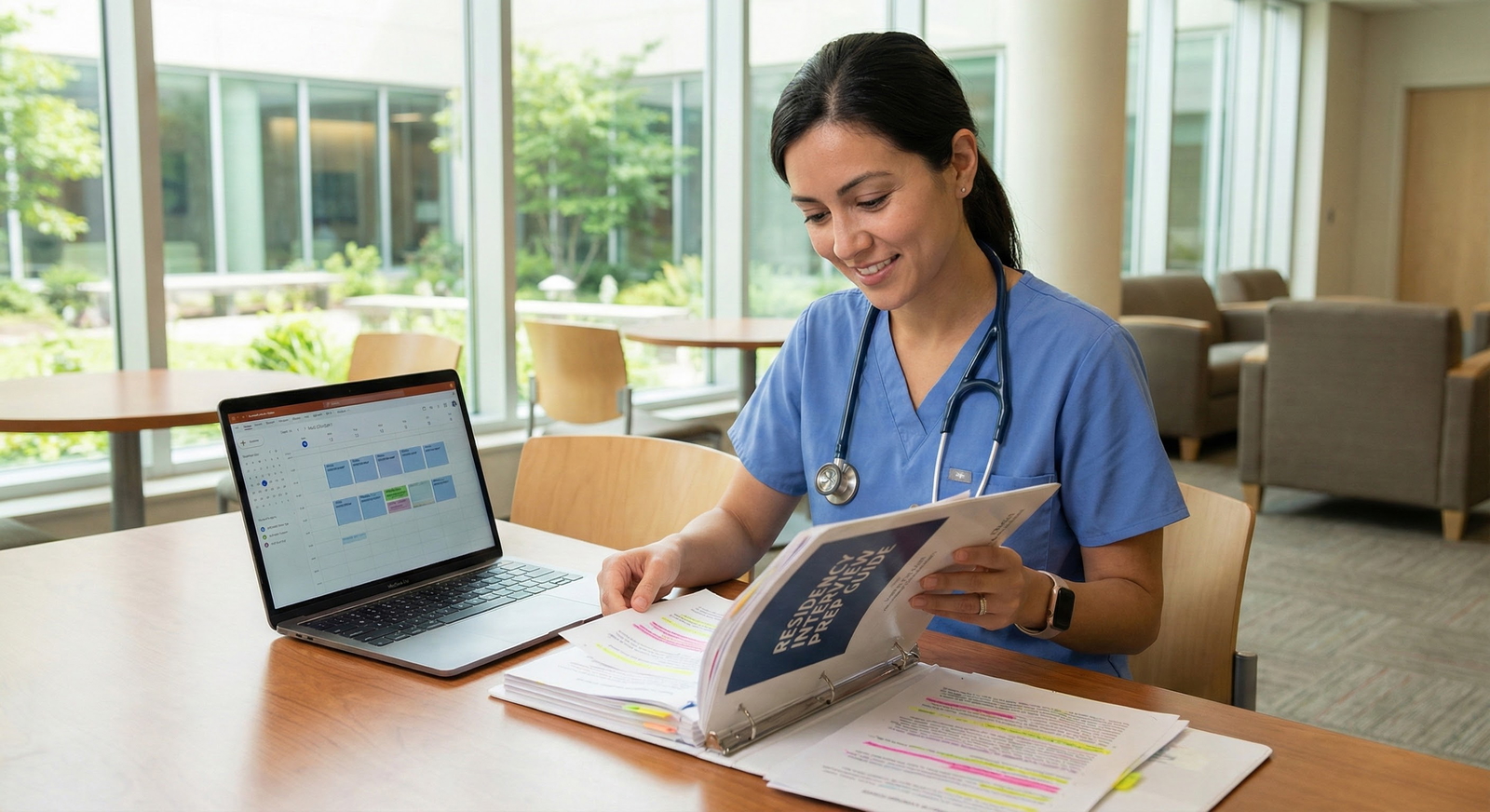
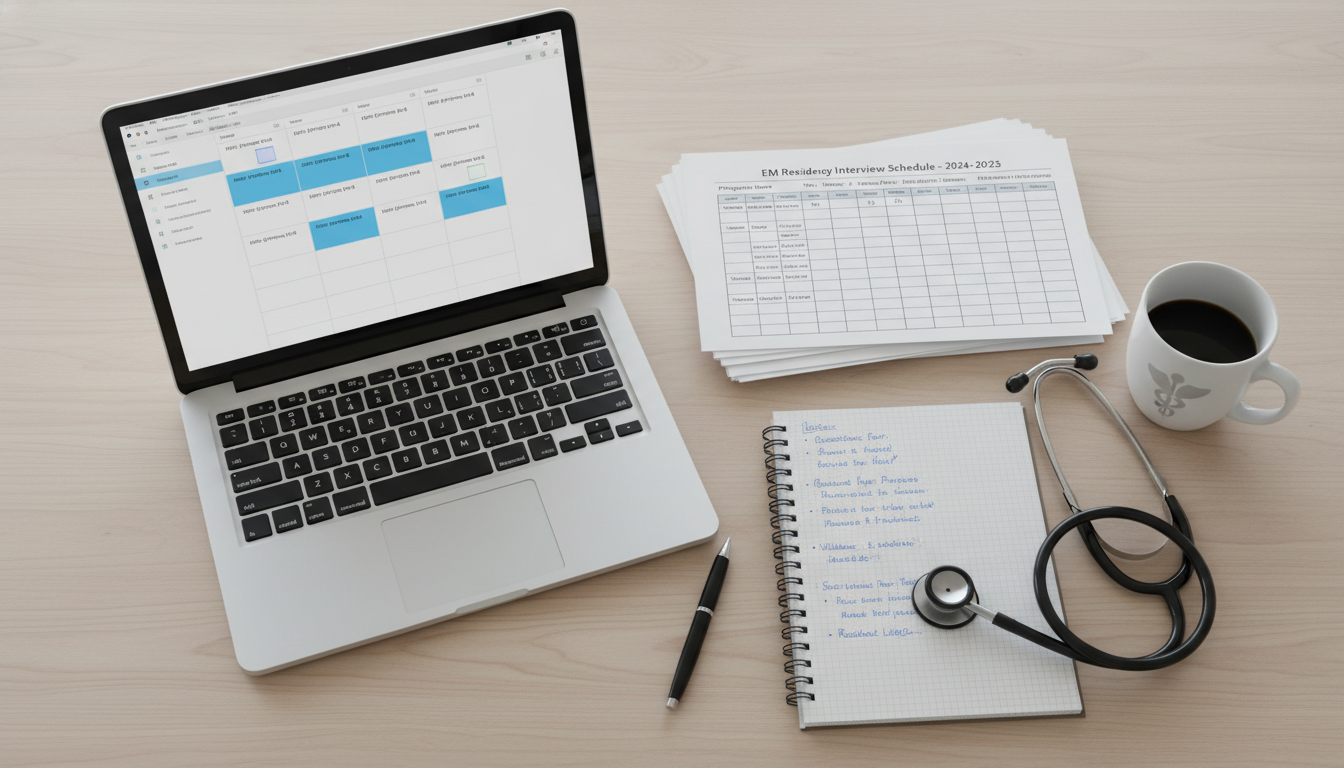
- Create a master calendar (digital or paper) with:
- Interview dates and times
- Time zones
- Contact person for each program
- Virtual links or travel details
- Confirm each interview with a short, professional reply if requested.
Be honest with yourself about exhaustion and travel. Emergency medicine interviews can be draining; avoid scheduling four interviews in four days if you can.
Virtual vs. In-Person Interviews
Many EM programs now use virtual formats, sometimes with optional in-person second looks.
Virtual interview preparation:
- Ensure reliable internet and a quiet, private space.
- Test camera, microphone, and lighting in advance.
- Choose a neutral, professional background (plain wall, bookshelf).
- Dress in full professional attire—head-to-toe—not just the visible half.
- Keep your ERAS application and program notes accessible but off-camera.
In-person preparation:
- Confirm location, parking, and arrival time.
- Know whether there is a pre-interview social and dress code (often business casual).
- Plan travel with time buffers for delays.
- Bring:
- A small notebook and pen
- A printed copy of your schedule
- A simple folder with copies of your CV (optional; rarely needed)
Professional Communication and Etiquette
Throughout the EM match process, your written and spoken communication reflects your professionalism.
- Address emails formally at first (e.g., “Dear Dr. [Last Name]”).
- Proofread emails for grammar and tone.
- Respond in a timely manner to coordinators and faculty.
- If you must cancel or reschedule:
- Do so as early as possible.
- Briefly apologize and thank them for the opportunity.
- Do not send daily updates or excessive emails; be respectful of time.
Post-interview thank-you notes are optional in many EM programs. If you send them:
- Keep them brief and specific.
- Do not make promises or statements that violate NRMP rules (e.g., “You will be my #1 rank” should be avoided in writing).
Mock Interviews, Self-Reflection, and Final Preparation
Beyond content and logistics, you must prepare your mindset and performance.
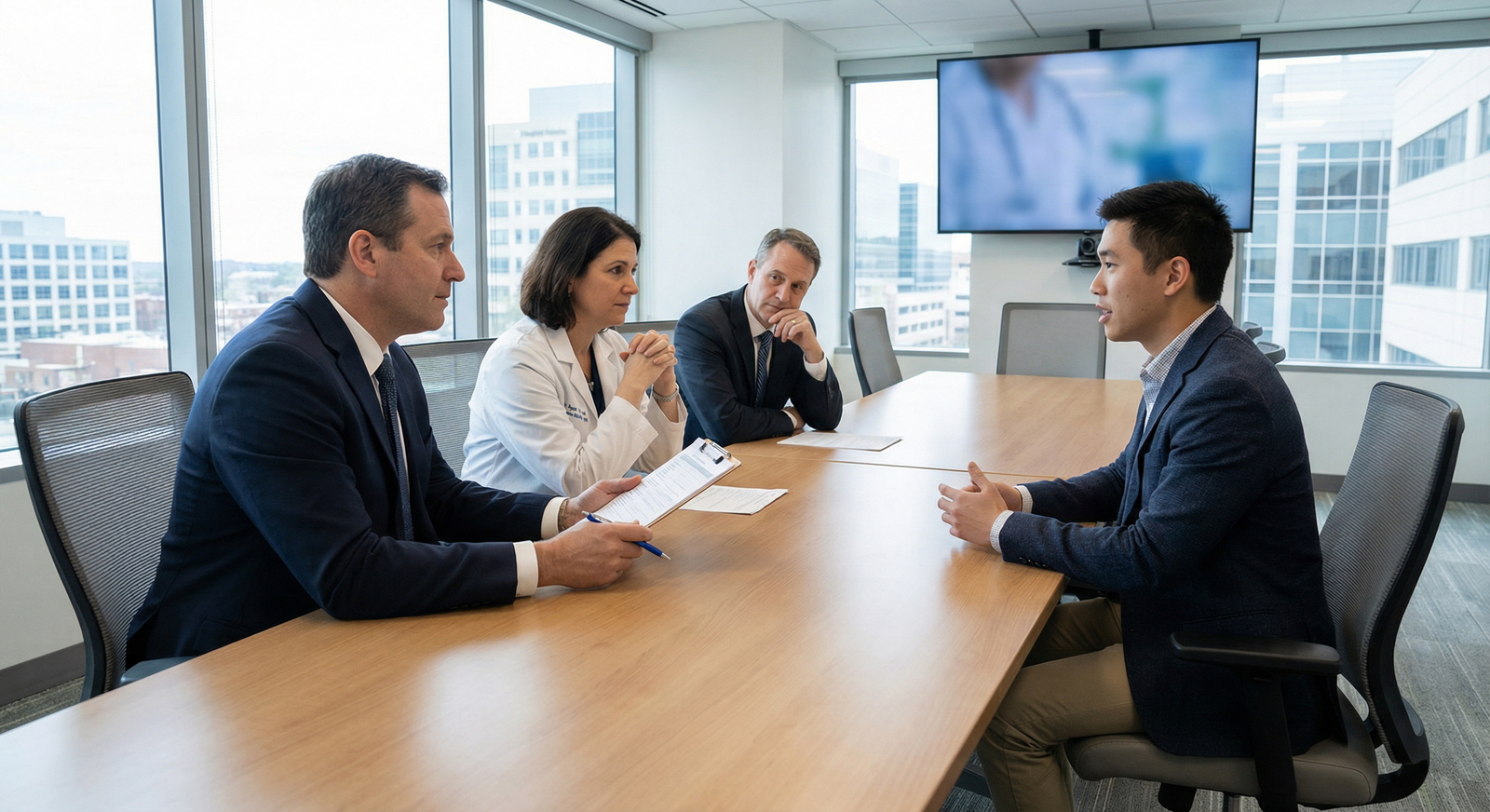
Conduct Structured Mock Interviews
At least 2–3 weeks before interviews begin:
- Arrange mock interviews with:
- EM faculty or advisors
- Career services
- Peers who can simulate faculty roles
- Ask for:
- Behavioral questions
- EM-specific “Why this specialty” and clinical questions
- Feedback on clarity, body language, and pacing
Record at least one session (with permission). Analyze for:
- Overuse of filler words (“um,” “like,” “you know”)
- Rambling or overly long answers
- Nervous mannerisms (pen clicking, hair twirling, looking away from camera)
Set concrete goals for improvement between sessions.
Build a Flexible Answer Bank
Instead of memorizing full paragraphs, create bullet-point schema for key questions:
- “Tell me about yourself”
- “Why EM?”
- “Why this program?”
- “Strengths and weaknesses”
- 3–5 clinical/scenario-based stories
- 3–5 examples of conflict, mistake, and growth
Practice adapting these frameworks rather than reciting them verbatim. Authenticity matters deeply in EM culture.
Managing Stress and Mindset
Emergency medicine is intense; programs want residents who manage stress constructively.
Before interviews:
- Prioritize basic sleep, hydration, and exercise routines.
- Practice brief grounding techniques:
- 4–7–8 breathing before logging in
- 10-second reset between interview rooms
- Remind yourself:
- Interviews are also your chance to evaluate whether the program fits you.
- Not every program will be a fit—and that’s okay.
After each interview day:
- Debrief with yourself:
- What did I like or not like about this program?
- How did I feel around the residents and faculty?
- What stood out about the ED, curriculum, or culture?
- Jot down impressions within 24 hours; you will forget details later.
These notes will be crucial when you formulate your EM match rank list.
FAQs: Pre-Interview Preparation for EM Residency (MD Graduates)
How early should I start residency interview preparation for emergency medicine?
For most MD graduate residency applicants, start focused pre-interview preparation about 4–6 weeks before your first EM interview:
- Weeks 1–2: Review application, define EM narrative, list key experiences
- Weeks 2–3: Research programs, build program snapshot notes, outline answers
- Weeks 3–4: Conduct mock interviews, refine structure, practice behavioral and clinical questions
- Ongoing: Update program notes, refine questions, maintain wellness routines
If you know you struggle with interviews, begin even earlier and schedule more mock sessions.
What are the most common interview questions residency programs ask in EM?
Patterns vary, but most EM programs include:
- “Tell me about yourself.”
- “Why emergency medicine?”
- “Why this program?”
- “Tell me about a time you made a mistake.”
- “Describe a challenging patient encounter.”
- “How do you handle stress or burnout?”
- “What are your strengths and weaknesses?”
- Occasionally: a simple clinical scenario (“How would you approach chest pain in the ED?”)
Preparing structured responses to these questions gives you a strong foundation for nearly any EM interview.
As an MD graduate, does my allopathic background help in the EM match?
Being an MD graduate from an allopathic medical school can be advantageous in the allopathic medical school match, as many EM programs are historically oriented around MD students. However, program directors prioritize:
- SLOEs and EM-specific performance
- Interview performance and perceived fit
- Professionalism and communication
- Genuine interest in the program
Your goal is to leverage your background but not rely on it; strong pre-interview preparation and thoughtful engagement during interviews will matter more than degree type.
How many mock interviews should I do to prepare for EM residency?
Most applicants benefit from 2–4 structured mock interviews:
- 1 with an advisor or faculty member for high-level feedback
- 1 focused on EM-specific and clinical reasoning questions
- 1–2 peer-based or career-services-based sessions for repetition and comfort
Beyond formal mock interviews, practice out loud by yourself. Rehearse core answers until you’re comfortable but still sound natural. The goal is confidence and clarity, not memorization.
By investing in deliberate, structured pre-interview preparation, you position yourself as a thoughtful, professional, and authentic emergency medicine candidate. When the time comes, you’ll walk into each EM match interview day prepared not only to answer questions— but to decide where you will best thrive as an emergency physician in training.