Essential Documents to Bring to Your Residency Interview: A Complete Checklist for Success
Preparing for a Residency Interview is about far more than practicing answers and polishing your handshake. The documents you bring—and how you organize and present them—send a powerful signal about your professionalism, attention to detail, and readiness for the demands of a medical career.
Programs rarely require you to hand over paper documents on interview day, since most information is already in ERAS or another application system. However, coming prepared with a well-organized set of key materials can:
- Help you answer questions with confidence and specificity
- Support conversations about your achievements, research, and future goals
- Demonstrate that you approach your medical career with structure and forethought
- Reduce last-minute stress and prevent avoidable mishaps
This guide expands the original checklist into a comprehensive, practical resource. You’ll find not only which documents to bring, but how many copies, how to organize them, and how to use them strategically during your interview day—whether it’s in-person or virtual.
Why Your Documents Matter in Residency Interviews
Professionalism and First Impressions
Residency programs are evaluating far more than your test scores. They are looking for colleagues who are:
- Reliable and organized
- Detail-oriented and prepared
- Able to manage complex tasks and deadlines
Arriving with a clean, structured documents folder or padfolio reinforces your image as someone who treats this next step in your medical career seriously. It reflects the same habits you’ll need when managing patient charts, consult notes, and orders on a busy ward.
Enhancing Interview Conversation and Communication
Well-chosen documents can actively support your interview conversation. For example:
- A printed CV can help you quickly reference specific dates, projects, or leadership roles.
- A research abstract can refresh your memory on methods or outcomes if you’re asked about details.
- Copies of presentations or posters can provide talking points about scholarly activity or quality improvement.
You may not physically show these documents to the interviewer, but having them at your fingertips can make your answers more specific, confident, and anchored in concrete examples.
Reducing Cognitive Load and Stress
Residency interview days are long, intense, and often involve multiple sessions with different faculty and residents. The last thing you want is to feel flustered because you can’t recall exact dates, positions, or details from your application.
A well-prepared packet of documents allows you to:
- Quickly check details during breaks
- Avoid awkward pauses when you can’t recall a date or title
- Feel more in control, which can boost your confidence and overall performance
Supporting Special Situations
Certain applicants may especially benefit from having thorough documentation:
- International Medical Graduates (IMGs) managing work authorization, visas, and foreign transcripts
- Non-traditional applicants with prior careers or extended research time
- Applicants with institutional actions or academic issues who may want to have supporting documentation or explanations ready
In these scenarios, having clear, organized documentation can help you answer tough questions professionally and transparently.
Core Residency Interview Documents Checklist
Below is a structured checklist of essential documents to bring to every in-person Residency Interview, and to have digitally at hand for virtual interviews.
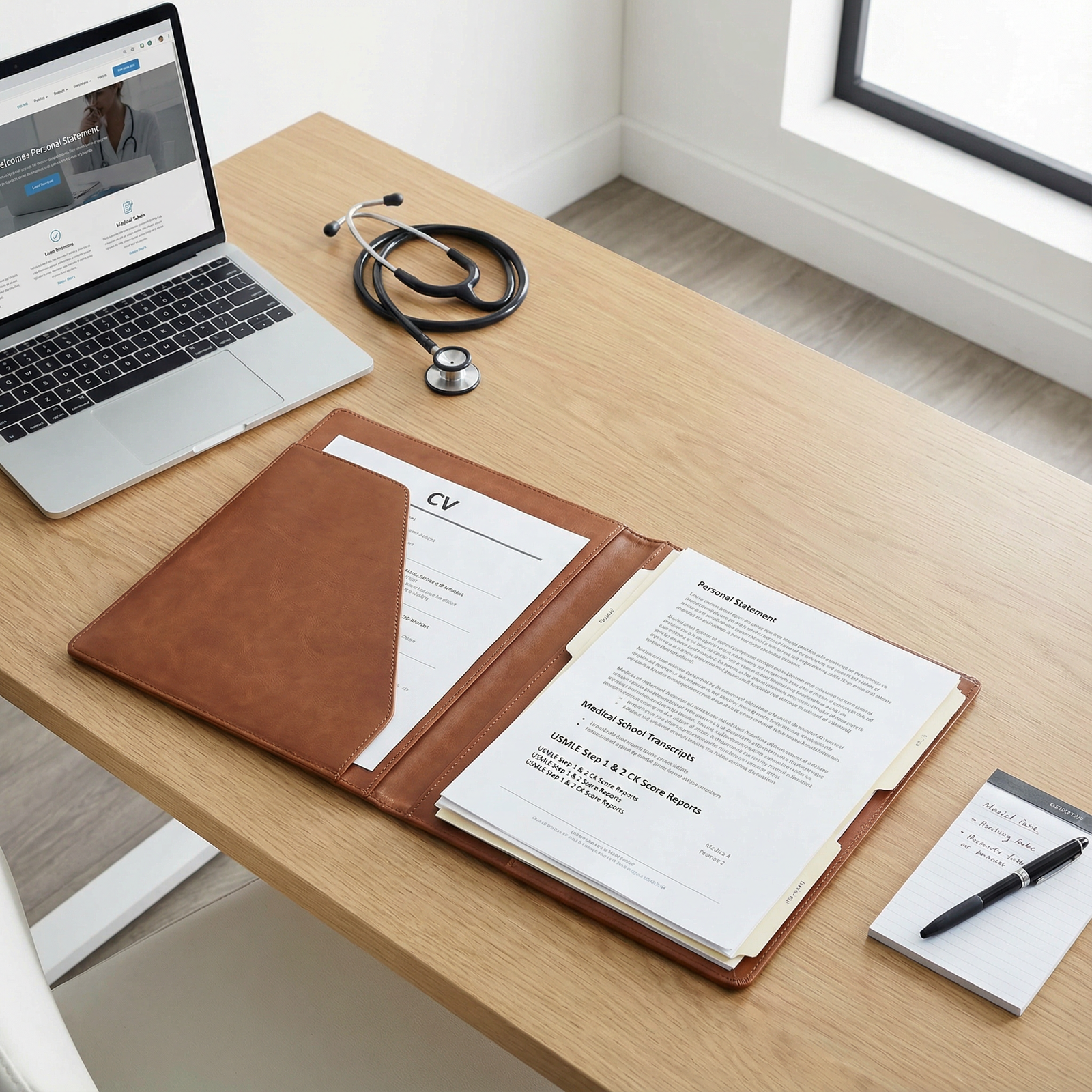
1. Updated Curriculum Vitae (CV)
Your CV is the backbone of your professional identity as a physician in training. Even though programs have already seen it, you should bring:
- 2–3 printed copies of your most recent CV
- A digital copy accessible on your phone or laptop (securely stored, e.g., in a password-protected drive)
Key points for Residency Interview preparation:
Ensure it’s fully updated
- Include recent rotations, electives, sub-internships, and any new responsibilities (e.g., chief roles, peer tutoring).
- Update ongoing research with current status (submitted, under review, accepted, published).
Tailor it slightly to your specialty
- For example, for Internal Medicine, you might highlight QI projects, outpatient experiences, and longitudinal care roles.
- For Surgery, you might emphasize operative exposure, procedural workshops, or anatomy teaching.
Polish the formatting
- Use a clean, professional font (e.g., Times New Roman, Calibri).
- Organize sections with clear headings: Education, Clinical Experience, Research, Publications, Presentations, Leadership, Volunteer Work, Skills.
- Keep margin and spacing consistent; avoid clutter and unnecessary graphics.
Having an updated, professionally formatted CV on interview day subtly reinforces your professionalism and attention to detail.
2. Personal Statement (Printed Copy)
Your personal statement is central to your story and motivation. Interviewers may reference it while speaking with you, and you should be intimately familiar with what you wrote.
Bring:
- 1–2 printed copies of your final submitted personal statement.
How to use it effectively:
- Refresh your memory before interviews. Review it during travel or the night before so your stories and examples are fresh.
- Prepare to expand on key themes. If you mentioned a formative patient encounter, important mentor, or hardship, be ready to elaborate with additional detail and reflection.
- Ensure consistency. Any new information you share during interviews should align with what you’ve written—no contradictions in timeline or emphasis.
This document is less about handing it out and more about aligning your spoken narrative with your written one.
3. Letters of Recommendation (If Available)
Most programs will not ask for physical copies of your letters of recommendation (LORs) since they’re already in ERAS. However, having them with you can be useful for your own reference.
Consider bringing:
- Personal copies of your LORs (if your writers shared them with you), organized and labeled.
- Do not distribute them to interviewers unless a program explicitly requests them.
How LORs help your interview preparation:
- Identify themes others see in you. Are you described as particularly compassionate, hardworking, a strong team player, or a natural leader? These strengths can become anchor points for your interview examples.
- Support your self-description. When you emphasize a quality in your answers, you can mentally tie it to what your recommenders have written (“My attending noted how I did X; here’s how that experience shaped my approach to patient care…”).
If a program asks for extra letters or updated LORs, you’ll be prepared to respond promptly after the interview.
4. Medical School Transcripts
Printed transcripts are not always requested on interview day, but they are important to have ready in case questions about coursework, remediation, or academic performance arise.
Bring:
- 1 official or sealed copy of your medical school transcript, if readily available,
or - 1–2 unofficial copies printed from your student portal (clearly marked as unofficial if applicable).
Best practices:
- Review them beforehand. Be ready to explain any dips in performance, course failures, leaves of absence, or extended time in medical school in a calm, non-defensive, and reflective way.
- Highlight key strengths. If you performed particularly well in rotations that align with the specialty, be ready to mention them (e.g., “I received honors on my sub-I in Internal Medicine and Neurology rotation”).
Some programs may ask to see official transcripts later in the Match process, so being prepared demonstrates foresight.
5. USMLE/COMLEX Score Reports
Score reports are central documents in your application and often guide the initial selection for interviews. On interview day, they may be used to clarify details or context.
Bring:
- 1–2 printed copies of your USMLE and/or COMLEX score reports (Step 1, Step 2 CK/Level 2, Step 3/Level 3 if taken).
- A digital version saved securely and easily accessible.
How to prepare:
Anticipate questions about your scores.
- If you had a lower score or a failed attempt, prepare a concise, honest explanation and—most importantly—what you learned and how you improved.
- If you have strong scores, be ready to connect them to habits of discipline and consistency you’ll bring to residency.
Know your score timeline. Programs might ask when you expect certain scores (e.g., Step 3) if not yet available.
Even if no one asks to see the physical copy, having it is a good risk-management step.
6. Application Confirmation and Interview Details
Logistics are a critical but often overlooked aspect of Professionalism. Nothing undermines a great clinical persona faster than being late or confused about where you’re supposed to be.
Have both digital and printed:
- Interview confirmation email (date, time, and format).
- Program contact information, especially the residency coordinator and main office phone number.
- Address, directions, and parking instructions for in-person interviews.
- Virtual platform details (Zoom, Thalamus, Teams, etc.) for online interviews, including meeting links and backup contact options.
Pro tips:
For in-person interviews, print a one-page summary sheet with:
- Program address
- Parking location and instructions
- Coordinator contact
- Interview start time and estimated end time
For virtual interviews, keep:
- A backup device (phone, tablet) ready for connection issues
- Tech check notes (test run completed, lighting, camera angle, background)
Being prepared for logistics is part of core interview preparation and signals reliability.
7. Proof of Insurance and Relevant Cover Letters (If Requested)
Some programs or affiliated hospitals may ask for:
- Proof of liability insurance for visiting students (especially if you are doing an away rotation or second-look visit).
- Specific cover letters or program-directed statements that you submitted as part of a supplementary application.
If a program has mentioned these in prior communication or in their instructions, bring:
- Printed copies of any requested documentation (1–2 each).
- Digital backups in your email or cloud storage.
This is more situational, but failing to bring requested documents can reflect poorly on your attention to directions.
8. Professional Portfolio: Certificates, Research, and Achievements
A professional portfolio is not mandatory, but it can be a powerful tool—especially if you have notable scholarly work or additional training.
Consider including:
Certificates
- BLS, ACLS, PALS (if relevant)
- Additional training: ultrasound workshops, simulation training, leadership courses
Research Documents
- Abstracts or posters (printed, 1–2 pages max each)
- First page of published manuscripts
- Brief summaries of your role and outcomes in major projects
Quality Improvement or Leadership Projects
- One-page summaries or diagrams of projects you led or contributed to (e.g., workflow improvement, patient safety initiatives).
Use this portfolio to:
- Refresh your memory on project details before the interview.
- Provide structure for your explanations of research, QI, or leadership during conversations.
- If specifically requested, show examples to a faculty member with an interest in your research area.
You rarely need to hand these out, but they are helpful anchors for confident, detailed answers.
9. Personal Folder or Padfolio: How to Present Your Documents
Presentation matters. A neat, professional padfolio or folder reinforces your commitment to a career in medicine and your understanding of expected professionalism.
What to bring in your padfolio:
- Printed CV and personal statement (2–3 copies of the CV, 1–2 of the statement).
- Score reports and transcript (1–2 copies each).
- Short list of questions for faculty, residents, and program leadership.
- Notepad and pen for jotting down names, key points, and impressions.
- Business cards (optional but useful if you have them).
Organizational tips:
- Use labeled sections or tabs (e.g., CV, Scores, Transcripts, Research, Miscellaneous).
- Keep documents in plastic sleeves or clean folders to avoid wrinkles and stains.
- Do a final check the night before to confirm everything is present and in order.
For virtual interviews, create a digital padfolio:
- One organized folder on your computer or cloud drive with:
- PDF versions of all key documents
- File names clearly labeled (e.g., “Lastname_CV_2025.pdf”)
- Keep this folder quickly accessible—but do not open documents during actual interview conversations unless absolutely necessary.
10. Additional Documents for Special Circumstances
Depending on your background, training path, or visa status, you may need to bring additional documentation to your Residency Interview.
For International Medical Graduates (IMGs)
Consider bringing:
- Passport (for ID and travel needs).
- Work authorization documents, such as:
- EAD card
- Proof of current visa status
- Documentation related to planned H-1B or J-1 sponsorship
- ECFMG certificate or evidence of pending certification.
- English language proficiency documents, if relevant (e.g., TOEFL scores, if requested by programs).
Programs may not ask to see all of this on interview day, but having it ready signals that you understand the process and are serious about your medical career in the U.S.
For Dual-Degree or Non-Traditional Applicants
If you have a previous career, advanced degree, or unique pathway:
- Bring transcripts or diplomas from additional degrees (MPH, PhD, MBA, etc.).
- Prepare brief summaries of your non-medical work experience and how it complements your Residency goals.
- Include relevant publications or projects from your prior career if they’re part of your story.
For Applicants with Leaves of Absence or Academic Issues
If applicable:
- Bring any official documentation clarifying the nature and resolution of a leave or academic concern (only if recommended by your dean’s office).
- Prepare a clear, concise explanation that emphasizes what you learned and how you’ve grown.
You may not hand over these documents, but they will help you frame a professional, honest explanation if needed.
Practical Tips for Organizing and Using Your Residency Interview Documents
Create a Master Documents Checklist
A few days before each interview (or group of interviews), create a simple, personalized Documents Checklist, including:
- CV – printed, updated
- Personal statement – printed
- USMLE/COMLEX score reports
- Medical school transcript
- Portfolio (certificates, research summaries)
- Interview confirmation and contact info
- ID and travel documents (for in-person interviews)
- Work authorization (if applicable)
Physically check each item off as you pack your padfolio and travel bag.
Always Maintain Secure Digital Backups
For robust Interview Preparation:
- Store PDFs of all key documents in encrypted, password-protected cloud storage (Google Drive, OneDrive, Dropbox, etc.).
- Email yourself a zip file of your documents to a professional email account as backup.
- Avoid storing sensitive documents in unsecured apps or on shared computers.
This protects both your data and your professionalism.
Keep Your Documents in Excellent Condition
Seemingly small details—like folded, torn, or stained papers—can subtly undermine your image.
- Use a sturdy folder or padfolio with firm backing.
- Avoid over-stuffing it; prioritize the most relevant documents.
- Travel with documents in carry-on luggage (never rely solely on checked baggage).
These small steps reflect the same care you’ll bring to patient charts and orders.
Frequently Asked Questions About Residency Interview Documents
1. Do I really need to bring physical documents if everything is in ERAS?
You may not be required to hand over physical documents, but having them is still highly recommended. Printed documents serve multiple purposes:
- They help you quickly reference dates, scores, and activities.
- They reduce stress and reliance on memory alone.
- They signal a high level of organization and interview preparation.
Think of them as a professional backup system—rarely needed, but invaluable when they are.
2. How many copies of my CV and other documents should I bring?
For each in-person Residency Interview, a good guideline is:
- CV: 2–3 copies
- Personal statement: 1–2 copies
- Score reports and transcript: 1–2 copies each
- Portfolio items (research, certificates): 1 copy of each, mainly for your own reference
You do not need a copy for every individual interviewer. These documents are primarily for you and occasionally for program staff if they request them.
3. Should I bring documents that I already submitted online (e.g., ERAS application, personal statement)?
Yes. Having printed and digital copies of key elements of your ERAS application—especially your CV, personal statement, and exam scores—helps you stay consistent and precise during interviews. You do not need a full printout of your entire ERAS submission, but your core narrative and credentials should be at your fingertips.
4. What should I do if I forget an important document on interview day?
If you realize you’ve forgotten a document:
- Stay calm. Programs are primarily evaluating your communication, fit, and professionalism, not your paper file.
- Use digital backups. If needed, you can usually reference a digital version from your email or cloud storage.
- If asked directly for a missing document, be honest and professional, and offer to email it promptly after the interview.
A single forgotten paper rarely makes or breaks an application—how you handle the situation professionally is more important.
5. Is there anything specific that International Medical Graduates (IMGs) should always bring?
IMGs should strongly consider bringing:
- Passport and personal identification
- Copies of visa or work authorization documents (if applicable)
- ECFMG certificate or proof of pending certification
- Printed score reports and transcripts from foreign institutions, especially if requested
Even if programs don’t ask for them on interview day, being able to confirm your readiness for U.S. training and visa eligibility strengthens your overall candidacy and demonstrates serious, organized Interview Preparation.
Preparing the right documents for your Residency Interview is an investment in your professional image and peace of mind. When your paperwork is complete, organized, and accessible, you are free to focus on what matters most: connecting with interviewers, showcasing your strengths, and demonstrating that you are ready to thrive in residency and beyond in your medical career.