Understanding the Family Medicine Residency Interview Landscape
Family medicine residency is often described as the “front door” of the health system, and programs are looking for applicants who can combine clinical competence with strong communication, adaptability, and a patient-centered mindset. Effective pre-interview preparation is what allows you to communicate that fit clearly and confidently.
In the context of the FM match, interview performance is frequently the main differentiator among applicants with similar board scores and clinical evaluations. Programs are trying to answer three questions:
- Can you do the work? (clinical readiness and professionalism)
- Will you fit our team and culture? (interpersonal and values alignment)
- Are you genuinely interested in us? (specific, informed motivation)
This guide focuses on what to do before the interview day to maximize your chances of success in the family medicine residency selection process. It covers both in-person and virtual formats and emphasizes residency interview preparation targeted to family medicine.
Step 1: Clarify Your Family Medicine Story and Career Vision
Before you practice a single interview question, you need clarity about your own narrative. Every strong interview is grounded in a coherent, authentic story.
A. Define Your “Why Family Medicine?”
Nearly every program will explore your reasons for choosing this specialty. Go deeper than “I like continuity of care” or “I enjoy broad scope.”
Reflect on:
- Formative experiences
- A longitudinal primary care clerkship
- A community health or FQHC experience
- Work with underserved or rural populations
- Patterns in your clinical preferences
- Enjoying seeing “a bit of everything” in clinic
- Liking preventive care and counseling conversations
- Appreciating relationship-building more than procedures
- Alignment with your values
- Interest in social determinants of health and health equity
- Desire for long-term patient relationships
- Preference for holistic, biopsychosocial approaches
Put this into a concise, structured narrative:
- A specific early exposure or realization
- How your experiences reinforced and refined that initial interest
- What aspects of family medicine practice you’re most excited about
- How this specialty aligns with your long-term goals
Aim for 60–90 seconds when spoken aloud—long enough to be meaningful, short enough to stay focused.
B. Articulate Your Career Goals (Even If They’re Evolving)
Programs do not expect you to have a rigid 20-year plan, but they do want a sense of direction. For family medicine, common trajectories include:
- Community-based outpatient practice
- Academic medicine or clinician-educator roles
- Rural or underserved practice
- Women’s health, OB-focused family medicine
- Sports medicine, geriatrics, addiction medicine, or other fellowships
- Leadership in quality improvement, health systems, or public health
Prepare 2–3 concise future visions, for example:
- “I see myself in a community-based practice serving a diverse, largely underserved population, with a strong focus on preventive care and chronic disease management.”
- “I’m interested in an academic or teaching environment where I can combine outpatient care with resident education and potentially curriculum development.”
Then link your goals to specific program features (e.g., strong OB training, robust behavioral health, community engagement, global health).
C. Identify Your “Brand”: 3–5 Core Strengths
Choose a small set of core themes that you want programs to remember:
- Example themes:
- “Patient-centered communicator who enjoys building trust with complex patients”
- “Team-oriented, organized, and reliable resident who helps systems run smoothly”
- “Advocate for underserved communities with interest in health equity and community partnerships”
- “Educator-minded resident who enjoys teaching patients, peers, and learners”
During your residency interview preparation, keep coming back to these themes in your answers and examples. Repetition (without sounding rehearsed) builds a memorable impression.
Step 2: Research Programs Strategically and Deeply
Generic enthusiasm is easy to spot and not persuasive. Targeted, informed interest is.
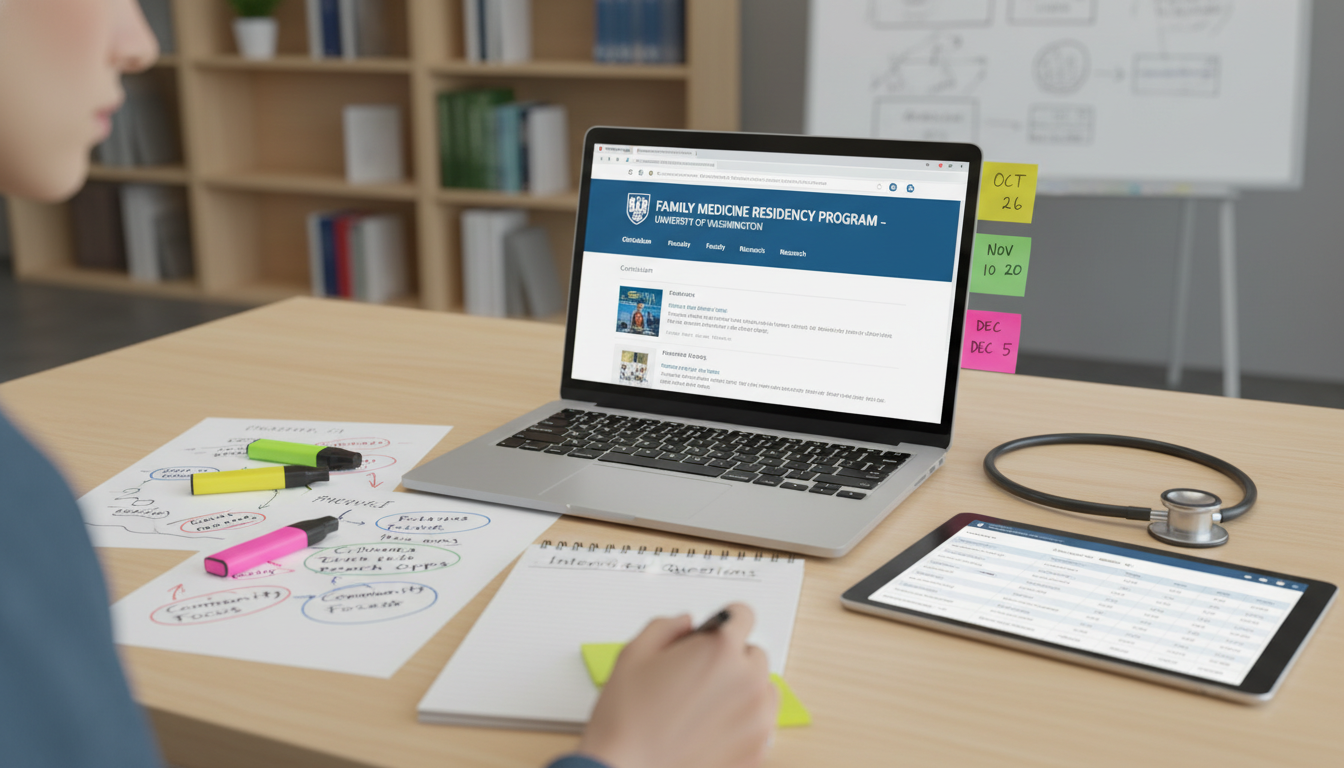
A. Build a Structured Program Research Template
Create a spreadsheet or document with sections like:
- Core program details
- Location, size, community vs academic, unopposed vs opposed
- Inpatient–outpatient balance
- Clinical training features
- OB opportunities and number of deliveries
- Procedures (e.g., joint injections, skin procedures, point-of-care ultrasound)
- Behavioral health integration and team structure
- Continuity clinic model (ownership of panel, frequency)
- Population and community
- Demographics of patient population
- Underserved or rural focus
- Special community outreach programs
- Education and support
- Didactics structure
- Mentorship system
- Wellness and resident support resources
- Unique strengths
- Global health, advocacy tracks, sports medicine focus, geriatrics emphasis
- Personal “fit” notes
- Why you might thrive here
- Specific questions to ask faculty and residents
Use this template for every program where you have an interview scheduled. This becomes your personal briefing document for pre-interview review.
B. Use Multiple Information Sources
To prepare for interviews, combine:
- Program website
- Curriculum, block schedules, mission and values
- Faculty bios and interests (e.g., addiction medicine, women’s health, medical education)
- Virtual or in-person open houses / info sessions
- Take notes on what current residents emphasize
- Social media
- Program Instagram, X (Twitter), or Facebook for culture, resident life, and community events
- NRMP and FREIDA data
- Program size, board pass rates, fellowship placements
- People you know
- Current residents or recent graduates from your school
- Advisors who know the program leadership
C. Translate Research Into Interview-Ready Talking Points
For each program, prepare:
- Two specific reasons you’re excited about the curriculum
- “I’m especially interested in your integrated behavioral health model and the opportunity to work longitudinally with psychologists in clinic.”
- One or two mission-alignment points
- “Your emphasis on caring for refugee populations resonates with my work with asylum-seeking patients during medical school.”
- Three to five program-specific questions
- “How has the program adjusted ambulatory training in response to changes in telemedicine use post-pandemic?”
- “Can you describe what longitudinal community engagement looks like for residents across the three years?”
This level of preparation immediately differentiates you during the FM match interview season.
Step 3: Master Common Family Medicine Residency Interview Questions
Knowing how to prepare for interviews means studying patterns in what you’ll be asked. The following categories and examples are common across interview questions residency programs in family medicine will ask.
A. Core Motivation and Fit Questions
- “Why family medicine?”
- Use the narrative you refined earlier; connect experiences to specific aspects of the specialty.
- “Why this program?”
- Reference 2–3 program features (curriculum, community, culture) plus mission alignment.
- “What are you looking for in a residency program?”
- Tie in teaching style, patient population, scope of practice, culture of support and feedback.
Preparation tip: Create bullet points rather than full scripts; practice speaking naturally from them.
B. Behavioral and Situational Questions
These explore how you function on teams and under stress:
- “Tell me about a challenging patient encounter you’ve had and how you handled it.”
- “Describe a time you made a mistake in clinical care or judgment and what you learned from it.”
- “Tell me about a time you had a conflict with a team member and how it was resolved.”
- “Describe a situation where you advocated for a patient.”
Use the STAR framework:
- Situation: Brief context
- Task: Your role
- Action: What you did (focus here)
- Result/Reflection: What happened and what you learned
Example (abbreviated):
“During my family medicine clerkship, I cared for a patient with uncontrolled diabetes who frequently missed visits (Situation). As the student on the team, I was asked to explore barriers to adherence (Task). I spent time discussing transportation and work schedule, and learned he couldn’t afford time off for appointments (Action). I coordinated with social work to arrange evening clinic appointments and helped explore medication assistance programs. Over the next several months, his A1c improved and he became more engaged in his care (Result). This reinforced for me how central it is in family medicine to understand social context and collaborate across disciplines (Reflection).”
Prepare 6–8 such examples that can flexibly fit many questions.
C. Strengths, Weaknesses, and Professional Development
Common prompts:
- “What are your strengths?”
- “What is one area you’re working to improve?”
- “How will our program help you grow?”
Tips:
- For strengths, align with themes programs value:
- Reliability, teamwork, communication, cultural humility, resilience, teachability.
- For growth areas, avoid red flags (e.g., chronic unprofessionalism) and focus on realistic, non-trivial issues:
- “I tend to be overly self-critical and am working on recognizing small successes.”
- “I’m learning to manage uncertainty better, especially in outpatient settings where answers aren’t immediate.”
- Always follow a weakness with:
- What you’ve already done to address it
- Specific strategies you’re continuing to use
D. Family Medicine–Specific Content Questions
Not all programs will ask clinical questions, but be ready for prompts like:
- “How would you explain hypertension to a patient with limited health literacy?”
- “How do you approach discussing vaccines with a hesitant parent?”
- “What role do you think family physicians should play in addressing social determinants of health?”
Preparation strategy:
- Practice plain-language explanations of common outpatient conditions.
- Use motivational interviewing elements (open-ended questions, reflective listening, shared decision-making).
- Be ready to show awareness of health equity, access barriers, and community context.
E. Ethical and Professionalism Scenarios
Common themes:
- Handling near-misses or errors
- Managing patient confidentiality with family members
- Dealing with unprofessional behavior by colleagues
Use a consistent ethical reasoning structure:
- Identify the core conflict (autonomy, beneficence, nonmaleficence, justice).
- Describe how you would gather more information.
- List options and weigh pros and cons.
- Emphasize patient-centered, team-based decision-making.
- Include seeking supervision when appropriate (as a resident you’re not alone).
Step 4: Practice Deliberately: Mock Interviews and Feedback
Preparation is not just reading questions—it’s speaking answers out loud and refining them.
A. Choose Practice Formats
Combine several of the following:
- Formal mock interviews
- Through your school’s career office or advising dean
- Specialty interest group or department-sponsored practice sessions
- Peer practice
- Take turns being interviewer and interviewee
- Use a set of common interview questions residency programs ask
- Self-recorded practice
- Record video of yourself answering 5–10 questions in a row
- Review body language, clarity, and pacing
B. Focus on Communication Skills
Key elements programs notice:
- Clarity: Are your answers structured, not rambling?
- Conciseness: Can you answer most questions in 1–2 minutes?
- Warmth and empathy: Especially crucial in family medicine; your interpersonal style matters.
- Eye contact and presence: Particularly in virtual settings.
- Professionalism: Avoid slang, speak respectfully about past colleagues and institutions.
Ask mock interviewers to give feedback specifically on:
- Times when they felt particularly engaged
- Points where your answer lost focus or felt rehearsed
- Whether your enthusiasm for family medicine and the program came through
C. Develop a System for Handling Unexpected Questions
You won’t be able to script every scenario. Practice:
- Pausing briefly before answering
- Saying, “That’s a thoughtful question; let me think for a moment”
- Structuring answers quickly: main point → supporting detail → brief conclusion
The ability to stay composed and thoughtful under mild pressure is itself an assessment of your readiness for residency.

Step 5: Optimize Logistics, Technology, and Professional Presentation
Pre-interview preparation is not only about content; practical details can influence how you’re perceived and how confident you feel.
A. For Virtual Family Medicine Residency Interviews
Technology check
- Reliable internet connection (run speed tests)
- Updated Zoom/Teams/Webex software
- Test microphone and camera; use headphones if needed to avoid echo
Environment
- Neutral, uncluttered background or tasteful professional setting
- Good front-facing lighting (window light or lamp behind your camera)
- Quiet space; inform roommates/family of your schedule
Backup plans
- Have a phone and charger nearby
- Keep program contact email/number accessible
- If something fails, briefly acknowledge and problem-solve calmly
On-screen professionalism
- Look at the camera when listening and speaking
- Mute notifications on computer and phone
- Keep water nearby; a small notebook is fine but avoid reading from notes
B. For In-Person Interviews
Travel planning
- Book travel early, allowing for delays
- Arrive the day before, if possible
- Have backup transportation options (ride shares, alternate routes)
What to bring
- Copies of your CV and personal statement
- Small notebook and pen
- A list of questions for the program
- Portable charger, snacks, water
Professional behavior throughout the day
- Be kind and respectful to everyone (coordinators, drivers, administrative staff). Word travels.
- During tours and meals, engage with residents and other applicants; you are being observed informally.
C. Dress and Appearance
- Attire
- Business formal: suit (skirt or pants), button-down or blouse, conservative dress if preferred
- Colors: dark or neutral suits; shirts in light, non-distracting colors
- Comfort and practicality
- For in-person: shoes you can walk in comfortably for tours
- Avoid overly heavy fragrances (some patients/residents may be sensitive)
Family medicine tends to be a bit more relaxed than some specialties, but err on the side of professional. You can still show personality in subtle ways (tie pattern, blouse color, accessories) while maintaining a polished image.
Step 6: Prepare High-Quality Questions for Interviewers
Programs consistently report that thoughtful questions distinguish engaged applicants. Your questions should:
- Show that you did your homework
- Reflect your career goals and values
- Help you evaluate fit honestly
A. Questions for Faculty/Program Leadership
- “How does your program balance autonomy and supervision as residents progress through training?”
- “Can you share how residents are involved in quality improvement or practice redesign in continuity clinic?”
- “What changes or innovations has the program implemented in the past few years, and what’s on the horizon?”
B. Questions for Current Residents
- “What do you think your program does particularly well in preparing you for independent family medicine practice?”
- “How would you describe the culture among residents? What kind of person tends to thrive here?”
- “How responsive has leadership been when residents raise concerns or propose changes?”
- “Outside of work, what is life like here in terms of community, cost of living, and things to do?”
C. Questions for Behavioral Health, OB, or Other Key Areas
Tailor questions based on your interests:
OB/women’s health:
- “How is continuity of pregnancy care integrated into your curriculum?”
- “Do residents have opportunities to be primary operators for deliveries, and how many do they typically complete?”
Behavioral health:
- “How do family medicine residents work with behavioral health providers day to day?”
- “Are there dedicated rotations or longitudinal experiences in mental health or addiction medicine?”
Questions should not be easily answered by a quick website glance; use your research to go deeper.
Step 7: Build a Pre-Interview Routine and Mental Readiness Plan
Performance on interview day is affected by your physical and mental state.
A. Develop a Night-Before Checklist
- Review your program-specific notes (15–20 minutes).
- Skim your own ERAS application, personal statement, and CV (what you wrote is what they’ve read).
- Lay out clothing, charge devices, and confirm schedule/time zones.
- Set 2 alarms (plus a backup person if you’re anxious about oversleeping).
Avoid cramming or rewriting answers; trust your preparation.
B. Day-of Strategies
Eat something light but sustaining before interviews.
Do a short centering routine:
- 3–5 minutes of deep breathing, stretching, or mindfulness.
- Remind yourself: “This is a conversation about whether we are a good fit—for both sides.”
If you feel nervous:
- Normalize it: almost everyone is.
- Reframe as excitement; research shows this improves performance more than trying to “calm down” completely.
C. Post-Interview Reflection (Still Part of Preparation)
Immediately after each interview day:
Write down:
- People you met and impressions
- Program strengths and potential concerns
- Culture and “vibe”
- What excited you; what gave you pause
Note any questions you wish you’d asked or points you forgot to mention; this can inform thank-you emails or future interviews.
Over time, this reflection process will sharpen your ability to communicate fit and preferences in subsequent interviews.
Frequently Asked Questions (FAQ)
1. How early should I start residency interview preparation for family medicine?
Begin serious preparation 4–6 weeks before your first interview:
- Week 1–2: Clarify your story, strengths, and career goals; compile common interview questions.
- Week 2–3: Research programs systematically; build your spreadsheet.
- Week 3–4: Do multiple mock interviews (formal, peers, self-recorded).
- Ongoing: Refine answers, update program notes, and practice questions specific to family medicine and your interests.
If your first interview is very early in the season, start earlier; the more you front-load practice, the more natural you’ll feel when it counts.
2. Are family medicine interviews less competitive or intense than other specialties?
Family medicine is often more conversational and relationship-focused, but that does not mean it’s casual or uncompetitive. Programs still assess:
- Your professionalism and preparation
- Your genuine interest in the specialty and their specific program
- How you’ll contribute to the team and community
The tone may be warmer and more personal, but expectations for thoughtful, reflective answers are just as high. Many programs place strong weight on interviews when building their rank lists in the FM match.
3. How much clinical knowledge do I need to show in a family medicine interview?
Most programs are not quizzing for board-style facts, but they do want to see:
- You can explain common primary care topics in clear, patient-centered language
- You understand the role of family physicians in:
- Chronic disease management
- Preventive care and screening
- Behavioral health and social determinants of health
- You have insight into your own readiness and learning needs
If a clinical question arises, focus on your reasoning process, patient safety, communication, and willingness to seek help rather than trying to impress with obscure details.
4. How many mock interviews should I do before the season?
Aim for at least:
- 1–2 formal mock interviews with an advisor, faculty member, or career office
- 2–3 peer practice sessions focusing on different question types (behavioral, ethics, “why program,” etc.)
- Several short self-recorded sessions (10–15 minutes) to refine your style and body language
Beyond that, quality matters more than quantity. Make sure you’re incorporating feedback, not just repeating the same mistakes. When your answers feel consistent, authentic, and flexible, you are ready.
Thoughtful pre-interview preparation allows you to showcase who you are as a future family physician: clinically capable, patient-centered, and aligned with the values of the programs you’re meeting. By clarifying your story, researching deeply, practicing deliberately, and managing logistics and mindset, you set yourself up to make the most of every family medicine residency interview opportunity.