Navigating the residency interview season is one of the most intense—and important—phases of your medical career. You prepare for weeks, give your best performance on interview day, and then… what comes next? Many applicants overlook how crucial the post-interview follow-up period is for reinforcing their candidacy, demonstrating professionalism, and building long-term professional networking connections.
Thoughtful, strategic follow-up after a Residency Interview won’t magically change your rank position, but it can subtly strengthen how you’re remembered, clarify your fit with the program, and signal that you’re a mature, communicative future colleague. Handled poorly, it can raise red flags. Handled well, it becomes a quiet but powerful asset in your overall application.
This guide walks you through evidence-informed, professional, and realistic follow-up strategies so your communication supports your goals without crossing lines or violating Match rules.
Why Follow-Up Matters in Your Residency Interview Journey
Post-interview follow-up is not just a courtesy; it’s an intentional extension of your interview performance and a reflection of how you will communicate as a resident physician.
How Follow-Up Supports Your Medical Career Goals
Effective follow-up communication allows you to:
Reinforce your interest in the program
A concise, personalized thank-you highlights that you are genuinely invested in their training environment—not just mass-applying to every program.Showcase professionalism and maturity
Programs want residents who communicate clearly, respectfully, and appropriately. Your follow-up is a preview of how you will email consultants, patients’ families, and hospital leadership.Express gratitude and respect for faculty time
Interview days are demanding for program directors, faculty, and residents. A simple note of appreciation demonstrates emotional intelligence, humility, and awareness.Clarify or expand on aspects of your candidacy
If you didn’t fully explain a project, rotation, or challenge during the interview, follow-up is a chance to briefly add context—without rewriting your entire application.Lay groundwork for long-term professional networking
Even if you don’t match at a particular program, interviewers may encounter you again—at conferences, fellowships, or academic collaborations. Positive candidate communication can have lasting benefits.
Understanding What Follow-Up Can—and Cannot—Do
It’s important to keep expectations realistic:
Follow-up CAN:
- Help interviewers remember you more clearly
- Underscore your alignment with program values
- Demonstrate strong written communication skills
- Clarify promised information (papers, posters, updated scores, etc.)
Follow-up CANNOT:
- Compensate for a poor interview performance
- Override program ranking policies
- Turn a non-interviewed applicant into a candidate
- Force programs to disclose your rank position (they won’t, and shouldn’t)
Your goal is not to persuade them to break rules or change formal decisions, but to professionally represent yourself and maintain a strong, positive presence in their minds.
Strategy 1: Crafting an Effective Residency Interview Thank-You Email
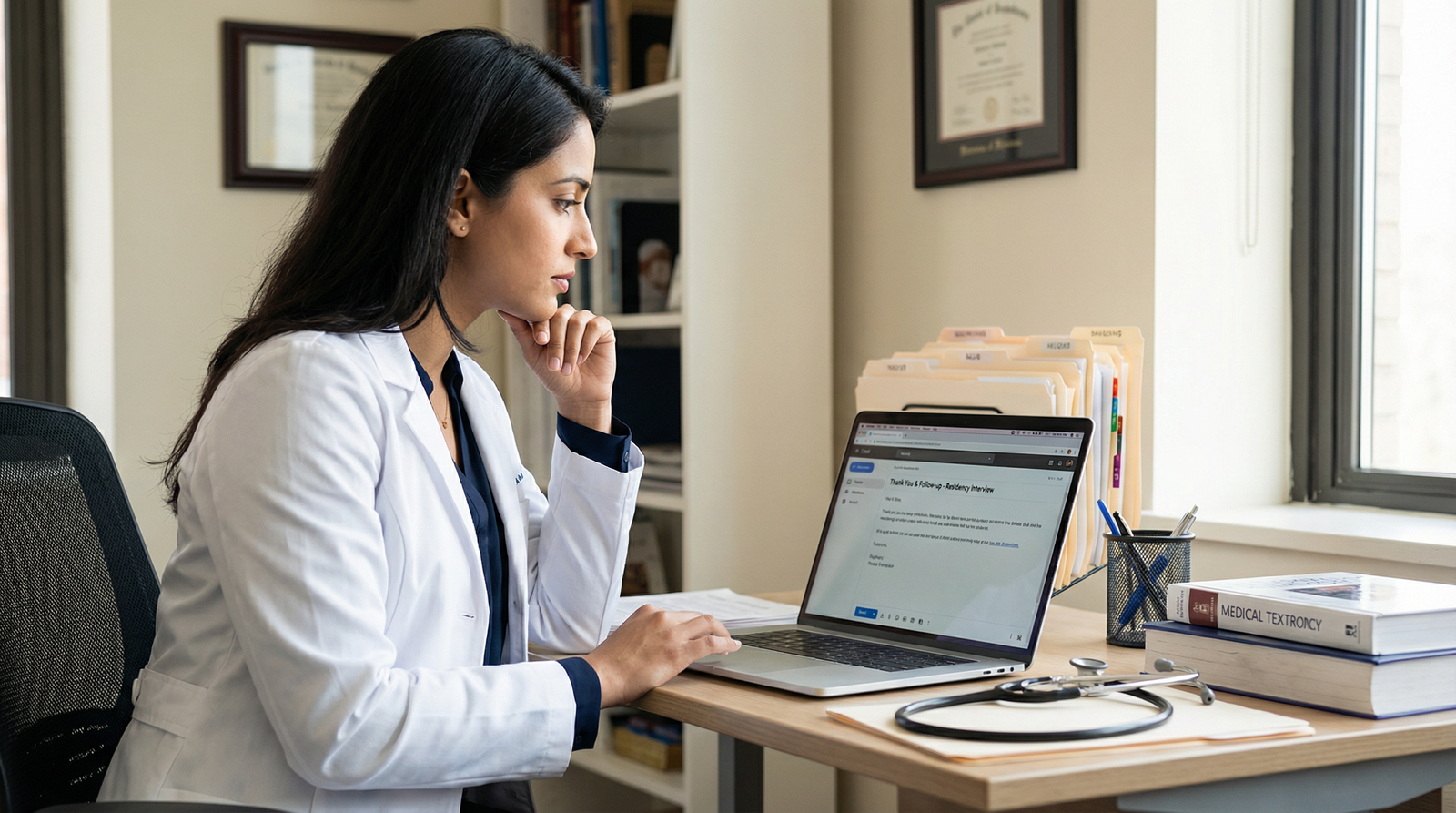
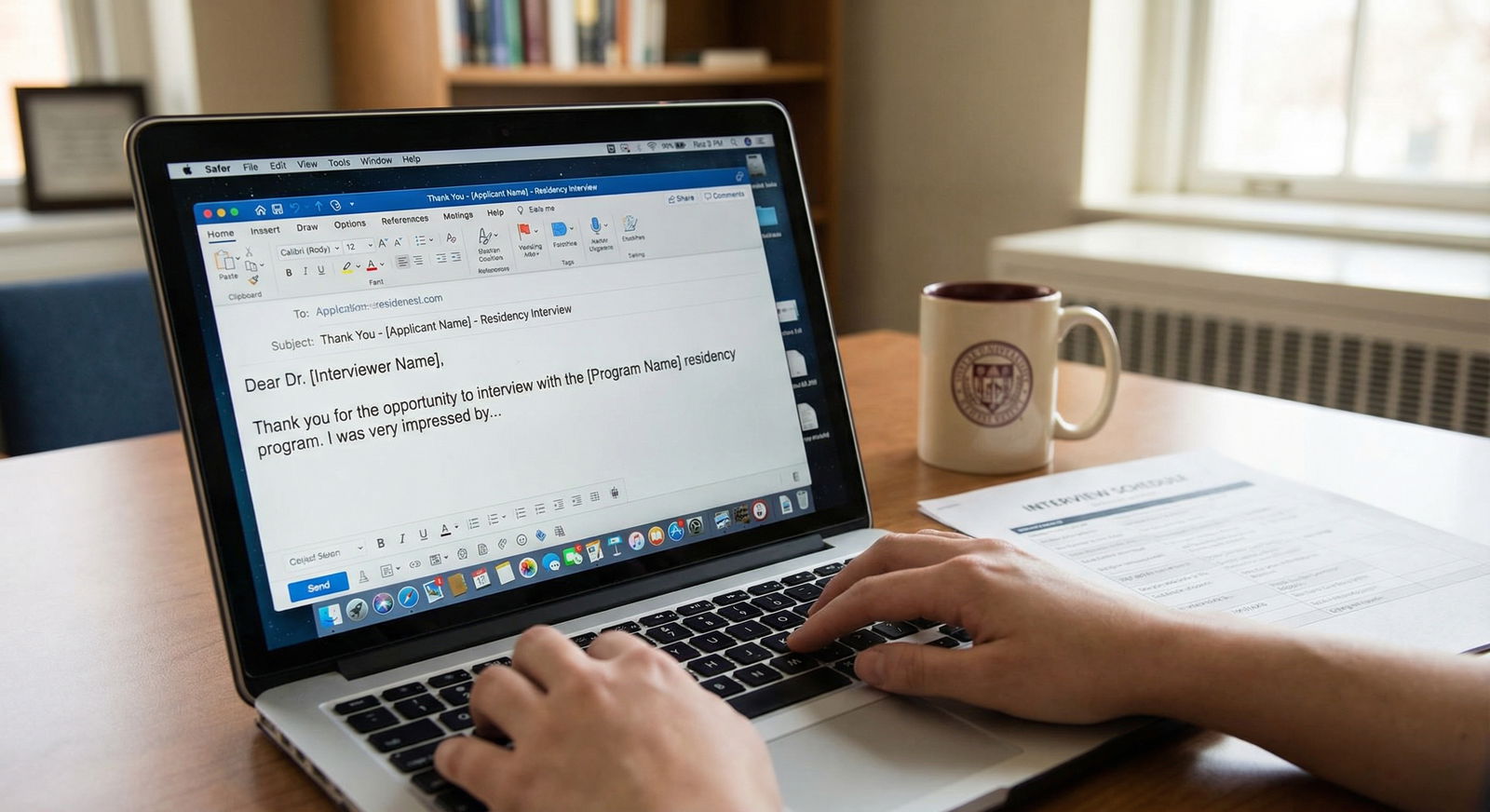
The foundation of post-interview Follow-Up Strategies is a clear, timely, and personalized thank-you email.
Timing: When to Send Your Thank-You Email
- Aim to send your thank-you email within 24–48 hours of your Residency Interview.
- Sending it the same day is fine if it doesn’t feel rushed or generic.
- If you had a multi-day or second-look experience, send your email within 24–48 hours of the last interaction.
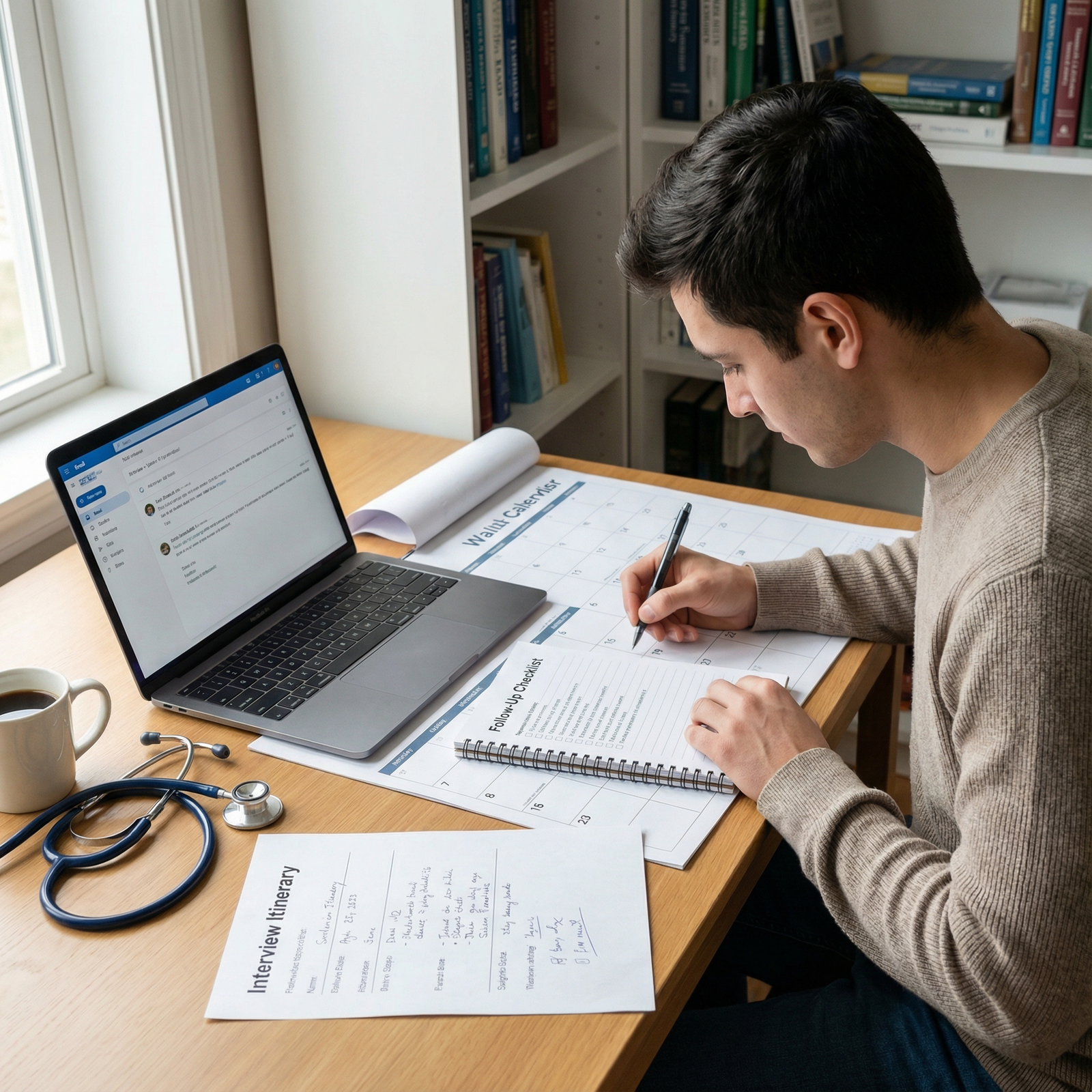
If you’re interviewing at several programs back-to-back, block time on your calendar before interview season to write these messages daily so you don’t fall behind.
Who Should Receive a Thank-You Email?
Prioritize:
- Program Director
- Associate/Assistant Program Director(s) who interviewed you
- Key faculty interviewers
- Chief residents or senior residents who conducted formal interviews
If you met many people (e.g., multiple residents in a panel), you can:
- Email the chief resident or coordinator and ask them to extend your thanks to the resident team, or
- Send a single group thank-you message if that’s how they communicated with you.
Always use the contact list or email instructions provided by the program to avoid over-messaging.
Core Components of a Strong Thank-You Email
Your message should be short—roughly 150–250 words—but specific and thoughtful. Include:
Professional subject line
Examples:Thank You – [Your Name] – Internal Medicine Residency Interview[Program Name] Interview – Appreciation from [Your Name]
Appropriate greeting
- Use: “Dear Dr. [Last Name]” or “Dear Dr. [Last Name] and the [Program Name] Team”
- Avoid overly casual openings like “Hey” or “Hi there.”
Clear expression of gratitude
- Mention the date of the interview and the position (e.g., categorical internal medicine, preliminary surgery).
Specific reference to your conversation or the program
Choose one or two details:- A unique educational feature (e.g., global health track, ultrasound curriculum)
- A patient story you discussed
- Research, QI, or mentoring opportunities that resonated with you
- Program culture, teaching style, or community engagement that aligns with your values
Reinforcement of your interest and fit
Very briefly connect your background and goals with the program’s strengths.Professional closing and signature
Include:- Full name
- Medical school and graduation year
- Contact information
- Optional: LinkedIn profile if it’s polished and relevant
Example: Polished Thank-You Email
Subject: Thank You – John Doe – Family Medicine Residency Interview
Dear Dr. Smith,
Thank you for the opportunity to interview for the Family Medicine residency at [Institution Name] on November 5. I truly appreciated the chance to learn more about your program and to hear your perspective on training residents to care for underserved communities.
Our discussion about the continuity clinic’s role in longitudinal patient care resonated with my experiences working in free clinics during medical school. I was especially encouraged by the program’s commitment to resident wellness and mentorship, which aligns strongly with the supportive learning environment I am seeking for my training.
I remain very excited about the possibility of joining your team and contributing to your community health initiatives. Thank you again for your time and consideration.
Best regards,
John Doe, MS4
[Medical School Name], Class of 2025
john.doe@email.com | (555) 555-5555
LinkedIn: linkedin.com/in/johndoe (if applicable)
Strategy 2: Deciding Whether to Send a Handwritten Note
In an era of digital communication, a handwritten card can stand out—as long as it feels genuine and not forced. This is optional, but can be particularly impactful for certain programs.
When a Handwritten Note Can Be Especially Effective
Consider sending a brief, professional handwritten note if:
- You interviewed with a smaller program where you built strong rapport with the faculty.
- You strongly identified the program as a top choice and want to express appreciation in a memorable way.
- The institution or faculty have a more traditional or community-based feel, where handwritten gestures are culturally valued.
If the program has clearly emphasized “email only” communication or strongly discourages additional mail, respect their instructions and skip this step.
How to Write a High-Impact Handwritten Note
Keep it simple and polished:
Use quality, neutral stationery
Plain white or simple professional note cards; avoid flashy designs, religious imagery, or humorous cards.Be concise (3–5 sentences max)
Summarize the same key points as your email: gratitude, specific positive impression, and enthusiasm.Write legibly and proofread
Even in handwriting, double-check names, titles, and spelling.
Example Handwritten Note
Dear Dr. Smith,
Thank you for the opportunity to interview for the Family Medicine residency at [Institution Name]. I enjoyed our conversation about your community outreach initiatives and how residents play an active role in serving local families.
Hearing more about your program’s supportive culture and strong mentorship reinforced my interest in training with your team. I am truly grateful for your time and consideration.
Warm regards,
John Doe
[Email] | [Phone Number]
You can send this in addition to an email, but avoid duplicating the wording exactly—slightly rephrase your main points.
Strategy 3: Using Professional Networking Platforms Wisely
Thoughtful Candidate Communication doesn’t stop with email. Platforms like LinkedIn can support long-term Professional Networking as your Medical Career develops.
Should You Connect with Interviewers on LinkedIn?
In most cases, yes—with care:
- Many academic physicians and program directors maintain LinkedIn profiles.
- A connection request after the interview can:
- Keep you informed of their work, publications, and roles
- Signal long-term interest in the specialty and academic collaboration
- Expand your professional network beyond Match season
Before connecting:
Audit your own profile
Make sure your photo is professional, your experiences are accurate, and your content is appropriate for faculty eyes.Send a personalized note
Avoid generic “I’d like to add you to my professional network” messages.
Example connection request:
Dear Dr. Smith,
It was a pleasure meeting you during the Family Medicine residency interview at [Institution Name] on November 5. I appreciated our discussion about community health and would be grateful to stay connected professionally.
Sincerely,
John Doe
If a faculty member rarely uses LinkedIn or has a very limited network, don’t take a lack of response personally.
Strategy 4: Following Up with Additional or Updated Information
Sometimes your Residency Interview will surface topics that warrant a follow-up message beyond a simple thank-you.
Appropriate Reasons to Send Additional Information
- You promised to send:
- A manuscript, poster, or published paper you discussed
- A PowerPoint, infographic, or educational resource you mentioned
- You receive a significant application update, such as:
- New publication acceptance
- Completed Step 2 or COMLEX Level 2 score (if not already reported)
- New leadership role or award relevant to residency training
How to Integrate Additional Information into Follow-Up
You can:
- Attach it to your original thank-you email (ideal if you mentioned it in the interview), or
- Send a brief, separate follow-up email with a clear subject line, for example:
Follow-Up Information – [Your Name] – [Program Name] InterviewUpdate to Application – [Your Name] – New Publication
Keep it tight:
- Reference the interview or prior discussion.
- Attach or link to the promised item.
- Avoid multiple long updates unless clearly important.
Example:
Dear Dr. Smith,
Thank you again for the opportunity to interview for the Family Medicine residency at [Institution Name] last week. During our conversation, I mentioned a quality improvement project on hypertension control in underserved clinics.
As promised, I am attaching the abstract and poster from that project, which we presented at the [Conference Name] in October. I hope this provides more detail on the outcomes we discussed.
I remain very enthusiastic about your program and appreciate your time and consideration.
Best regards,
John Doe
Strategy 5: Maintaining Professionalism and Boundaries in All Communications
Every email, card, and message you send is part of the holistic picture programs form of you as a future colleague. Clear, professional Candidate Communication is essential.
Key Principles of Professional Follow-Up
Check spelling, grammar, and names
- Confirm the correct spelling of every faculty name and title.
- Run your email through spell-check or have a trusted mentor glance at it.
Keep your tone respectful and calm
- Avoid excessive flattery, emotional bargaining, or desperation.
- Do not overshare personal life details unless they’re directly relevant and appropriate.
Do not pressure programs for information
- Never ask where you are on their rank list.
- Avoid language that could be interpreted as coercive or transactional (“If you rank me high, I will…”).
Respect NRMP Match communication rules (if applicable)
- Programs and applicants cannot ask each other for ranking commitments.
- You may express interest or enthusiasm, but avoid definitive promises that could be misinterpreted.
Avoiding Over-Communication
Well-intentioned applicants sometimes hurt their candidacy by communicating too frequently. To stay on the safe side:
- One thank-you email per interviewer is sufficient.
- If you send a handwritten note, that is additional, not a trigger for more emails.
- Limit subsequent follow-ups to meaningful updates or a single status inquiry if appropriate.
If you’re unsure whether your message adds value or just adds noise, pause and ask a mentor or advisor.
Strategy 6: Knowing When and How to Reach Out Again
After sending thank-you notes, the waiting period begins. It’s natural to feel anxious—but follow-ups should still be measured and professional.
Understanding the Residency Selection Timeline
- Many programs follow strict Rank Order List deadlines and internal review schedules.
- Some programs explicitly state: “Due to NRMP rules, we will not respond to post-interview communication about ranking.”
- Others may send periodic “Thank you for interviewing” or “We enjoyed meeting you” messages.
Before sending a second follow-up, check:
- The program’s website or applicant handbook for communication policies.
- Any post-interview emails you received from the coordinator.
When a Status Follow-Up Email Is Reasonable
Consider a brief, polite status inquiry if:
- Several weeks have passed beyond the timeline the program posted for communication (if they provided one).
- You have a significant new update that could reasonably influence their understanding of your application.
- You haven’t received any confirmation that your application is complete.
A status follow-up is not mandatory and should be used sparingly.
Example: Professional Second Follow-Up Email
Subject: Follow-Up on Residency Application – John Doe
Dear Dr. Smith,
I hope you are well. I wanted to follow up regarding my application for the Family Medicine residency at [Institution Name]. It was a pleasure interviewing with your program on November 5, and I remain very enthusiastic about the opportunity to train with your team.
If there are any updates regarding my candidacy or if any additional information would be helpful, please let me know. I appreciate the time and effort your team dedicates to reviewing applications.
Thank you again for your consideration.
Best regards,
John Doe
[Contact Information]
If the program has clearly stated that they will not respond to post-interview emails, you may still send a thank-you note, but should avoid status check-ins that disregard their policy.
Frequently Asked Questions: Post-Interview Follow-Up for Residency Applicants
1. When exactly should I send my thank-you email after a residency interview?
Aim for within 24–48 hours of your interview. This window allows you to:
- Reflect on specific aspects of the program that stood out to you
- Avoid appearing rushed or template-driven
- Ensure the interaction is still fresh in the interviewer’s memory
If your interview falls on a Friday, sending your message by Sunday evening or Monday morning is reasonable. Delayed emails (5+ days later) are still better than none, but they lose some immediacy.
2. Should I send both an email and a handwritten note, or is that excessive?
Sending both is acceptable if:
- Your email goes out first and is concise and professional.
- Your handwritten note is brief, slightly different in wording, and aligned with the program’s culture.
If you are interviewing at many programs and time is limited, prioritize high-quality emails to all interviewers over handwritten notes. Handwritten notes are optional, not expected.
3. How can I make my follow-up stand out without sounding insincere?
Focus on specificity and authenticity rather than length or flattery:
- Reference a particular conversation, clinic, rotation, or initiative you genuinely found compelling.
- Connect that element to your own experiences or goals (e.g., prior community work, research interest, or learning style).
- Keep the tone professional and grounded; avoid exaggerations like “This is the only program where I could ever see myself.”
Programs can sense copy-pasted emails. Customization is what sets you apart.
4. Is it acceptable to follow up more than once with the same program?
Yes—but with clear boundaries:
- One thank-you email per interviewer is standard.
- One additional email may be appropriate if:
- You have a meaningful application update, or
- You are politely checking on status after a reasonable time and in line with program policies.
Avoid repetitive or weekly check-ins. If you haven’t heard back after a single follow-up and the Match timeline is progressing, it’s best to wait and let the formal process unfold.
5. What if I forgot to mention something important during the interview—should I bring it up in my follow-up?
Yes, if the information:
- Is substantive (e.g., a major project, rotation, award, or relevant skill), and
- Directly supports your fit with the program or clarifies a previous answer.
In your follow-up email, briefly introduce the point:
“I realized after our conversation that I did not have a chance to mention my recent QI project on reducing ED boarding times, which further strengthened my interest in systems-based practice…”
Keep it to 2–3 sentences and avoid turning your follow-up into a secondary personal statement.
Thoughtful, well-timed follow-up after a Residency Interview is an important part of your overall application strategy. By combining clear Candidate Communication, professional Follow-Up Strategies, and mindful Professional Networking, you signal that you’re ready not just to enter a program—but to thrive as a reliable, collegial physician in your future Medical Career.