
Understanding the Family Medicine Interview Landscape as an IMG
Family medicine is one of the most IMG-friendly specialties in the United States, but it is also highly competitive in terms of preparation and professionalism. Programs are looking for residents who are clinically competent, adaptable, and committed to the broad scope and continuity of care that define family medicine.
As an international medical graduate, you bring unique strengths—multilingual skills, cross-cultural experience, and resilience—but you must also overcome perceived gaps: unfamiliarity with the US healthcare system, differences in training models, or time since graduation. Pre-interview preparation is where you can correct misconceptions and highlight your true value.
This IMG residency guide focuses specifically on pre-interview preparation for family medicine, so that when you reach the interview day, you are not “practicing,” you are performing.
Key goals of pre-interview preparation:
- Understand what family medicine programs value and screen for
- Align your story and experiences with core FM competencies
- Master residency interview preparation (content, delivery, and logistics)
- Anticipate and practice common interview questions residency programs ask
- Organize documents, communication, and technology to avoid last-minute stress
Step 1: Clarify Your Family Medicine Narrative
Before you rehearse answers or memorize buzzwords, you need a clear, authentic narrative about why family medicine and why you, as an IMG, fit the specialty and the US system.
A. Define Your “Why Family Medicine?” Story
Programs want to see that you understand family medicine beyond “I like everything” or “I enjoy talking to patients.” Your pre-interview preparation should include building a layered answer that addresses:
Exposure to primary care & continuity
- Specific clinics, rotations, or observerships where you followed patients over time
- Experiences managing chronic diseases, preventive care, and health promotion
Understanding of family medicine in the US
- Emphasis on outpatient continuity clinics, team-based care, behavioral health integration, and community health
- Role in caring for patients of all ages, from pediatrics to geriatrics
Personal alignment with FM values
- Long-term relationships with patients
- Holistic and biopsychosocial approach
- Interest in underserved, rural, or urban communities
Example structure for your response:
- Beginning (Motivation): A pivotal patient or experience that sparked your interest
- Middle (Exposure & Understanding): Rotations and US experiences that deepened your understanding of FM
- End (Future Orientation): How a family medicine residency in the US aligns with your long-term goals
B. Build a Coherent IMG Story
As an international medical graduate, your path may include gaps, transitions, or non-linear experiences. Pre-interview, you should:
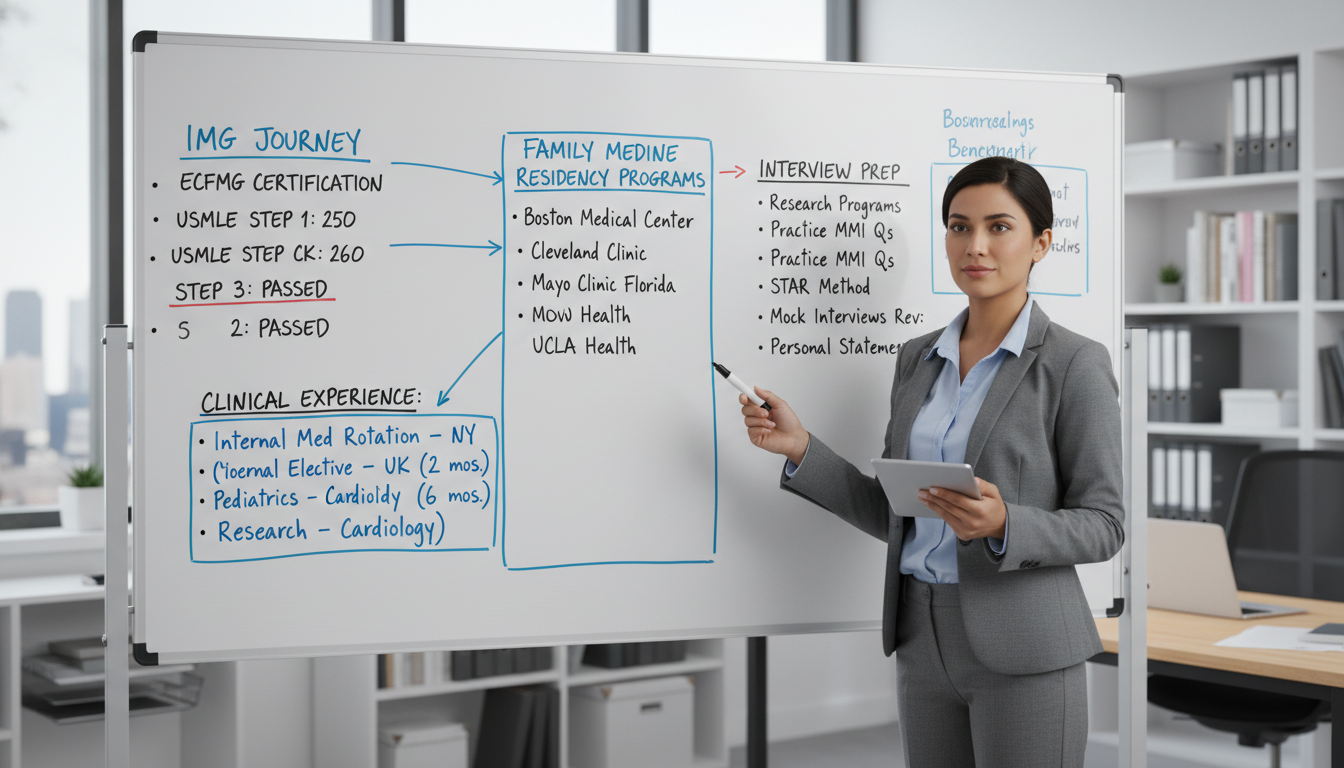
- Map your timeline: Medical school → internships → exams → US clinical experience → research or work → application
- Identify potential red flags such as:
- Year of graduation more than 5–7 years ago
- Gaps without clinical involvement
- Multiple exam attempts
- Prepare clear, honest, and forward-looking explanations, e.g.:
- “During this period, I focused on preparing for USMLE and gaining clinical exposure in the US; I also volunteered at a community health clinic to remain connected to patient care.”
Avoid defensive language. Focus on what you learned and how it made you better prepared for residency.
Step 2: Deep-Dive Residency Interview Preparation – Content
Residency interview preparation for family medicine has distinct themes: communication, teamwork, adaptability, empathy, and commitment to primary care. This is where you move from passive reading to active practice.
A. Master Core Family Medicine Themes
Pre-interview, review your experiences and group them under core FM themes. For each theme, identify 2–3 concrete examples from your background.
Continuity of Care & Longitudinal Relationships
- Example: Following a diabetic patient over months, adjusting treatment, and counseling about lifestyle changes.
- USCE example: Seeing the same patient in clinic for follow-up visits under a preceptor.
Broad Clinical Scope
- Example: Managing acute illness in children, antenatal visits, chronic disease management, and geriatric concerns.
- Emphasize flexibility and comfort with uncertainty.
Teamwork & Interprofessional Collaboration
- Example: Working closely with nurses, social workers, pharmacists, or interpreters to improve patient outcomes.
Cultural Competence & Communication
- Example: Navigating care for patients from different cultural backgrounds, religious beliefs, or socioeconomic conditions.
- As an IMG, highlight language skills and cross-cultural sensitivity.
Community and Preventive Medicine
- Example: Organizing a vaccination drive, health education sessions, or community screening camp.
Organize these in a prep document so you can quickly adapt them for different interview questions.
B. Practice Common Interview Questions for Family Medicine
Programs often use similar interview questions residency-wide, but with a family medicine emphasis. Prepare structured, concise answers.
Common questions to prepare:
- Tell me about yourself.
- Why family medicine?
- Why this program / this community?
- How do you handle difficult patients or challenging families?
- Describe a time you made a mistake. What did you learn?
- Tell me about a time you worked with a team to solve a problem.
- How do you deal with stress or burnout?
- What are your long-term career goals in family medicine?
- How will you adapt to the US healthcare system as an IMG?
For each, practice using STAR or PAR frameworks:
- STAR: Situation – Task – Action – Result
- PAR: Problem – Action – Result
Example (difficult patient):
- Situation: A patient with poorly controlled diabetes repeatedly missed appointments.
- Task: Improve adherence and build trust.
- Action: I explored barriers (transportation, financial stress), simplified the treatment plan, and involved a social worker.
- Result: The patient started coming regularly and HbA1c improved over several months.
C. Prepare Behavioral and Scenario-Based Answers
Family medicine interviews frequently include behavioral questions and scenario-based ethics or communication challenges.
Prepare for scenarios like:
- A patient refuses a recommended vaccination.
- A parent requests antibiotics for a viral illness.
- A patient cannot afford medications.
- You suspect domestic violence or child abuse.
Your approach should demonstrate:
- Respect for patient autonomy
- Clear communication and education
- Cultural sensitivity
- Use of team and resources (social work, interpreters, community resources)
- Patient safety and professionalism
Step 3: Program Research and Tailoring Your Fit
Pre-interview preparation is not only about what you will say, but also whom you are saying it to. One of the biggest mistakes IMGs make in the FM match is giving generic answers that could apply to any program.
A. Systematic Program Research
For each program offering a family medicine residency interview:
Review the program website thoroughly:
- Mission and values
- Patient population (rural, urban, underserved, immigrant, refugee)
- Curriculum: Obstetrics, geriatrics, behavioral health, sports medicine, procedures
- Tracks or special interests: Global health, community medicine, academic medicine
- Clinic sites and hospital affiliations
Look at resident and faculty profiles:
- Backgrounds, interests, and fellowships
- Presence of other IMGs (indicates potential IMG-friendliness)
Check external sources:
- FREIDA and program-specific forums for structure and call schedules
- Program social media for recent projects, wellness initiatives, or community outreach
B. Connect Your Story to Their Program
Create a one-page summary per program with:
- 3–4 reasons you like the program (specific, not generic)
- 2–3 ways you can contribute
- 2–3 intelligent questions to ask faculty and residents
Example tailoring:
- Program emphasizes obstetrics in FM → Mention your experience with prenatal care and interest in continuing women’s health.
- Program serves underserved immigrant communities → Highlight your language skills and experience serving similar populations in your home country.
- Program has a global health or refugee health track → Connect with your background as an IMG and any global health or mission experience.
This preparation makes your “Why this program?” answer compelling and shows that you have done your homework.

Step 4: Practical Logistics and Performance Skills
Even strong candidates can underperform if logistics, technology, or non-verbal communication are neglected. Pre-interview preparation must include rehearsal of delivery, not just content.
A. Organize Your Interview Season Calendar
For the FM match, you may receive multiple interview offers in a short period. Avoid confusion and last-minute panic by:
- Using a single master calendar (digital or paper)
- Recording:
- Date and time (with time zone)
- Platform (Zoom, Thalamus, Webex, etc.)
- Contacts and backup phone number
- Dress code and schedule (information session, faculty interviews, resident social)
Plan for time zone differences, especially if you are not yet in the US. Being late because of time zone confusion is a preventable error.
B. Technology and Environment Setup (for Virtual Interviews)
Many family medicine interviews remain virtual or hybrid. A week before each interview:
Test your equipment:
- Stable internet connection
- Working camera (eye level or slightly above)
- Clear microphone or headset
- Updated software and meeting links
Prepare your interview space:
- Quiet, well-lit room with neutral background
- No clutter, distracting posters, or noisy surroundings
- Lighting from in front of you, not behind
Professional appearance:
- Business-formal attire (suit or blazer; conservative colors)
- Hair and grooming neat; minimal, professional makeup or accessories
Run a mock interview over the actual platform to identify any audio/visual issues.
C. Non-Verbal Communication and Presence
Residency program directors repeatedly mention that they look for applicants who seem:
- Approachable
- Coachable
- Respectful
- Comfortable with patients and colleagues
Practice:
- Eye contact: Look at the camera, not the video of yourself, when speaking.
- Posture: Sit upright, slightly leaning forward; avoid slouching or fidgeting.
- Voice: Speak clearly, at a moderate pace. As an IMG, be mindful of accent clarity and enunciation—practice aloud.
- Facial expressions: Maintain a calm, warm, engaged expression; occasional nods as you listen.
Record yourself answering mock interview questions and review:
- Did I answer the actual question?
- Was I concise or too long-winded?
- Did I seem confident and personable?
D. Document and Information Readiness
Have easily accessible:
- Your ERAS application and personal statement for that specialty
- List of your US clinical experiences, including dates and locations
- Updated CV
- Copies of any publications, poster titles, or projects you mention
Know your own application thoroughly. Any discrepancy between what’s on paper and what you say raises concerns.
Step 5: Refining Your Answers as an IMG – Special Considerations
As an international medical graduate, certain themes will almost certainly come up in your family medicine residency interview. Pre-interview preparation must include rehearsed, sincere responses to these areas.
A. Adapting to the US Healthcare System
Expect questions like:
- “How will you adapt to the US healthcare system?”
- “What challenges do you anticipate as an IMG?”
Frame your response to show:
- Awareness of differences (insurance-based care, electronic health records, patient-centered communication styles).
- Evidence of adaptation through US clinical experience (USCE), observerships, or volunteering.
- Openness to feedback and lifelong learning.
Example points:
- “During my observership at X Clinic, I became familiar with EHR documentation, preventive care guidelines, and multidisciplinary team meetings.”
- “I actively seek feedback and have found that it helps me quickly adjust to new systems.”
B. Communication and Cultural Competence
Family medicine emphasizes communication more than many specialties because of its longitudinal and community-based care model.
You should prepare examples that illustrate:
- Explaining complex conditions in simple language
- Handling language barriers (use of interpreters, bilingual skills)
- Respecting cultural beliefs about illness and treatment
As an IMG, your multicultural background can be an asset:
- “Having trained and lived in different healthcare environments, I am comfortable working with patients from many cultural and socioeconomic backgrounds. I approach every encounter with curiosity and respect, and I check for understanding rather than assuming agreement.”
C. Addressing Gaps, Scores, and Attempts
If you have:
- Multiple attempts on USMLE or other exams
- A long gap after graduation
- Career shifts (from another specialty to family medicine)
Prepare non-defensive, structured explanations:
- State the fact briefly and clearly.
- Provide context if appropriate (without making excuses).
- Emphasize what you learned and how you improved.
- Connect to your readiness now.
Example:
- “I passed Step 1 on my second attempt. At that time, I struggled with test-taking strategies more than content. I sought help, changed my study methods, and since then I have passed all subsequent exams on the first attempt. This experience taught me how to identify weaknesses early and address them systematically, which is the same approach I now apply to clinical learning.”
D. Showing Long-Term Commitment to Family Medicine
Programs want residents who will finish training and remain engaged in primary care. Prepare to discuss:
- Your vision 5–10 years after residency
- Interest in community practice, academics, or fellowship (such as geriatrics, sports medicine, or obstetrics)
- Desire to work with specific populations (rural, inner-city, underserved, immigrant, LGBTQ+, etc.)
Align your long-term plan with the program’s mission when possible (but remain authentic).
Step 6: Mock Interviews, Feedback, and Final Rehearsal
The most powerful part of pre-interview preparation is repeated, realistic practice with feedback.
A. Types of Mock Interviews
Peer Practice
- Practice with other IMGs or friends applying to residency.
- Use compiled lists of interview questions residency programs commonly ask.
- Record sessions and self-review.
Mentor or Faculty-Led Mock Interviews
- Ask a supervising physician from your USCE, research mentor, or faculty advisor.
- They can give you perspective from the US program side.
Professional or Institutional Workshops
- Many IMG support organizations, hospitals, or schools offer formal residency interview preparation sessions.
B. Focus Areas During Feedback
Ask your interviewer to comment on:
- Clarity and organization of answers
- Professionalism of body language and tone
- Overuse of filler words (“um,” “like,” “you know”)
- Whether you are actually answering the question
- Whether your enthusiasm for family medicine and for the specific program comes through
Incorporate feedback in a targeted way; don’t completely change your style with every suggestion, but look for patterns.
C. Final 48-Hour Checklist Before Each Interview
Two days before:
- Re-review the program’s website and your one-page program summary
- Practice your opening responses:
- “Tell me about yourself.”
- “Why family medicine?”
- “Why this program?”
- Prepare clothes, confirm interview links, test technology
Night before:
- Light review of your notes—no cramming
- Print or open your question list for faculty and residents
- Go to bed early, avoid heavy late-night meals or caffeine
Morning of:
- Professional attire and grooming
- Brief vocal warm-up: speak out loud for 5–10 minutes to loosen your speech
- Deep breathing exercises to reduce anxiety
Think of this as performance day; all the real work should already be done.
FAQs: Pre-Interview Preparation for IMGs in Family Medicine
1. How early should an international medical graduate start residency interview preparation for family medicine?
Ideally, begin serious preparation 4–6 weeks before the start of interview season, and at least 2 weeks before your first scheduled interview. Early start allows you to:
- Clarify your narrative and family medicine motivation
- Organize experiences into themes
- Conduct several mock interviews
- Research programs thoroughly
Rushed preparation often leads to disorganized answers and increased anxiety.
2. What are the most important interview questions for an IMG to prepare for?
For an IMG in family medicine, prioritize:
- “Tell me about yourself.”
- “Why family medicine?”
- “Why this program?”
- “How will you adapt to the US healthcare system?”
- “Describe a challenge or failure and what you learned.”
- “How do you work within a team?”
These core questions often determine how well the committee understands your motivation, maturity, and fit.
3. How can I stand out as an IMG in the FM match during interviews?
You stand out by combining authenticity, preparation, and alignment:
- Communicate a clear, sincere passion for family medicine and longitudinal patient care.
- Highlight unique IMG strengths: multilingual abilities, cultural competence, global perspective.
- Provide specific, concrete examples of clinical experiences and teamwork.
- Show that you understand each program’s mission and how you fit it.
- Demonstrate professionalism through punctuality, organization, and respectful communication.
4. What are good questions to ask interviewers in a family medicine residency interview?
Ask questions showing that you are already thinking like a future resident in that program:
- “How does your program support residents who are interested in underserved or immigrant populations?”
- “Can you describe the continuity clinic experience and how residents build long-term patient relationships?”
- “How is feedback given to residents, and how is resident wellness supported?”
- “Are there opportunities for teaching, community projects, or global health during residency?”
Avoid questions easily answered on the website (e.g., number of residents per year).
Thorough, strategic pre-interview preparation transforms you from a nervous candidate into a confident future colleague. As an international medical graduate aiming for a family medicine residency, your experiences are valuable and relevant—you simply need to organize, rehearse, and present them in a way that clearly shows programs: You understand family medicine, you fit their mission, and you are ready to thrive in the US healthcare system.