Understanding the ENT Residency Landscape as an IMG
Otolaryngology–Head and Neck Surgery (ENT) is one of the most competitive specialties in the U.S. For an international medical graduate, pre-interview preparation is not just helpful—it is essential. Before you even start your detailed residency interview preparation, you need a clear understanding of:
- How ENT programs view IMGs
- What they are assessing during interviews
- How your background might be perceived relative to U.S. graduates
- Unique strengths you can highlight as an international medical graduate
Why ENT Is Especially Competitive for IMGs
ENT residency positions are limited, and the specialty attracts applicants with:
- High board scores
- Strong research portfolios
- ENT-specific letters of recommendation
- U.S. clinical experience
For an IMG, the bar is often even higher. Programs may have:
- Less familiarity with your medical school
- Concerns about your exposure to U.S. healthcare systems
- Questions about visa sponsorship and long-term plans
None of this means you cannot match into ENT—but it does mean that your pre-interview preparation must be more strategic, more polished, and more tailored than average. Think of your interview as the moment you transform from a PDF application into a real potential colleague.
What ENT Programs Look For in the Interview
Across programs, ENT faculty and residents tend to seek candidates who:
- Are teachable: intellectually curious, willing to learn
- Are dependable: reliable, professional, and prepared
- Are good team members: collaborative, non-arrogant, kind
- Handle pressure well: can operate in a fast-paced environment
- Communicate clearly: crucial for talking with patients and surgical teams
- Demonstrate genuine interest in ENT: not just “competitive specialty shopping”
For IMGs, additional “silent questions” often include:
- Can this person adapt to U.S. culture and hospital systems smoothly?
- Will communication (language, accent, documentation) be a barrier?
- Are they committed to staying in the U.S. long-term (or at least the duration of residency)?
- Do they understand the realities of ENT residency (call, long hours, surgical demands)?
Pre-interview preparation should be built around answering these questions—with evidence—through your stories, demeanor, and professionalism.
Laying the Foundation: Self-Assessment and Program Research
Effective residency interview preparation begins long before you rehearse specific interview questions residency programs may ask. It starts with deeply understanding yourself and the programs that invited you.
Step 1: Honest Self-Assessment of Your Application
Before you prepare any scripted answers, analyze your own file in the way a program director would.
Ask yourself:
What are my strongest selling points?
- ENT research (publications, posters, QI projects)
- Strong ENT letters of recommendation
- U.S. clinical experience in ENT or related surgical fields
- Distinctive experiences: leadership, teaching, global health, prior career
What are my perceived weaknesses as an international medical graduate?
- Gaps after graduation
- Limited or no U.S. clinical experience
- Lower board scores or multiple attempts
- Visa requirement
- Non-traditional path (career change, older graduate)
What are my “red flags” that will likely prompt questions?
- Failed exams (USMLE, COMLEX, or equivalents)
- Significant time off from clinical work
- Transfers between schools or programs
- Disciplinary issues (if any)
Write your strengths and weaknesses down. Your pre-interview preparation should systematically transform your strengths into compelling narratives and your weaknesses into honest, well-framed explanations with lessons learned.
Step 2: Deep Program Research—Going Beyond the Website
An effective IMG residency guide for ENT emphasizes that generic answers are fatal in a competitive specialty. You must show each program you are genuinely interested in them, not just “ENT somewhere in the U.S.”
For each program on your interview list, build a brief “program dossier”:
Core Data
- Location, hospital system, size of program (number of residents)
- Required rotations (e.g., head and neck oncology, otology, pediatrics, rhinology)
- Call structure and workload
People
- Program Director and key faculty interests
- Identifiable ENT subspecialties emphasized: skull base, laryngology, facial plastics, etc.
- Alumni placements (fellowships, academic/private practice)
Culture Clues
- Mission statements or values they highlight
- Mentions of diversity, inclusion, or interest in global health
- Emphasis on research vs. community practice
Practical Aspects for IMGs
- Visa sponsorship (if applicable)
- Historical number of IMGs in the program (from website, social media, or resident bios)
- Any clear pathways or mentions of international collaboration
Sources to use:
- Official program websites
- FREIDA / ACGME program listing
- Program and departmental social media (Instagram, Twitter/X, LinkedIn)
- Resident profiles and their publications (PubMed, Google Scholar)
- Any webinars, open houses, or virtual Q&As the program has hosted
Now connect your profile to theirs:
- If the program does a lot of head and neck oncology, highlight related research or rotations.
- If they emphasize underserved care, bring up your work in low-resource settings as an IMG.
- If they value research, be ready to speak in depth about your projects, methodology, and outcomes.
This detailed, targeted research will directly inform your answers to “Why our program?” and will help you ask intelligent questions at the end of interviews.

Mastering the Core Content: Stories, Answers, and ENT-Specific Preparation
Once you understand your own profile and the programs you are interviewing with, you can move into structured residency interview preparation—focusing on what you will say and how you will say it.
Building Your Personal Story as an IMG
Programs will almost always ask some version of:
- “Tell me about yourself.”
- “Walk me through your journey to medicine and ENT.”
- “How did you become interested in otolaryngology?”
For an international medical graduate, these questions are a powerful chance to:
- Normalize your non-U.S. training path
- Show maturity, resilience, and adaptability
- Connect your background to ENT specifically
Craft a 2–3 minute narrative that briefly covers:
- Where you trained and key formative experiences in medical school
- How you discovered ENT (a case, a mentor, a rotation, an operation)
- Why ENT fits your personality and strengths
- Why the U.S. system and this match path made sense for you
Avoid:
- Overly long stories (more than 3–4 minutes)
- Excessive detail about non-ENT specialties you considered
- Negative comments about your home country’s system
Preparing for Classic Behavioral and Medical Interview Questions
The most successful IMG residency guide approaches interview questions residency programs use as clusters to practice, not isolated lines to memorize. Use the STAR method (Situation, Task, Action, Result) to structure your answers:
Common question clusters for ENT interviews:
Teamwork and Conflict
- “Tell me about a time you had a conflict with a colleague or nurse.”
- “Describe a situation where you had to work with a difficult team member.”
Stress and Resilience
- “Tell me about a stressful situation in the hospital and how you handled it.”
- “Describe a time you made a mistake and what you learned.”
Ethics and Professionalism
- “Have you ever witnessed unprofessional behavior? What did you do?”
- “Describe a challenge related to patient safety and how you responded.”
Leadership and Initiative
- “Tell me about a time you led a project or initiative.”
- “Describe a time you improved a process or solved a problem in the hospital.”
Prepare at least 2 strong examples for each category. Try to choose examples that:
- Involve clinical scenarios when possible
- Show your role clearly and specifically
- Demonstrate qualities ENT programs value: calm under pressure, clear communication, respect for the team, patient-centeredness
ENT-Specific Preparation: Showing Genuine Interest
For an otolaryngology match, you must go beyond generic “I like surgery and clinic combination” answers. Before interviews, ensure you can clearly articulate:
What aspects of ENT you’ve actually experienced:
- Outpatient clinics (e.g., chronic sinusitis, hearing loss, voice disorders)
- Operating room cases (e.g., tonsillectomy, tympanoplasty, thyroidectomy, FESS)
- Emergency or in-patient ENT consults (airway issues, epistaxis, neck masses)
What you find compelling about these experiences:
- Anatomy and fine motor skills in the OR
- Longitudinal relationships with patients (e.g., pediatric ENT)
- Interdisciplinary collaboration (neurosurgery, oncology, pulmonology)
Be prepared for questions like:
- “What ENT experiences have you had so far?”
- “What ENT cases or patients have most influenced you?”
- “Are you interested in any subspecialty yet?”
As an IMG, if your ENT exposure was primarily in your home country, frame it in a way that shows transferable skills, but also acknowledge that:
- You are eager to learn U.S.-based protocols and guidelines
- You understand that disease patterns and resource availability may differ
- You are adaptable and willing to integrate new practices
Anticipating IMG-Specific Questions
You will likely be asked about:
- Why you chose the U.S. for residency
- How you adapted to U.S. culture and healthcare (if you have U.S. experience)
- Your visa status and long-term plans
Prepare concise, positive, and honest answers:
- Emphasize educational quality, research environment, and structured training as reasons for coming to the U.S.
- Connect your adaptability and multicultural background to working with diverse patient populations.
- When discussing visas, be factual and calm: you understand the process, are prepared for it, and are committed to the full length of training.
Communication, Cultural Fluency, and Mock Interviews
For international medical graduates, how you communicate can matter as much as what you say. Programs are evaluating whether patients, nurses, and colleagues will understand you easily and enjoy working with you.
Refining English Communication and Accent Clarity
If English is not your first language, focus on:
- Pace: Slowing down slightly can dramatically improve clarity.
- Pronunciation of key medical terms: otitis media, laryngoscopy, epistaxis, dysphagia, nasopharyngeal, vestibular, etc.
- Avoiding overly complex vocabulary: Clear and simple is better than advanced but confusing wording.
Practical steps:
- Record yourself answering common questions and listen critically.
- Ask a native speaker (friend, mentor, or language tutor) to give feedback.
- Practice explaining complex ENT topics in simple language, as if to a patient.
Understanding U.S. Clinical and Social Norms
Residency interview preparation for IMGs must include cultural adaptation:
- Professional politeness: Address faculty as “Dr. [Last Name]” unless invited to do otherwise.
- Eye contact: In the U.S., moderate eye contact signals engagement and honesty.
- Conciseness: Long, indirect answers may be seen as evasive; aim to answer the question directly, then add context.
- Boundaries: Avoid overly personal questions to interviewers (salary, family, politics).
Running Effective Mock Interviews
Mock interviews are one of the highest-yield steps in pre-interview preparation.
Try to schedule at least:
- 1–2 general mock interviews (overall style, behavior)
- 1–2 ENT-focused mock interviews (content, ENT enthusiasm, research discussion)
Ideal mock interviewers:
- ENT faculty or fellows (if available)
- Faculty from other surgical specialties
- U.S. residents (especially those who recently matched into ENT or other competitive fields)
- Career advisors familiar with IMG residency guide principles
Ask for feedback on:
- Clarity and structure of your answers
- Body language and professionalism
- Whether your enthusiasm for ENT feels authentic and specific
- Any areas where you sound defensive or vague (often around weaknesses or visa issues)

Logistics, Documents, and Day-Before Preparation
Strong content and communication can be undermined if you appear disorganized or unprofessional. As an international medical graduate, demonstrating meticulous attention to detail reassures programs about your reliability.
Organizing Your Interview Season
Create a centralized system (spreadsheet or app) that tracks:
- Interview dates and times (accounting for time zones)
- Format (in-person vs. virtual)
- Interviewers’ names and titles (when known)
- Program highlights and your specific reasons for interest
- Travel arrangements and accommodation (for in-person)
- Thank-you email list after each interview
This is especially important if you are juggling multiple time zones or travelling from overseas.
Documents to Have Ready
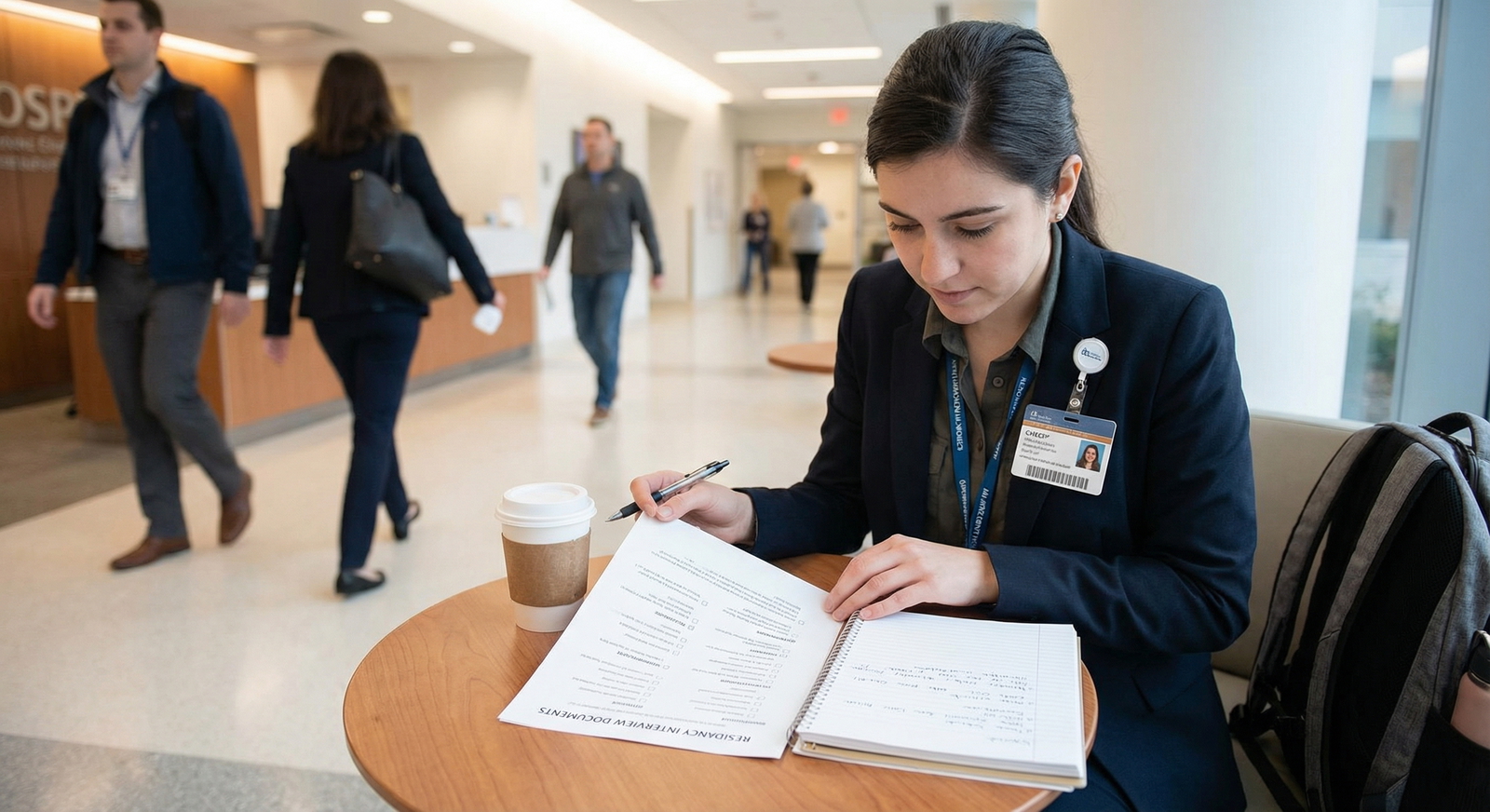
For both virtual and in-person interviews, prepare:
- Updated CV (even if ERAS-based, a clean PDF with your photo and contact details is useful)
- Printed copy of your ERAS application and personal statement
- A brief, 1-page summary of your research projects (title, role, outcomes)
- List of your publications and presentations
- Any important certificates (if attending in-person and requested)
You won’t necessarily be asked to produce these, but being able to quickly reference your own materials during preparation reduces confusion and boosts confidence.
Technical Setup for Virtual Interviews
Virtual interviews are now common, and your setup says a lot about your preparation.
Checklist:
- Internet: Stable, high-speed connection; test video calls with friends.
- Device: Laptop or desktop is preferred over phone.
- Camera: Clean lens, eye-level placement. Look into the camera regularly.
- Audio: Use headphones or a good-quality microphone to minimize echo and noise.
- Background: Neutral, tidy, well-lit space; avoid distracting posters or clutter.
- Lighting: Natural light in front of you or a soft lamp; avoid strong backlighting.
Do a full technology test with the specific platform (Zoom, Microsoft Teams, Thalamus, etc.) the program uses. Know how to:
- Mute/unmute quickly
- Turn video on/off
- Rename yourself appropriately (First Last, MD)
Clothing and Professional Appearance
ENT is a surgical specialty; programs expect a polished, professional look but not flashy fashion.
- Attire: Conservative suit or blazer in dark or neutral colors; tie optional but common for men in the U.S.; modest professional blouse or shirt.
- Grooming: Hair neat, facial hair trimmed if present, minimal jewelry, subtle makeup if used.
- Cultural Clothing: If you wear religious or cultural attire (e.g., hijab, turban), it is absolutely acceptable; just keep the overall style neat and professional.
The Day Before the Interview
Day-before pre-interview preparation should be calm and intentional, not frantic.
Review, don’t cram
- Skim your application, personal statement, and research.
- Revisit your program dossier and “Why this program?” points.
Prepare your questions
- 3–5 thoughtful questions for faculty (about training structure, mentorship, subspecialty exposure).
- 2–3 questions for residents (about culture, workload, support).
Logistics
- Confirm time (and time zone).
- For in-person: confirm route, parking, or public transport; lay out your clothes.
- For virtual: confirm meeting links, test microphone and camera again.
Rest and mindset
- Light exercise or a walk can reduce anxiety.
- Go to bed early and avoid heavy late-night screen time.
- Remind yourself: the invite means they see potential; the interview is to confirm it, not to “catch” you.
Putting It All Together: Strategic Mindset for ENT IMGs
As an international medical graduate aiming for the otolaryngology match, your pre-interview preparation should integrate three layers:
Content Mastery
- Clear personal story and motivation for ENT
- Strong, structured answers to common behavioral and clinical questions
- ENT-specific understanding of cases, clinics, and subspecialties
Context Awareness
- Deep program-specific research and tailored “Why this program?” answers
- Clear understanding of how your IMG background is perceived—and how it is a strength
- Prepared, confident responses about visas, U.S. system adaptation, and long-term goals
Communication and Professionalism
- Polished language, pacing, and nonverbal communication
- Reliable logistics and technology, whether virtual or in-person
- Visible qualities of a future ENT colleague: calm, respectful, curious, and team-oriented
If you approach your residency interview preparation with this structured strategy, you are not passively “hoping to impress.” You are actively demonstrating why you belong in an ENT residency—not despite being an IMG, but in many ways because of the resilience, adaptability, and depth of experience that come with that path.
Frequently Asked Questions (FAQ)
1. As an IMG, how many ENT interviews do I need to feel competitive for the match?
Numbers vary each year, but because ENT is highly competitive, most applicants (including U.S. graduates) try to attend as many interviews as reasonably possible. IMGs typically have fewer ENT interview offers, so each one becomes more critical. The focus should be on:
- Maximizing your performance at every interview you receive
- Avoiding cancellations unless there is a true conflict
- Applying broadly across programs that consider IMGs
There is no guaranteed “safe” number, but excellent performance in 5–8 interviews can be more meaningful than average performance in 10–12.
2. How should I handle questions about gaps in my CV or failed exams?
Be honest, brief, and growth-oriented:
- Acknowledge the event without making excuses.
- Explain contributing factors factually (overload, personal circumstances, unfamiliar format).
- Demonstrate change: specific steps you took to improve (study strategies, time management, support).
- Show outcome: later successes (better scores, strong clinical evaluations, completed research).
Programs are not looking for perfection; they are looking for self-awareness and maturity. Long, defensive explanations raise more concerns than the gap or failure itself.
3. How can I show real interest in ENT if I had limited ENT exposure in my home country?
You can still demonstrate serious interest by:
- Highlighting any related experiences (e.g., general surgery, emergency medicine, head and neck oncology) and explaining how they guided you toward ENT.
- Participating in ENT research, even if observational or retrospective.
- Attending ENT conferences, webinars, or grand rounds (in-person or virtual).
- Shadowing ENT surgeons in the U.S. or your home country when possible.
During interviews, emphasize how you actively sought ENT exposure given your constraints, and how you’re eager to immerse yourself in the specialty during residency.
4. What types of questions should I ask interviewers to show I’m well-prepared?
Ask specific, thoughtful questions that reflect your research and priorities. For example:
- To faculty: “I saw that your program has strong exposure to head and neck oncology. How early in training do residents become involved in complex oncologic cases?”
- To residents: “Can you describe how approachable the faculty are for mentorship, especially if we’re interested in research or a particular subspecialty?”
- To either: “How does the program support residents who are IMGs in adapting to the U.S. healthcare environment?”
Avoid questions easily answered on the website (e.g., “How many residents per year?”) and avoid focusing too heavily on salary or vacation early in the conversation.
By combining a clear understanding of the ENT landscape, targeted program research, structured practice of interview questions residency programs commonly use, and attention to IMG-specific challenges, you can approach your otolaryngology match interviews with confidence. The effort you invest in pre-interview preparation now is one of the highest-yield steps you can take on your path to a successful ENT residency as an international medical graduate.