Understanding the In-Person Residency Interview as a Non‑US Citizen IMG
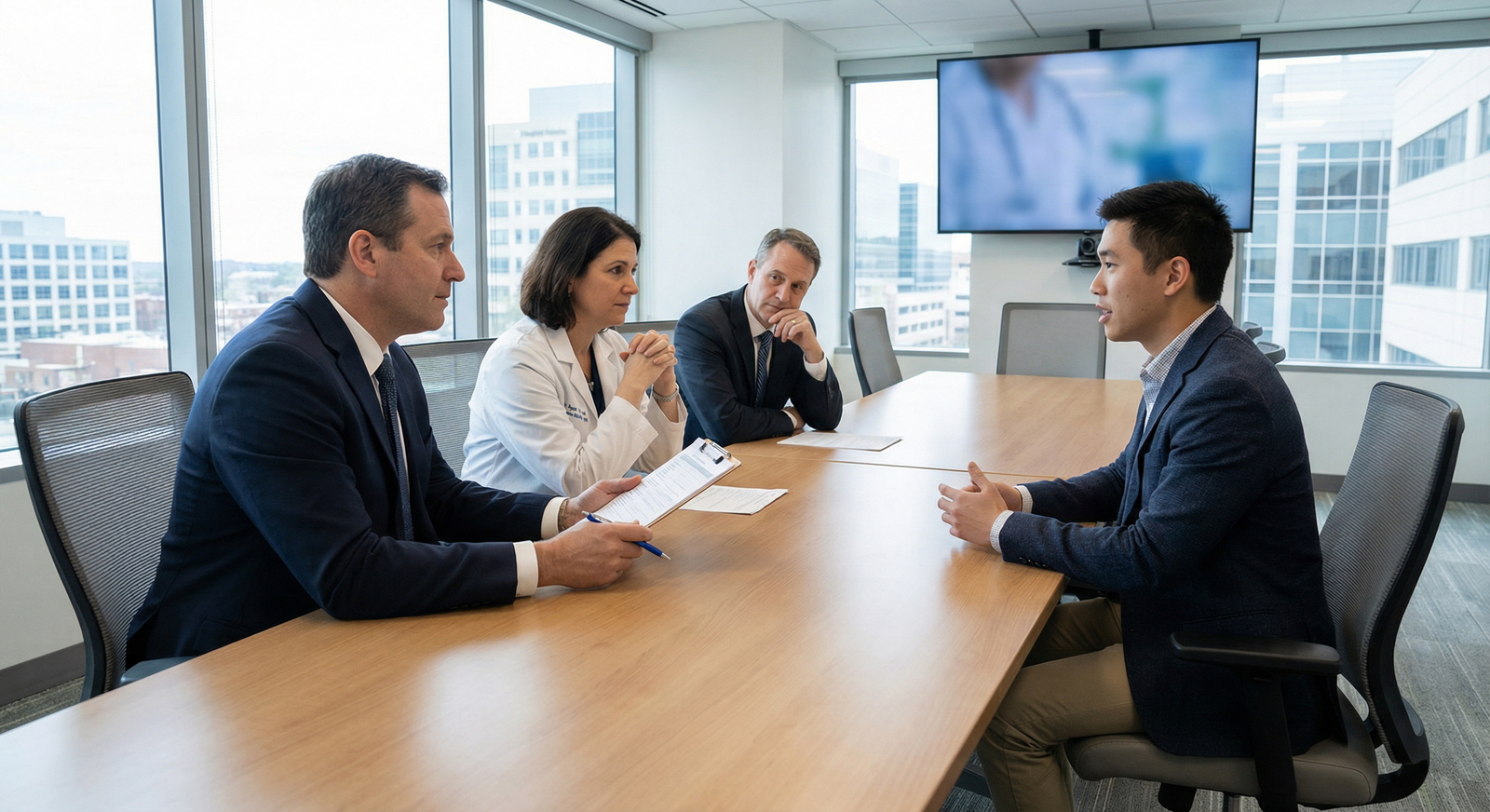
For a non-US citizen IMG or foreign national medical graduate, the in person residency interview is more than just a conversation—it is your opportunity to prove you are trainable, trustworthy, and a good investment for a program that will also need to sponsor your visa. While your application got you the invitation, your performance on interview day often determines where you’ll end up on the rank list.
This guide focuses specifically on in-person interview strategy for non-US citizen IMGs: how to prepare, what to wear interview day, how to handle common and IMG-specific questions, and how to navigate cultural and logistical challenges.
We’ll walk through:
- Pre-interview preparation strategies
- Travel, logistics, and immigration considerations
- Professional appearance and first impressions
- Interview day structure and behavior
- Answering questions effectively (including visa and IMG issues)
- Post-interview follow-up
Throughout, you’ll see practical examples tailored to international graduates.
1. Pre‑Interview Preparation: Build a Strong Strategic Foundation
Thorough preparation is your greatest advantage, particularly as a non-US citizen IMG competing in a crowded field.
1.1 Know Your Application Inside Out
Anything in your application is fair game. Before each in person residency interview:
- Re-read:
- Personal statement
- ERAS application (especially work, research, and volunteer sections)
- MSPE / Dean’s Letter
- Letters of recommendation summaries (if you know the content)
Create a “talking points” document:
- List each experience with:
- Your role
- What you actually did day-to-day
- A challenge you faced
- A specific patient or project story you can tell (de-identified)
- Skills you gained (clinical, communication, leadership)
Example:
Experience: Volunteer in rural clinic (home country)
Talking points:
- Role: Student volunteer assisting in triage and health education
- Challenge: Managing long lines and limited staff
- Story: Elderly patient with uncontrolled diabetes who couldn’t afford meds—how you coordinated with local NGOs
- Skills: Resourcefulness, patient education, working in under-resourced settings
Having these details ready reduces anxiety and prevents vague answers like “I learned a lot” without specifics.
1.2 Understand Each Program’s Identity and Needs
Program-specific preparation is especially important for a foreign national medical graduate who must show a strong, intentional interest in the US healthcare system.
For each program, research:
- Mission and patient population
- Size, fellowships offered, and hospital type (community vs academic vs county)
- Program’s history with IMGs and visa sponsorship
- Unique features: tracks, curriculum innovations, research focus
Use:
- Program website (read “About Us,” “Curriculum,” “Residents,” “Program Director’s Message”)
- FREIDA and program’s official ACGME listing
- Social media: program’s X (Twitter), Instagram, or LinkedIn
- Virtual open house recordings or info sessions (if available)
Create a one-page program sheet:
- Why this program appeals to you (3 program-specific reasons)
- How you could contribute (your skills, language, background)
- Specific questions to ask faculty and residents
This preparation helps you avoid generic statements like “I like your strong clinical training” and instead say:
“I’m particularly drawn to your continuity clinic structure with a large immigrant population and embedded behavioral health services. That aligns closely with my prior experience working with low-income communities in [country] and my interest in primary care psychiatry.”
1.3 Structure and Practice Your Answers
Even if your English is strong, spoken fluency under stress can be challenging. Build a system:
Use structured frameworks:
- For personal/behavioral questions: STAR (Situation, Task, Action, Result)
- For weakness or failure: IDA (Issue, Decision, Adjustment/Action)
- For “why this specialty/program”: Past, Present, Future
Example (STAR for conflict resolution):
- Situation: “During my internal medicine rotation in [country], our team disagreed on whether to admit a chest pain patient.”
- Task: “As the student, I needed to help gather information without escalating the conflict.”
- Action: “I suggested reviewing guidelines together, clarified the timeline of symptoms, and presented detailed vitals and ECG findings.”
- Result: “We admitted the patient, who was later diagnosed with NSTEMI. The attending appreciated my organized presentation, and I learned to use evidence to align the team.”
Practice answers out loud:
- With a friend or mentor (preferably someone familiar with US training)
- Alone using video recording to check:
- Pace and clarity
- Filler words (“um,” “like,” “you know”)
- Eye contact and body language (if simulating in-person)
Aim for 1–2 minutes per answer: concise but specific.
1.4 Address Accent and Communication Concerns Proactively
Many non-US citizen IMGs worry about their accent. Having an accent is not a problem; being hard to understand is.
Strategies:
- Ask a trusted US-based colleague or mentor: “Do you ever have trouble understanding me? Which words or sounds are confusing?”
- Practice slowing your pace by 10–20%—especially at the start of answers
- Prioritize:
- Clear opening sentence
- Short, structured points
- Brief summary ending
If you’re unsure about a question during the interview, it’s completely acceptable to say:
“I want to make sure I understand correctly. Are you asking about [X] or [Y]?”
This shows maturity and communication skills.

2. Travel, Logistics, and Immigration: Avoid Preventable Problems
For a foreign national medical graduate, logistics can be as stressful as the interview itself. Good planning prevents last‑minute disasters.
2.1 Visa and Entry Planning
If you are traveling from outside the US for in person residency interviews:
- Confirm your visa status and entry requirements:
- Visitor visa (B1/B2) or ESTA (if eligible)
- Purpose: business/meetings, not “job search” or “employment”
- Carry:
- Interview invitation emails (printed or accessible on phone)
- Hotel reservations and return ticket
- A brief, honest explanation if asked: “I’m attending medical residency interviews at US hospitals.”
If you’re already in the US (e.g., on a student, research, or work visa):
- Double-check that travel to interview locations will not conflict with status rules
- Keep your I-94, passport, and visa document (I-20/DS-2019/work authorization) valid and accessible
Never give inaccurate information to immigration officials; clarity and consistency are critical.
2.2 Scheduling and Route Optimization
In-person residency interviews can involve significant travel. For a non-US citizen IMG with limited US experience, planning routes and timing is essential.
- Use a spreadsheet to track:
- Dates, times, and time zones
- Program locations and addresses
- Flight/bus/train details
- Hotel information
- Try to:
- Group interviews geographically when possible
- Avoid scheduling back-to-back interviews that require long-distance overnight travel
- Build in buffer days for weather delays, especially in winter
If you anticipate conflicts, communicate early and professionally:
“Thank you for the invitation. I am honored. I have another interview scheduled for that same date in a different state. Would it be possible to consider an alternative date if available?”
2.3 Local Logistics: Hotels, Transport, and Timing
Once you confirm an in person residency interview:
- Hotel:
- Choose a safe area close to the hospital or with direct public transit
- Check reviews for noise levels and Wi-Fi reliability
- Transport:
- If using public transit, do a “test run” on Google Maps beforehand
- If using ride-sharing (Uber/Lyft), plan a backup option in case of surge pricing or delays
- Timing:
- Aim to arrive at the city at least the day before
- On interview day, plan to arrive at the hospital 30–40 minutes early
- Use nearby coffee shop or hospital lobby if you’re too early
Never underestimate time for security, parking, and hospital navigation. Many hospitals are large and confusing.
2.4 Dealing with Jet Lag and Fatigue
Traveling across time zones for several in-person interviews can hurt your performance.
Suggestions:
- Arrive 1–2 days early for long-distance travel (especially intercontinental)
- Adjust your sleep gradually a few days before travel
- Stay hydrated, avoid heavy meals late at night, and limit caffeine after mid-afternoon
- Do a short rehearsal in your room the evening before: walk through your introductory pitch, common questions, and your “tell me about yourself” answer
3. First Impressions: Professional Appearance, Dress, and Non-Verbal Skills
Programs do not expect you to be a fashion expert; they expect you to look professional, neat, and appropriate for US norms.
3.1 What to Wear Interview Day: Clothing Guidelines
For both men and women (and gender-neutral dressing), the safest choice is conservative business formal.
General rules:
- Suit:
- Dark or neutral color: navy, charcoal, dark gray, or black
- Well-fitted (tailoring if possible)
- Avoid bright patterns or flashy colors
- Shirt/Blouse:
- Light solid colors (white, light blue, light gray)
- Ironed and wrinkle-free
- Shoes:
- Closed-toe, clean, polished
- Low to moderate heels for those who wear heels
- Comfortable enough for walking during hospital tours
For those wearing ties or equivalent:
- Simple, professional tie (not cartoon characters or extremely bright designs)
- Avoid novelty accessories
Jewelry and accessories:
- Minimal and not distracting
- Neutral watch and small earrings, if desired
- Avoid excessive perfume/cologne (some hospitals are fragrance-free)
Hygiene and grooming:
- Clean, trimmed nails
- Hair neat and away from face
- If you have facial hair, keep it well-groomed
If your home culture’s formal attire differs from US norms (e.g., national dress), you can still wear it, but most IMG applicants find it safer to align with standard US business formal for residency interviews.
3.2 Non-Verbal Communication and Body Language
In many US programs, your demeanor can influence how “coachable” and “team-friendly” you seem.
Key points:
Handshake (if culturally and situationally appropriate):
- Firm but not aggressive
- 1–2 seconds with eye contact and a polite greeting
- Since COVID-19, some people skip handshakes; follow the interviewer’s lead
Eye contact:
- Maintain natural, friendly eye contact
- Avoid staring; looking away occasionally is normal
- If eye contact norms differ in your culture, practice with someone who can give you feedback on what feels “normal” in the US
Posture:
- Sit upright, shoulders relaxed
- Avoid crossing arms (can seem defensive)
- Don’t slouch or lean too far back
Gestures:
- Natural hand movements are fine
- Avoid fidgeting with pens, phones, or jewelry
Small behaviors—smiling, nodding, actively listening—send strong positive signals.

4. Mastering Interview Day: From Arrival to Goodbye
Understanding the typical structure of an in person residency interview reduces uncertainty and helps you perform consistently.
4.1 Typical Interview Day Structure
While every program is different, many follow this pattern:
- Arrival and check-in with program coordinator
- Program overview by Program Director or Associate Program Director
- Individual interviews (3–6 interviews, 15–30 minutes each)
- Resident interaction (lunch, tour, or Q&A)
- Hospital tour / facilities tour
- Closing session and final questions
Throughout the day, remember: you are always being observed—not in a suspicious way, but in the sense that impressions are formed everywhere, not just in formal interviews.
4.2 Interaction with Coordinators, Residents, and Staff
Some programs explicitly ask staff for their impressions of applicants. Be kind, respectful, and professional with everyone.
Program coordinator:
- Greet them warmly; they often are your best logistical ally
- Thank them at the beginning and end of the day
- If you have last-minute delays or issues, call or email them promptly and politely
Residents:
- Treat them as key decision influencers—they often have a strong voice in ranking
- Ask genuine questions about:
- Work-life balance
- How they feel supported by faculty
- Their experience as IMGs (if applicable)
- Avoid:
- Asking only about vacation, moonlighting, and salary
- Dominating the conversation or being overly negative about other programs
4.3 Handling Common Question Types
As a non-US citizen IMG, expect questions in these categories:
4.3.1 Tell Me About Yourself / Walk Me Through Your CV
Use a clear structure:
- Present: Who you are now (IMG, recent graduate, US experience if any)
- Past: Key formative experiences
- Future: What you are seeking in residency
Example:
“I’m a non-US citizen IMG from [country], and I graduated from [medical school] in 2022. During medical school, I developed a strong interest in internal medicine, particularly caring for patients with chronic diseases in resource-limited settings. I completed three months of US clinical electives in [city], where I appreciated the emphasis on teamwork and evidence-based practice. I’m now looking for a residency that offers strong clinical training with exposure to underserved populations, like your program.”
4.3.2 Why This Specialty?
Highlight:
- When and how you discovered your interest
- Specific patient or rotation experiences
- How your strengths match the specialty’s demands
Avoid: “I like to help people,” or “I love internal medicine because it’s broad” without examples.
4.3.3 Why Our Program?
This is where your program research matters.
Strong answer components:
- 2–3 program-specific features
- How your background fits their mission
- Reference to their patient population, curriculum, or unique strengths
4.3.4 Weaknesses, Gaps, and Red Flags (IMG-Specific)
Common topics for foreign national medical graduates:
- Gaps after graduation
- Limited or no US clinical experience
- Attempts on USMLE exams
- Older year of graduation
- Changing specialties
Approach:
- Be honest but non-defensive
- Provide context, not excuses
- Emphasize what you learned and how you improved
Example (gap):
“After graduation in 2020, I had an 18-month gap primarily due to visa delays and COVID-related restrictions. During that time, I completed online CME courses, prepared for USMLE Step 2 CK, and volunteered at a local clinic in [country]. This period reinforced my commitment to internal medicine and helped me stay current with guidelines.”
4.4 Visa and Immigration Questions: Answering Confidently
As a non-US citizen IMG, you will often be asked:
- “What is your visa status?”
- “Do you require visa sponsorship?”
- “Are you open to J-1?” or “Are you eligible for H-1B?”
Guidelines:
- Answer factually and briefly, without emotional weight.
- Know your situation before interviews:
- Are you eligible for J-1 only?
- Do you need H-1B or simply prefer it?
- Do you hold another status (e.g., F-1 with OPT, J-1 research scholar)?
Example:
“I am a non-US citizen currently residing in [country]. I will require visa sponsorship to begin residency and I am fully eligible for a J-1 visa. If your program sponsors H-1B visas, I would also be open to that option, provided I meet the licensing and exam requirements.”
Avoid long stories about immigration difficulties unless directly asked. Programs mostly need clarity about feasibility, not detailed history.
4.5 Asking Your Own Questions
Interviewers expect you to ask thoughtful questions. Prepare a small list for different types of interviewers:
- For Program Director/Associate Program Director:
- “How do you see this program evolving over the next 3–5 years?”
- “How do you support residents who are interested in [research/primary care/fellowship]?”
- For faculty:
- “What qualities make residents successful in this program?”
- “How would you describe the culture of feedback here?”
- For residents:
- “What are the biggest strengths and weaknesses of this program?”
- “How is the schedule in the first year? What does a typical call night look like?”
- “As an IMG, have you felt supported by the program?”
Avoid questions that are easily answered on the website or in the brochure (e.g., “How many residents do you have?”).
4.6 Group Settings, Lunch, and Tours
During lunch or tours, you are still being evaluated—especially on collegiality and communication.
Tips:
- Engage in friendly conversation, not just interviews questions
- Ask residents about the city, housing, and life outside work
- Don’t dominate the conversation or interrupt others
- Show interest in other applicants without comparing scores or “bragging”
5. Managing Stress, Cultural Differences, and Authenticity
5.1 Recognizing Cultural Communication Differences
As a foreign national medical graduate, some norms may differ from your home culture:
- In many US training environments:
- Modest self-promotion is expected (e.g., “I led this project…”)
- Direct, respectful eye contact is valued
- Clear, concise answers are preferred over very long, detailed ones
You can adapt while staying authentic:
- Practice highlighting your achievements with “we” and “I” balance:
- “Our team accomplished X, and my specific role was Y.”
- Use positive, confident phrases:
- “I am confident that I can adapt quickly…”
- “I believe my background in [X] will allow me to contribute in [Y] way.”
5.2 Handling Anxiety and Imposter Feelings
Many non-US citizen IMGs feel like they don’t belong in US academic hospitals. Remember:
- You already cleared major hurdles: USMLE, ECFMG certification, application screening.
- Programs chose to invite you; they’re curious to know more, not to trap you.
Practical strategies:
- Pre-interview:
- Deep breathing exercises or short mindfulness practices
- Visualize walking confidently into the hospital and answering clearly
- During interviews:
- If you get stuck, it’s fine to say:
“That’s a great question; may I take a moment to think?”
- Take a brief pause, then answer
- If you get stuck, it’s fine to say:
If you truly don’t know an answer (e.g., a clinical question):
“I’m not certain of the exact answer, but my approach would be to [explain your reasoning process].”
5.3 Being Professional Without Being Robotic
While preparation is crucial, over-memorized answers can sound unnatural. Aim for:
- Prepared themes, flexible wording
- Natural conversation, not speech recitation
- Listening carefully to each question instead of automatically launching a pre-planned answer
6. After the Interview: Reflection, Communication, and Strategy
What you do after your in person residency interview can strengthen your decision-making and, in some cases, your connection with programs.
6.1 Immediate Post-Interview Notes
As soon as you leave (or reach a quiet place):
- Write down:
- Your overall impression of the program
- Strengths and concerns
- Names and roles of people you met
- Specific conversations or details that stood out
This will help later when comparing programs for your rank list.
6.2 Thank-You Notes
Many programs consider thank-you notes optional, but they remain common practice.
If you send them:
- Keep them short (4–6 sentences)
- Personalize:
- Mention a specific topic you discussed
- Reiterate one reason you like the program
Example:
Dear Dr. [Name],
Thank you for taking the time to speak with me during my interview at [Program]. I enjoyed our discussion about caring for patients with limited English proficiency and appreciated your insights on how the program supports residents’ growth as educators. My experience working with diverse communities in [country/city] makes me especially excited about the patient population you serve. It would be an honor to train at [Program].
Sincerely,
[Your Name]
Follow any explicit program instructions—some state they do not want post-interview communication.
6.3 Evaluating Programs as a Non-US Citizen IMG
When ranking programs, consider factors particularly relevant for foreign national medical graduates:
- Consistent visa sponsorship history (J-1 vs H-1B)
- Program’s culture toward IMGs (check proportion of IMG residents, speak with IMG residents if possible)
- Clinical exposure to diverse and underserved populations
- Support for:
- Research or scholarly activity
- Board preparation
- Mentorship and career development (including fellowship placement if important to you)
- City environment:
- Cost of living
- Public transportation
- Communities or services that might ease your transition (cultural centers, language support)
Remember: rank programs in the order you truly prefer, not based on where you think you are more likely to match. The NRMP algorithm favors applicant preferences.
FAQ: In-Person Interview Strategies for Non-US Citizen IMGs
1. As a non-US citizen IMG, should I tell programs that they are my “number one choice” during the interview?
You should be honest without making promises to multiple programs. During the interview, it’s fine to say, “Your program is very high on my list,” or “I am very impressed and could see myself thriving here.” If later you genuinely decide a program is your first choice, you may send a post-interview communication stating that, provided it aligns with NRMP guidelines and program policy. Never tell more than one program they are your absolute #1.
2. I have a strong accent. Will that hurt my chances during in-person interviews?
An accent alone is not a problem; clarity is what matters. Many US physicians have accents. Focus on speaking slightly slower, organizing your thoughts clearly, and checking comprehension. If interviewers understand you and feel comfortable that patients will as well, your accent will not be a significant barrier. Practicing with native or near-native English speakers can help identify any specific words or sounds to adjust.
3. How can I politely discuss visa sponsorship without sounding like I only care about that?
First, research each program’s stated visa policy. If you still need clarification, you can ask in a neutral, professional way, preferably to the Program Director or coordinator:
“As a non-US citizen IMG, I will require visa sponsorship. Could you share how your program typically handles visas for residents, and whether you sponsor J-1, H-1B, or both?”
Keep it brief and then move on to other topics about training and education; this shows you take logistics seriously but are primarily focused on learning and contribution.
4. What if I get a clinical question and I truly don’t know the answer?
Programs are assessing your reasoning process and honesty. You can respond:
“I don’t know the exact guideline recommendation, but my approach would be to [describe your reasoning steps—stabilize the patient, gather critical information, consult appropriate resources].”
Avoid guessing wildly or pretending to know. Showing a safe, thoughtful approach is better than a partially correct but unsafe answer.
By combining thorough preparation, cultural awareness, and authentic communication, a non-US citizen IMG can perform exceptionally well in in person residency interviews. Your international background is not a liability; when presented well, it is a unique strength that brings diversity, resilience, and perspective to any residency program.